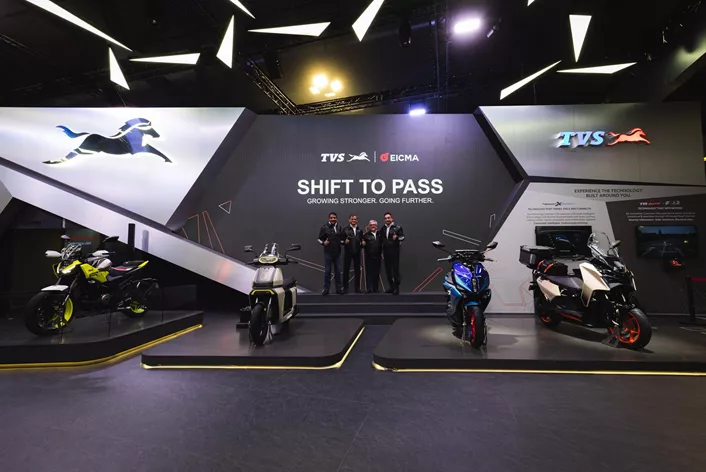
Four new models, four approaches to urban traffic: on 3 November at EICMA 2026, TVS is presenting the RTR 125 LC along with the M1-S, Orbiter and TVS X electric scooters in European specification. This expands the brand's line-up from six models in 2025 to eleven. Following its first EICMA appearance in 2025 and the establishment of its design and development centre in Bologna, the European model range continues to take shape. As part of our New Models 2027 coverage, we take a look at each of the four vehicles individually.
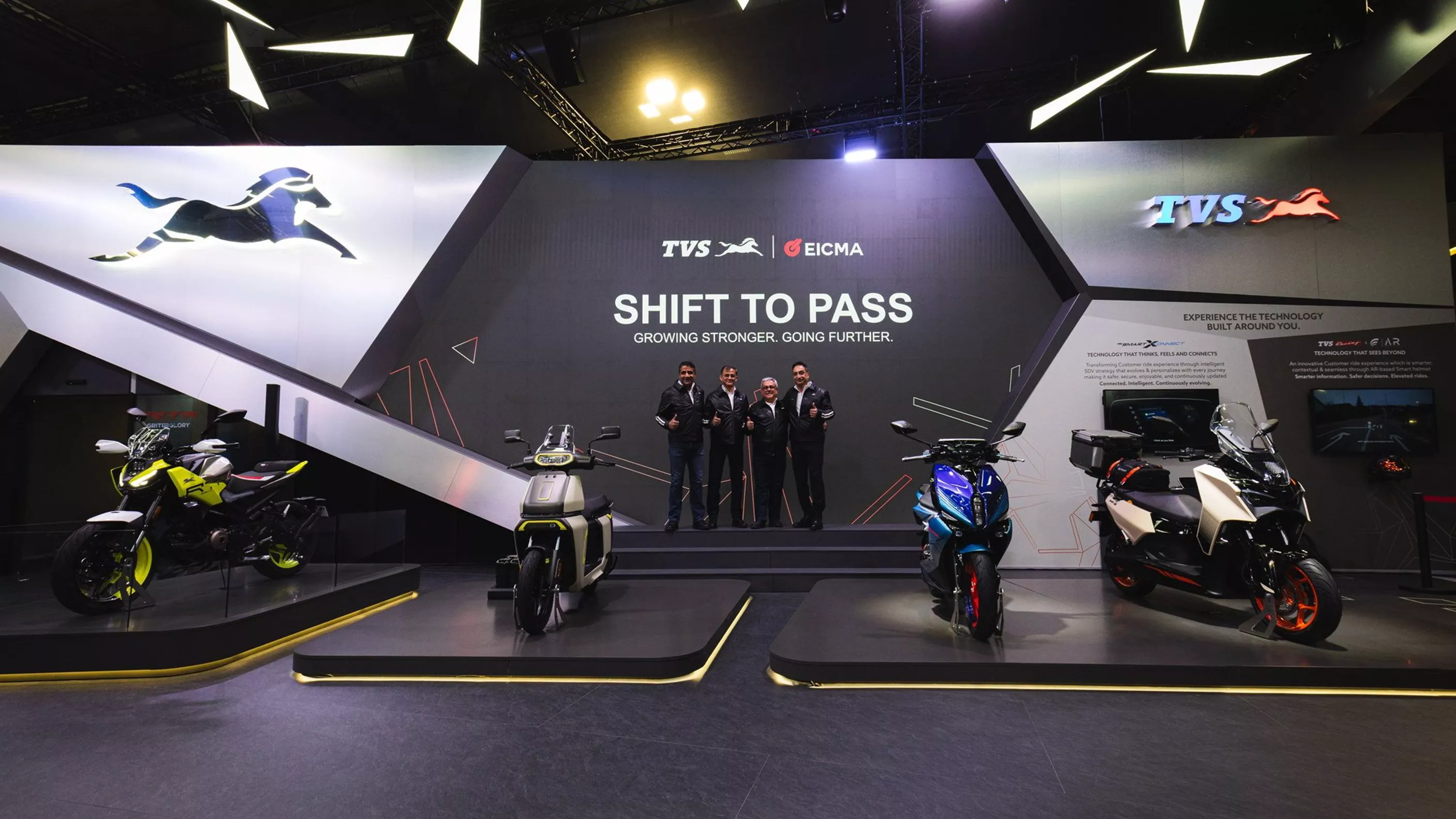
TVS New Models 2027 at EICMA
A sporty 125 and three electric city scooters
With an A1 streetfighter and three electric scooters, the Indian manufacturer is expanding its European line-up. The RTR 125 LC, M1-S, Orbiter and TVS X each set very different priorities, from a removable battery to a connected panoramic display.

Der Horvath
published on 03/11/2026
1,311 Views
TVS RTR 125 LC: 14.9 hp for the A1 class
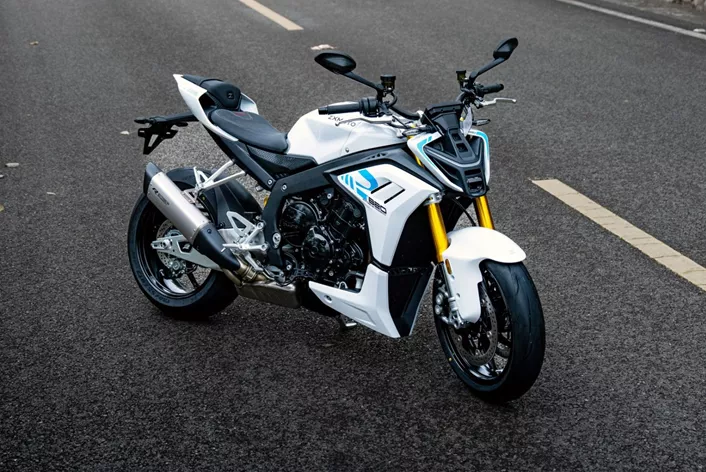
The RTR 125 LC brings streetfighter looks to the A1 class. A prominent tank with broad shoulder flanks, sharply drawn proportions and the exposed trellis frame define its appearance. Up front sits a rectangular LED projector headlight with daytime running light, while the rear features a three-piece LED tail light. The indicators are LED too. TVS presents the 125 as a production-ready bike designed to cover both the daily commute and weekend rides.
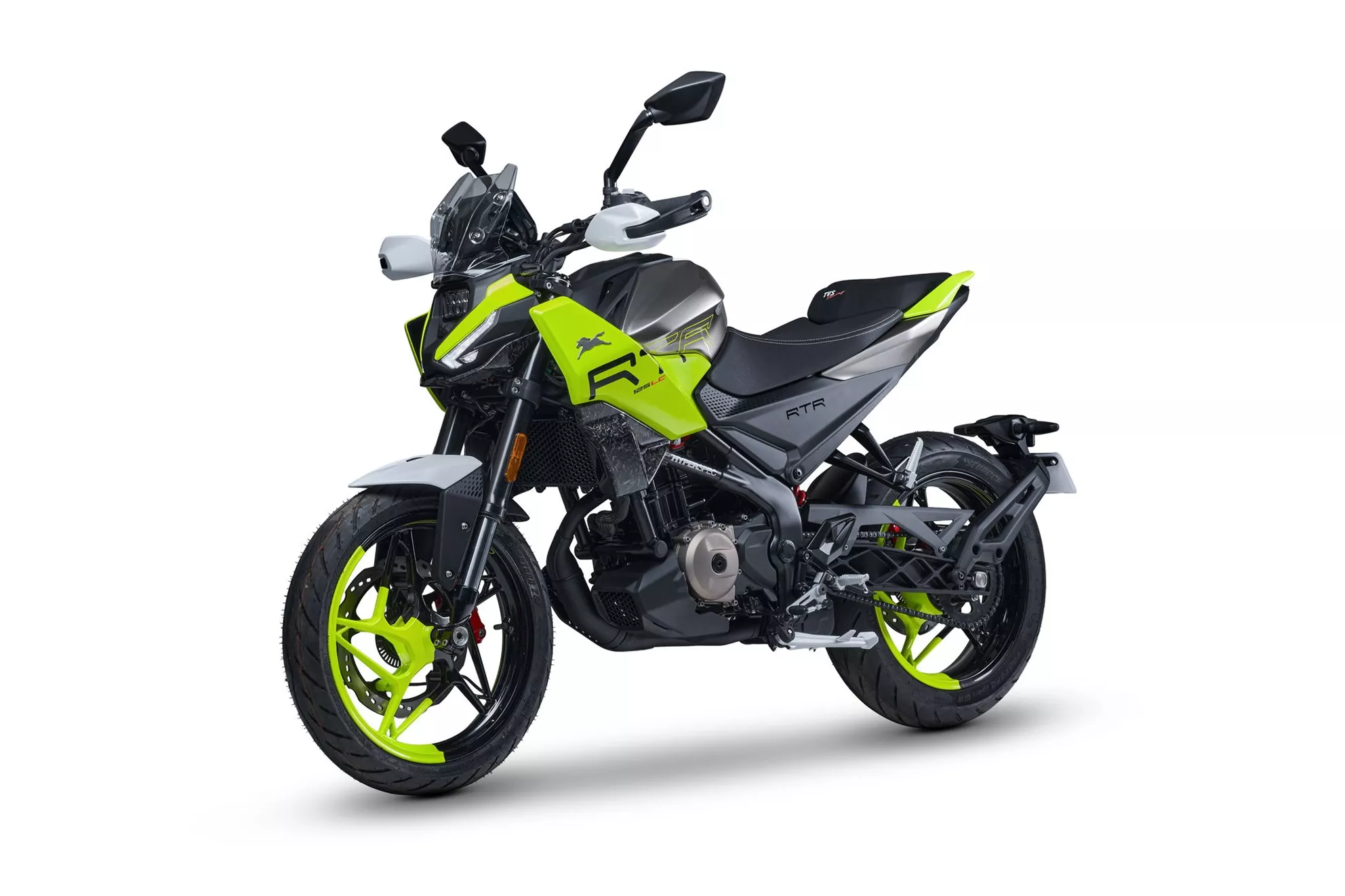
The RTR 125 LC combines streetfighter looks with an 11 kW powertrain for the A1 class.
At its heart is a liquid-cooled 125 cc four-valve engine with double overhead camshafts. TVS quotes 11 kW, or 14.9 hp, at 9,000 rpm and 12 Nm at 7,000 rpm. This is paired with a six-speed gearbox and an assist-and-slipper multi-plate clutch, which is designed to ease operation and support controlled downshifts. Riding modes allow the bike to be adapted to changing conditions.
TVS RTR 125 LC: KYB fork and map navigation
The Synchro Stiff chassis combines the trellis frame with a cast swingarm. Up front works a 41 mm KYB upside-down fork, with an adjustable monoshock at the rear. The alloy wheels wear 100/80-17 and 140/70-R17 tyres. Braking is handled by a 300 mm disc with a radially mounted Bybre caliper at the front and a 240 mm disc with a Bybre caliper at the rear. Dual-channel ABS completes the system.
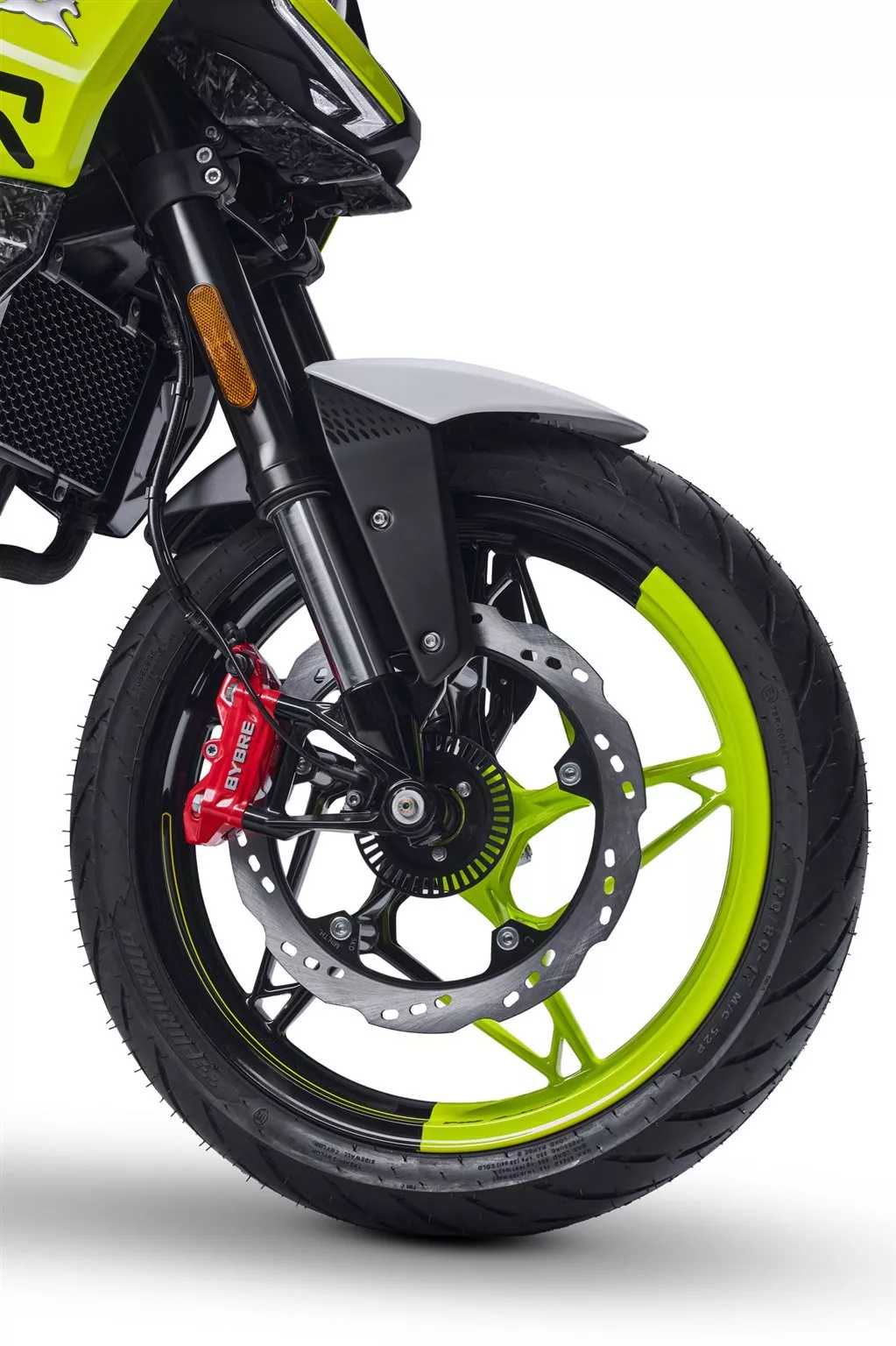
The RTR 125 LC pairs a 41 mm KYB USD fork with a radially mounted Bybre brake caliper.
For the cockpit, TVS relies on a five-inch, or 13-centimetre, TFT display with multi-way Bluetooth connectivity. Alongside turn-by-turn navigation, full-screen map mirroring is provided. Hazard lights are also part of the features. The technical data comes from the pre-homologation specification and may still change with final approval.
TVS M1-S: Electric maxi-scooter with 26 litres of storage
One year after its concept debut, the M1-S returns as a production-ready electric maxi-scooter. Developed in Singapore, the model targets European commuters. Its design follows the principles of Presence, Tamed Emotions and Framed Surfaces: large scooter proportions, restrained details and clearly framed surfaces with flowing contours. LED lighting with distinctive position lights defines the front. The European launch model comes in Spectre Black, with more colours to follow.
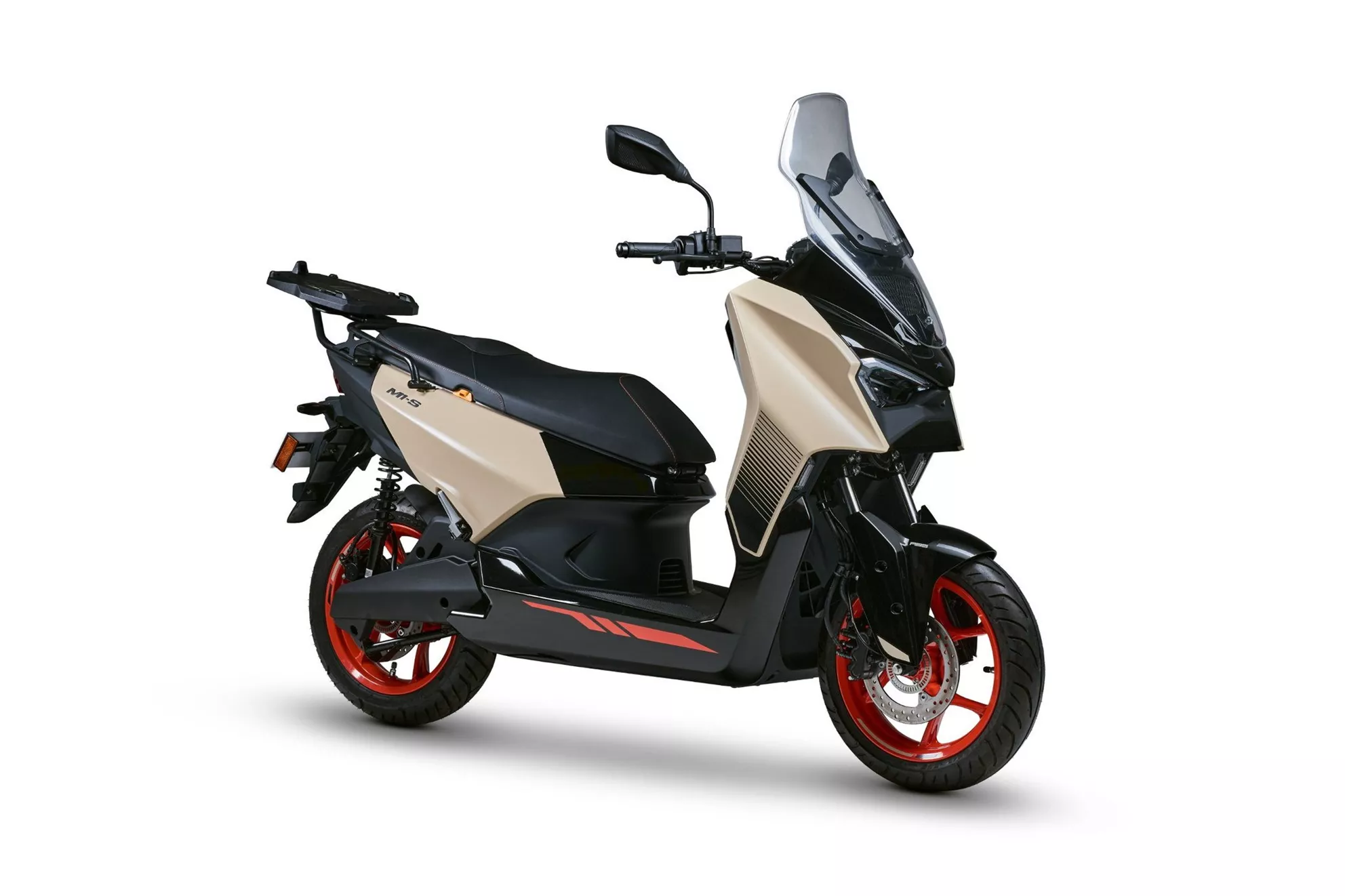
With the M1-S, TVS presents a production-ready electric maxi-scooter for European commuters.
What makes it practical for everyday use? Under the seat there are 26 litres of storage, enough for a full-face helmet. Up front, a left-hand glovebox with a USB-A port and an open compartment for a 500 ml bottle round things off. Seat height is 800 mm, ground clearance 170 mm. With a 1,350 mm wheelbase, the M1-S measures 1,970 × 730 × 1,190 mm and, according to TVS, has a wet weight of 150 kg. The battery, mounted low in the floorboard, is designed to provide a low centre of gravity and a balanced ride feel.
TVS M1-S: 12.5 kW peak and 1.8 kW charging
A frame-mounted permanent magnet synchronous motor delivers 5 kW rated power and a short-term peak output of 12.5 kW. TVS quotes 3.7 seconds from 0 to 50 km/h and a top speed of 105 km/h. The lithium-ion battery with NMC cells stores 4.2 kWh. The expected range is 120 km, based on internal testing with the current riding mode configuration. This is a provisional figure based on the WMTC test cycle. The 1.8 kW on-board charger for household sockets is said to take the charge level from 10 to 80 percent in 75 minutes.
Beneath the fairing sits a tubular steel frame with a fork and twin adjustable shocks at the rear. The 14-inch wheels wear 110/70 tyres at the front and 120/70 at the rear. A 230 mm brake disc at each end, dual-channel ABS, tyre pressure monitoring on both wheels and cruise control make up the safety and assistance package. TVS lists the M1-S for the A1 licence class. All details are subject to homologation.
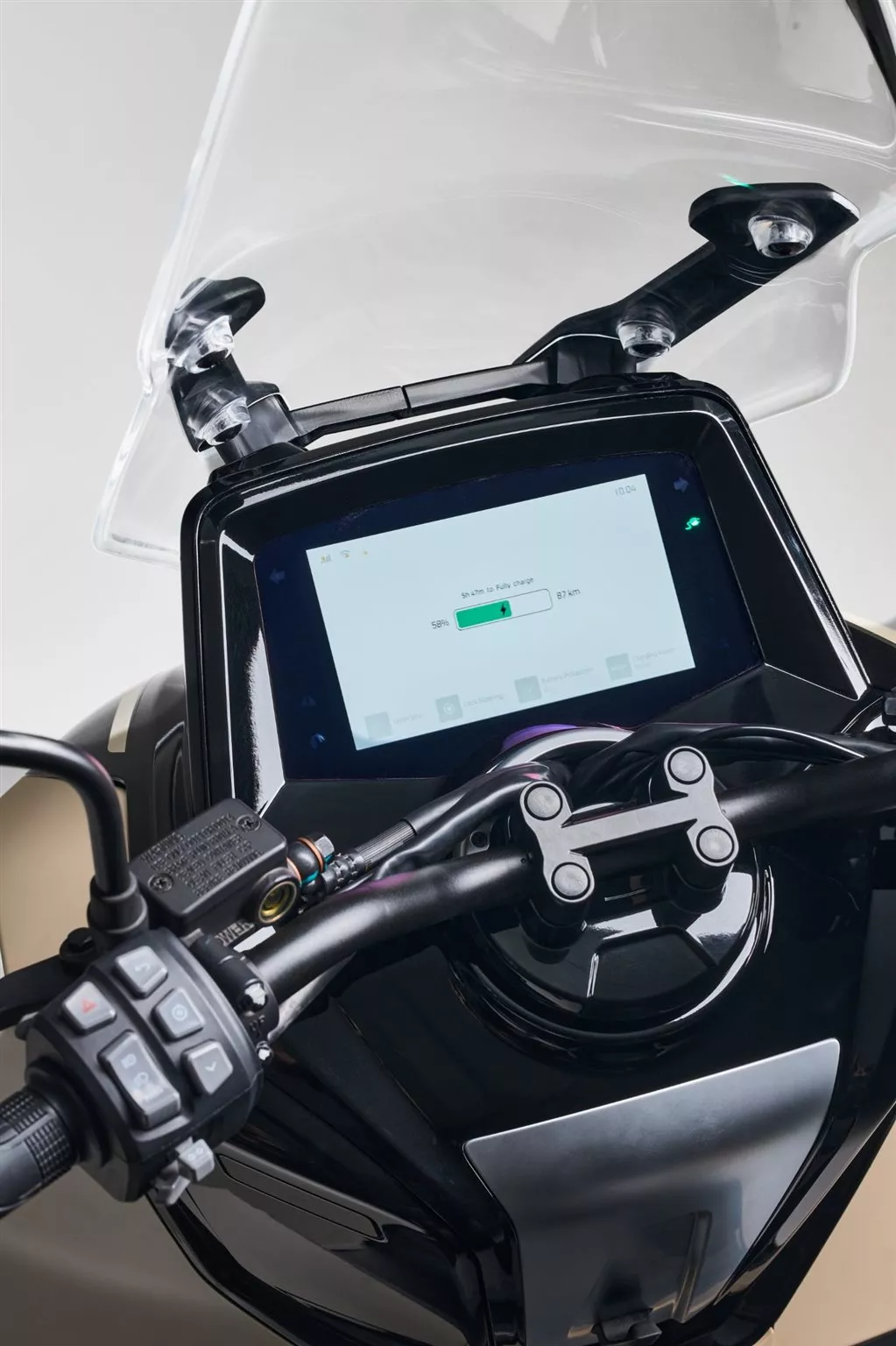
On the M1-S, a seven-inch TFT shows the riding information.
A seven-inch TFT shows the riding information. Wi-Fi, Bluetooth and built-in LTE connect the scooter to an Android and iOS app. In addition to key fob start, TVS lists app-based start, seat opening, vehicle tracking and service updates. The LTE connection enables services even when the smartphone is not nearby, while over-the-air updates refresh the software remotely.
TVS Orbiter: Two battery sizes for everyday city life
The Orbiter focuses on daily trips. Straight lines and a shape designed for aerodynamic efficiency meet a crystal LED headlight, LED indicators and LED tail light. For the European launch, TVS lists Lunar Grey and Stratos Blue, with more colours to follow. Wide handlebars, an upright seating position and a long, flat seat at a height of 760 mm are meant to make everyday city riding comfortable. There are 34 litres available under the seat, giving the compact scooter more storage space than the other two electric models presented here.
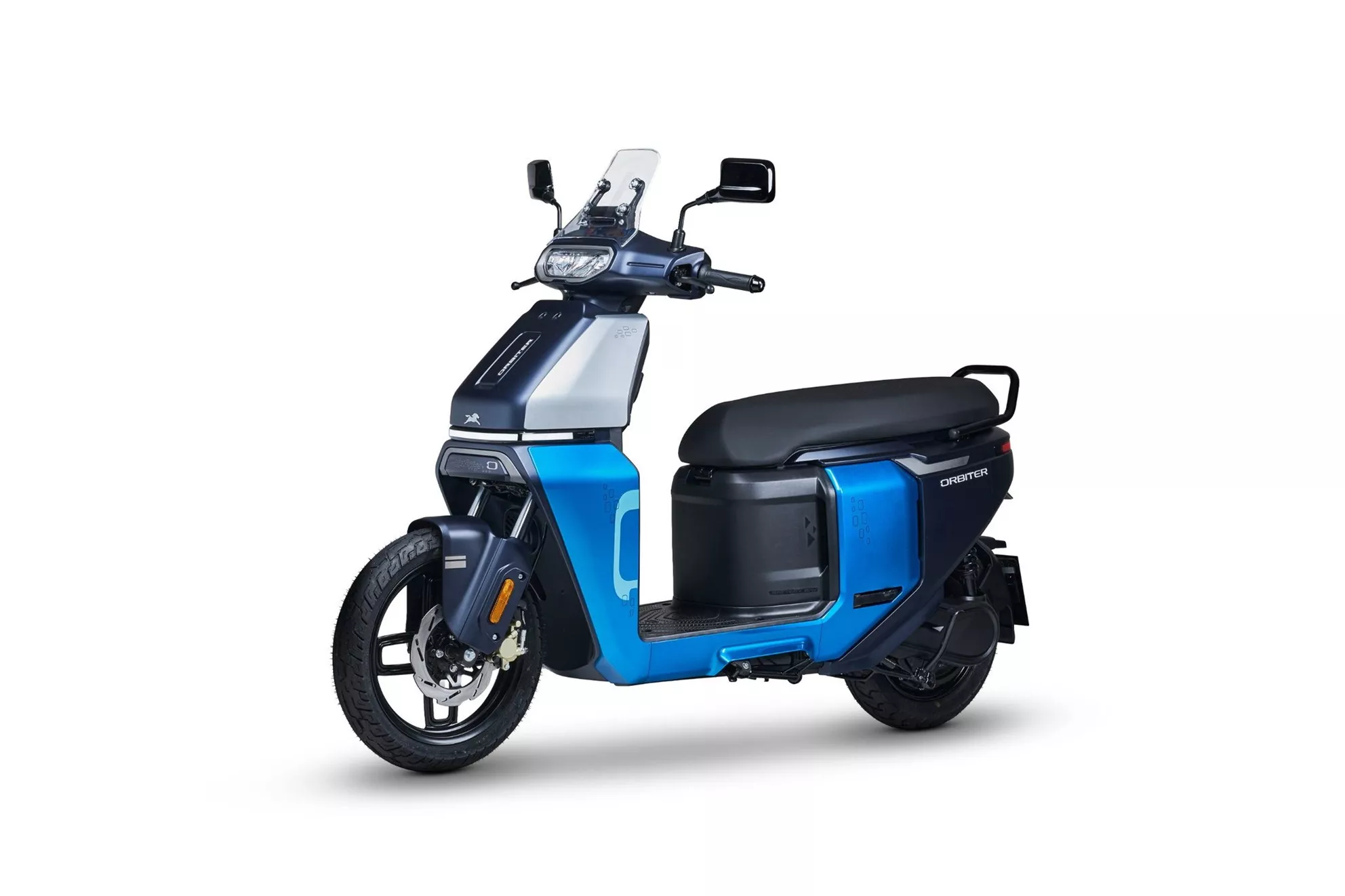
The Orbiter is designed as a compact electric scooter for everyday city life.
The brushless DC hub motor produces 1.85 kW nominal and 2.9 kW peak. The provisional top speed is 45 km/h, and TVS specifies at least the AM licence class. The NMC lithium-ion batteries come in two sizes: with 1.8 kWh the manufacturer expects 70 km, with 3.1 kWh 105 km of range. Both figures are provisional expected WMTC values from internal pre-homologation testing. According to TVS, EU type approval is expected in 2027.
TVS Orbiter: Removable battery, subject to confirmation
At 550 W, charging from 0 to 80 percent is said to take 2 hours 39 minutes for the small battery and 4 hours 33 minutes for the large one. The documentation mentions both an on-board charger and an external charger. Connection to a household socket is clearly provided for. Both batteries are described as removable, although this feature still has to be confirmed after homologation. An optional charging dock is intended to allow charging both in and out of the vehicle.
A tubular steel frame, a fork and twin rear shocks form the chassis. The Orbiter rolls on a 14-inch alloy wheel with a 90/80-14 tyre up front and a 12-inch wheel with 90/90-12 at the rear. A 220 mm disc at the front and a 130 mm drum at the rear work with a combined braking system, or CBS. Both versions come as standard with cruise control, automatic hill hold and reverse parking assist. With a 1,330 mm wheelbase, the scooter measures 1,855 × 728 × 1,284 mm and offers 165 mm of ground clearance. TVS quotes a wet weight including battery of 102 and 114 kg respectively.
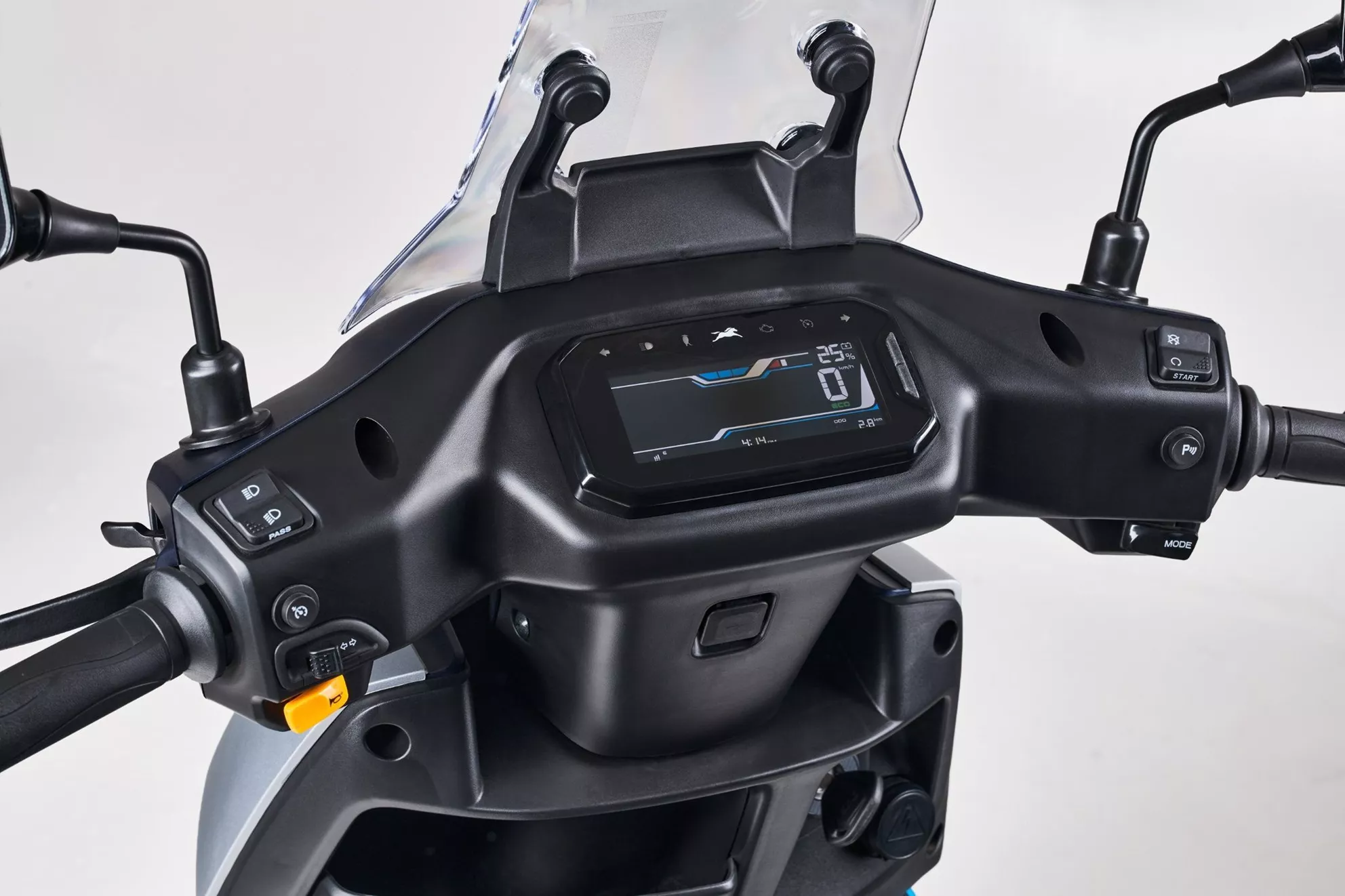
The Orbiter gets a five-inch colour LCD with TVS SmartXonnect.
The five-inch colour LCD connects to TVS SmartXonnect via Bluetooth, with built-in LTE supplementing the Android and iOS app. Functions include turn-by-turn navigation, incoming and missed call information and remaining range. LTE services cover geofencing, crash and fall alerts, real-time vehicle tracking, navigation to the scooter, ride history, real-time state of charge and charging status, theft alerts and over-the-air updates. The Orbiter is developed, engineered and manufactured in India. According to TVS, millions of kilometres of real-world riding data went into its development, along with 600 safety and structural load tests.
TVS X: Aluminium frame and 110 km/h top speed
With the TVS X, design and connected technology take centre stage. Following the concept at EICMA 2025, TVS is now presenting the production-ready European specification with 14-inch wheels on both axles. It is based on the Xleton platform with an aluminium frame. The slim shape combines a compact projector headlight with cornering light and sequential lighting. Satin Champagne is planned for the European launch, with more colours to follow.
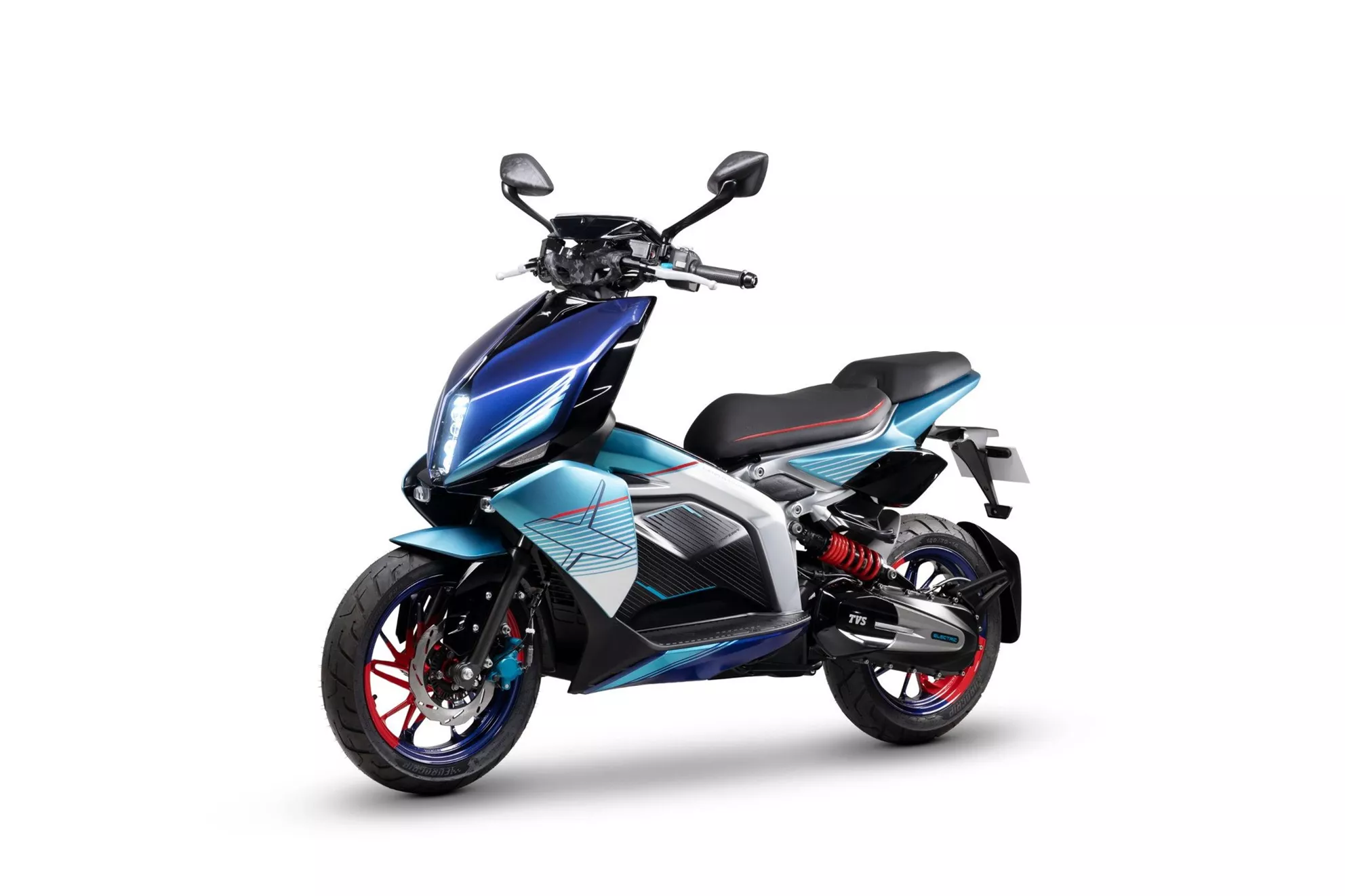
The production-ready TVS X focuses on electric performance and extensive connectivity.
The frame-mounted permanent magnet synchronous motor delivers 7.5 kW rated power and 11.7 kW peak power. According to TVS, the sprint from 0 to 40 km/h takes 2.5 seconds, and top speed is 110 km/h. Xtealth is intended for daily commuting, Xtride for more dynamic response and Xonic for maximum performance. Regeneration can be adjusted in five levels. The fixed 4.43 kWh NMC lithium-ion battery is said to deliver up to 140 km under internal test conditions. Using the 950 W on-board charger on a household socket, charging from 0 to 80 percent takes 3 hours 30 minutes, according to the manufacturer.
TVS X: Panoramic touchscreen and built-in LTE
The cockpit features a 10.2-inch panoramic TFT touchscreen with Android Auto and full map navigation on board. Compatible apps from a connected Android smartphone can be used via the display. Wi-Fi and Bluetooth are on board, as is a dedicated LTE connection, so mobile data doesn't depend solely on the paired phone.
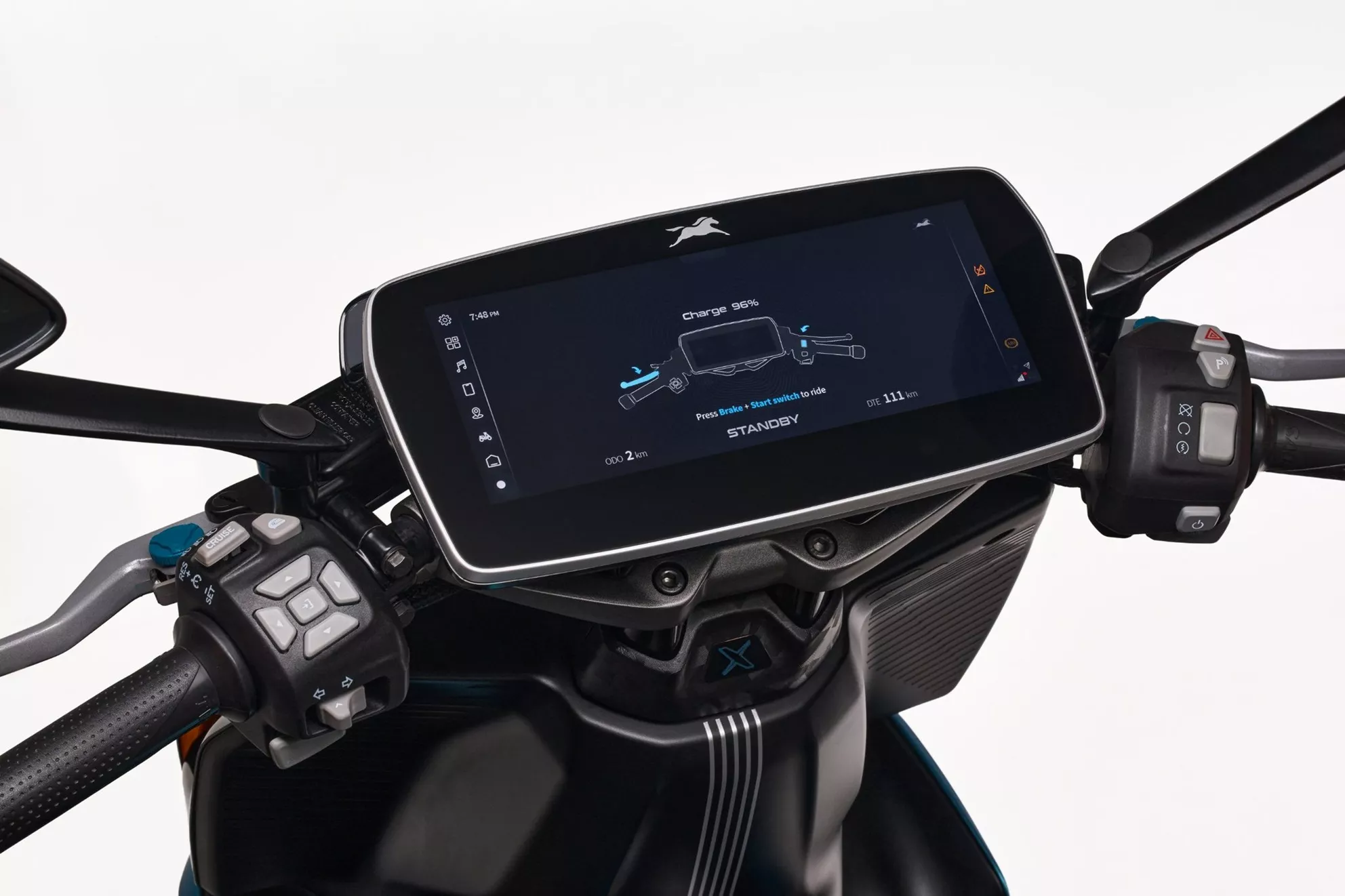
The 10.2-inch panoramic touchscreen of the TVS X offers Android Auto, among other features.
A fork works up front, with a monoshock at the rear. The tyres measure 100/80-14 and 120/70-14, both monitored by tyre pressure monitoring. Disc brakes on both wheels with dual-channel ABS and cruise control round out the features. The TVS X measures 1,875 × 726 × 1,178 mm with a 1,325 mm wheelbase. Seat height and ground clearance are 790 and 175 mm, and the wet weight is 143 kg. Under the seat there is a 19-litre storage compartment.
TVS lists the vehicle class as L3e and the licence as A1. The X is currently undergoing EU whole vehicle type approval, after which sales in Europe are set to begin. Performance and charging figures are provisional, and the stated range is not yet a confirmed WMTC figure. Actual range depends on riding style, payload, temperature and conditions. The same applies to the provisional ranges of the Orbiter.
TVS at EICMA: Discover the models in Hall 18
The new models are on display at TVS stand I64 in Hall 18 at the Fiera Milano exhibition centre in Rho. EICMA 2026 opens to the public from 5 to 8 November, following the press and trade days on 3 and 4 November. TVS has also announced riding opportunities for the Orbiter and TVS X in its own test ride area.
More news from EICMA 2026






FAQ on the new TVS models for Europe
Which new TVS is aimed at A1 newcomers? The RTR 125 LC offers a 125 cc engine with 11 kW, or 14.9 hp, a six-speed gearbox and a slipper clutch. The manufacturer also lists the M1-S and TVS X for the A1 class.
Which of the three electric scooters offers the most storage space? The Orbiter offers 34 litres under the seat. The M1-S has 26 litres with room for a full-face helmet, the TVS X 19 litres.
How do the batteries differ? The M1-S has 4.2 kWh, the TVS X a fixed 4.43 kWh battery. The Orbiter offers a choice of 1.8 or 3.1 kWh. The announced removability of both Orbiter batteries still has to be confirmed after homologation.
How reliable are the range figures? The 120 km of the M1-S and the 70 or 105 km of the Orbiter are provisional expected values from internal testing. For the TVS X, TVS quotes up to 140 km under internal test conditions. Final homologated figures may differ.
TVS New Models 2027 at EICMA Images
Source: 1000PS

The RTR 125 LC rounds out TVS’s line-up as a sporty A1-class motorcycle.

After its concept debut, the M1-S returns as a production-ready electric maxi-scooter.

The Orbiter is one of three new TVS electric models coming to Europe.

The TVS X is presented at EICMA in its production-ready European specification.

The exposed trellis frame defines the RTR 125 LC’s side profile.

The front three-quarter view highlights the RTR 125 LC’s pronounced tank shrouds.

Right-side view of the RTR 125 LC, featuring a cast swingarm and split seat.

The RTR 125 LC’s tail features a three-section LED taillight.

Close-up of the front fender on the RTR 125 LC.

The tank and shoulder panels shape the RTR 125 LC’s streetfighter look.

At the rear, the RTR 125 LC is equipped with a 240 mm disc brake.

On the RTR 125 LC, sharply sculpted bodywork meets an exposed frame.

The liquid-cooled 125 cc engine features four valves and dual overhead camshafts.

TVS quotes 12 Nm at 7,000 rpm for the RTR 125 LC’s engine.

The RTR 125 LC pairs a 41 mm KYB USD fork with a radially mounted Bybre brake caliper.

The rider and pillion seats on the RTR 125 LC are visually distinct.

Side view of the RTR 125 LC’s rectangular LED projector headlight.

The daytime running light and projector headlight define the RTR 125 LC’s front end.

Three light elements give the RTR 125 LC’s tail its distinctive signature.

The RTR 125 LC’s five-inch TFT supports map mirroring and turn-by-turn navigation.

Close-up of the RTR 125 LC’s chain, swingarm and rear wheel.

The M1-S is TVS's first electric maxi-scooter.

The left three-quarter view shows the M1-S fitted with a top case.

Distinctive position lights define the front end of the M1-S.

Up front, a 230 mm disc with dual-channel ABS handles braking on the M1-S.

The LED lights define the M1-S’s front-end signature.

The windscreen is part of the M1-S’s distinctive maxi-scooter design.

TVS lists the M1-S seat height at 800 mm.

A seven-inch TFT display shows the M1-S’s riding information.

The M1-S offers 26 litres of under-seat storage.

The M1-S’s left-hand front glovebox features a USB-A port.

The left-side view shows the Orbiter’s clean, straightforward design.

The Orbiter’s right side, with its long, flat seat.

Up front, the Orbiter features a crystal LED headlight.

TVS will offer the Orbiter with two different battery capacities.

LED taillight and LED turn signals come as standard on the Orbiter.

The Orbiter’s rear three-quarter view shows off its long seat.

The Orbiter’s 14-inch front wheel is fitted with a 220 mm brake disc.

The brand emblem on the Orbiter’s front fairing.

The LED tail light stretches across the rear of the Orbiter.

The Orbiter gets a 5-inch colour LCD display with TVS SmartXonnect.

With 34 litres of under-seat storage, the Orbiter offers the most space of the electric trio.

The Orbiter is designed to charge at 550 W from a standard household outlet.

The Xleton platform with its aluminium frame forms the basis of the TVS X.

The TVS X runs 14-inch wheels at both ends in Europe.

A compact projector headlight defines the TVS X’s slim front end.

TVS quotes a rated output of 7.5 kW and a peak output of 11.7 kW for the X.

The rear three-quarter view highlights the monoshock and the TVS X’s sleek profile.

The rear of the TVS X, viewed straight on.

Disc brakes and dual-channel ABS come as standard on the TVS X.

Alongside the projector headlight, the TVS X’s lighting setup includes cornering lights.

A close-up of the TVS X’s taillight.

The TVS X’s 10.2-inch panoramic touchscreen includes Android Auto, among other features.

The 950 W onboard charger charges the TVS X’s fixed battery via the charging port.

The exposed section of the frame beneath the seat reveals the TVS X’s construction.