Since 1999, Suzuki's 645 cc V-twin has been part of the SV story. According to the manufacturer, more than 500,000 of these engines have been built by now. With the SV-7S, the concept gets a new chapter: Suzuki sticks with the narrow twin and the steel trellis frame, but adds an electronics package along with smartphone connectivity. The target audience still ranges from beginners to experienced riders, with use cases from the daily commute to weekend rides and the occasional trackday. So the familiar base is meant to stay, while the control options grow significantly.
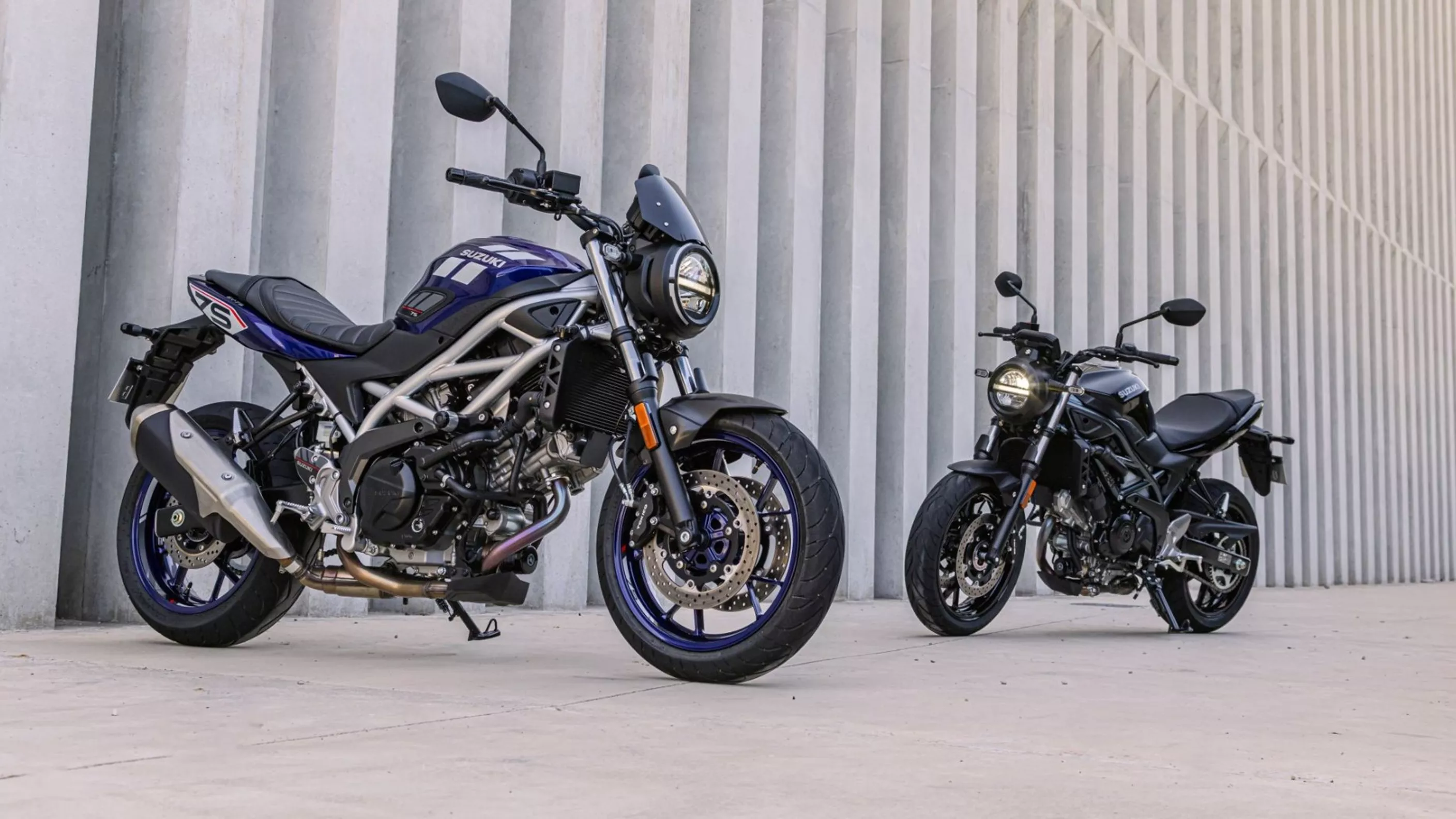
Suzuki SV-7S 2027: The V-twin stays, the electronics step up
SV650 legacy gets a quickshifter and three riding modes
The familiar 645 cc V-twin gets electronic company: Suzuki pairs it with ride-by-wire, a quickshifter, and a connected TFT. The 785 mm seat height remains. What changes on the new naked bike compared to the SV650?

Der Horvath
published on 03/11/2026
5,032 Views
Suzuki SV-7S continues the V-twin story
Suzuki SV-7S: 645 cc, 54 kW and Euro 5+
At its heart still works a liquid-cooled 90-degree V-twin with two overhead camshafts and four valves per cylinder. Suzuki quotes 73.4 hp (54 kW) at 8,500 rpm and 64 Nm at 6,800 rpm. The engine is said to combine its characteristic uneven firing intervals with well-metered torque and revvy character. Power reaches the rear wheel via a six-speed gearbox. The datasheet lists 4.1 l/100 km for WMTC consumption and 96 g/km for CO₂ emissions.

The 645 cc V-twin produces 54 kW and 64 Nm, according to Suzuki.
The key innovation sits at the throttle: ride-by-wire controls two electronic throttle bodies, each 39 mm in diameter, laying the groundwork for the new assistance functions. Optimized injectors and two iridium spark plugs per cylinder are meant to improve combustion. The airbox sits directly under the tank, leaving room in the seat area for a narrow, low design. Shorter, newly designed airbox outlet pipes are meant to support power delivery into higher revs. Suzuki has also reworked the intake sound.
The compact 2-into-1 exhaust system meets Euro 5+, according to Suzuki. Under load, the V-twin is meant to sound more present, while staying restrained at cruising speed. The exhaust features a newly designed, structured cover with a satin finish. Inside the engine, Suzuki relies on SCEM cylinder coating, coated pistons, L-shaped piston rings, and piston cooling via oil jets. These measures are meant to reduce friction and support thermal resilience. The alternator and gearbox gears have also been reworked with durability and the new electronic control system in mind.
Suzuki SV-7S: Three modes and quickshifter
How much influence do you get over the V-twin? The Suzuki Drive Mode Selector offers three riding modes. A for Active is meant to respond especially directly and feel punchier than the SV650. B for Basic is intended for everyday use and, according to Suzuki, is based on the SV650's power character. C for Comfort softens throttle response and limits output to 45 kW. Engine braking has also been tuned for smoother deceleration. The traction control, independent of this, offers three levels and can be switched off: Level 1 intervenes the least, Level 2 is intended for regular road conditions, Level 3 for wet or slippery surfaces. It's regulated via ignition timing and throttle valve opening.
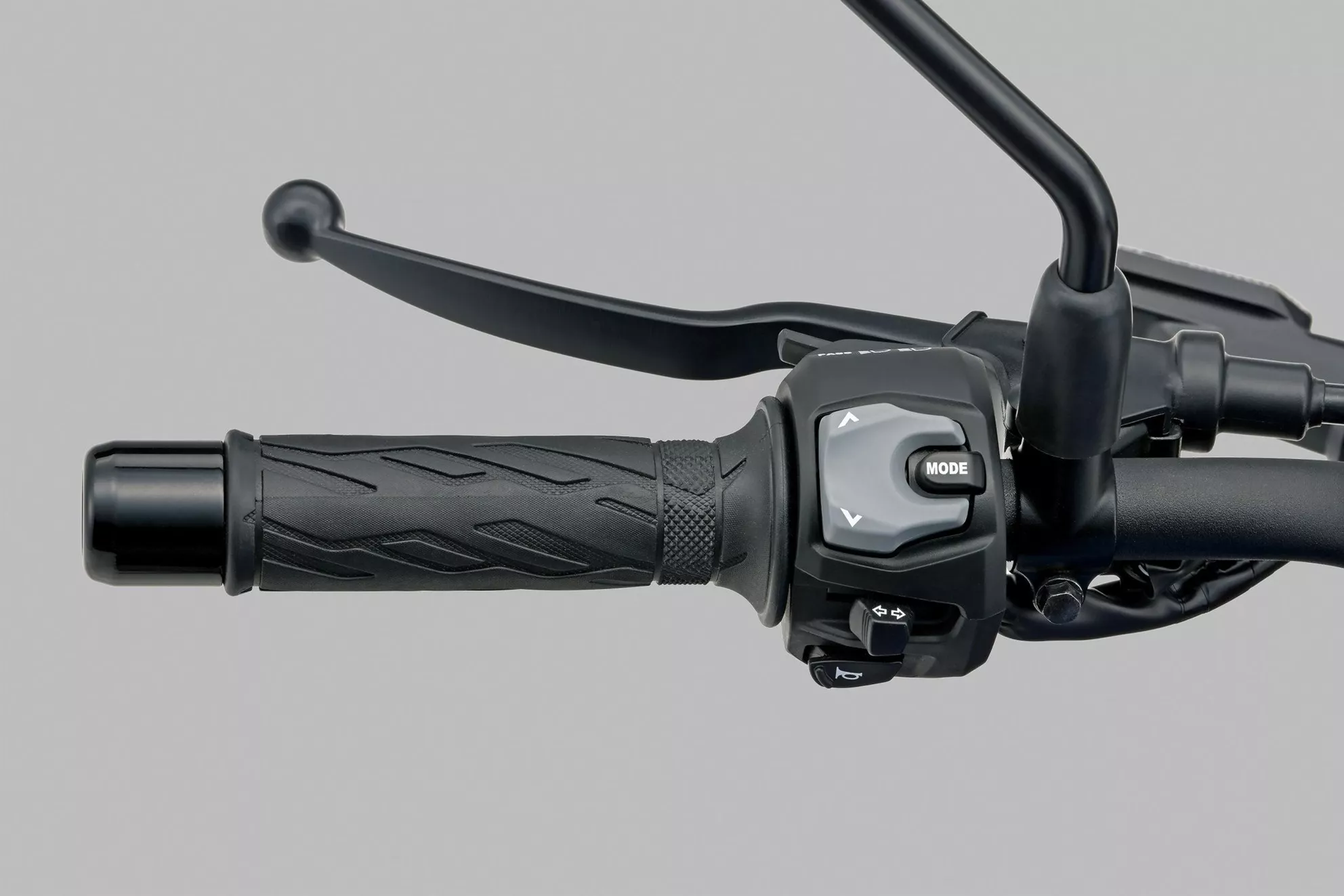
Riding mode, traction control, and quickshifter are set via the left side of the handlebar.
The switchable bidirectional quickshifter allows clutchless upshifts above 2,000 rpm and downshifts above 1,700 rpm. Riding mode, traction control, and quickshifter are set via the left switch cluster. Easy Start fires up the engine with a brief press of the starter button, without pulling the clutch when in neutral. Low RPM Assist is meant to prevent excessive rpm drop when engaging the clutch, in stop-and-go traffic, and when making U-turns.
Suzuki SV-7S: Familiar base, wider handlebar
The steel trellis frame and the steel tube swingarm with an elongated cross-section remain central building blocks. Suzuki promises a balance of agility, stability, and comfort, even with a pillion or luggage. The figures: 1,445 mm wheelbase, 25 degrees steering head angle, 106 mm trail, and 135 mm ground clearance. Wet weight is listed by Suzuki as 200 kg.
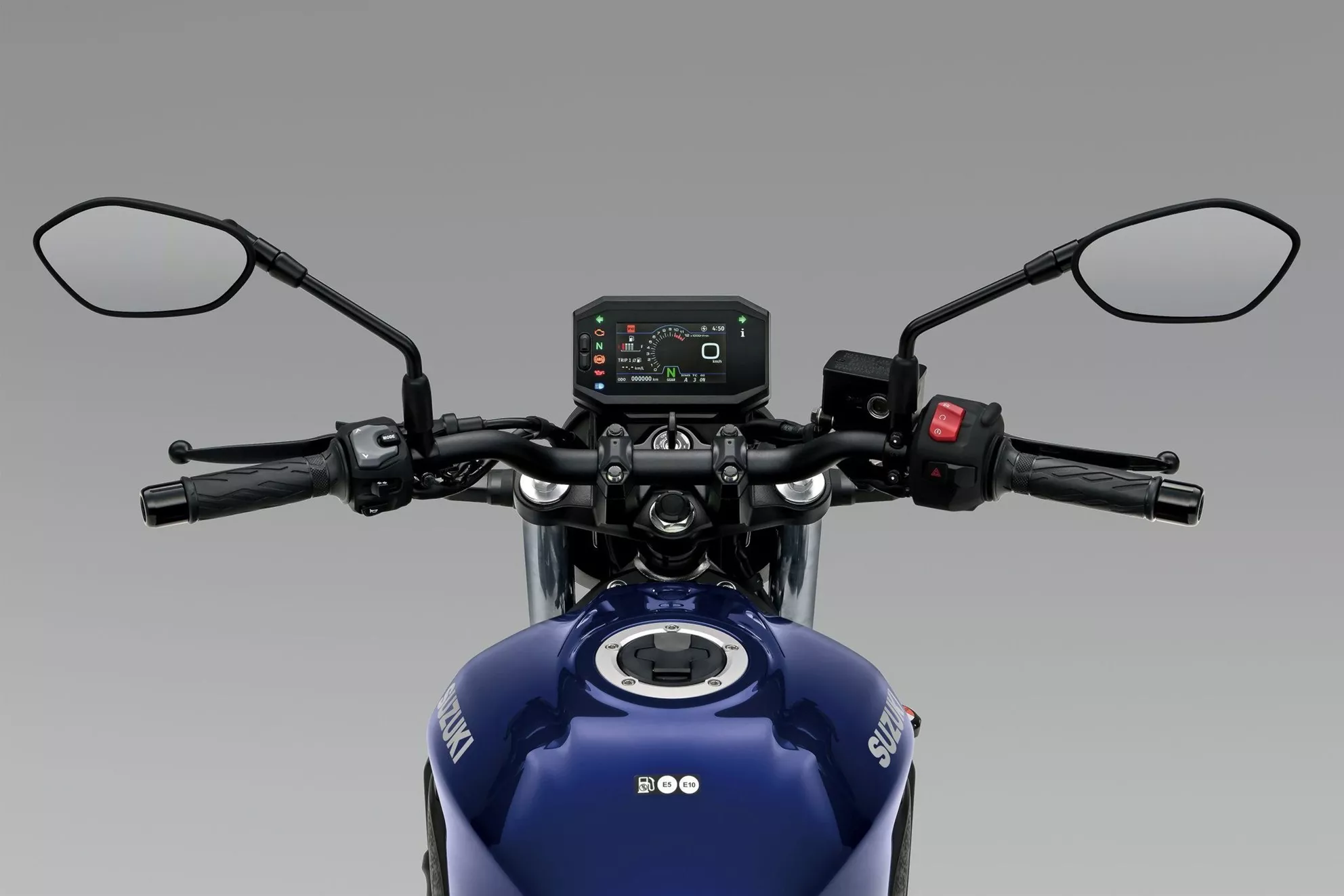
The 719 mm wide aluminum handlebar is positioned closer to the rider than on the SV650.
For ergonomics, Suzuki goes for an upright riding position. The tapered aluminum handlebar is 719 mm wide, wider than on the SV650 and positioned closer to the rider. Grip positions move outward by 11.5 mm each compared to the SV650. Handlebar angle and bend are meant to accommodate different body sizes. Added to this are a 785 mm seat height, a narrow seat, and a tight transition to the tank designed to make it easier to get your feet down. The redesigned tank, said to be lighter according to Suzuki, still holds 14 liters and creates space for electronics underneath. Knurled aluminum footpegs and a helmet lock under the seat round out the everyday equipment, while a separate pillion seat remains.
Suzuki SV-7S: Chassis, brakes and tires
Up front works a conventional, hydraulically damped 41 mm telescopic fork with 125 mm of travel. At the rear, 129 mm is available at the wheel, with the linkage-actuated shock adjustable across seven preload settings. Suzuki states that it places the focus on comfort without giving up the sporty character. What of that actually comes through in the twisties will have to be shown by a ride. Braking up front is handled by two floating-mounted 290 mm discs with four-piston calipers, and at the rear by a 240 mm disc. ABS is of course present.
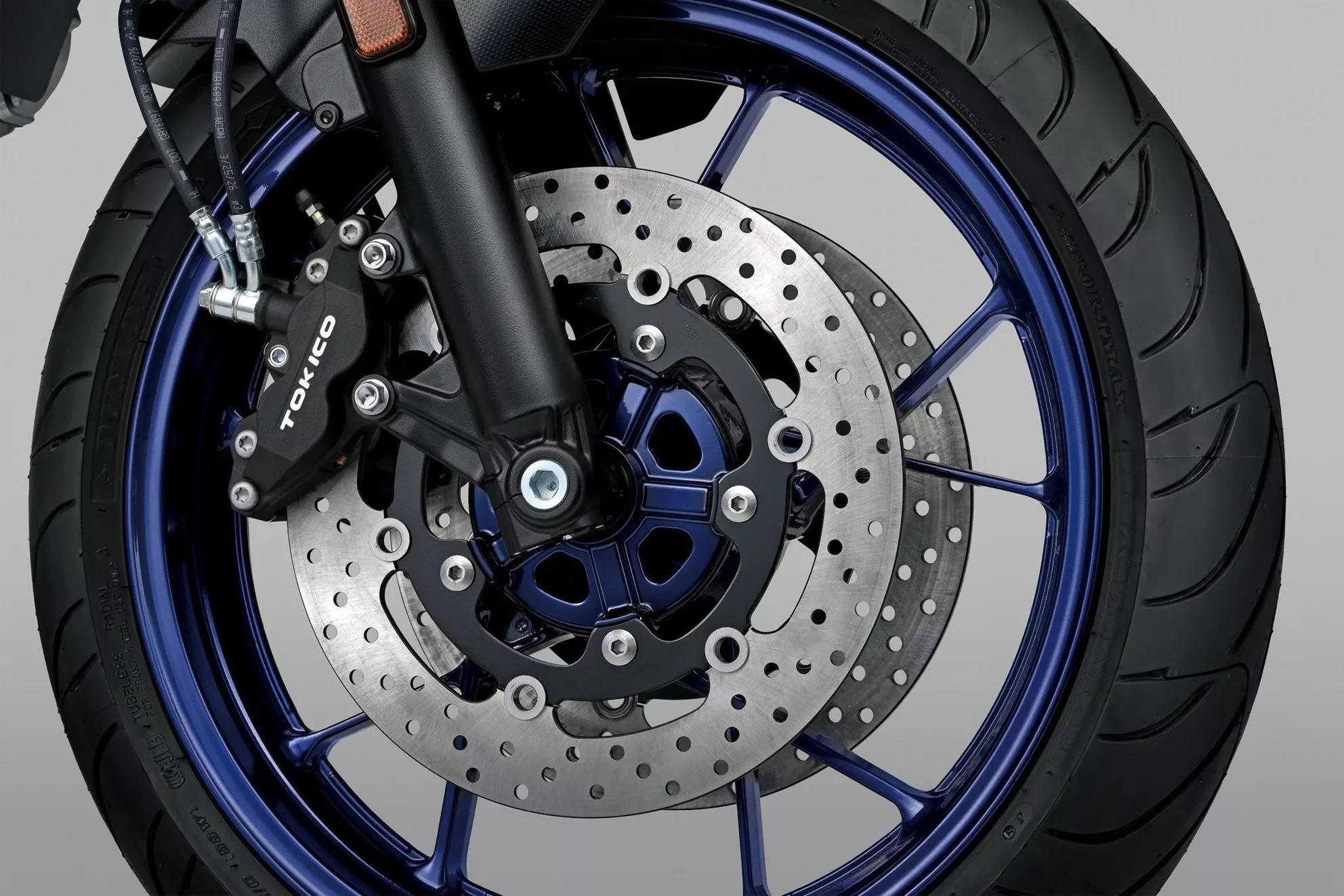
Up front, Suzuki combines two 290 mm discs with four-piston calipers.
The cast aluminum wheels with ten spokes, color-matched to the bodywork, carry tubeless Dunlop Roadsmart III tires. Dimensions are 120/70 ZR17 front and 160/60 ZR17 rear. Suzuki says it chose the sport touring tires for their combination of grip, stability, and tread life.
Suzuki SV-7S: Round headlight meets TFT
Visually, the SV-7S remains a slim naked bike with a visibly integrated trellis frame, clean lines, and narrow tail fairing pieces. The new LED round headlight is flattened at the bottom, with a narrow position light running through its center. A multi-reflector system is meant to improve illumination. Turn signals, taillight, and license plate light likewise use LEDs. The black anodized handlebar and the black-painted upper handlebar clamp receive a matching surface structure after bead blasting. The wiring harness and its routing have also been reworked to accommodate the additional sensors and emissions control.
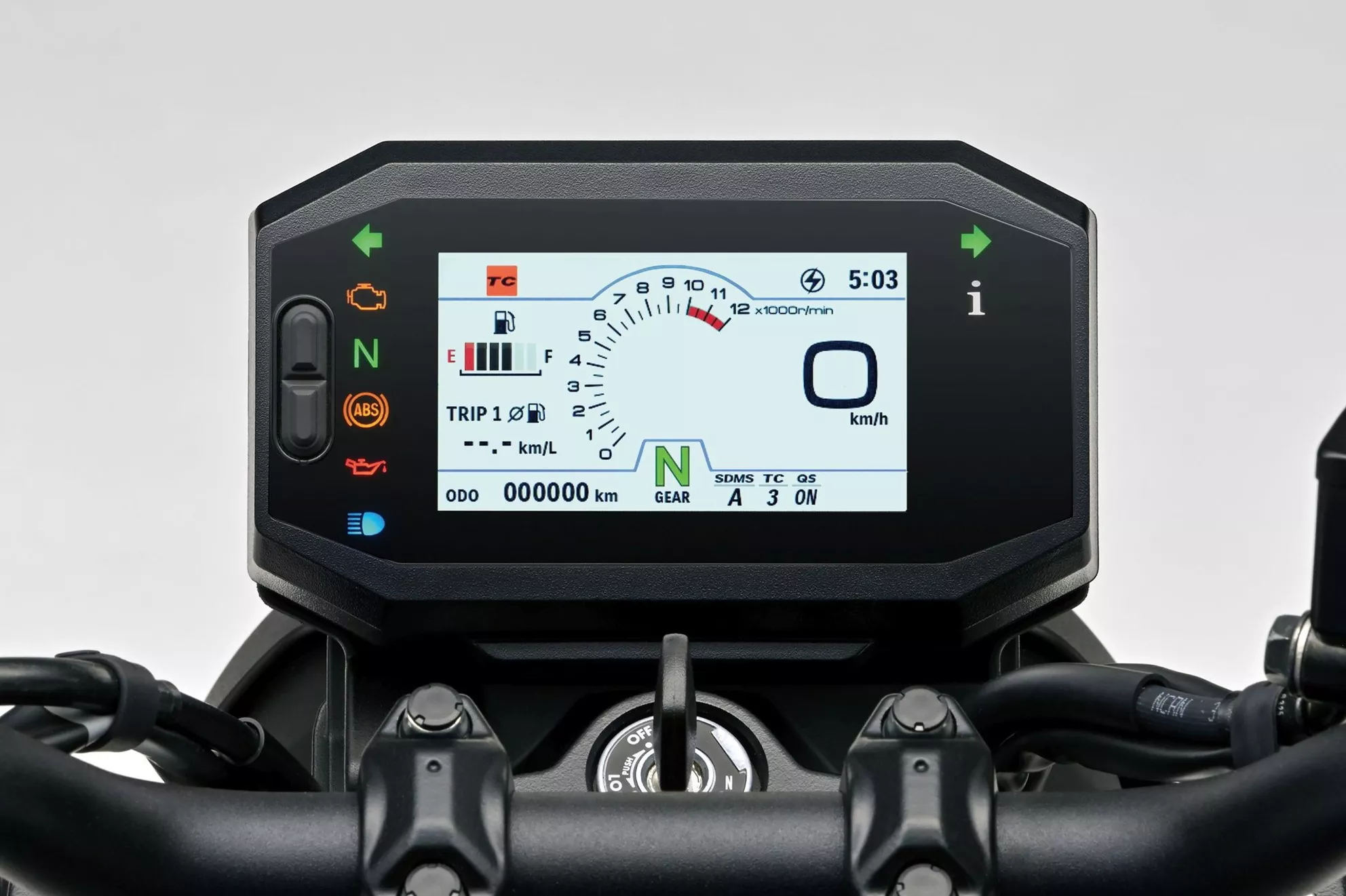
The 4.2-inch TFT shows a round tachometer when no smartphone is connected.
The 4.2-inch color TFT shows a classic round tachometer when no smartphone is connected, switching to a horizontal layout when navigation is linked. A brightness sensor automatically controls the display's illumination, with day and night views also selectable manually. Blue graphics, a bar that shifts from light to dark blue with rpm, and a start-up animation are part of the display. Shown among other things are instantaneous and average fuel consumption, gear, speed, rpm, remaining range, odometer, two trip meters, battery voltage, coolant temperature, an oil change reminder, and a 12-hour clock. Riding mode, traction control, and quickshifter status can also be tracked on the dash.
Suzuki SV-7S: What the smartphone app can do
Via Bluetooth, the TFT connects to the Suzuki Ride Connect+ app for iOS and Android. Navigation shows turn arrows, distances, estimated arrival time, remaining distance, and traffic jam alerts. Map view and voice guidance are available on the smartphone or via a headset, as is information on dealers and other points of interest. Call, SMS, supported social media, and calendar notifications appear on the dash. Android supports Google Calendar, iOS its own calendar app. Only under Android is there also automatic call rejection with a preset SMS reply, excluding IP calls.
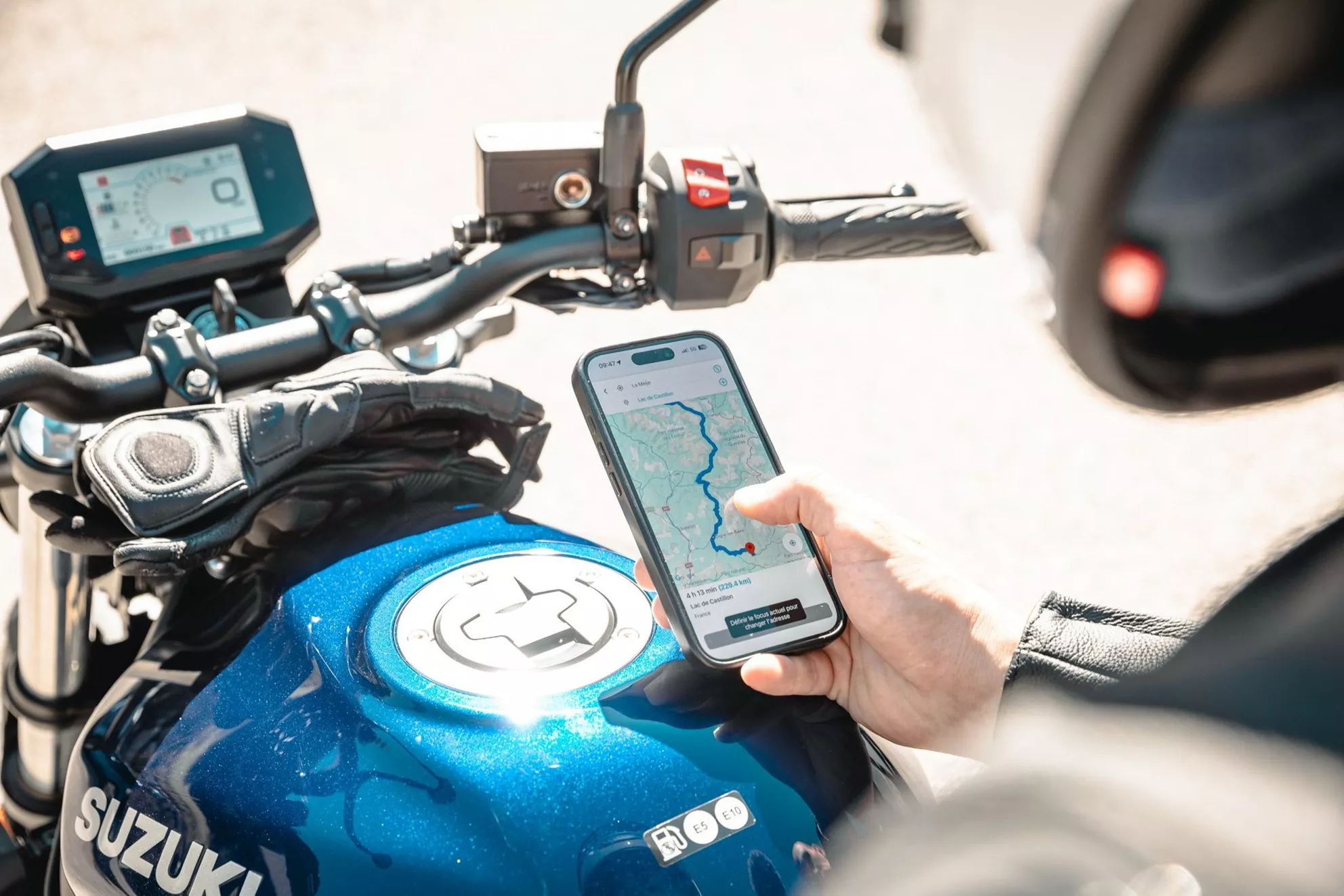
Smartphone connectivity runs via Bluetooth and the Suzuki Ride Connect+ app.
Weather data for the current location also works without active navigation. In addition, there are weather alerts, rain cloud notices along the route when navigation is active, and adjustable speed warnings. Notifications can be turned on and off. The app can show the last parking spot, log daily and monthly consumption and distance data, and share rides. The last ten navigated routes and ten favorites are saved, including ride time, distance, consumption, and top and average speed. Rides without a smartphone connection are not included in the connected ride statistics.
In addition, the app offers vehicle data from the last connection status, maintenance information such as tires and battery, five selectable service reminders, and expiry notices. A digital wallet lets you store images of your driver's license and up to three ID documents along with expiry reminders. With the ignition switched off, the connection ends to save battery. The range of functions also depends on data transmission. A connected cockpit, then, whose capabilities go well beyond plain arrow navigation.
Suzuki SV-7S: Colors, price and availability
Suzuki lists three color options. Pearl Suzuki Deep Blue No. 4 combines a blue body and blue wheels with a frame in Mat Sword Silver. With Glass Sparkle Black, a black body and wheels meet a gray frame. The third version combines Mat Sword Silver on the tank and frame with black fairing pieces and blue wheels. Suzuki has not yet announced a price or a concrete market launch.
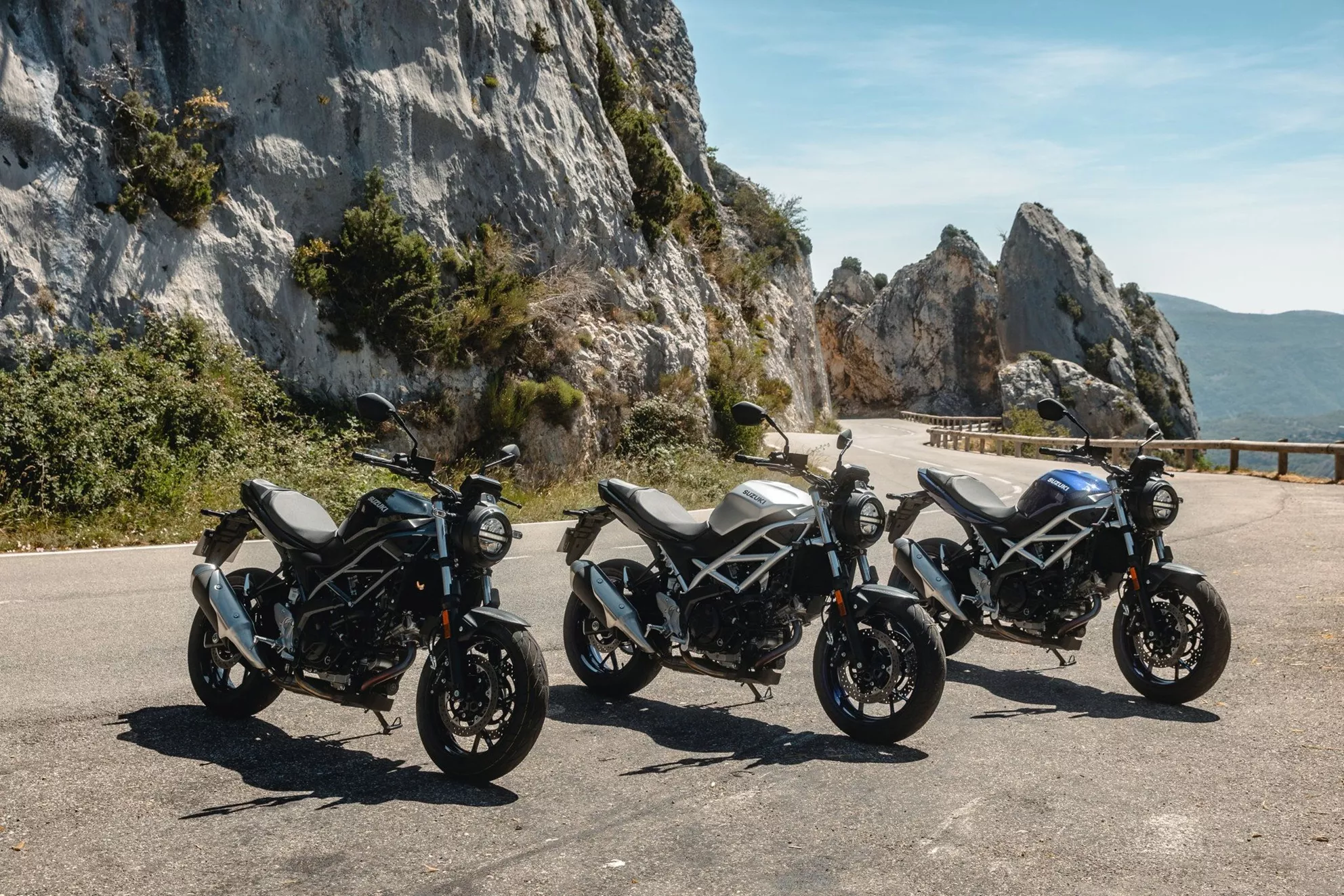
An overview of the three announced color variants of the Suzuki SV-7S.
More naked bike news


Suzuki SV-7S: The most important questions
What engine does the Suzuki SV-7S have?
A liquid-cooled 645 cc V-twin with a 90-degree cylinder angle. Suzuki quotes 54 kW at 8,500 rpm and 64 Nm at 6,800 rpm, plus Euro 5+ compliance.
What electronic aids does the SV-7S come with?
Ride-by-wire, three riding modes, a three-level switchable traction control, a bidirectional quickshifter, ABS, Easy Start, and Low RPM Assist. In Comfort mode, output is limited to 45 kW.
How tall and how heavy is the Suzuki SV-7S?
Seat height is 785 mm, with a wet weight of 200 kg according to Suzuki. The tank holds 14 liters.
Does the Suzuki SV-7S have navigation?
With a connected smartphone and the Suzuki Ride Connect+ app, the 4.2-inch TFT offers arrow navigation. Map view and voice guidance run via the smartphone or a headset. The app supports iOS and Android.
What does the Suzuki SV-7S cost and when does it arrive?
Price and a concrete market launch are not mentioned in the press materials provided.
- How much does a Suzuki SV-7S cost?
- Here you will find an overview of the price level of new and used motorbikes!
Suzuki SV-7S 2027: The V-twin stays, the electronics step up Images
Source: 1000PS

Suzuki SV-7S with rider seated while riding on a sunny road. Suzuki’s 645cc V-twin has been part of the SV story since 1999.

Blue SV-7S viewed from the front at an angle in the studio. According to the manufacturer, more than 500,000 of these engines have now been built.

V-twin on the left. The SV-7S opens a new chapter for the concept: Suzuki sticks with the narrow twin and steel trellis frame, while adding an electronics package with smartphone connectivity.

Three SV-7S models in different colours. The bike still appeals to everyone from beginners to experienced riders, with uses ranging from the daily commute to weekend rides and the occasional track day.


Muffler. At its heart is still a liquid-cooled 90-degree V-twin with dual overhead camshafts and four valves per cylinder.


Suzuki SV-7S with rider seated, riding along a winding country road. Suzuki quotes 54 kW at 8,500 rpm and 64 Nm at 6,800 rpm.


Suzuki SV-7S with rider on board, riding along a twisty country road. Bore and stroke are 81.0 x 62.6 mm, with a compression ratio of 11.2:1.


Suzuki SV-7S with rider seated, riding along a twisty country road. The engine is designed to combine its characteristic uneven firing intervals with easily controllable torque and a willingness to rev.


Suzuki SV-7S with rider aboard on a winding country road. Power is delivered to the rear wheel via a six-speed gearbox.


Suzuki SV-7S ridden on a winding country road. The spec sheet lists WMTC fuel consumption at 4.1 l/100 km and CO2 emissions at 96 g/km.


V-twin engine. These are manufacturer figures, which can vary in real-world use depending on factors such as weather, road conditions, riding style and maintenance.


Suzuki SV-7S with rider on board on a country road. The key update is in the throttle: ride-by-wire controls two 39 mm electronic throttle bodies, providing the basis for the new rider aids.


Suzuki SV-7S with rider aboard on a country road. Optimized fuel injectors and two iridium spark plugs per cylinder are designed to improve combustion.


Suzuki SV-7S with rider on board, riding on a country road. The airbox sits directly beneath the tank, leaving room for a slim, low-profile design around the seat.


Suzuki SV-7S with rider aboard on a country road. Shorter, redesigned airbox outlet ducts are designed to support power delivery higher up the rev range.


Suzuki SV-7S with rider on board, riding a sunny road loop. Suzuki has also revised the intake sound.


Suzuki SV-7S with rider seated, riding on a sunny road. According to Suzuki, the compact 2-into-1 exhaust system meets Euro 5+ standards.


Suzuki SV-7S with rider aboard on a sunny road ride. Its catalytic converter is housed in the collector, with oxygen sensors upstream and downstream of the cat feeding data to the fuel-injection system.


Suzuki SV-7S with rider seated, riding on a sunny road. The V-twin should sound more pronounced under load while staying subdued at cruising speed.


Suzuki SV-7S with rider on board, riding on a sunny road. The exhaust stands out with its redesigned textured cover and satin finish.


Suzuki SV-7S with rider seated and riding on a sunny road. The engine features Suzuki’s SCEM cylinder coating, coated pistons, L-shaped piston rings and oil-jet piston cooling.


Suzuki SV-7S with rider seated on the bike during a sunny road ride. These measures are designed to reduce friction and support thermal durability.


Suzuki SV-7S with rider on board on a sunny road ride. The alternator and transmission gears have also been revised for greater durability and to accommodate the new electronic control system.


Suzuki SV-7S with rider on board, riding a sunny road loop. At its heart is still a liquid-cooled 90-degree V-twin with dual overhead cams and four valves per cylinder.


Suzuki SV-7S with rider seated while riding on a sunny road. Suzuki quotes 54 kW at 8,500 rpm and 64 Nm at 6,800 rpm.


Suzuki SV-7S with rider on board, riding a sunny road loop. Bore and stroke measure 81.0 x 62.6 mm, with a compression ratio of 11.2:1.


Suzuki SV-7S with rider on board, riding a sunny road. The engine is designed to combine its characteristic uneven firing intervals with easily controllable torque and a willingness to rev.


Suzuki SV-7S with rider on board on a sunny road ride. Power is delivered to the rear wheel via a six-speed gearbox.


Stock muffler. The spec sheet lists WMTC fuel consumption at 4.1 l/100 km and CO2 emissions at 96 g/km.


Left-hand switchgear. How much control do you get over the V-twin?


Left handlebar switchgear. The Suzuki Drive Mode Selector offers three riding modes.


Suzuki SV-7S with rider seated, riding along a road between rocky outcrops. The “A” for Active is designed to deliver a more direct response and a punchier feel than the SV650.


Suzuki SV-7S with rider seated, riding along a road between rocks. The “B” in Basic signals its everyday focus; according to Suzuki, its power delivery is inspired by the SV650.


Suzuki SV-7S with rider seated, riding along a road between rock faces. C for Comfort softens throttle response and limits power to 45 kW.


Suzuki SV-7S with rider on board, riding along a road between rocky outcrops. Engine braking has also been tuned for smoother deceleration.


Suzuki SV-7S ridden on a road between rocky outcrops. The traction control offers three levels and can be switched off: Level 1 intervenes least, Level 2 is suited to normal road conditions, and Level 3 to wet or slippery surfaces.


Suzuki SV-7S with rider seated, riding along a road between rocky outcrops. Power delivery is controlled via ignition timing and throttle opening.


Suzuki SV-7S with rider seated, riding along a road between rock formations. The switchable bidirectional quickshifter allows clutchless upshifts above 2,000 rpm and downshifts above 1,700 rpm.


Handlebar controls. Riding modes, traction control and the quickshifter are adjusted via the left-hand switchgear.


Suzuki SV-7S ridden through urban streets and along country roads. Easy Start fires up the engine with a brief press of the starter button, even in neutral without pulling in the clutch.


Suzuki SV-7S with rider aboard in urban traffic and on country roads. Low RPM Assist helps prevent the revs from dropping too far when releasing the clutch, in stop-and-go traffic and during U-turns.


Suzuki SV-7S with rider seated, riding through urban streets and on country roads. Rider aids have their limits: traction control can’t prevent every loss of grip caused by carrying too much speed into a corner or braking, nor can it stop the front wheel from washing out.


Suzuki SV-7S with rider on board, riding through urban streets and out on the open road. How much say do you get over the V-twin?


Suzuki SV-7S with rider on board, riding through an urban setting and on country roads. The Suzuki Drive Mode Selector offers three riding modes.


Suzuki SV-7S with rider seated, riding through urban streets and on country roads. The “A” for Active is designed to deliver a more immediate response and a punchier feel than the SV650.


Suzuki SV-7S with rider seated, riding through urban streets and on country roads. The B stands for Basic: designed for everyday use, with a power delivery that Suzuki says is inspired by the SV650.


Handlebars and cockpit. The steel trellis frame and steel swingarm with its elongated cross-section remain key components.


Seat. Suzuki promises a balance of agility, stability and comfort, even with a passenger or luggage.


Tank and frame. The figures: 1,445 mm wheelbase, 25-degree rake, 106 mm trail and 135 mm ground clearance.


Rider and front end. The SV-7S measures 2,115 mm long, 785 mm wide and 1,090 mm tall.


Footpeg and gear lever. The compact layout is designed to make manoeuvring and riding at low speeds easier.


Tank and frame. Suzuki has gone for an upright riding position.


Seat. The tapered aluminium handlebar is 719 mm wide—wider than the SV650’s—and positioned closer to the rider.


Suzuki SV-7S with rider on board, riding the road loop, partly through a tunnel. The handlebar grips are positioned 11.5 mm further out on each side than on the SV650.


Suzuki SV-7S with rider on board during a road ride, including a tunnel section. The handlebar angle and sweep are designed to suit riders of different heights.


Suzuki SV-7S with rider seated on the road loop, including a section through a tunnel. The 785 mm seat height, narrow seat and slim junction with the tank are designed to make it easier to get both feet on the ground.


Suzuki SV-7S with rider on board during a road ride, partly through a tunnel. The redesigned tank, which Suzuki says is lighter, still holds 14 litres and creates space underneath for electronics.


Suzuki SV-7S with rider seated on the road course, including a tunnel section. Knurled aluminium footpegs and a helmet holder beneath the seat add everyday practicality, while a separate pillion seat is retained.


Suzuki SV-7S ridden on the road course, with the rider seated and sections running through a tunnel. The steel trellis frame and steel swingarm with its elongated cross-section remain key components.


Suzuki SV-7S with rider on board during a road ride, including a section through a tunnel. Suzuki promises a balance of agility, stability and comfort, even with a passenger or luggage.


Suzuki SV-7S with rider seated, riding on a group ride. The figures: 1,445 mm wheelbase, 25-degree rake, 106 mm trail and 135 mm ground clearance.


Suzuki SV-7S with rider seated and riding on a group ride. The SV-7S measures 2,115 mm long, 785 mm wide and 1,090 mm tall.


Suzuki SV-7S with rider aboard on a group ride. Its compact design is intended to make manoeuvring and low-speed riding easier.


Suzuki SV-7S with rider seated on the move during a group ride. Suzuki has opted for an upright riding position.


Suzuki SV-7S with rider seated, riding on a group ride. The tapered aluminium handlebar is 719 mm wide—wider than the SV650’s and positioned closer to the rider.


Suzuki SV-7S with rider aboard on a group ride. The handlebar grips are positioned 11.5 mm farther out on each side than on the SV650.


Suzuki SV-7S with rider aboard on a group ride. The handlebar angle and sweep are designed to suit riders of different heights.


Suzuki SV-7S with rider on a group ride. Features include a 785 mm seat height, a slim seat, and a narrow transition to the tank for easier ground contact.


Footpeg and engine. The newly redesigned, lighter tank by Suzuki still holds 14 liters and creates space for electronics underneath.


Front brake. Up front, there's a conventional 41mm telescopic fork with hydraulic damping and 125mm of travel.


Rear shock. The rear wheel has 129 mm of travel, and the linkage-operated shock offers seven-step spring preload adjustment.


Rear suspension. Suzuki says it has focused on comfort without compromising the bike’s sporty character.


Front wheel. We’ll have to ride it through the twisties to see how much of that makes it to the road.


Fork and front brakes. Up front, braking is handled by twin 290 mm floating discs with four-piston calipers; at the rear, a 240 mm disc.


Suzuki SV-7S with rider seated, riding on a road loop with scenic countryside in the background. Suzuki explicitly points out that the system does not necessarily shorten braking distances or prevent the bike from sliding out under braking mid-corner.


Suzuki SV-7S ridden on a road through scenic countryside. Tubeless Dunlop Roadsmart III tyres are fitted to the ten-spoke cast aluminium wheels, colour-matched to the bodywork.


Suzuki SV-7S with rider seated, riding on the road loop with a scenic backdrop. Tyre sizes are 120/70 ZR17 at the front and 160/60 ZR17 at the rear.


Suzuki SV-7S with rider on board, riding the road loop against a scenic backdrop. Suzuki says it chose the sport-touring tyres for their combination of grip, stability and mileage.


Suzuki SV-7S with rider on board, riding on the road with scenic countryside in the background. No specific tyre assessment can be inferred from the presentation.


Suzuki SV-7S ridden on the road, with the landscape as a backdrop. Up front, a conventional 41 mm telescopic fork with hydraulic damping and 125 mm of travel does the work.


Suzuki SV-7S with rider seated on the road course, framed by the surrounding landscape. The rear wheel has 129 mm of travel, and the linkage-operated shock offers seven-step preload adjustment.


Suzuki SV-7S with rider on board, riding on a road course with scenic countryside in the background. Suzuki says comfort is a priority, without sacrificing its sporty character.


Suzuki SV-7S with rider on board, riding the road loop against a scenic backdrop. How it performs in the twisties remains to be seen.


Suzuki SV-7S with rider seated, riding on a country road and through a tunnel. Braking is handled by twin floating 290 mm front discs with four-piston calipers and a 240 mm rear disc.


Suzuki SV-7S with rider on board, riding on a country road and through a tunnel. Suzuki explicitly points out that the system does not necessarily shorten stopping distances or prevent the tyres from sliding when braking in corners.


Suzuki SV-7S ridden on country roads and through a tunnel. The colour-matched ten-spoke cast aluminium wheels are shod with tubeless Dunlop Roadsmart III tyres.


Suzuki SV-7S with rider aboard on the open road and in a tunnel. Tyre sizes: 120/70 ZR17 front and 160/60 ZR17 rear.


Suzuki SV-7S with rider on board, riding on a country road and through a tunnel. Suzuki says it chose the sport-touring tyres for their combination of grip, stability and mileage.


Suzuki SV-7S with rider on the move, cruising down the backroads and into the tunnel. Can't judge the tires just from the visuals.


LED headlight off. The SV-7S retains the look of a slim naked bike, with its trellis frame clearly integrated into the design, clean lines and slim tail bodywork.


TFT display in night mode. The new round LED headlight is flattened at the bottom, with a slim position light running through its centre.


Tail light switched off. A multi-reflector system is designed to improve illumination.


Headlight and front end. The turn signals, taillight and license plate light are also LED.


Front end. After blasting, the black-anodized handlebar and black-painted upper handlebar clamp have matching surface finishes.


LED headlight. The wiring harness and its routing have also been revised to accommodate the additional sensors and emissions control system.


LED turn signals. Without a smartphone connection, the 4.2-inch color TFT displays a classic round tachometer; when navigation is connected, it switches to a horizontal layout.


Blue SV-7S, viewed from the rear. 4 combines blue bodywork and blue wheels with a Mat Sword Silver frame.


Blue SV-7S, front view. Glass Sparkle Black pairs black bodywork and wheels with a grey frame.


Blue SV-7S, viewed from the rear left against a grey background. The third colourway combines Mat Sword Silver on the tank and frame with black bodywork and blue wheels.


Blue SV-7S, right-side profile. The press materials provided do not specify a price or a confirmed market launch date.


Silver-black SV-7S in left profile. Technical specifications refer to the European model; features and colors may vary by market.


Black SV-7S seen from a slight front angle. Individual shots of the base also showcase accessories, including a version for the European market.


Black SV-7S in right side profile. Combining a blue body and blue wheels with a frame in Matte Sword Silver.


Black SV-7S in portrait mode against bright architecture. Glass Sparkle Black combines a black body and wheels with a gray frame.


Accessory muffler. The third variant combines Mat Sword Silver on the tank and frame with black fairing parts and blue wheels.


Black SV-7S in profile view against the facade. The press release does not mention a price or specific market launch date.


Aftermarket exhaust and rear wheel. Technical specifications are based on European standards; equipment and colors may vary by market.


Tank with Suzuki logo. Individual images of the base also showcase accessories, including a version for the European market.


Portrait shot of the SV-7S and rider against a mountain backdrop. The 4 combines a blue body and blue wheels with a frame in Matte Sword Silver.


SV-7S color variants at the rocky overlook. Glass Sparkle Black combines a black body and wheels with a gray frame.


Three SV-7S with riders by the roadside. The third variant combines Mat Sword Silver on the tank and frame with black fairing parts and blue wheels.


Two SV-7S with riders at the viewpoint. The press release doesn't mention a price or a specific market launch.


Blue SV-7S in profile against the facade. Technical specifications refer to the European model; features and colors may vary by market.


Blue SV-7S in front of a tall, ribbed wall. Individual shots of the base also showcase accessories, including a version for the European market.


Blue SV-7S accessorized in right side profile. It combines a blue body and blue wheels with a Mat Sword Silver frame.


TFT display with accessory windscreen. In Glass Sparkle Black, the black body and wheels meet a grey frame.


Blue SV-7S angled from the front in portrait mode. The third version combines Mat Sword Silver on the tank and frame with black fairing parts and blue wheels.


Tank paintwork. The press materials provided do not mention a price or a specific launch date.


Rear wheel and tail section. Technical specifications refer to the European model; equipment and colours may vary by market.


Front end with accessory windscreen. Some images in the press kit also show accessories, including a version for the European market.


Two SV-7S bikes angled from the front against bright architecture. The combo features a blue body and blue wheels with a Matte Sword Silver frame.


Two SV-7S models in portrait format, with a dark foreground. Glass Sparkle Black pairs black bodywork and wheels with a grey frame.


Two SV-7S bikes in a vertical architectural shot. The third version pairs Mat Sword Silver on the tank and frame with black bodywork and blue wheels.


Rear end and rear wheel. The press materials make no mention of a price or a specific launch date.


Two SV-7S bikes and their riders with a mountain backdrop. Technical specifications refer to the European model; equipment and colours may vary by market.


Black SV-7S parked alone in front of a dark showroom wall. Separate images of the documentation also show accessories, including a version for the European market.


Blue SV-7S between the rider and a second motorcycle. 4 combines blue bodywork and blue wheels with a frame finished in Mat Sword Silver.


SV-7S and rider silhouetted against the low-hanging sun. In Glass Sparkle Black, the black body and wheels contrast with a gray frame.


Silver tank, viewed from above. The third version combines Mat Sword Silver on the tank and frame with black bodywork and blue wheels.


Blue SV-7S in portrait mode against a mountain backdrop. The provided press release doesn’t mention a price or specific market launch date.


Blue SV-7S and its shadow against a rock face. Technical specifications refer to the European model; features and colors may vary by market.


Blue SV-7S angled from the front against a mountain backdrop. Individual shots of the base also showcase accessories, including a version for the European market.


Blue SV-7S with accessories among plants in portrait format. Combines a blue body and blue wheels with a frame in Matte Sword Silver.


Accessory windscreen. Glass Sparkle Black bodywork and wheels contrast with the grey frame.


Frame accessories. The third version pairs Matte Sword Silver on the tank and frame with black bodywork and blue wheels.


Blue SV-7S with rider against a backdrop of mountains and lake. The press release does not mention a price or a specific market launch date.


Blue SV-7S with a top case fitted, parked at the roadside. Technical specifications refer to the European model; equipment and colours may vary by market.


Silver-and-black SV-7S in portrait orientation against a mountain backdrop. Separate images of the press kit also show accessories, including a version for the European market.


Silver tank and front end. 4 combines blue bodywork and blue wheels with a frame in Mat Sword Silver.


Three SV-7S bikes in portrait format, with rocks in the background. Glass Sparkle Black pairs black bodywork and wheels with a grey frame.


Two SV-7S models in portrait orientation in front of the building. The third version pairs Mat Sword Silver on the tank and frame with black bodywork and blue wheels.


Two SV-7S bikes with riders on a mountain road. The press materials provided do not mention a price or a specific market launch date.


Two SV-7S models with riders in front of a sweeping mountain landscape. Specifications refer to the European model; equipment and colours may vary by market.


Two SV-7S models leaned over on a winding road. Separate images in the gallery also show accessories, including a version for the European market.


Silver-and-black SV-7S with rider approaching a bend. Variant 4 pairs blue bodywork and wheels with a Mat Sword Silver frame.


Silver-black SV-7S in a vertical mountain shot. Glass Sparkle Black pairs the sleek black body and wheels with a grey frame.


Silver-black SV-7S with rider in a covered passage. The third version combines Mat Sword Silver on the tank and frame with black fairing parts and blue wheels.


Silver tank with rider. The press material provided does not specify a price or a confirmed launch date.