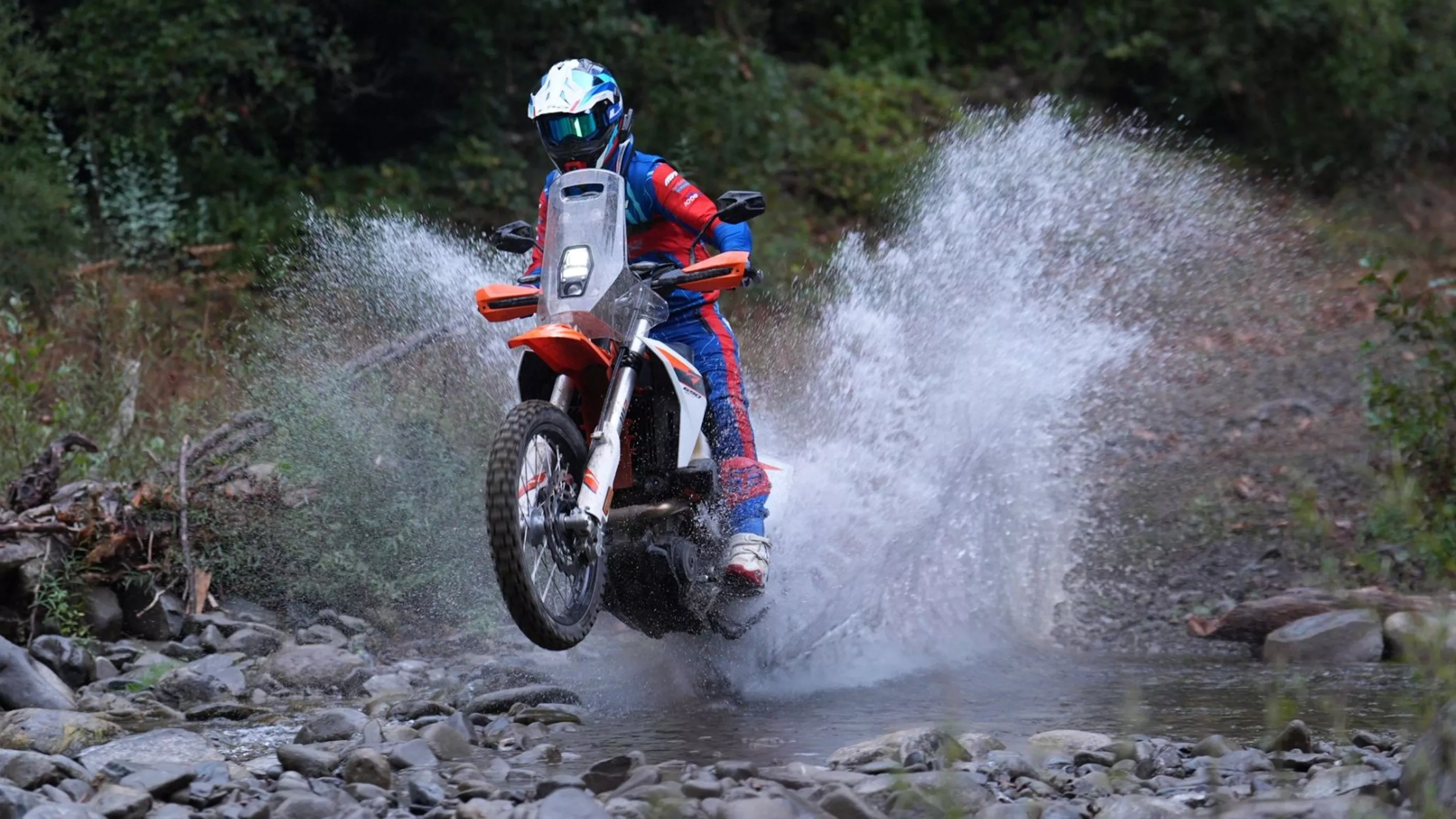
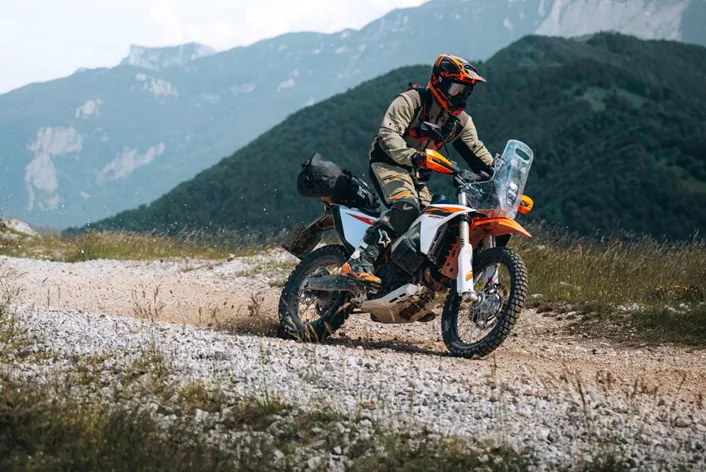
Riding alongside a great rally name like Meoni isn't something you take for granted. His father Fabrizio - a rally legend - was one of the defining figures of the Dakar race, and now I'm sitting here in Greece, riding with the son through dusty gravel tracks around Nafpaktos, and the KTM 690 Rally does exactly what it's supposed to: it tempts you into going faster than you'd actually planned.
KTM 690 Rally 2026 Test: Rally Bike for Road and Off-Road
How much Dakar is really in it?
The KTM 690 Rally 2026 brings genuine rally DNA to the road. In Greece it had to prove itself on fast gravel tracks, demanding off-road sections and wet asphalt. How well do the single-cylinder engine, rally chassis and electronics work - and for whom is it the better alternative to the big adventure bike

Bernd
published on 9/24/2026
7,563 Views
Nafpaktos instead of Dakar: A press launch with everything
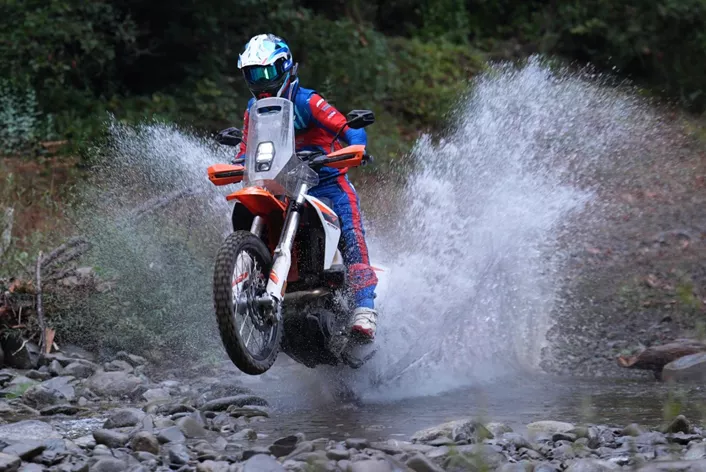
Nafpaktos sits right on the sea, and the surrounding area practically hands you the perfect test setting. Day one greeted us with 25 to 28 degrees and brilliant sunshine. In the evening, rain rolled in, and day two belonged to wet asphalt, muddy tracks and dripping visors. That wasn't a problem, it was a gift: anyone who really wants to get to know a bike needs exactly this range. Dry, wet, fast, slow, road, off-road - Nafpaktos gave us everything in two days. And the KTM 690 Rally held its own in all these situations - sometimes brilliant, sometimes with noticeable quirks you should know about.
Concept: When a Dakar machine gets street legal
The KTM 690 Rally positions itself as a street-legal rally bike for those who want more than a normal adventure bike - and less than a full-blown Dakar race machine. It's not a reworked enduro with a "Rally" sticker slapped on. The rally tower, the iconic nav-cockpit element, was taken 1:1 from the 450 Rally works machine. That's not marketing speak, you see it and you feel it. At the same time, it's not a device only for the tightest trails: it also wants to function on the road, wants to eat up kilometers and still make the rider's heart race the moment a gravel section shows up. It gives a clear statement, both visually and conceptually, against a direct competitor like the Husqvarna 701 Enduro, which is technically built on a very similar base.
Engine: Character with rough edges - that's how it should be
The single-cylinder in the KTM 690 Rally is not an engine for people seeking smoothness. It produces 73 Newton meters of torque - a number you don't just see on the spec sheet, but above all feel when accelerating out of a tight corner and the engine pushes with brutal determination. On wet tarmac I came to appreciate this especially: ride a gear higher, let the torque do the work, open the throttle early - the bike plays along, with a sense of control that's reassuring. At the same time, there's this one quirk that belongs to the character of the single: in slow, technical terrain it wants to be handled with sensitivity. The clutch needs to be metered with fingertip feel, because the flywheel mass was not increased on the Rally - unlike some other variants. The result: an engine that can also stall if ridden too slowly, at too low revs. Anyone who knows this, who deals with it, finds no flaw in it, but character. At high speeds - around 100 km/h - the rally windscreen provides reasonable wind protection, and the engine hums its typical single-cylinder song. Unpleasantly noticeable? Really only in the very slow range. Otherwise it positively invites you to attack. That's exactly what it triggered in me. I wanted more - and that's the highest form of compliment you can pay an engine's character.
Chassis: Comfort instead of stiffness - a surprise
This is where I was most surprised. The name "Rally" raises expectations of a stiff, precise chassis geared toward fast gravel kilometers that shakes you mercilessly on the road. The reality of the KTM 690 Rally 2026 is different - and that's actually meant as a positive. According to KTM, the chassis adjustments compared to the Enduro variant are modest. You can feel it: the bike offers 265 mm of travel up front and 250 mm at the rear, and it makes generous use of this potential. Off-road that means comfort, absorption, and the composure you need on loose, coarse gravel. Standing up - which is the natural riding position for this bike on such terrain - you feel distinctly more secure than sitting down. Riding fast on country roads, though, the bike noticeably starts to pogo under load changes. Anyone expecting a taut KTM will initially be puzzled. But anyone who understands that the chassis was built primarily for off-road use will grasp the logic. The seat ergonomics suit riders of medium stature well, as long as you sit centered. Larger or heavier riders will hit the firmer part of the damping sooner while seated - a taller aftermarket seat would then be a sensible investment. On long off-road stretches you ride this bike almost permanently standing up anyway.
Electronics: Modern tools, applied with restraint
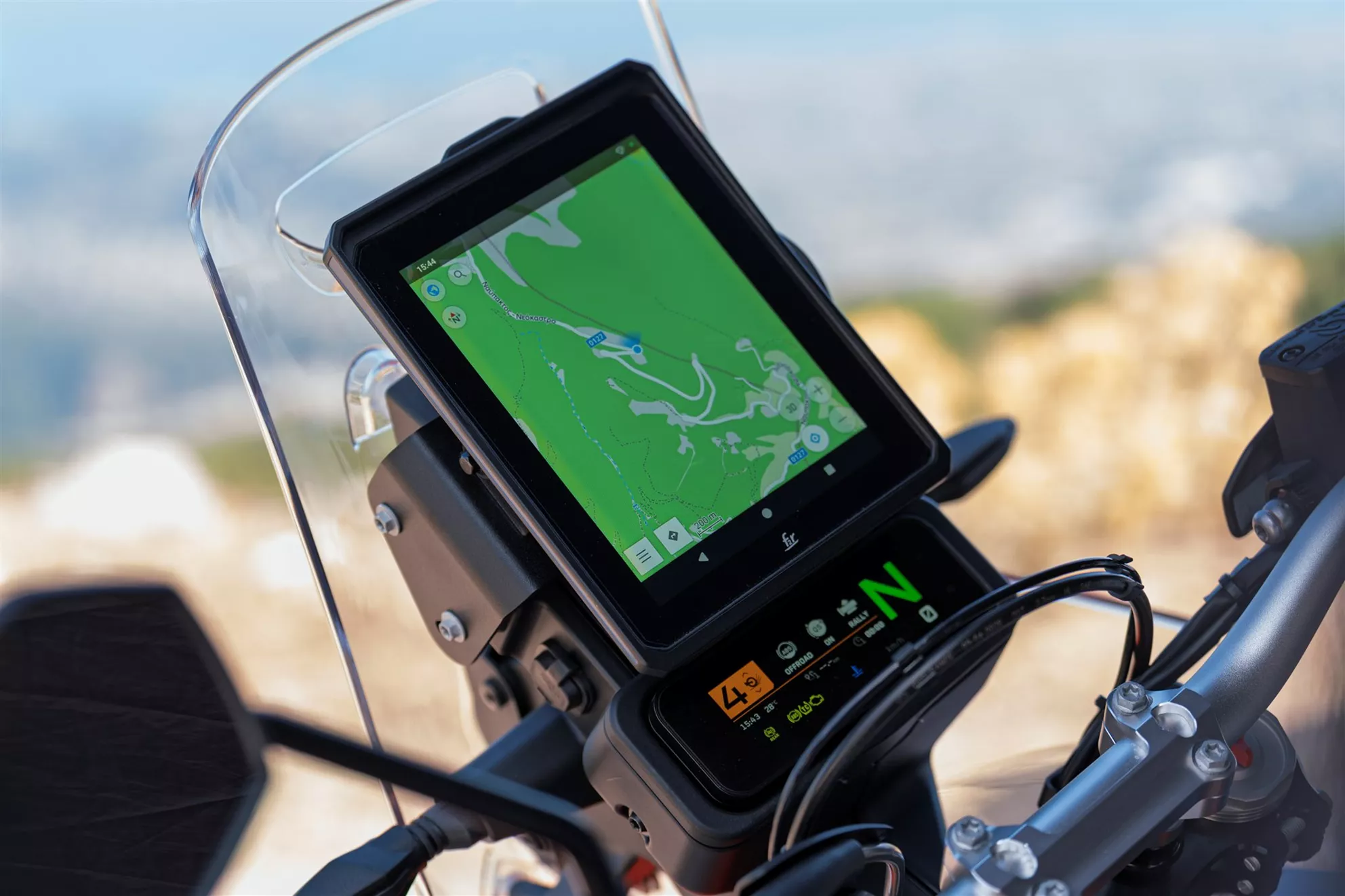
The KTM 690 Rally 2026 comes with ride-by-wire, traction control and several riding modes. Anyone who opts for the optional tech package additionally gets a quickshifter and the Rally mode with Dynamic Slip Adjust. And I'll say it clearly: that's fun. Not because electronics impress for their own sake, but because here it's noticeably useful. On the last 20 kilometers of the second test day, conditions prevailed that I won't forget anytime soon: extreme rain, extremely slick asphalt, almost no grip. In Street mode, the electronics worked discreetly and defensively in the background - exactly what you need in this situation. The Offroad mode provides maximum stability for more leisurely off-road use, the Rally mode maximum adjustability when you want the rear to step out slightly and want the system to play along rather than intervene. The ABS regulates early on wet tarmac, but with finesse. Up front you definitely feel it at the limit - two wide-eyed moments included. For really ambitious use, the ABS on the 690 Rally can be fully deactivated, by the way. On the road I wouldn't recommend that. Off-road? That decision is up to the rider. Overall operation is intuitive - menu cursor instead of a separate cruise control switch, clear logic, nothing that requires the manual.
Comparison: Sister against sister
The 690 Enduro R and the Husqvarna 701 Enduro share the technical base with the KTM 690 Rally - that's no secret. In wet, switchback corners on Greek asphalt I formed a clear impression: the 690 Rally feels noticeably more sluggish by comparison. This, however, is less down to the chassis itself and more to the tires. Our test bikes weren't fitted with tubes but with mousse inserts - and the extra weight of this insert is noticeable in handling. With classic Continental TKC 80 second generation tires, with which the bike harmonizes as if made for it, the picture changes significantly. The grip level on wet tarmac was surprisingly good for me. The engine delivers so much torque that on wet stretches you can easily ride a gear higher and relax the situation. The chain rattles a bit more at too-low revs - typical for this engine type, but worth mentioning. The chassis of the 690 Rally surprises with more comfort than expected, which even gives it a slight edge over the 701 Enduro in pure off-road use.
Ergonomics and long distance
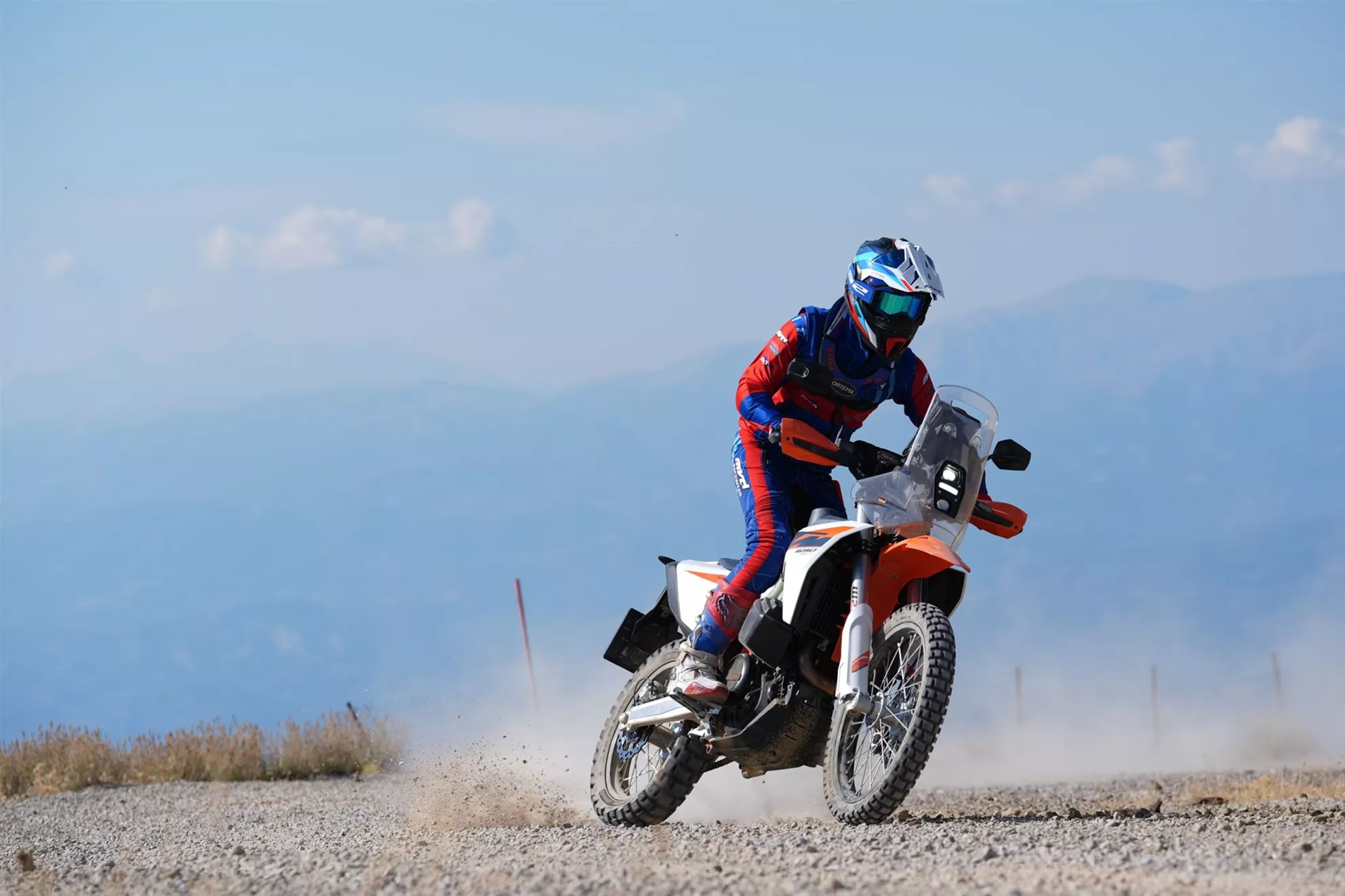
Two days, mostly off-road, partly on gravel that didn't allow a single second of letting up on body input - and I kept coming to the same conclusion: I prefer riding the KTM 690 Rally standing up. Not because there's no alternative, but because it simply works better. Over loose gravel, the standing position provides a feeling of control and security that's missing when seated. The knee angle in the seated position is pleasant, and the bike is well manageable even for taller riders. When seated: anyone sitting in the middle of the bike and not too heavy finds a comfortable position. Anyone sliding back or bringing more body weight quickly hits the firm part of the substructure. A taller aftermarket seat makes sense here. The rally tower with integrated nav system exceeded my expectations - no wobbling at cruising speed, stable mounting, clear readability. The operating logic, which I already knew from the KTM Supermoto, made sense immediately.
Technical data at a glance
The KTM 690 Rally 2026 is based on the proven single-cylinder engine of the 690 family with 73 Nm of torque and a displacement of 693 cc. The suspension travel figures are generous: 265 mm up front, 250 mm at the rear - a clear statement toward off-road capability. The rally tower was taken 1:1 from the 450 Rally works machine. Ride-by-wire, traction control and ABS come standard - the latter fully deactivatable. The optional tech package brings a quickshifter, Dynamic Slip Adjust and the Rally mode. The 690 Rally comes shod from the factory with Continental TKC 80 second generation tires - a combination that convinces on gravel and wet tarmac. The seat height is well suited for medium-sized riders; for taller or heavier riders, an aftermarket seat with more height is recommended.
More KTM News
- How much does a KTM 690 Rally cost?
- Here you will find an overview of the price level of new and used motorbikes!

KTM 690 Rally 2026 - Experiences and Expert Review
Bernd
The KTM 690 Rally is, for me, a genuine lightweight adventure bike - particularly interesting for more demanding TET tracks and riders who consciously want to downsize from a big adventure bike. Low weight, good handling and still enough touring capability make the concept compelling.
Alternatives to the KTM 690 Rally
KTM 690 Rally 2026 Test: Rally Bike for Road and Off-Road Images
Source: 1000PS


