76 speed records, 279 km/h on tarmac and an aero helmet that looks like a coconut: the story of Ernst Henne is among the craziest chapters BMW history has to offer. In the big 1000PS video, it's told by Fred Jakobs — who knew Henne personally and took over his complete records, picture documents and photo albums for the BMW archive. 1000PS editor ZONKO, already a Henne fan before the shoot, can't stop marvelling.
How an orphan became a motorcycle legend
Ernst Henne and the 279 km/h record
In 1937, Ernst Henne blasted into history at 279 km/h – on a supercharged BMW with a sheet-metal aero helmet. The full story in the big 1000PS video with Fred Jakobs.

nastynils
published on 27/07/2026
13,895 Views
76 records and an unimaginable number
Ernst Henne set 76 speed records. In 1929 he started with — for his time — a modest 216 km/h. The high point: 1937, a 500 cc supercharged BMW, 279.5 km/h. So you could say he did 280. On tarmac, and in the north of Munich at that.
These world records followed fixed rules, as Fred Jakobs explains in the video: electrical timing with two wires, a flying start, a measured kilometre or mile — and the course was run in both directions to cancel out tailwind. The road surface had to be extremely smooth. Such stretches existed in Hungary, in Wiener Neustadt, and later on the new German autobahns, with Frankfurt being the last venue.
Three-time IDM champion Helmut Dähne summed it up at Henne's 100th birthday: what Henne rode back then would be like doing 600 today — no suitable tyres, no aerodynamic experience, a completely different world. Fred Jakobs confirms: the tyre situation was so dramatic that the rubber sometimes spun on the rim, simply because the right material didn't exist.
The helmet that looks like a coconut
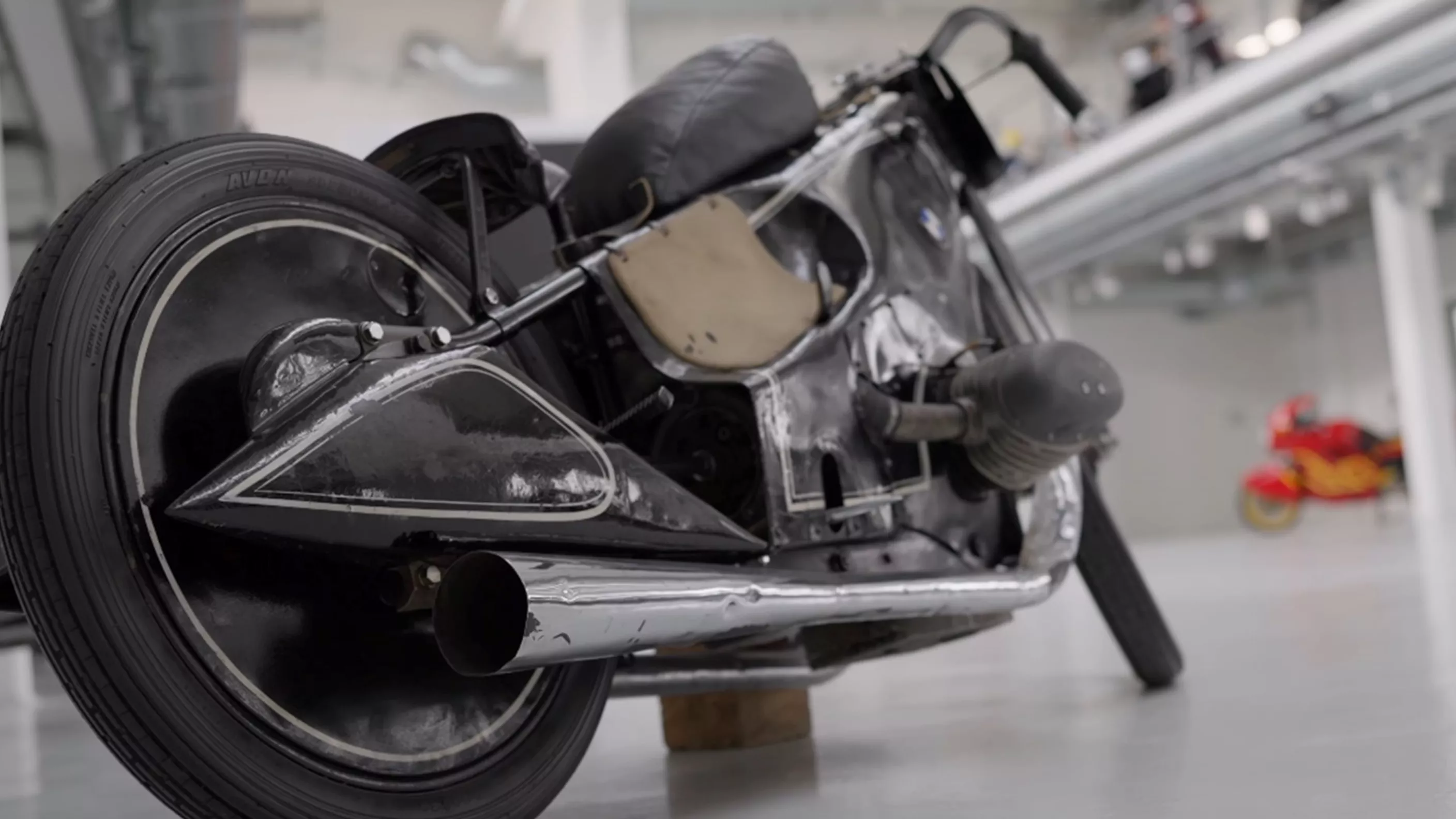
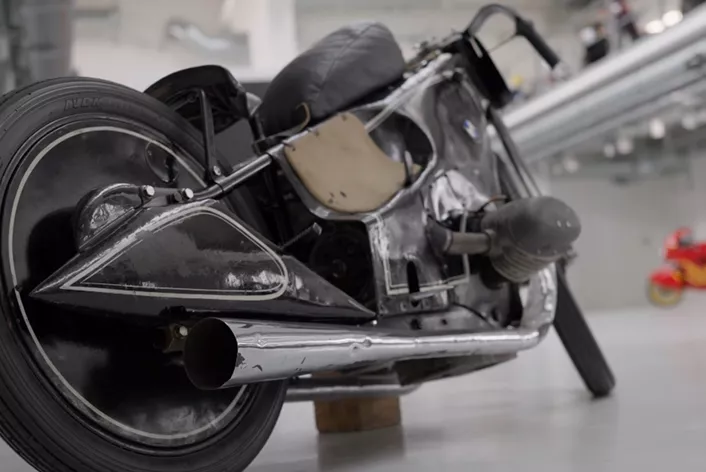
On this record machine, the limits were pushed in every single component. The fork is beautifully faired, there's an engine fairing, and the rider lies flat on a cushion. Then came an aerodynamic add-on for the helmet — the helmet itself made of a leather-and-wood mix, which was at least an improvement over the early leather caps.
In the video, ZONKO nails it: the aero add-on looks like a coconut. Fred Jakobs dryly notes that a real coconut would offer about the same level of protection. The fascinating part: today's time-trial cyclists use exactly the same Kamm shape. And the add-on is made of thin sheet metal — plastic of that quality didn't exist back then. With the full aluminium fairing he reached 279 km/h; with a partial fairing it was around 250.
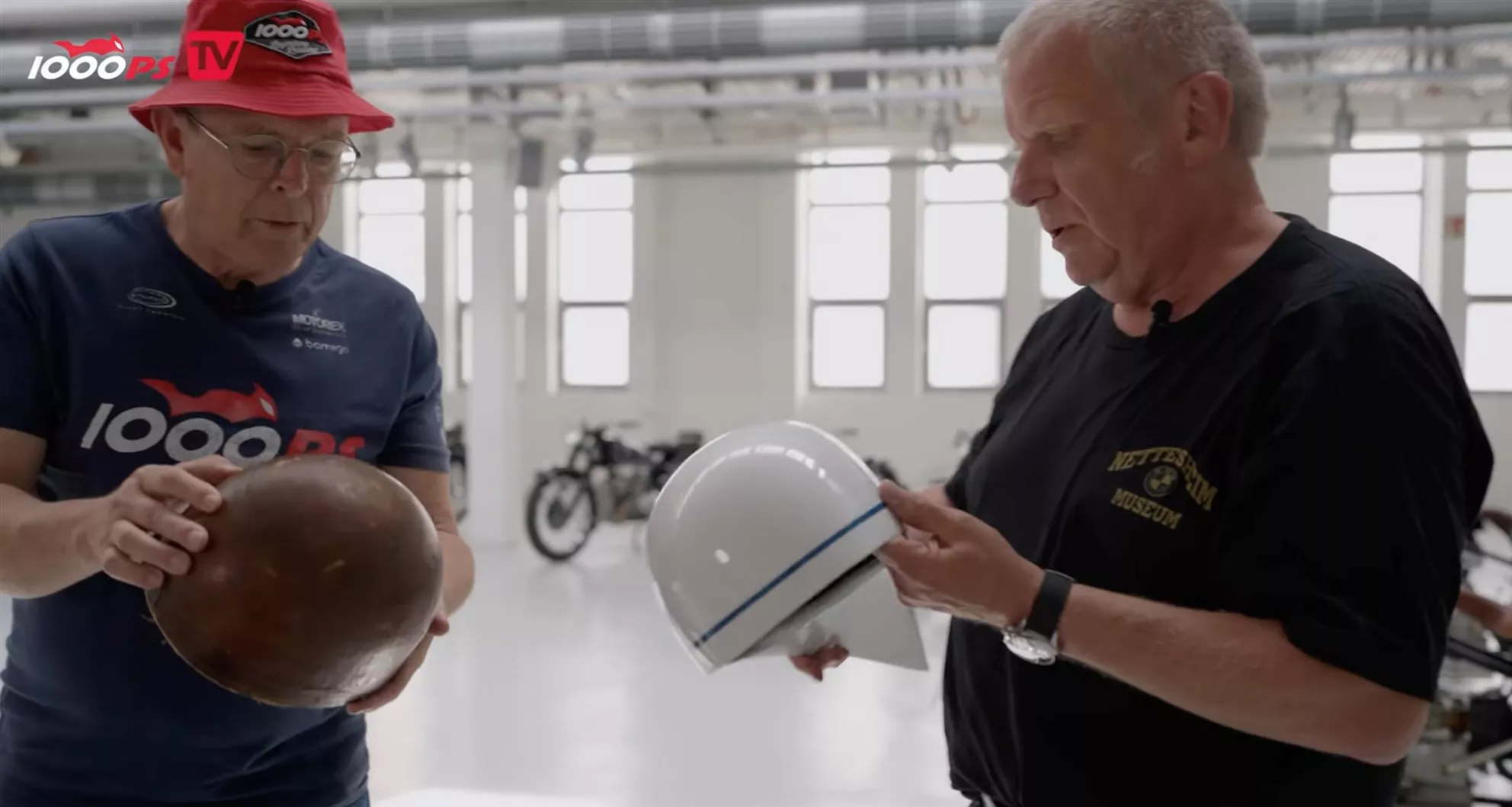
Aerodynamics in sheet metal: Henne's helmet add-on – Fred Jakobs' verdict in the video: about as protective as a coconut.
From the farm to the fastest machine in the world
What makes Henne so special is the road he took. He was an orphan. At weekends he went from village to village selling vegetables and eggs from the farm, saved the money — and used it to pay for a mechanic's apprenticeship. Back then you had to pay for your own training. The man did it all on his own.
At his first race in Mühldorf, he was allowed to try out a colleague's customer bike, a Megola — and finished third straight away. Later he set up his own business in Munich, right next to a small motorcycle factory called Astra. At one race, BMW officials were in the crowd, Henne got a contract, became road racing champion and was also hugely successful off-road. Envious rivals badmouthed him, but the man was top-notch both on the road and off-road.
Even in the '50s he was a genuine superstar. His photo albums are packed with racers like Rudolf Caracciola and even the German national football team that won the 1954 World Cup. Henne lived to 101. At his 100th birthday party he was still on the dance floor with his second wife at half past ten. At 80 he was still riding a GS off-road, right over the branches.
Spare plugs, a racing hump and a record average of 200
Technically, the record machine packs the supercharged engine with bevel-shaft drive. For the record, the boost pressure was cranked up considerably — towards 90 hp — because Henne only had to last a few kilometres. In racing, output was lower because the machines had to last longer. How closely record machines and production models were linked is shown by an anecdote from the video: for an advert, BMW retouched a production bike, darkened the supercharger — and just like that, the racer had become a production shot.
Bevel-shaft drive was used in racing into the '50s, and in sidecar racing even into the '70s. One detail on the race bike sparks enthusiasm in the video: a spare spark plug on both the left and the right. The reason: races were damn long — at classics like the Solitude you were out there for five hours, and plugs failed, so you swapped them on the move. Then there's the so-called "Rennbrötchen" (racing hump), which looks like a pillion seat but isn't: on the straights, the rider slides flat towards the back to reduce drag.
Just how durable the technology was is proven by the Grenzlandring: there, Georg "Schorsch" Meier rode an average of 200 km/h in the '40s. An oval, sure — but that means the machines were fully capable of sustained full throttle.
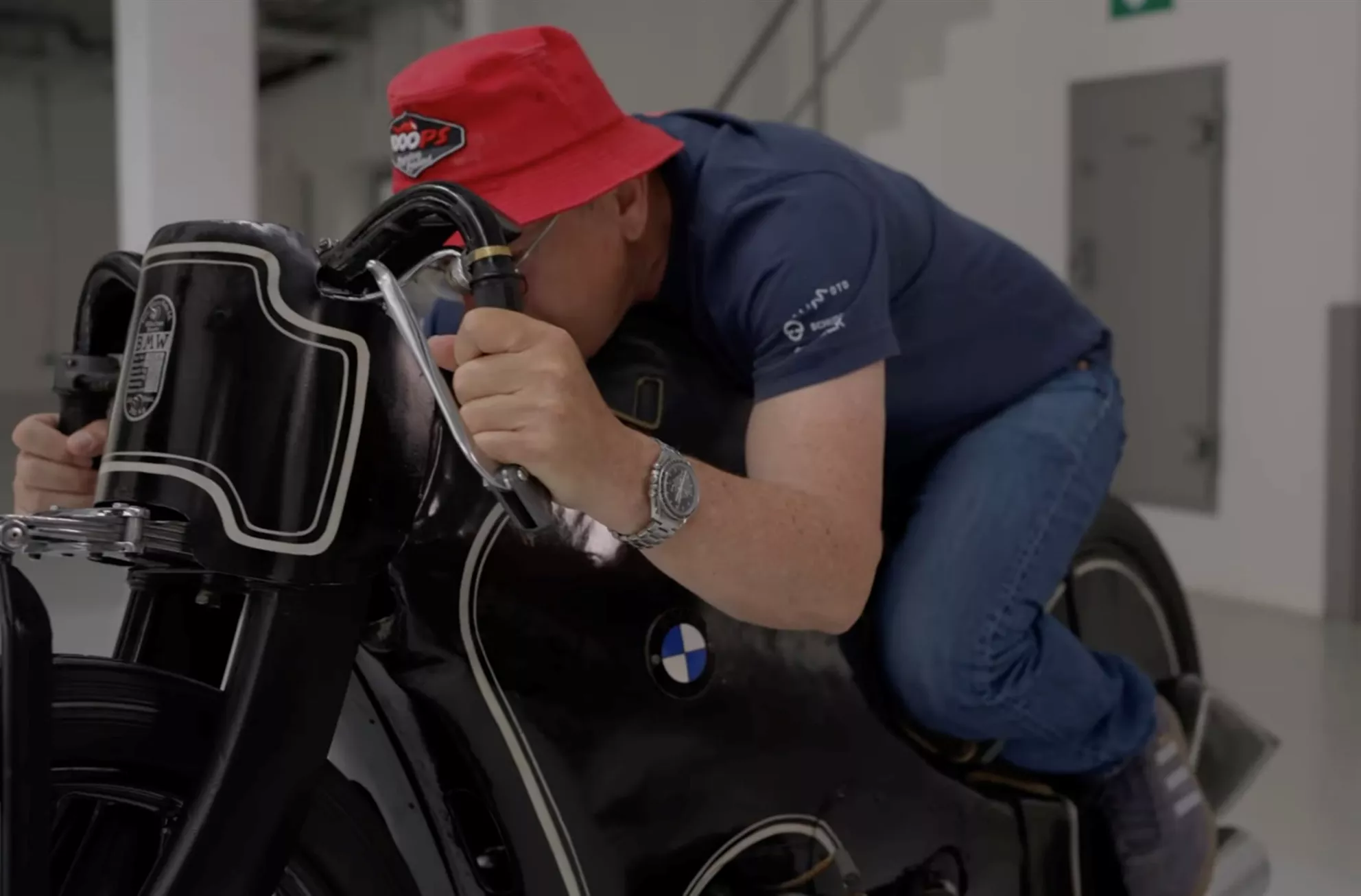
Flat as a time triallist: in this position you see very little road ahead of the front wheel – at almost 280 km/h.
Why Henne called it quits
After his last world record run, Henne quit. "That's it now," he said. Afterwards he also raced cars — he drove Silver Arrows for Mercedes. During practice at the Nürburgring he had a pretty heavy crash. Georg Meier later drove for Auto Union too — his car caught fire during a fuel stop because a mechanic was smoking next to the huge petrol cans.
The world record as the brand's sharpest advertising
Why was this record so important for BMW? Fred Jakobs puts it perfectly in the video: back then there was no 1000PS, no comparison tests. Motorsport was the only way to compare brands at all — and a world record was understood the same everywhere. "Fastest motorcycle in the world" is a statement anyone grasps instantly, no matter where on the planet.
BMW was able to advertise with it right into the 1950s. Along the way, the record was snatched away for a while by an Englishman and an Italian, but essentially BMW held it for many years. Just how big the advertising impact was is shown by one anecdote: supposedly even Henry Ford was desperate to have the world record bike after reading about BMW's record in the press. He didn't get it — instead, he got a fast, sporty production model for an awful lot of money. And that's exactly the point: a single record could carry an entire brand — and it did.
The history of BMW Motorrad

This extensive video was made possible by the passion and commitment of ZONKO, the BMW Motorrad team and our partners: