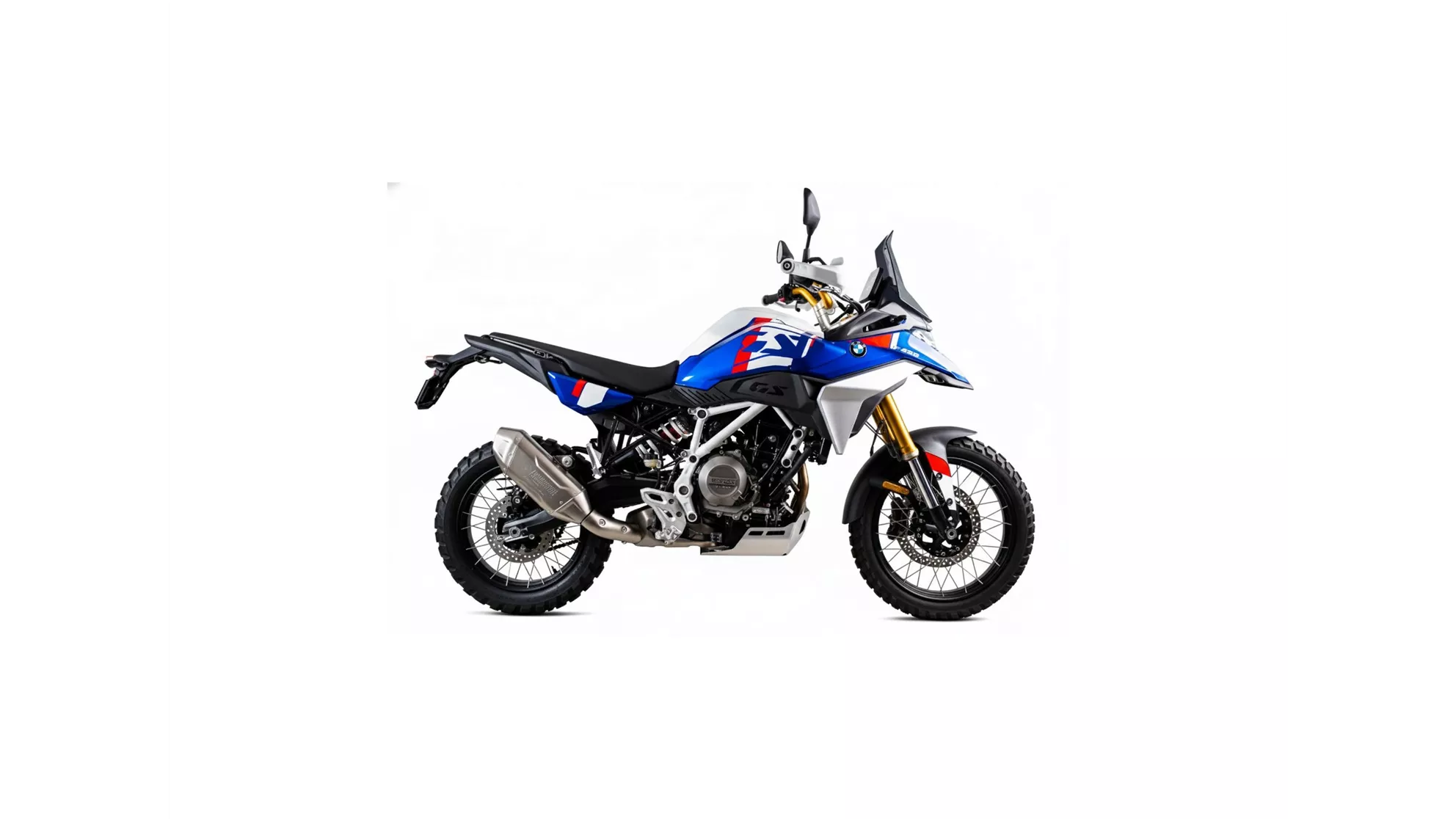
The BMW F 450 GS has hit the A2 adventure bike market like a bomb. Several colleagues have already put it through its paces on the road and off-road, and Bernd Hiemer, a Supermoto world champion, even pushed it to the limit on loose surfaces. What's been missing so far is a proper two-up trip. That's exactly where Norway comes in. My very first motorcycle tour once led through this country, sparked my passion for two wheels and ultimately even helped me land my spot in the 1000PS editorial team. Now I'm returning with the little GS. Almost two weeks, nearly 2,000 kilometres, a pillion and luggage are set to show whether the much-praised A2 bike also works as a grown-up adventure bike.

BMW F 450 GS too weak and small for the big two-up trip?!
Is 48 hp enough for Norway with a pillion?
How well does the little GS fill the big Bavarian's shoes? In Norway, the BMW F 450 GS has to prove that it lives up to its prestigious name and can impress over almost 2,000 kilometres with a pillion and luggage, even with "only" 48 hp and compact dimensions.
&width=72&height=72&bgcolor=rgba_39_42_44_0&mode=crop "Author: Gregor")
Gregor
published on 13/10/2026
3,139 Views
Why the little BMW GS has to go to Norway
BMW F 450 GS 2026 on the long haul
The first real test doesn't await between the fjords, but on the German autobahn between Hamburg and Kiel. The weather is miserable, the engine is still fresh and I keep it at around 130 km/h. I don't need more than that to get to know the little GS. Even two-up and loaded with luggage, it holds 130 to 140 km/h without drama, though it already needs well over 7,000 revs to do so. High-frequency vibrations come through the handlebar and leave a slight tingling after you get off. Personally, though, I don't consider noticeable vibrations particularly critical and find the GS's motorway comfort perfectly fine. In Norway itself, sustained high speed plays a smaller role anyway. The limit is mostly 80 km/h, and the hefty fines reliably kill any urge to speed.

Even two-up and with luggage, the little GS holds 130 to 140 km/h without drama, but demands over 7,000 revs to do so.
BMW F 450 GS 2026 tech and features
A quick overview of the key technical data: the liquid-cooled parallel twin draws on 420 cc, produces 48 hp at 8,750 rpm and delivers 43 Nm at 6,750 rpm. Particularly interesting is the 135-degree crankpin offset. A unique design that provides nice grunt in the middle of the rev range. The spec sheet lists 178 kg wet weight with a full tank, and the tank holds 14 litres. There's 180 mm of suspension travel front and rear, plus an 845 mm seat height, a 19-inch front wheel and a 17-inch rear wheel. The test bike comes with the Sport package. Among other things, it adds Riding Modes Pro, Shift Assistant Pro, engine guard, hand guards, off-road footpegs, a clear windscreen and the adjustable sport suspension. The Easy Ride Clutch introduced with the 450 GS, a centrifugal, automated clutch control, is explicitly not fitted to this bike. Clutch work is done the classic way with the lever. For the trip, the GS was additionally fitted with the tall touring windscreen and heated grips.
BMW F 450 GS 2026 - Key Facts
Engine and Drive Train
| Engine type | In line |
|---|---|
| Bore | 72 mm |
| Stroke | 51.6 mm |
| Engine power | 48 HP |
| Rpm at Max. Power | 8,750 rpm |
| Torque | 43 Nm |
| Rpm at Torque | 6,750 rpm |
| Compression Ratio | 13 |
| Fuel system | Injection |
| Throttle Bore | 38 mm |
| Starter | Electric |
| Clutch Type | Multiplate in oil-bath |
| Transmission | Chain |
| Transmission Type | Gearshift |
| Number of gears | 6 |
| Cylinders | 2 |
| Strokes | 4-Stroke |
| Valves per cylinder | 4 |
| Valves | DOHC, Drag lever |
| Cooling | liquid |
| Displacement | 420 ccm |
Brakes Rear
| Type | Disc |
|---|---|
| Diameter | 240 mm |
| Piston | Double piston |
| Shock mount | Floating caliper |
Suspension Front
| Front suspension | Upside-Down telescopic fork |
|---|---|
| Brand | Kayaba |
| Diameter | 43 mm |
| Travel | 180 mm |
| Adjustment | Compression, Rebound |
Suspension Rear
| Shock absorber | Monoshock |
|---|---|
| Shock mount | direct |
| Brand | Kayaba |
| Travel | 180 mm |
| Adjustment | Compression, Preload, Rebound |
| Material | Aluminium |
Chassis
| Frame | Steel |
|---|---|
| Frame type | Tubular, Load-bearing engine |
| Rake | 28.1 degree |
| Trail | 115 mm |
Brakes Front
| Type | Single disk |
|---|---|
| Diameter | 310 mm |
| Piston | Four pistons |
| Shock mount | Fixed caliper |
| Actuation | Hydraulic |
| Technology | Monoblock |
Assistance Systems
| Advanced Rider Assistance Systems | ABS, Cornering ABS, Traction control, Cornering traction control |
|---|
Dimensions and Weights
| Front tyre width | 100 mm |
|---|---|
| Front tyre height | 90 % |
| Front tyre diameter | 19 inch |
| Rear tyre width | 130 mm |
| Rear tyre height | 80 % |
| Rear tyre diameter | 17 inch |
| Length | 2,161 mm |
| Width | 869 mm |
| Wheelbase | 1,465 mm |
| Seat Height | 845 mm |
| Kerb Weight | 178 kg |
| Fuel Tank Capacity | 14 l |
| Top Speed | 165 km/h |
| Range | 368 km |
| Battery power (Volts V) | 12 V |
| Battery capacity (Amp-hours Ah) | 8 Ah |
| Combined CO2 emissions | 88 g/km |
| Combined fuel consumption | 3.8 l/100km |
| Euro Norm | Euro 5+ |
| Maximum authorized weight | 355 kg |
Equipment
| Equipment | LED daytime running lights, LED-Headlights, Lighting |
|---|
Sport suspension handles pillion and luggage with ease
On an adventure bike, sport suspension quickly sounds like harshness. But that's exactly what the F 450 GS doesn't deliver. The suspension clearly reports what's happening under the wheels without getting skittish on motorway ridges or bumpy Norwegian roads. With a pillion and luggage, the little GS stays stable, soaks up bumps well and inspires confidence. A big GS with semi-active suspension glides more smoothly, no question. But on a bike costing three times as much, anything else would be odd. What matters is that the 450 doesn't lose its balance. It's comfortable without feeling sluggish or boring.
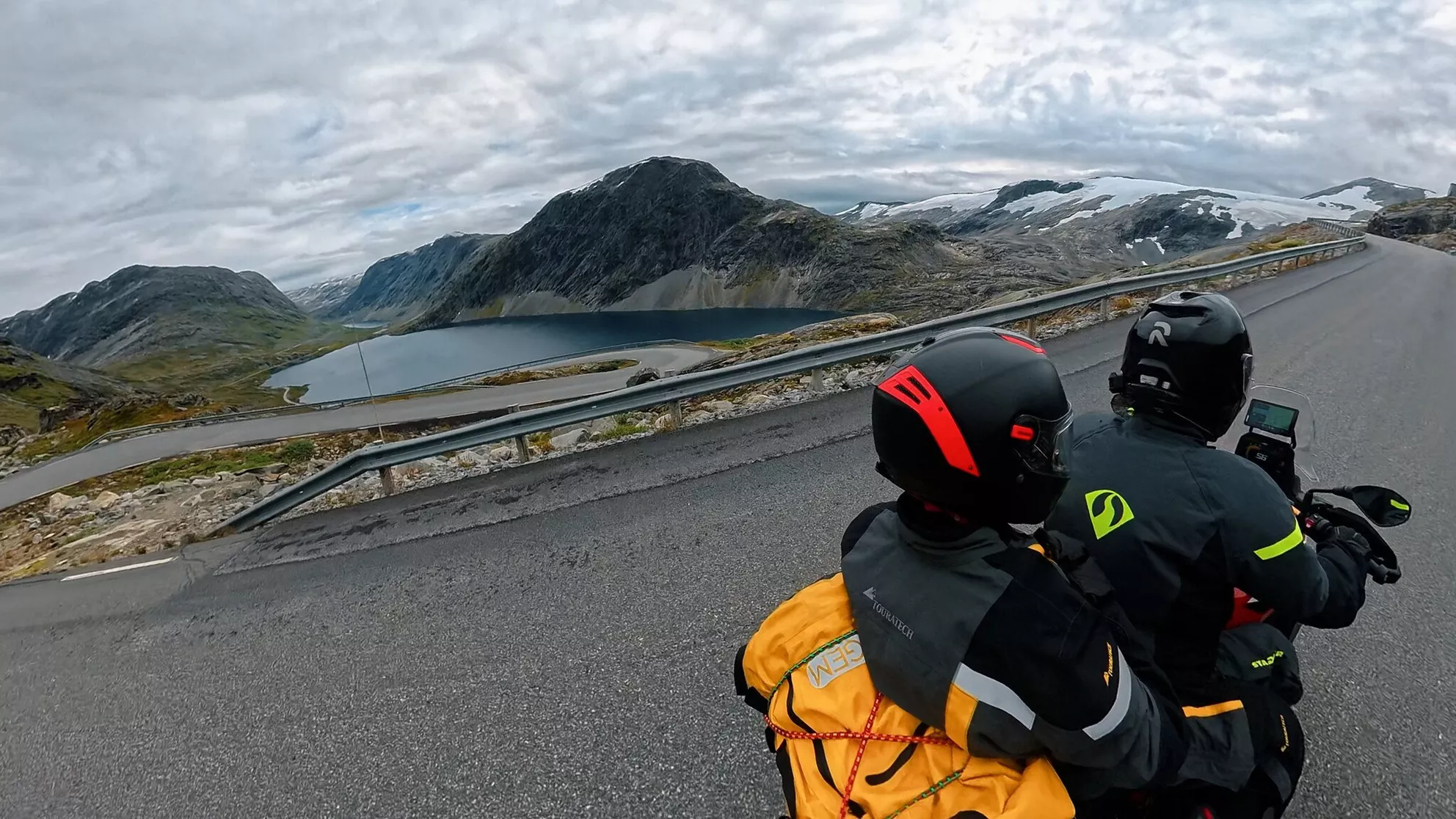
With a pillion and luggage, the F 450 GS stays stable, soaks up bumps well and inspires confidence.
Wind protection and ergonomics of the F 450 GS
At 1.85 metres, I sit surprisingly relaxed on the small bike. The upper body stays upright, the handlebar comes nicely towards you and the knee angle isn't too tight. No hunched-up monkey-on-a-grindstone posture here. Tall riders are most likely to notice the difference to big touring bikes in terms of wind protection. The F 450 GS is generally built rather low, and accordingly the windscreen is of modest height too. In the low position, the airflow hits me roughly at nose height, creating turbulence at the helmet. Chest and lower face sit calmer in the wind, but the protection isn't outstanding. I didn't have the tools on the trip for the higher setting. Still, I doubt that raising it by around 3 cm would have fundamentally changed the wind protection. The low, slim design provides a clear view and easy access, but does expose tall riders more to wind and weather on long distances.

The upright ergonomics suit a 1.85-metre rider too, while the tall windscreen creates noticeable turbulence at the helmet.
Pillion comfort hits its limits on payload
178 kg wet weight and a 355 kg gross vehicle weight rating result in a payload of 177 kg in standard trim. Subtract the weight of the luggage system and travel gear, and depending on the setup, roughly 160 to 165 kg remain for rider and pillion. That's the first clear limit of the F 450 GS's two-up capability. The second awaits on the seat. My girlfriend and I are both slim, so width, space and knee angle work for us. However, the padding of the pillion seat tapers towards the rear, so more heavily built passengers are likely to find it harder to get comfortable. In return, the compact BMW plays its trump cards in handling. The extra weight doesn't sit uncomfortably high, the bike remains easy to balance and still carves playfully through the corners. Stopping on uneven ground or riding at low speeds in dense traffic also lose their terror.
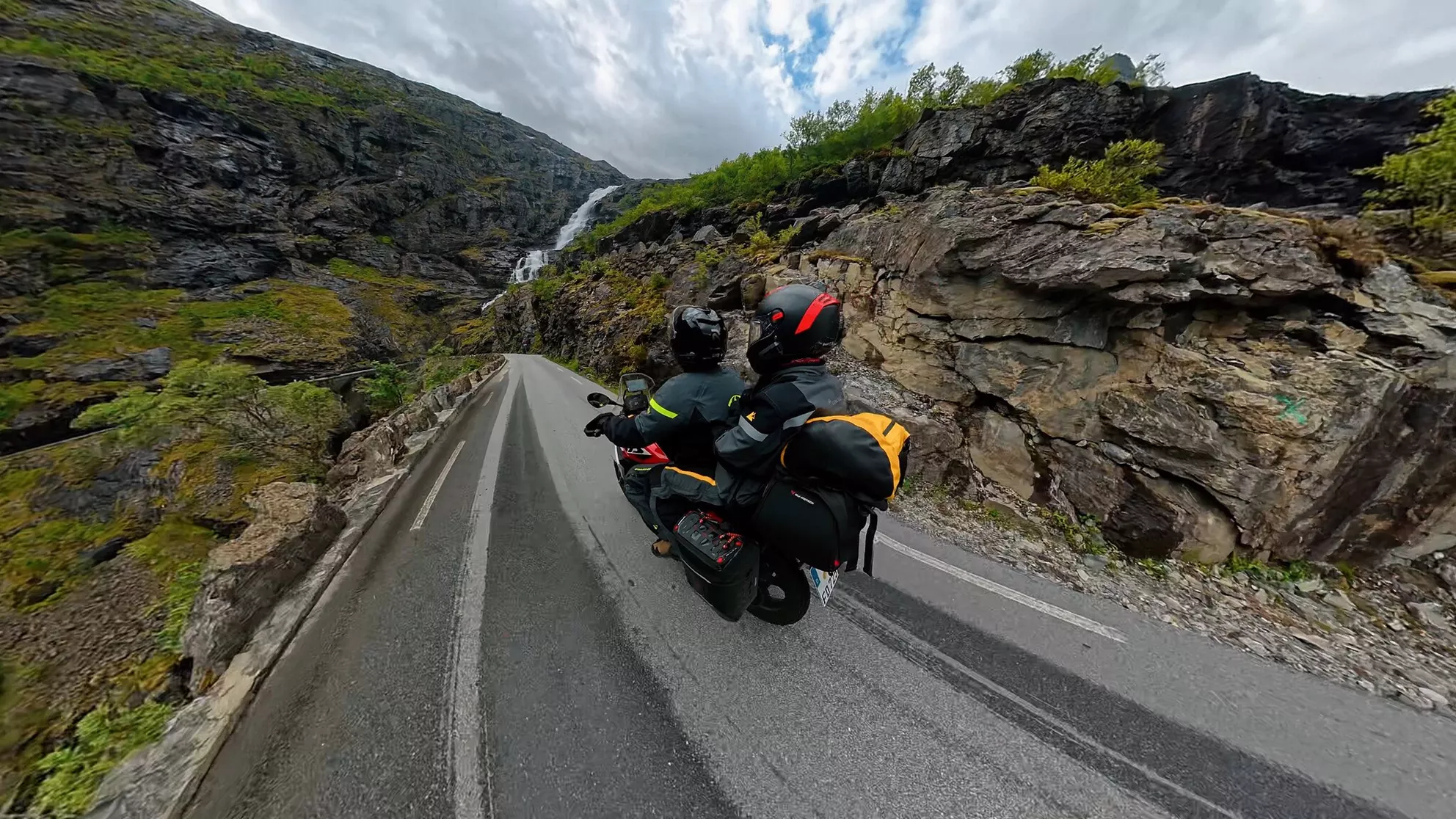
With my girlfriend, even long riding days on the F 450 GS are no problem. But then again, we're both petite lightweights. Bigger couples could run into problems with the available space and the permitted payload.
Norway reveals fuel consumption and real-world range
For this test, Norway is more than just a pretty backdrop. The scenery is a dream, many roads are surprisingly good, the odd bumpy stretch provides the necessary suspension check and the low speeds cut travel costs. After 1,350.4 kilometres, we're at an average consumption of 3.6 l/100 km. In times of skyrocketing fuel prices, that's an important feature. On the motorway, at higher speeds and revs, it was more like 5.5 l/100 km. So if you ride fast a lot, expect noticeably more thirst. But in Norway, you don't have this "problem". At the maximum permitted 80 km/h, constantly holding the throttle becomes more of a test of patience. There's no cruise control, as on many A2 adventure bikes. Right here it would be welcome and could also protect your wallet from an inattentive excursion over the speed limit.
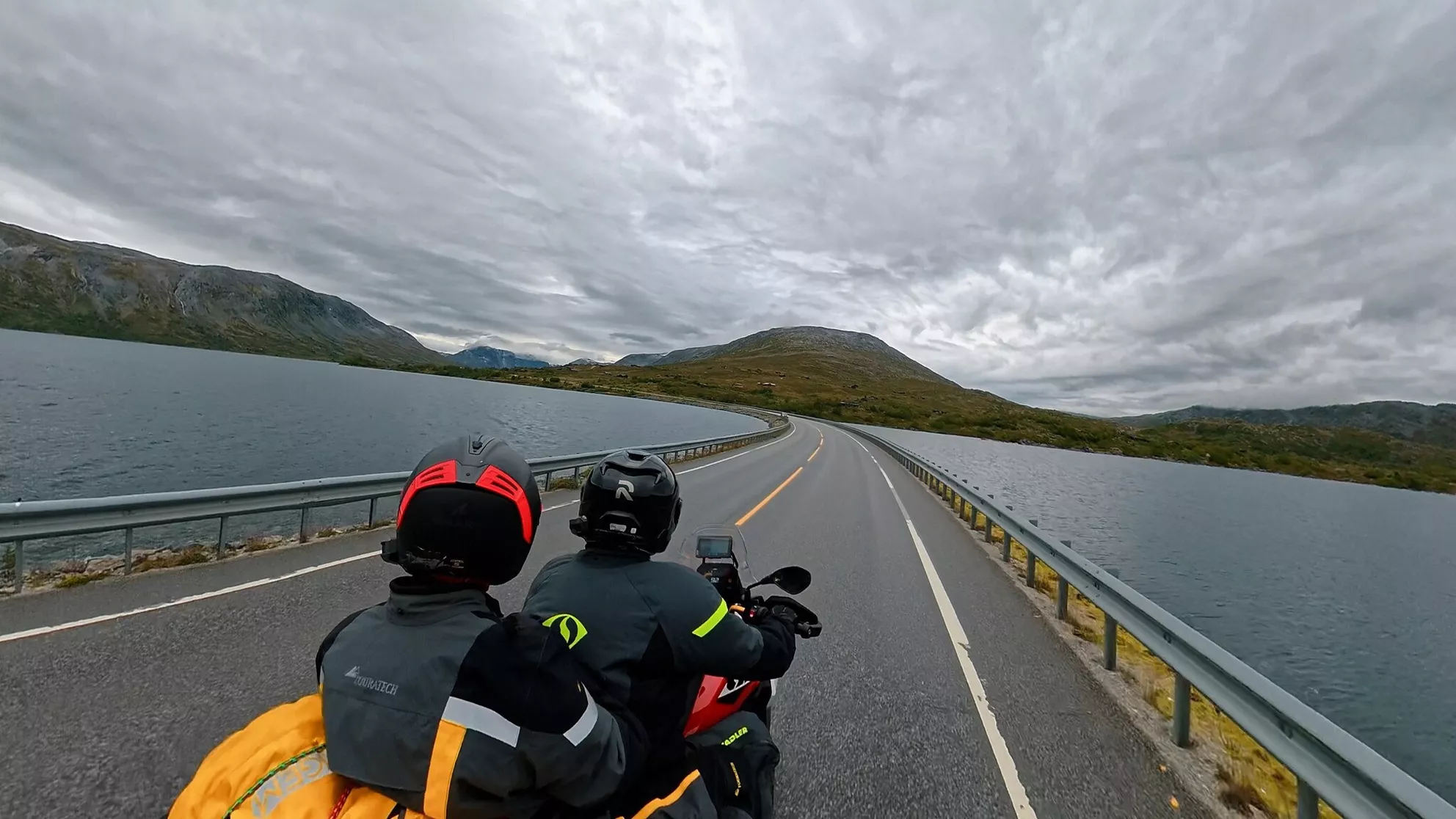
At Norwegian touring pace, consumption drops to 3.6 litres per 100 kilometres, yet there's still no cruise control.
Feelgood Reisen and CHIGEE guide us through Norway
I'm not the type for group tours, but at the same time I lacked the time this year to research and plan our trip in depth. So for the first time, I tried an organised self-guided tour. The tour through Norway was put together by Feelgood Reisen, who specialise in these self-guided trips. That way you find all the highlights of a country and don't miss any sights or great roads, yet you can follow the route at your own discretion and stop when, where and how you like. All the details and more background on Norway and the motorcycle trip can be found in the travel report.
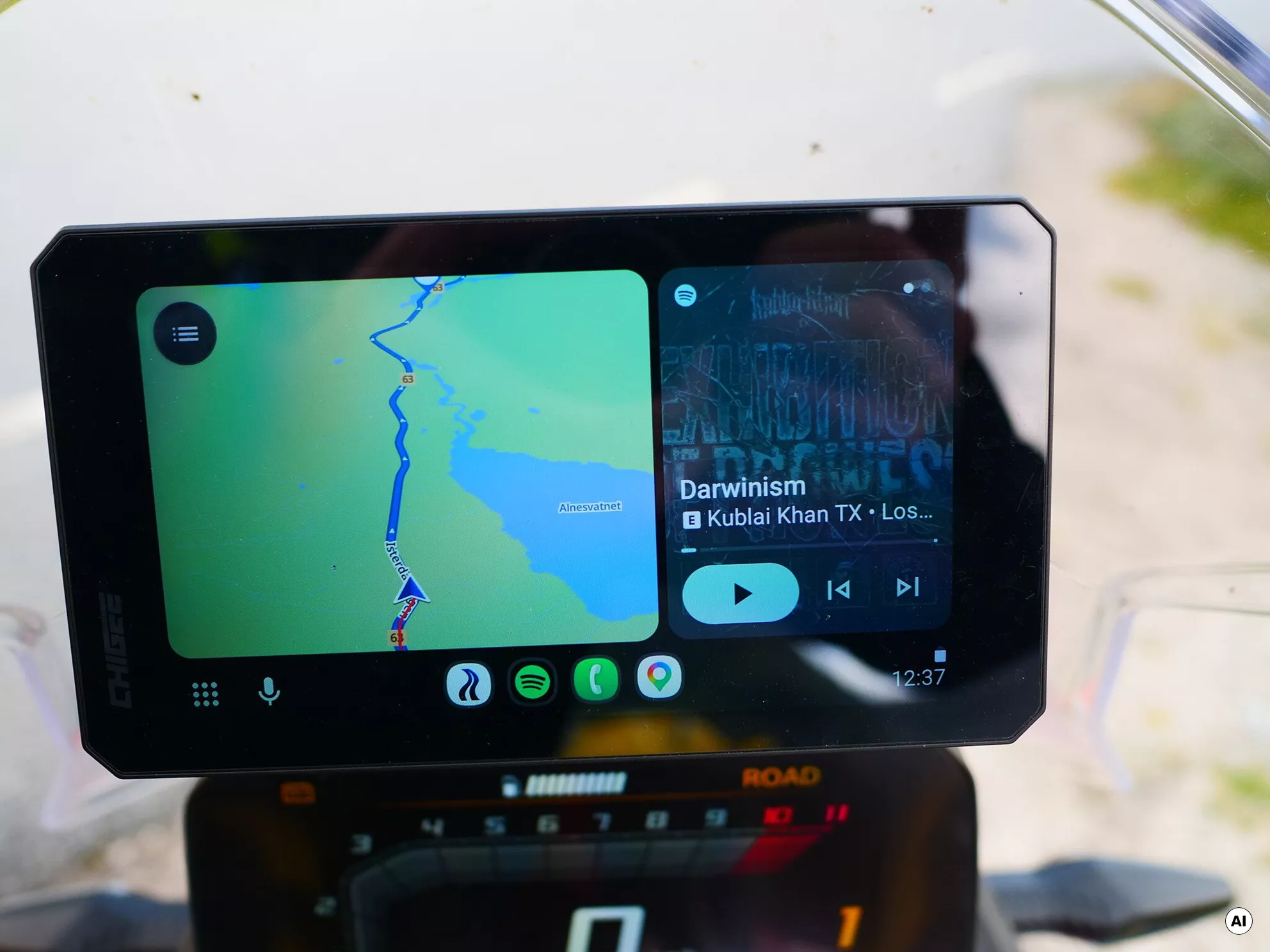
With the Chigee AIO-6, I can conveniently use Android Auto on any bike and follow Feelgood Reisen's exquisite routes without a care.
The tracks were provided to us by Feelgood Reisen via Kurviger. Since I'm not familiar with the BMW Navigator and don't want to learn it just for this one tour, a CHIGEE AIO-6 sits in the BMW navigation mount. It brings Android Auto and Apple CarPlay to the bike and, in this configuration, can be operated via the BMW handlebar controls. The device is weatherproof and could additionally be paired with camera or radar systems, though that wasn't necessary on this trip. Here it simply serves as a practical smartphone mirror. That very function suits the supplied route material and makes navigation straightforward without having to learn a new operating concept.
SW-Motech solves the BMW's luggage problem
When it comes to luggage, there's a gap in BMW's range. The side bags from the genuine accessories for the F 450 GS are small, and because of the compact OEM luggage rack, the larger tail bag extends over the pillion seat. If you only ride the F 450 GS solo, you can live with that. For a two-up trip, it's not a viable solution. That's why the test bike carries a system from SW-Motech. At the rear a PRO Rackpack tail bag and on the sides waterproof WP bags with the new V-LOC system. The fact that SW-Motech had developed and made so many products available so soon after the F 450 GS's market launch was our salvation. BMW could learn a thing or two from that. In future, the Bavarians could well offer customers who want to travel with a passenger a luggage option that actually keeps the second seat free. The small displacement shouldn't be an excuse for the lack of adequate options. After all, it's a GS!
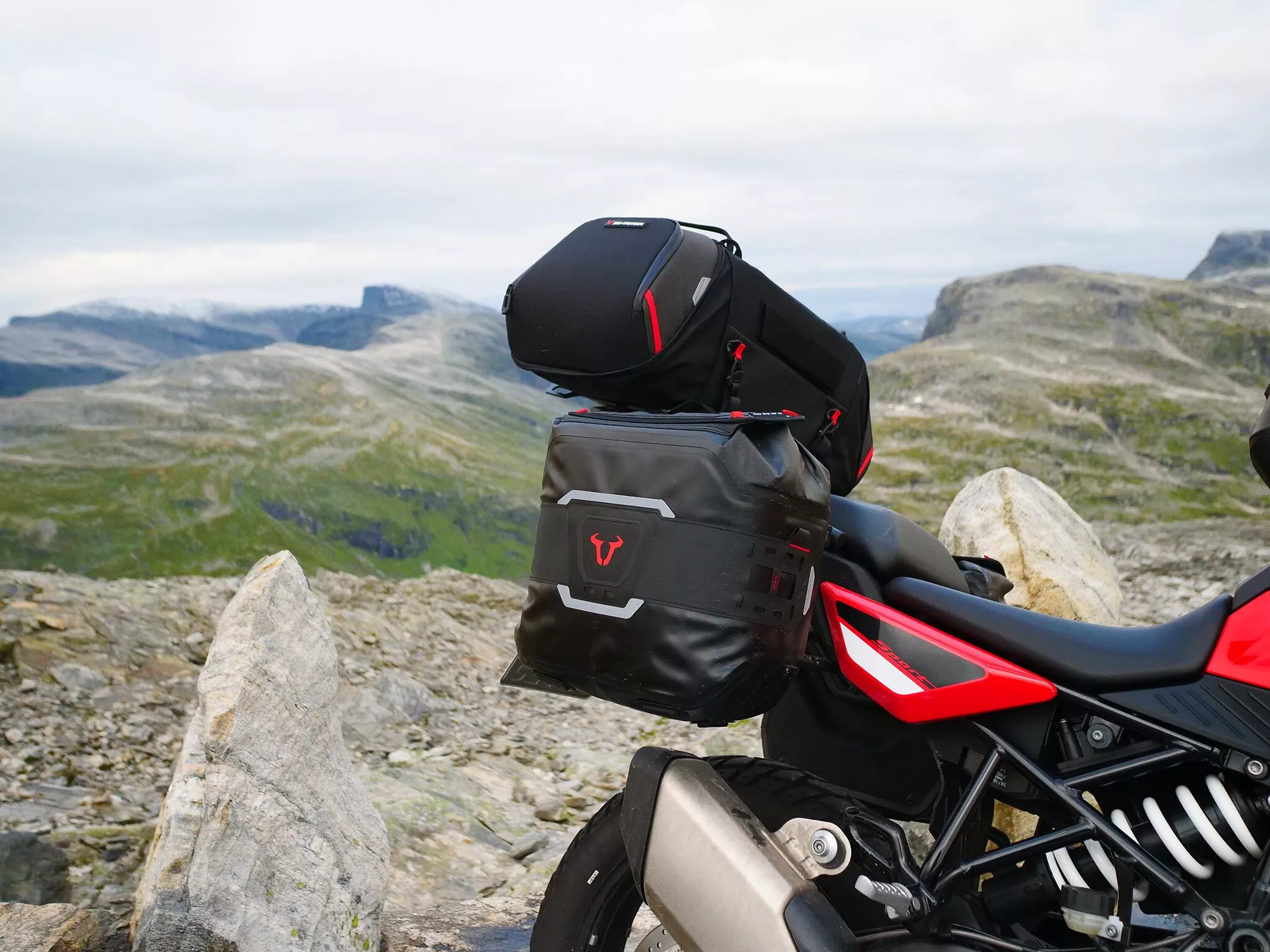
The loaded touring setup keeps the pillion seat free, where BMW's genuine solution reaches its limits for two people.
48 hp is enough on the BMW F 450 GS two-up
Does a big trip necessarily need a big GS? After almost two weeks, my answer is: no. The twin pulls strongly from the midrange, the quickshifter works quickly and crisply, and there's enough power for overtaking or a spirited corner exit. Occasionally you have to pick a lower gear for that. So what? Not once do I wish for 100 hp or more. Not once does boredom or frustration set in in the saddle. The F 450 GS carries two slim people plus luggage through Norway more comfortably, stably and confidently than many "grown-up" bikes. Its limits lie in payload, space and OEM luggage options. If you can live with those points, you get a surprisingly grown-up adventure bike that stays small without feeling small.
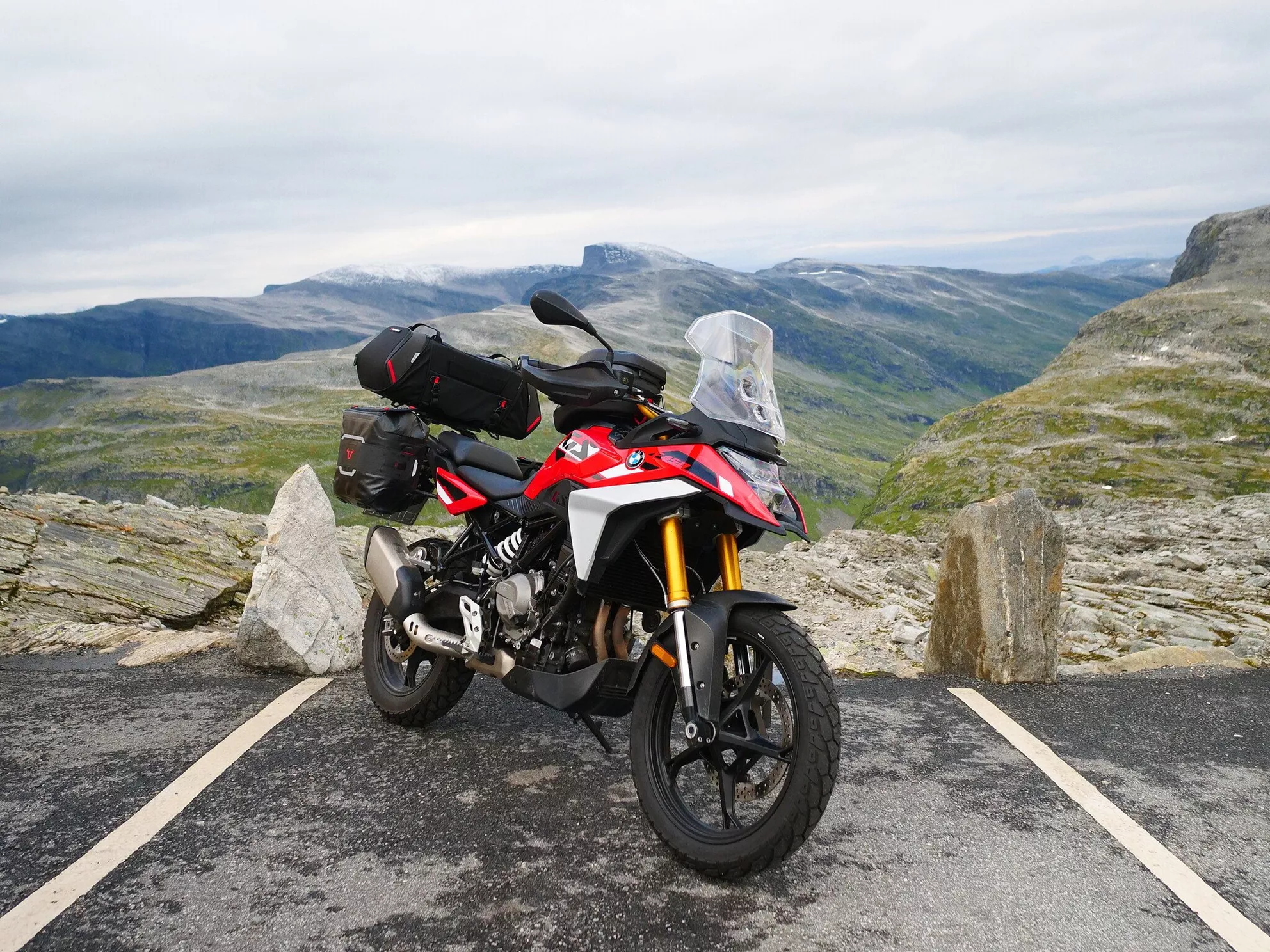
With 48 hp, the little GS confidently carries two slim people plus luggage through Norway while staying playful and fun.
- How much does a BMW F 450 GS cost?
- Here you will find an overview of the price level of new and used motorbikes!
&width=60&height=60&bgcolor=rgba_39_42_44_0&mode=crop "Author: Gregor")
BMW F 450 GS 2026 - Experiences and Expert Review
Gregor
The BMW F 450 GS is a surprisingly grown-up A2 adventure bike. Its 420 cc twin offers enough grunt in everyday traffic, the low weight keeps the handling pleasantly light even with a pillion, and the adjustable suspension gives clear feedback with decent comfort. Two slim people can travel convincingly on it with luggage, as long as the limited payload and the narrow pillion seat suit the crew. On long stages, the only moderate wind protection and the lack of cruise control become more noticeable, and at higher motorway speeds revs, vibrations and consumption rise. If you're not expecting a premium-class sofa on wheels, you get an accessible, economical and corner-hungry touring bike that can do far more than its 48 hp would suggest.
More from 1000PS Magazine
BMW F 450 GS too weak and small for the big two-up trip?! Images
Source: 1000PS