Poky, Editor-in-Chief 1000PS: Now that KTM is back to positive quarterly results, how does it see 2027? Is a positive result next year still a firm target?
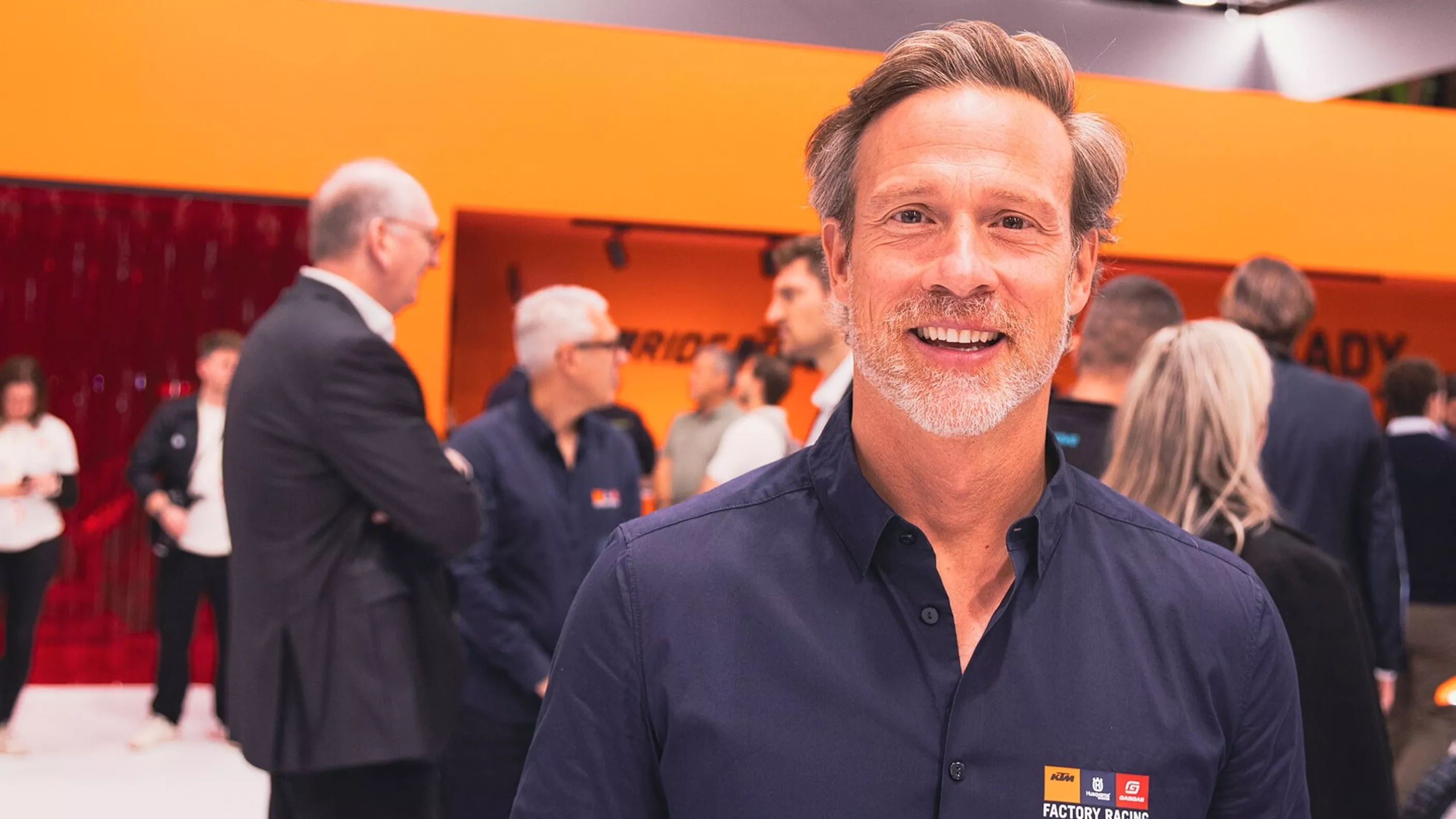
KTM takes customer service to an unprecedented level
CEO Neumeister on customer loyalty, MotoGP and a fresh start
In the 1000PS interview, KTM boss Gottfried Neumeister announces 15 years of spare parts supply for street and off-road bikes. He talks about customer service and dealers, the restructuring, the postponed Super Duke GT, his MotoGP plans and the manufacturer's fresh start.

Poky
published on 11/22/2026
1,510 Views
KTM: Restructuring and financial outlook
Gottfried Neumeister, CEO KTM: For a listed company, "firm target" is a delicate phrase. We haven't published any official guidance for 2027 yet. We're currently drawing up next year's budget and will most likely communicate our expectations along with it. Only then can I get more specific.
What I can already say: this year's development has been extraordinarily pleasing. In the first quarter we had a positive EBITDA, in the second quarter a positive EBIT, and in the third quarter we increased that positive EBIT by another ten million euros or so. Even the net result for the third quarter was only slightly negative at around minus three million euros. Looking at the full year, we're still in the red on EBIT. But if we continue this trend in the fourth quarter, it is very much our goal to achieve a positive EBIT as early as 2026, which would be truly incredible.
You have to put that into perspective: the previous year saw more than 440 million euros of negative EBIT and a total loss of around 600 million euros. The fact that we were able to largely turn that situation around within a year is mainly thanks to our loyal customers, our dealers and our teams in Mattighofen and all over the world. What matters most to me is that KTM is growing again. We've left behind the phase in which everything revolved purely around restructuring, and we're looking ahead.
Poky: How far have inventories been reduced by now? At the end of 2024 there were around 270,000 bikes in stock.
Neumeister: The roughly 270,000 bikes - about 200,000 at dealers and importers and 70,000 with us - refer to the end of 2024, when I joined KTM. We already reduced that stock significantly in 2025. Today there are still around 104,000 bikes at dealers and importers. We've published that, too.
For one or two quarters now we've been roughly at the level we wanted to reach. There is no single ideal stock level worldwide, though. It depends on how many bikes are meant to be sold, how quickly the goods can be shipped and how the respective market works. In Australia, for example, bikes spend longer on the ship and go through quarantine processes. In the USA, customers often expect to ride their bike away from the dealer immediately. That requires more stock on site.
An important key figure is the so-called stock turn, i.e. how often the inventory turns over in a year. In Europe we're at around three turns and want to reach maybe four in the medium term. In America it's about two, worldwide around two and a half.
Poky: So 100,000 units of stock are perfectly manageable with a production volume of 200,000?
Neumeister: You can think in that order of magnitude. Roughly. These figures should be understood as a guideline, not a rigid formula.
Poky: Bajaj is now the majority owner. How freely can you decide on strategy and investments?
Neumeister: I have their full trust here. Bajaj has clearly stated that KTM is to continue as an independent company with independent management. The owners exercise their role through the supervisory board. I was able to put together my own management team, including Petra Preining in finance, Stephan Reiff for sales and marketing and Christof Lischka for development and product.
I have a very good exchange with Rajiv Bajaj. His message to me is always essentially: decide what's best for KTM. If Bajaj can help with its size, its capabilities or its scale, we should make use of that. But we shouldn't first think about what would be most convenient for the owner, but about what KTM needs.
Austria as a location, costs and production
Poky: In earlier interviews you mentioned material cost reductions of 20 to 30 percent. What has been achieved, and are further job cuts planned?
Neumeister: Cutting costs and making processes more efficient is an ongoing task for every manufacturer. But you shouldn't automatically derive a new job-cut programme from that. We had to make tough cuts because the organisation had become far too complex and too large for its current task. Alongside the motorcycle business we also had bicycles and with the X-Bow a car project. Technically the X-Bow is a great product, but with just 36 vehicles sold most recently, it didn't help us sell more motorcycles. It simply wasn't a fit for us.
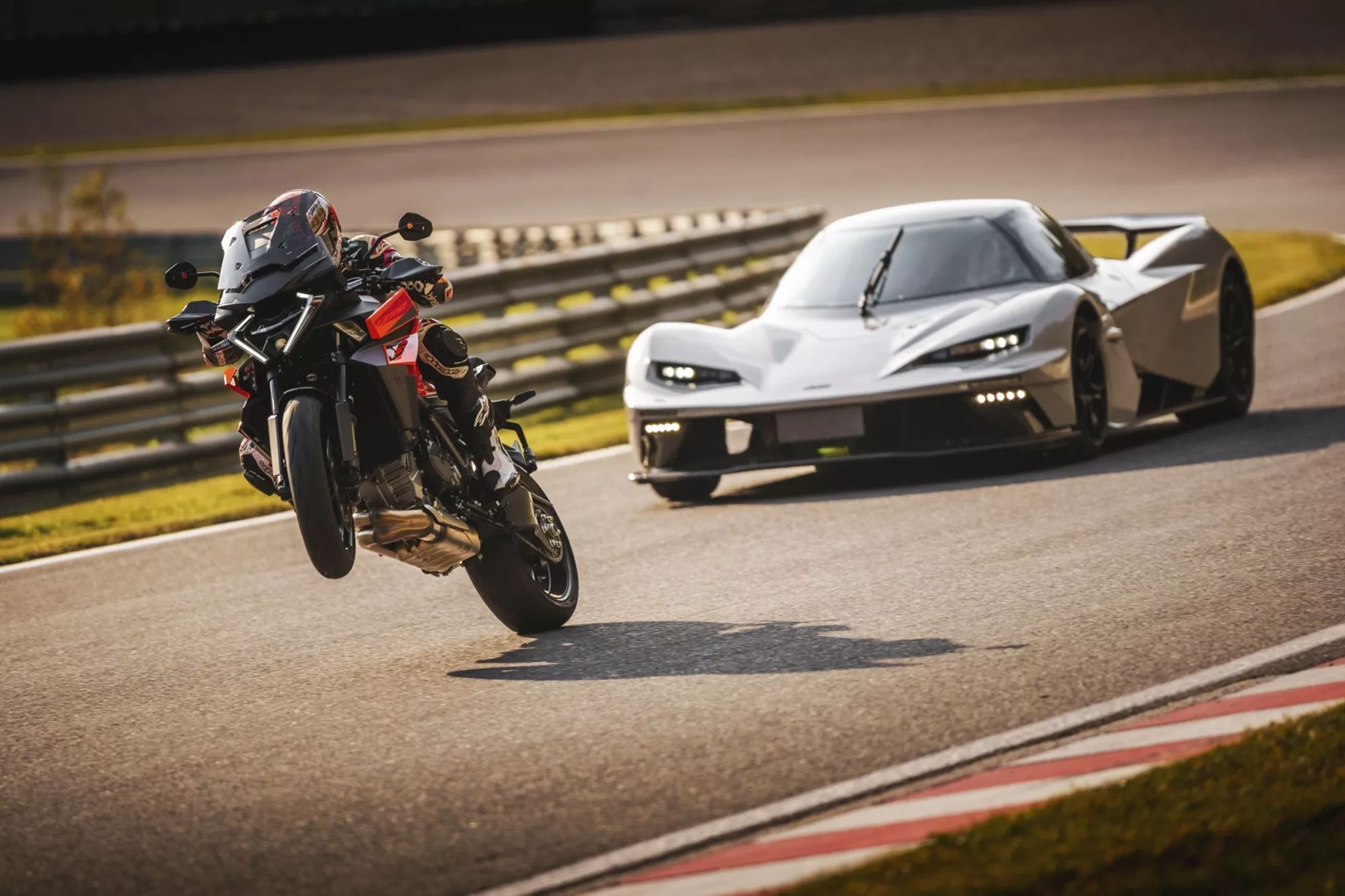
1390 Super Duke GT yes, X-Bow no - KTM refocuses on its core business
When business areas like these fall away, purchasing, accounting and all other departments have to change as well. That's why the savings weren't limited to individual areas. We completed this major adjustment after our announcement. Of course it remains necessary to face international competition and to constantly question material costs and manufacturing processes.
An important example is model complexity: at the peak we had around 190 different off-road variants, now there are 98. We sell almost the same number of off-road bikes, but need far fewer special versions to do so. If a variant only sells a few hundred units a year, it still generates costs for development, homologation, spare parts and warehousing. Often that simply doesn't pay off.
According to our figures, direct assembly costs, or rather personnel costs in manufacturing, account for only around eight percent. A significant share of the savings therefore concerned administration and other overheads, not the actual production staff. On the contrary: we're currently hiring again in production.
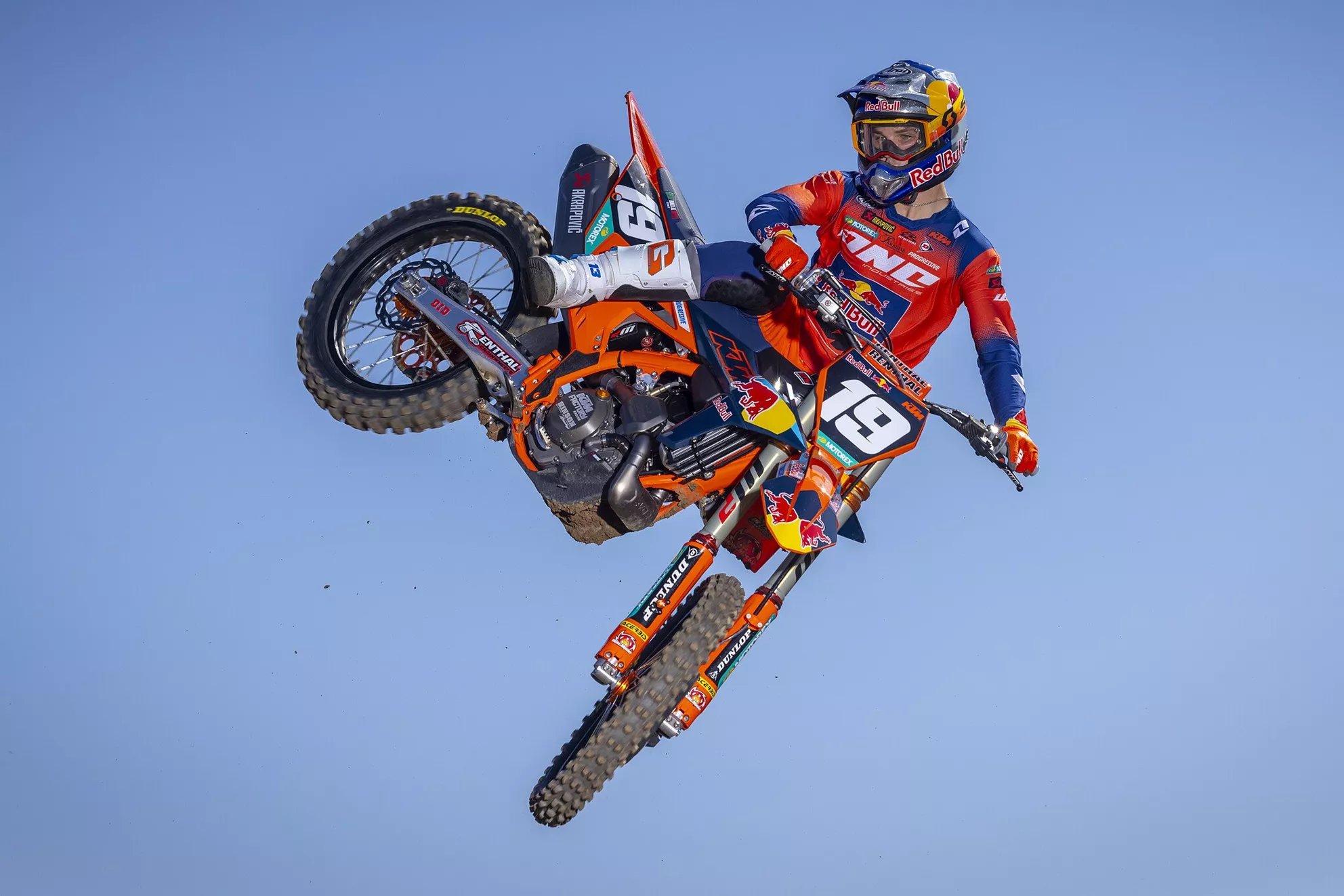
Fewer different off-road models, but the right ones: KTM 250 SX-F with the most powerful 250 engine in the world
Poky: What production capacity does Mattighofen have today? In the past, with two-shift operation, around 110,000 bikes per year were possible per shift.
Neumeister: That was the former order of magnitude. At the peak we built around 220,000 bikes in two shifts. However, we have since reorganised production. Together with our partners in India we analysed the processes. A production line used to have 17 stations; now it has 21. We reassigned individual assembly steps and, for example, integrated software flashing directly into the line.
As a result, productivity has risen significantly: from around 80 to about 119 bikes per employee.
Poky: Per month?
Yes, per month. So today we can build more in just one shift than previously assumed. In addition, with the newly hired staff we'll be able to restart the second shift. That's a positive signal for the site.
Poky: What does that mean for volume in 2026 - how many bikes will leave the production line in Mattighofen?
We'll publish the final annual production figures in due course. What's certain: we've already celebrated the 100,000th bike produced in Mattighofen this year. The fourth quarter is particularly important for us, because a large part of off-road production falls in the second half of the year. I expect that around 30,000 more bikes could be added there.
That shows how we think about the Austrian site: we don't just want to secure it, but to expand it again in the long term through better processes. I didn't come to KTM to make the company as small as possible. My career has always been defined by building up and growth. That's the phase I want to get back to with KTM.
Model policy, development budget and a new off-road generation
Poky: How will KTM prioritise new platforms in future? Is it mainly about margin and volume, or also about making "Ready to Race" technologically visible?
Neumeister: It needs a balance. Before the crisis we spent around 250 million euros a year on research and development. That put us among the top 500 companies in the world. For this year, the budget will probably be around 100 million euros. That's still a considerable investment, but we have to handle it very consciously.
First priority goes to models that sell in relevant numbers and deliver a good contribution margin. They help us get back to profitability fastest. Alongside that, KTM needs selected flagship projects that shape our brand and our technological expertise. Anything that is neither a volume model nor such a lighthouse project may have to wait.
That can mean a project's start of series production gets pushed back by a few months, maybe even to 2030. That's annoying, but without this prioritisation we as a company might not even have had the prospect of seeing 2030 at all.
Poky: Which areas had to take a back seat? Can you name a specific model line?
Neumeister: One area where we've been able to push ahead less over the past two years than we originally wanted is electrification. With the Freeride E we have an important electric model that's also well received. In electric motocross, some competitors are already further ahead. But our top priority was the completely new off-road generation.
This generation begins with the motocross models just presented; the enduro models will follow. Despite the difficult past two years, we continued developing the project as planned. We're talking about a largely new bike with a new chassis and new bodywork, a revised engine and closed-cartridge suspension instead of the previous air suspension. On the 250 we're talking about 51 hp and an oval throttle body. This technical development is crucial for KTM, because roughly half of our volume comes from off-road bikes.
A Super Duke GT is also a great bike, but it's not a comparable volume driver. That's why we had to push this project back. That's no statement against its quality or its technological level, but a consequence of the necessary priorities.
Poky: I got to ride the Super Duke GT as a prototype back in 2024. So is its delay mainly a consequence of the restructuring?
Neumeister: Yes. We had to decide what to tackle first and which projects had to wait. That's exactly where the delay comes from. The Super Duke GT is technically very far developed - product maturity wasn't the issue.
Poky: China is increasing price pressure considerably. Where must KTM never cut corners?
Neumeister: On quality - and on our ambition to be among the best in each class for performance and riding dynamics. "Ready to Race" is not an interchangeable advertising slogan. If we compromise on these qualities, at some point we'll no longer stand out from the competition.
Customer service is just as important. It's not enough to sell a bike at an attractive price. What matters is how well we support the customer afterwards, over years: Can they reach someone when there's a problem? Do they get help? How reliable is the dealer and service network? Whether someone buys a bike from the same brand again is often only decided over the following five or ten years. There will always be mistakes. But the customer has to feel that we take their problem seriously and deal with it. I can have the best bike in the world, but if I can't ride it because spare parts are missing and it's just sitting in the garage, I'm absolutely furious. That's why we're back above 93% spare parts availability today.
By the way, we're now extending this spare parts availability to 15 years for street models. The legal obligation is 7 years, we already had 10 for street bikes and now we're adding another 5 on top. I must not be afraid of going on the offensive here and making this investment in working capital, because that in turn is an investment in customer loyalty, in availability, and above all it's a really strong message - and off-road is following suit.
Poky: So that means spare parts are guaranteed for 15 years for off-road models too?
Neumeister: That's right. Spare parts availability for street models and off-road models for 15 years. Whether the off-roaders live that long or not, i.e. whether someone wrecks them or not, is of course another question. (grins)
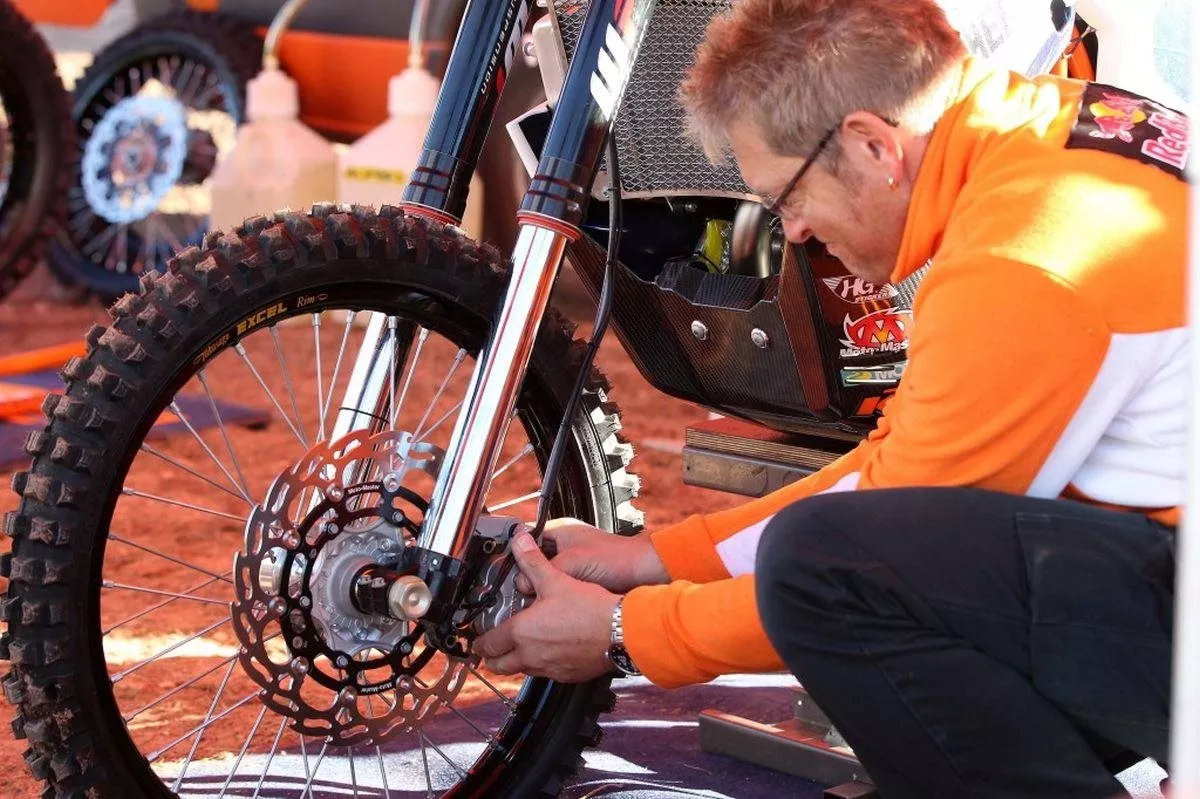
15(!) years of spare parts availability - whether street or off-road model - that's a statement!
Poky: Does that mean rideability and riding dynamics will count for more at KTM in future than the longest possible features list?
Neumeister: Exactly. We don't win by offering the most features or the biggest display. A KTM bike should only have what really contributes to riding. We want to improve handling, setup and controllability. Simply making a 450 even more powerful isn't the decisive improvement for many riders. What can matter much more is how well that power can be used.
A long features list is easy to copy. A convincing combination of riding performance, technical development, brand and service is not so easy to imitate. We won't win a pure price war against low-cost manufacturers. Our answer has to be differentiation - and of course customer service.
Husqvarna and GASGAS: the role of the group brands
Poky: Does KTM still need three motorcycle brands? Do Husqvarna and GASGAS really reach additional customers, or do they cannibalise KTM's business?
Neumeister: I think we can be very proud of what we've achieved with Husqvarna. When the brand still belonged to BMW, around 10,000 bikes were sold; with us it peaked at over 70,000. Husqvarna has an exceptionally loyal customer base, especially in the USA and Australia.
At first you might think that anyone who doesn't want an orange KTM will just buy a machine in a different colour. But it's not that simple. For many motorcyclists, a brand is almost a family tradition, a kind of religion. Take the Husky fans at Supercross in America, for example. They've identified with the brand for decades. That's why I don't automatically see cannibalisation between Husqvarna and KTM, but rather a complement.
With GASGAS, on the other hand, I was critical of the previous positioning. If a brand targets ambitious racers, they want the same competitiveness as with a KTM or Husqvarna. Making such a machine only marginally cheaper and saving on important components in return doesn't convince me. A price difference of a few hundred euros doesn't automatically create significantly more demand in a limited sport market.
There are basically two coherent paths: either the brands offer different identities at a comparable price and performance level. Or a product is genuinely designed as a significantly cheaper entry-level offer. A merely slightly stripped-down variant in between makes little sense in my view.
Motorsport, MotoGP and brand value
Poky: I'd like to move on to racing: after the restructuring, KTM continues to invest in MotoGP and is developing a bike for the new 850cc regulations. How did you justify these investments to Bajaj?
Neumeister: For us, motorsport isn't a one-off special investment but an ongoing part of our business. When a company has lost so much money, it's entirely legitimate to critically question this commitment too. I travelled to India several times and explained why motorsport is of exceptional importance to KTM. In my view, hardly any other motorcycle brand is so closely tied to racing.
"Ready to Race" is part of our identity. For us, racing is also a development field in which we test technologies under extreme conditions before they may find their way into production bikes. Our successes show that this ambition isn't just a thing of the past. Since our first Dakar win in 2001, by my count we've won 22 of the 24 Dakar Rallies held. In 2026 alone, we've already won 23 world championship titles to date.
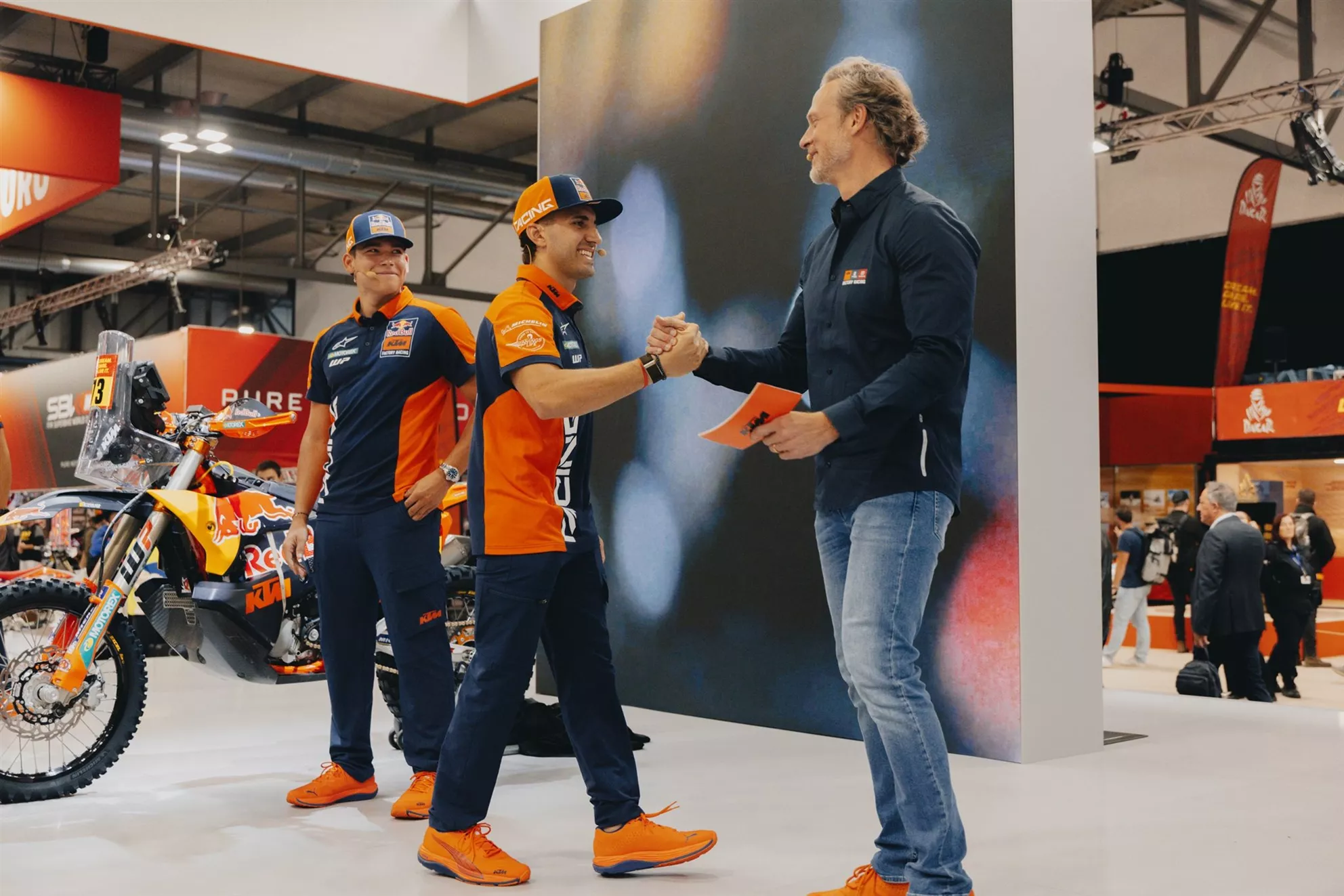
Ready to Race as a core element of identity - Neumeister at the presentation of the 2027 Dakar team
Of course the economic effect can't simply be measured by motorcycle sales in a single Grand Prix country. A race in Malaysia is followed worldwide. MotoGP mainly pays into brand value: it makes KTM known from Buenos Aires to Bangkok. With the RC 990 R and the expansion of the RC model family - including a 450 that's already here on the stand, and further planned models - our racing identity is also becoming more visible in the street portfolio.
Poky: Will KTM be better able to afford this commitment in future? What role do sponsors, cost rules and MotoGP's new commercial management play?
Neumeister: The economic environment is changing. With Liberty Media, attention for MotoGP is growing, and that opens up new opportunities in sponsorship and marketing. At the same time, I consider cost discipline important. For me, one of the most essential things is to seriously consider a cost cap. Standardised solutions, for example for fuel, could also lower costs without the sport losing appeal for spectators.
Our own spending has already come down. While MotoGP used to cost us around 40 to 45 million euros, the figure is now moving more towards 35 million euros. If sponsorship income rises and conditions become more favourable, the expense could fall further - perhaps to 20 or 15 million euros in the long term. These are possible developments, not fixed budget commitments.
In off-road racing the economic dynamics are different. There the expense tends to remain a permanent cost item. Here too we've concentrated our activities and questioned unnecessary duplicate structures. We don't need to field all three group brands in the same racing class everywhere. In the USA, for example, we want to get stronger again in the 250 class. Pit Beirer and his team have already realised considerable savings. But motorsport as a whole remains a fixture: we compete to win and because success strengthens our brand - not to speculate on a rising market value of the racing team.
Poky: The RC16 has proven itself a race-winning bike this season. Are the new 2027 MotoGP regulations more of an opportunity or a risk for KTM?
Neumeister: I generally see such a fresh start as an opportunity. We were very early with the development of the new 850cc engine, and the first tests have encouraged us. I'm convinced our engineers can show a thing or two technically.
One challenge is the tyre switch to Pirelli. Some other manufacturers have more experience with this tyre. Naturally we still lack years of data on how it behaves at different temperatures, wear conditions and lean angles. That's a potential disadvantage, but I don't want to turn it into an excuse. We have to solve the task.
What's crucial is that Pit Beirer and the team have enough room to manoeuvre. If we need an additional tyre specialist or aerodynamicist, the budget has to be there for it. Saving in the wrong place would be absurd if we're competing with the ambition of becoming world champion.
Poky: How do you assess Pedro Acosta's departure and the future line-up of your MotoGP team?
Neumeister: I have huge respect for Pedro and tried several times to keep him. He went through a difficult phase: after the insolvency we still had to contest the first half of 2025 with older material. I could understand that he became impatient. He wants to win and measures his career by sporting success. For me he's one of the most talented riders in the field. I think it's quite possible he'll become world champion several times, and I wish him that.
For KTM, however, a change is also an opportunity to give the team a broader base. In the past, an enormous share of the development work and technical feedback rested on the shoulders of a single rider. Pedro could describe very precisely why a bike worked one day and not the next. Such a strong dependency isn't ideal in the long run. It's like in a restaurant. You don't want to have just one cook who's brilliant, because if he runs off on you, you're simply screwed.
That's why we deliberately chose Alex and Fabio. I see great potential in both and a lot of motivation to ride for KTM in a factory team. We want to build a team in which the strengths of several riders and staff work together. From the Rookies Cup through Moto3 and Moto2 we've already achieved a great deal. The MotoGP title is still missing - and that's what we want to fight for.
Dealer network, residual values and customer proximity
Poky: From the lofty heights of MotoGP back to retail. At 1000PS we support over 1,000 motorcycle dealers in the DACH region with our website solutions and know their concerns well. In the past, bikes were sometimes pushed into dealerships under heavy pressure. What's different today, and how does KTM measure this change?
Neumeister: For me it starts with listening. I talk to dealers at conferences and in smaller discussion groups, because I want to understand where the problems lie. Any dealer who wants to reach me gets a response. Everyone gets a personal callback from me within 24 hours. But what really counts is how we actually manage sales.
We monitor very closely how many bikes are sold to end customers - daily, weekly and monthly. And we only deliver as many bikes into the market as it can absorb. In 2026 we even deliberately decided to keep deliveries below end-customer sales. In the short term we might have been able to show more revenue. But it was more important to us that dealers could reduce their inventories in a healthy way.
A high stock of old models generates discounts and puts pressure on residual values. We had to correct that situation. According to the available figures, our unit numbers have increased by around 50 percent, but revenues by more than 80 percent. That shows we're not only selling more again, but also at better prices and with smaller discounts. KTM shouldn't be a discount brand. The problems in the past were to a considerable extent self-inflicted - we had to put that right.
Poky: How does this demand-driven management work with around 4,000 dealers worldwide?
Neumeister: It takes very differentiated management. The fact that around 4,000 dealers worldwide stayed loyal to us despite the crisis is important good news. Of course some have taken on additional brands. I can't blame anyone for that: a dealer has to secure their business and be able to pay their staff.
But we also mustn't tighten supply so much that customers no longer find bikes at the dealer. That's why, especially in large markets like Germany, we look very closely at which model is available in which region and how quickly it sells. If a model is in low demand at one dealer but sold out at another, we may have to redistribute stock and find solutions together.
That's exactly what I mean by a new relationship with retail: not just offloading bikes, but listening, readjusting and being reachable for our partners. Our dealers are one of the most important points of contact with the end customer - and therefore also our most important multipliers.
KTM takes customer service to an unprecedented level Images
Source: 1000PS

KTM’s lineup at the show ranged from the big Super Duke to the smaller models.

The Super Duke R family gets new colours and cockpits for 2027.

The smaller adventure range was also part of KTM’s 2027 lineup of new models.

The 790 Adventure is one of the adventure models in KTM's 2027 lineup.

The tank and side fairings define the new look of the Super Duke GT family.

A close-up of the GT lettering on the orange fairing.

Close-up of the LED headlight assembly on the Super Duke GT family.

Detail of the fairing and GT lettering on the new sport-touring family.

The Super Duke GT family’s lighting signature on a ride in the dark.

The big Super Duke GT EVO leaned over on a mountain road.

An elevated view of the Super Duke GT EVO leaning through a corner.

The GT EVO’s cockpit view shows the touchscreen being operated with gloves on.

Another moment at the controls of the GT EVO’s large TFT display.

The GT EVO’s cockpit, with the AMT’s parking indicator clearly visible.

The GT EVO’s touchscreen menu selection from the rider’s perspective.

The map display can be controlled directly via the GT EVO’s touchscreen.

The GT EVO’s 8.8-inch TFT combines ride data and navigation.

The GT EVO with its rider against a forested mountain backdrop.

The GT EVO in a static side view in front of a rock face.

Studio shot of the GT EVO, showing the front and left side.

The left-side view of the GT EVO highlights its compact sport-touring silhouette.

Right-side view of the GT EVO, showing the LC8 engine and exhaust.

The GT EVO, seen from the front at an angle, with a tall windscreen and side fairings.

Rear view of the GT EVO in the studio.

The Super Duke R in black, viewed from the front-left.

The Super Duke R in black, viewed from the left.

The Super Duke R in black, viewed from the front-right at an angle.

The Super Duke R in black, viewed from the rear-right at an angle.

The Super Duke R in black, viewed from the right side.

The Super Duke R in black, viewed from above.

The orange Super Duke R, with a view of the cockpit.

The orange Super Duke R, viewed from the left.

The orange Super Duke R, viewed from the front-right at an angle.

The orange Super Duke R, viewed from the rear-right at an angle.

The orange Super Duke R, viewed from the right.

The orange Super Duke R, viewed from above.

The Super Duke R EVO in black, viewed from the front left.

The Super Duke R EVO in black, viewed from the left.

The Super Duke R EVO in black, viewed from the front-right at an angle.

The Super Duke R EVO in black, viewed from the rear right.

The Super Duke R EVO in black, viewed from the right.

The Super Duke R EVO in black, viewed from above.

The orange Super Duke R EVO, with a view of the cockpit.

The orange Super Duke R EVO, viewed from the front-left.

The orange Super Duke R EVO, viewed from the left.

The orange Super Duke R EVO, viewed from the front-right at an angle.

The orange Super Duke R EVO, viewed from the rear right.

The orange Super Duke R EVO, viewed from the right.

The orange Super Duke R EVO, viewed from above.

The 390 Adventure R in a left-side studio view.

A front three-quarter view of the 390 Adventure R.

The 390 Adventure R from a rear three-quarter angle, showing its right side.

The front-end design of the 390 Adventure R, viewed from the opposite angle.

Studio shot of the 390 Adventure R, showing the fairing and front wheel.

The 390 Adventure R, viewed from the rear left.

The 790 Adventure on a winding mountain road, viewed from above.

On the road with luggage: the 790 Adventure riding through a village.

A gravel section against a mountain backdrop shows the 790 Adventure in its element on tour.

The 790 Adventure with the rider seated on a road section.

The 790 Adventure cornering with luggage fitted.

The 790 Adventure on an unpaved mountain road.

Head-on view of the 790 Adventure tackling a gravel section.

Another action shot shows the 790 Adventure from the front.

The side fairing showcases the 790 Adventure’s dark graphics.

Rear-right view and side profile of the black 790 Adventure in the studio.

The 790 Adventure from the rear-left angle.

The 790 Adventure’s dark front-end styling in the studio shot.

The 790 Adventure, viewed from the front at an angle against a white background.

The left-side view shows the 790 Adventure’s new black look.

The right-hand side of the 790 Adventure in the 2027 model lineup.

The 790 Adventure from above in the studio.

The new colour scheme of the 390 SMC R, seen from an angled front view.

The 390 SMC R in left-side profile, showing off its graphics.

Right-side view of the 390 SMC R for model year 2027.

Top-down view of the 390 SMC R, showing the handlebars and seat.

The 390 Enduro R gets new colours and graphics for 2027.

Left-side view of the 390 Enduro R with its orange frame.

The 390 Enduro R shows off its new styling on the right-hand side.

The overhead view shows the colour scheme of the 390 Enduro R.

The 125 SMC shows off its dark graphics in a right-side view.

KTM showed the 125 SMC as one of its small-displacement supermoto models for 2027.

Left-side view of the 125 SMC with its updated look.

Top-down view of the 125 SMC’s seat, tank and handlebars.

The 125 Enduro shows off its new orange graphics from a front three-quarter angle.

The left-side view of the 125 Enduro shows the colour scheme across the tank and tail.

The new design of the 125 Enduro, viewed from the right-hand side.

The 125 Enduro’s slim profile is clear from above.