Poky, Editor-in-Chief of 1000PS: After last year, Yamaha remains a heavyweight in Europe. But Chinese manufacturers are closing the gap, especially in middleweight segments. Where is Yamaha most at risk of losing customers? Which markets or categories do you need to recover for 2027?

Yamaha R1: Europe boss admits dropping road bike was a mistake
"We lost those customers, and we feel that"
Yamaha Motor Europe CEO Olivier Prévost admits dropping the road-legal R1 was a mistake and says the brand wants to return to the category. In our EICMA interview he also discusses the smaller Ténéré, Chinese competition, RW700 and electric mobility.

Poky
published on 11/20/2026
Olivier Prévost (President and CEO of Yamaha Motor Europe): Competition from Chinese and Indian manufacturers is clearly increasing. I do have doubts about whether the European market can accommodate all the new brands we see here. That isn't only about the number of motorcycles or the products themselves. It's about distribution, dealer networks, aftersales and spare-parts management. I don't think there is room for all these new companies to establish sustainable operations. Of course, some will remain; some already have a position.
For Yamaha, the competition also makes gaps in our product range more visible. There are two main areas. The first is approximately 400 to 500 cc. We offer models up to 300 cc, then there is a gap until roughly 690 cc. That's why we have been talking about the smaller Ténéré concept. It fills a much-anticipated place in our adventure range, but it also gives us a new engine platform. We would not develop an engine only for one model. So, as the French saying goes, we can kill two birds with one stone: introduce a smaller Ténéré and create a powertrain that can support other motorcycles.
The second gap is above 1,000 cc. Today we no longer have a strong offering there, apart from a track-only R1, which isn't road-homologated in Europe.
Poky: I'll come back to the R1.
Prévost: Certainly. This upper segment is particularly difficult because of technology, investment, development resources and limited global volumes. You are essentially developing motorcycles for Europe and the United States, which is a relatively small part of the global motorcycle market. Yet it's very important for the brand's image. We want to return to it, but because of the complexity it takes time.
Poky: Yamaha is showing the smaller Ténéré prototype here. Assuming that it eventually becomes a production motorcycle, aren't you worried about arriving late? BMW, Kawasaki, KTM and others are already competing in this category.
Prévost: Today's competition isn't simply about products and prices. It's also about speed. The new brands move very quickly, and that is challenging us. If Yamaha wants to remain innovative, we also have to become faster. We recognise that.
That means reviewing some of our working methods. At the same time, we must not compromise on quality and reliability. Those are Yamaha's assets and important reasons why customers are willing to pay more for our motorcycles. The challenge is to preserve our quality and innovation while reducing development times. That is something we're actively working on.
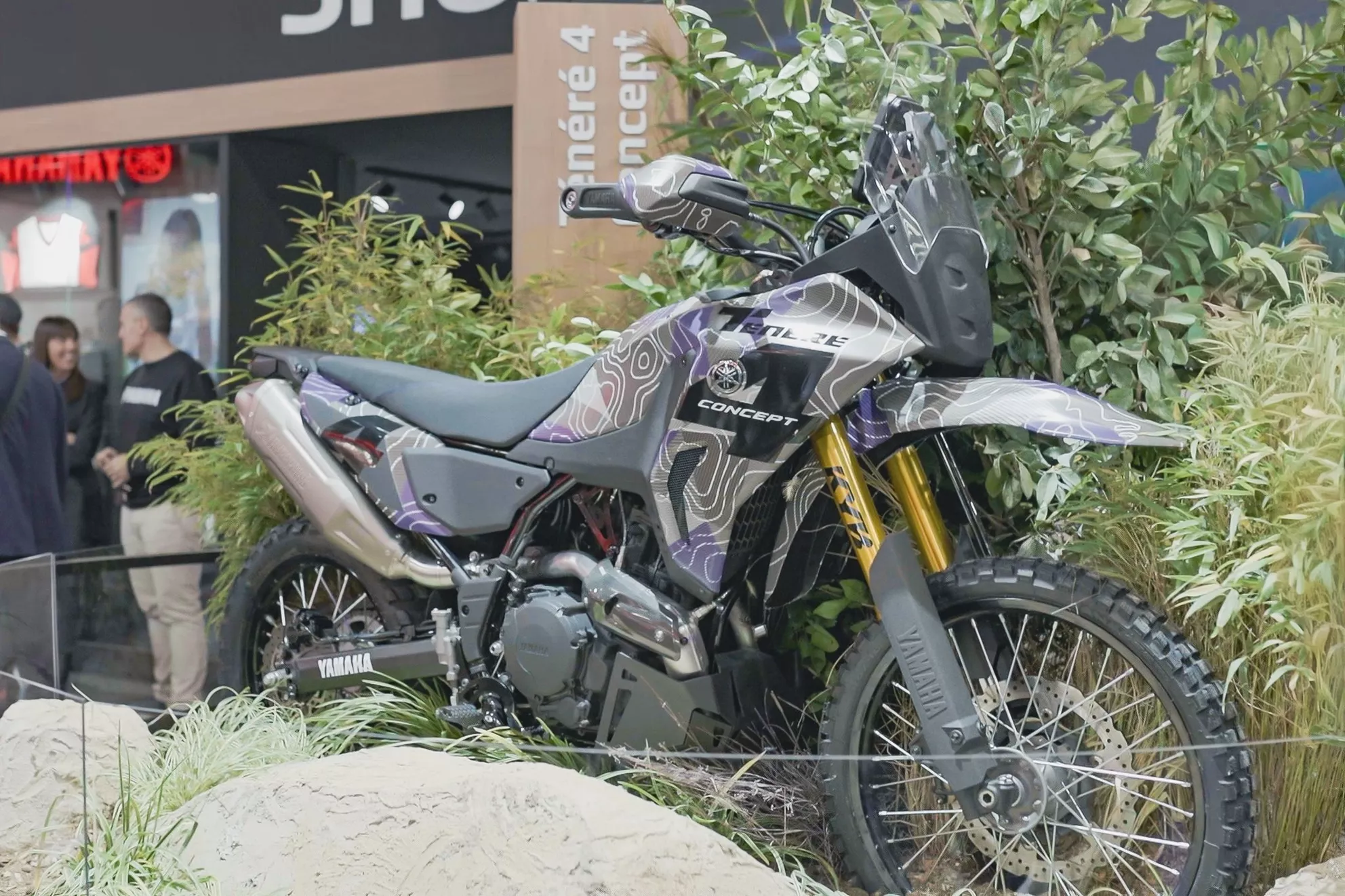
Too late to the party? Unfortunately the Tenere 4 is only a concept
Poky: Can you already confirm that production of the smaller Ténéré has been approved and it simply needs time? Or is it still only a prototype with an uncertain future?
Prévost: As I said yesterday, it's much more than a design exercise. We call the bike on display a concept, and the final product will probably look somewhat different. But there is an ongoing development project.
You know Japanese companies: we work with PDCA - plan, do, check, act. We begin by defining a plan. That includes milestones such as when development should be completed and when production should start. Such a plan exists for the Ténéré project.
Poky: Moving on to the new models: the RW700 (Explorer) and RW350. Who is the customer for the 700? Is this more than a TMAX for gravel roads or a Ténéré turned into a scooter?
Prévost: The 700 is deliberately somewhere between a scooter and a motorcycle. Personally, I don't want to choose one category. I don't think customers should have to either. The important question is whether the vehicle meets their needs.
You can ride it every day, commute into the city, go to work and carry your belongings in the helmet compartment. At the weekend you can enjoy genuine motorcycle character. It offers the practicality of a scooter but the handling, dynamic behaviour and sporty feel of a motorcycle.
I've ridden it myself. Initially, I sat on it like a motorcycle, with my feet on the motorcycle-style pegs. It felt agile and sporty. Then I unfolded the forward foot platforms, changed to a more relaxed riding position and that worked well too. It may be hard to imagine just from looking at photos, but the motorcycle is genuinely capable. If you want to stand up on the pegs when riding on loose ground, you can do so.
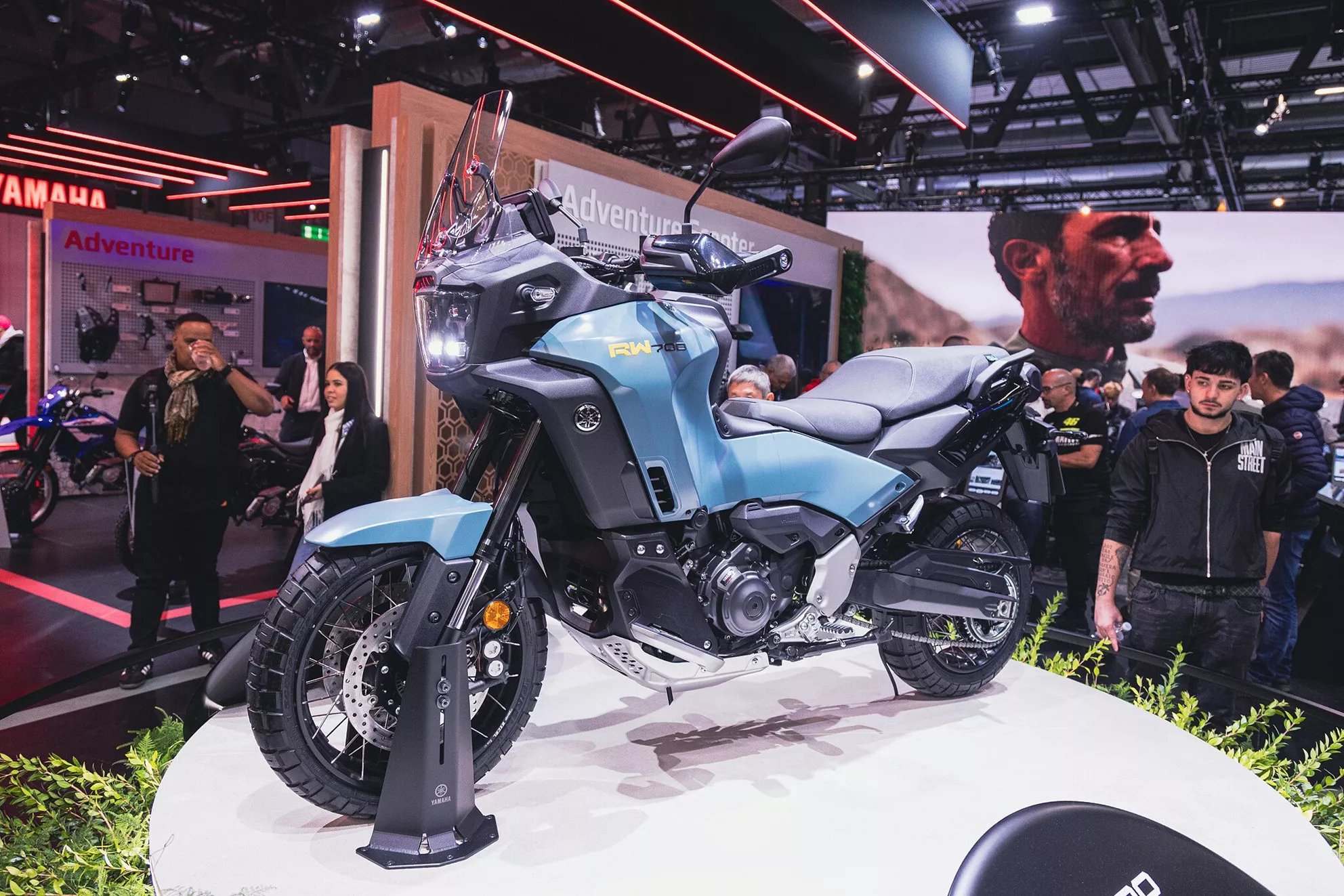
Is it a bird, is it a plane? We are looking forward to ride the RW700
Poky: I'm very curious how customers will perceive it and look forward to riding it. What is its weight?
Prévost: 230 kilograms.
Poky: Leaving the dust behind and moving to the racetrack: Yamaha has a huge racing heritage, but there is no longer a road-legal R1 in Europe. With the forthcoming MotoGP regulations, is there still a future for road-going litre-class supersport motorcycles? Might a future R1 follow the new 850 cc MotoGP formula?
Prévost: We have to distinguish MotoGP regulations from those of the Superbike World Championship. I haven't heard of an intention in World Superbike to reduce displacement. So a 1,000 cc motorcycle - or even something larger - remains relevant in the supersport category.
Our R9, with its 900 cc engine, is performing extremely well in World Supersport. But it doesn't have the same emotional appeal as a four-cylinder 1,000 cc machine. We recognise that.
And, frankly speaking, I cannot say that ending the road-homologated R1 was our best idea. We believed that a track-only version would satisfy racing fans and track-day customers. In reality, it severely limits how the motorcycle can be used. Many sports-bike enthusiasts want to ride their machines on public roads too, even for ordinary trips. We lost those customers, and we feel that. We want to return to the category.
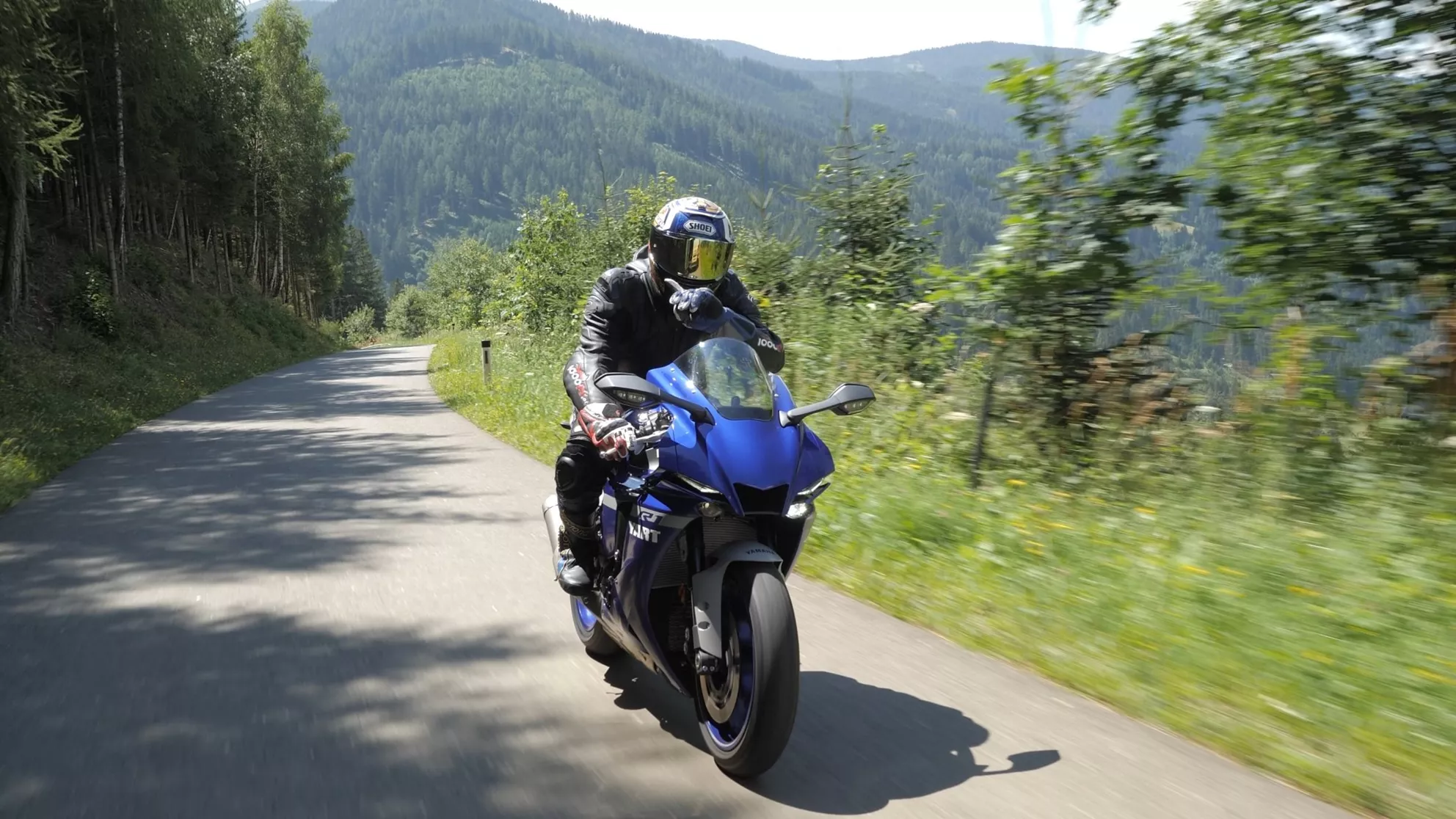
(Not only) we miss the road legal R1
Poky: Yamaha has shown electric concepts and production-ready scooters. Do you see a market for a proper electric motorcycle?
Prévost: Not at present. Our focus remains on urban mobility. That's why we are introducing two electric scooters that customers will be able to buy next year. But when you ask about an electric equivalent of, say, a Tracer 9, we don't see a viable market for that right now.
Poky: How large do you expect electric-scooter sales to be compared with internal-combustion equivalents? Will they remain niche products? Can you give a percentage?
Prévost: They will remain niche products. It's difficult to put a figure on it, but if I take the NMAX as an example, I'd say an electric equivalent might account for less than ten percent at present.
Poky: Will the electric models cost substantially more than the combustion versions?
Prévost: Yes, there will be a price gap, and that's one of the main obstacles to the growth of electric mobility. An urban scooter such as the NMAX costs around €4,000 in many markets, depending on the country. Buyers in that category are very price-sensitive. If an electric version is significantly more expensive, that makes the purchase difficult to justify.
We aren't entering electric mobility because we expect huge sales immediately. We're realistic about the current market. But Yamaha cannot ignore an entire category simply because it isn't profitable or high-volume today.
Some manufacturers appear to cherry-pick attractive categories, introducing products quickly wherever there is money to be made. Walk around this show and you'll see many similar products, often close to copies of one another. Yamaha does not want to copy people who copied us. We want to create something different - that's part of the thinking behind the RW - and we also want to invest in electric mobility because we believe there will be demand in the medium to long term.
That demand could grow because of higher petrol prices, incentives or restrictions introduced by large European cities, falling battery costs, better technology, greater range and improved performance. We need to be present in the market, learn from it and contribute to its development.
Poky: If more cities followed Paris, perhaps electrification would accelerate much faster.
Prévost: Exactly. We used to sell many XMAX 125 scooters in Paris, and the regulations introduced there affected that business significantly. We have to respond to that changing market.
Poky: Returning to CP2 and CP3: these are proven engines, but rivals increasingly offer strong equipment at lower prices. How long can Yamaha defend its position without changing its cost structure or doing something fundamentally different?
Prévost: If you compare equivalent motorcycles from Yamaha and newer competitors, the gap can be around twenty percent, depending on the model. Twenty percent is a lot for customers today. New brands may also have more up-to-date features because they move so quickly.
We are working on two things: reducing the price difference and becoming faster. Both are important. We are no longer competing only product against product or price against price. This is increasingly a competition about speed.
Poky: As the person responsible for Europe, is part of your job to push the Japanese organisation to work faster? Does Yamaha's traditional way of working sometimes slow things down?
Prévost: Japan must consider all regions of the world, while my task is to make sure it understands the specific situation in Europe.
If all you want is sales volume, Europe isn't where you would start. The value of Europe lies elsewhere: in motorcycle culture, sophisticated customer expectations and the types of machines people buy. Those requirements push manufacturers to develop technologies and concepts that can later spread worldwide.
Europe can generate new designs and ideas. Consider Yamaha's MAX scooter family: NMAX, XMAX and TMAX. The TMAX came first, developed for European customers around 25 years ago. Italy and France were among its strongest early markets. We've even introduced a 25th-anniversary limited edition this year.
The XMAX followed. It was originally developed and manufactured in Europe for the European market, first finding success in the 250 cc category, then 125 cc, 400 cc and now 300 cc. Yet today that European idea succeeds globally.
Poky: Including Asia?
Prévost: Yes. Indonesia is currently the biggest market for XMAX by volume, and China is second. We sell approximately 20,000 XMAX scooters in China, even though they are positioned as very premium products there. With such a huge population, there are still enough customers willing to pay that price.
That is part of Yamaha Europe's mission: bring European motorcycle culture, design sensibility and passionate customer feedback into Japan's global development process. We want to preserve this way of thinking and find ways for successful European ideas to work in other regions as well.
Poky: Thank you very much.
Yamaha R1: Europe boss admits dropping road bike was a mistake Images
Source: 1000PS

Yamaha RW700 2027

Yamaha RW700 Explore 2027

Yamaha RW700 Explore 2027

Yamaha RW700 2027

Yamaha RW700 2027 – CP2 Engine and Drivetrain

Yamaha RW700 2027 – Shift rocker and left-hand controls

Yamaha RW700 2027 – Chain Drive

Yamaha RW700 Explore 2027 – CP2 Engine

Yamaha RW700 Explore 2027 – Left-Hand Shift Rocker

Yamaha RW700 Explore 2027 – Engine and Right Footpeg

Yamaha RW700 2027 – Left-Hand Controls

Yamaha RW700 2027 – Ride Modes on the TFT

Yamaha RW700 Explore 2027 – TFT Display and Riding Modes

Yamaha RW700 2027 – Front Fairing and Front Wheel

Yamaha RW700 2027 – Rear Wheel and Brake

Yamaha RW700 2027 – Monoshock

Yamaha RW700 2027 – Front Wheel and Twin-Disc Brake

Yamaha RW700 2027 – Tyre Tread

Yamaha RW700 Explore 2027 – Fork and Front Fairing

Yamaha RW700 Explore 2027 – Rear Wheel and Chain Drive

Yamaha RW700 Explore 2027 – Front Wheel and Braking System

Yamaha RW700 2027

Yamaha RW700 2027

Yamaha RW700 2027

Yamaha RW700 2027

Yamaha RW700 2027

Yamaha RW700 2027

Yamaha RW700 2027

Yamaha RW700 2027

Yamaha RW700 2027

Yamaha RW700 2027

Yamaha RW700 2027 – Seat

Yamaha RW700 2027 – Footpeg with Rubber Insert

Yamaha RW700 2027 – Helmet Compartment

Yamaha RW700 2027 – Fold-out Front Footrest

Yamaha RW700 2027

Yamaha RW700 Explore 2027

Yamaha RW700 Explore 2027

Yamaha RW700 Explore 2027

Yamaha RW700 Explore 2027

Yamaha RW700 Explore 2027

Yamaha RW700 Explore 2027

Yamaha RW700 Explore 2027

Yamaha RW700 Explore 2027

Yamaha RW700 Explore 2027

Yamaha RW700 Explore 2027 – Rider and Passenger Seats

Yamaha RW700 Explore 2027 – Helmet Storage

Yamaha RW700 Explore 2027 – Centre Stand and Footpegs

Yamaha RW700 Explore 2027 – Folding Front Footrest

Yamaha RW700 2027

Yamaha RW700 2027

Yamaha RW700 2027

Yamaha RW700 2027

Yamaha RW700 2027

Yamaha RW700 2027

Yamaha RW700 2027

Yamaha RW700 2027

Yamaha RW700 2027

Yamaha RW700 2027 – TFT Display

Yamaha RW700 2027 – Smart Key Operation

Yamaha RW700 2027 – TFT Display

Yamaha RW700 2027 – Headlight

Yamaha RW700 Explore 2027

Yamaha RW700 Explore 2027

Yamaha RW700 Explore 2027

Yamaha RW700 Explore 2027

Yamaha RW700 Explore 2027

Yamaha RW700 Explore 2027

Yamaha RW700 Explore 2027

Yamaha RW700 Explore 2027

Yamaha RW700 Explore 2027

Yamaha RW700 Explore 2027

Yamaha RW700 Explore 2027 – Backlit Switches

Yamaha RW700 Explore 2027 – Left-Hand Controls

Yamaha RW700 Explore 2027 – Smart Key Operation

Yamaha RW700 Explore 2027 – Headlight and Front Fairing

Yamaha RW700 Explore 2027 – Navigation on the TFT Display

Yamaha RW700 Explore 2027 – Throttle Grip and Right-Hand Controls

Yamaha RW700 Explore 2027 – LED Headlight

Yamaha RW700 Explore 2027 – Fork Adjustability

Yamaha RW700 2027 – Side Fairing and Model Badge

Yamaha RW700 2027 – Front Fairing

Yamaha RW700 2027

Yamaha RW700 2027

Yamaha RW700 2027

Yamaha RW700 2027

Yamaha RW700 2027

Yamaha RW700 2027

Yamaha RW700 2027

Yamaha RW700 2027

Yamaha RW700 2027

Yamaha RW700 2027

Yamaha RW700 2027

Yamaha RW700 2027

Yamaha RW700 2027

Yamaha RW700 2027

Yamaha RW700 2027

Yamaha RW700 2027

Yamaha RW700 2027

Yamaha RW700 2027

Yamaha RW700 2027

Yamaha RW700 2027

2027 Yamaha RW700 Explore – Side Fairing and Cockpit

Yamaha RW700 Explore 2027 – Model lettering

Yamaha RW700 Explore 2027

Yamaha RW700 Explore 2027

Yamaha RW700 Explore 2027

Yamaha RW700 Explore 2027

Yamaha RW700 Explore 2027

Yamaha RW700 Explore 2027

Yamaha RW700 Explore 2027

Yamaha RW700 Explore 2027

Yamaha RW700 Explore 2027

Yamaha RW700 Explore 2027

Yamaha RW700 Explore 2027

Yamaha RW700 Explore 2027

Yamaha RW700 Explore 2027

Yamaha RW700 Explore 2027

Yamaha RW700 Explore 2027

Yamaha RW700 Explore 2027

Yamaha RW700 Explore 2027

Yamaha RW700 Explore 2027

Yamaha RW700 Explore 2027

Yamaha RW700 Explore 2027

Yamaha RW700 Explore 2027

Yamaha RW700 Explore 2027

Yamaha RW700 Explore 2027

Yamaha RW700 Explore 2027

Yamaha RW700 Explore 2027

Yamaha RW700 Explore 2027