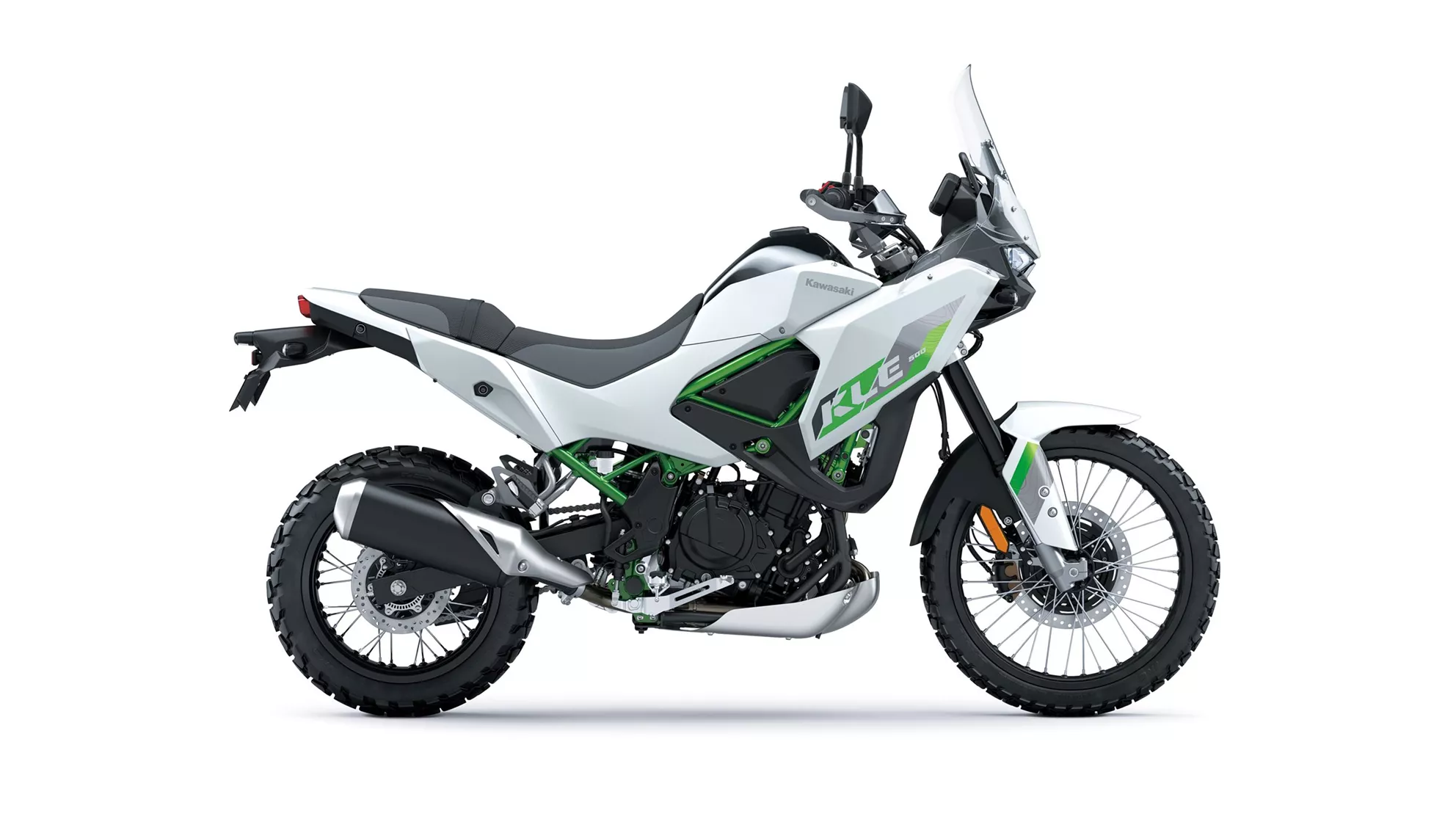
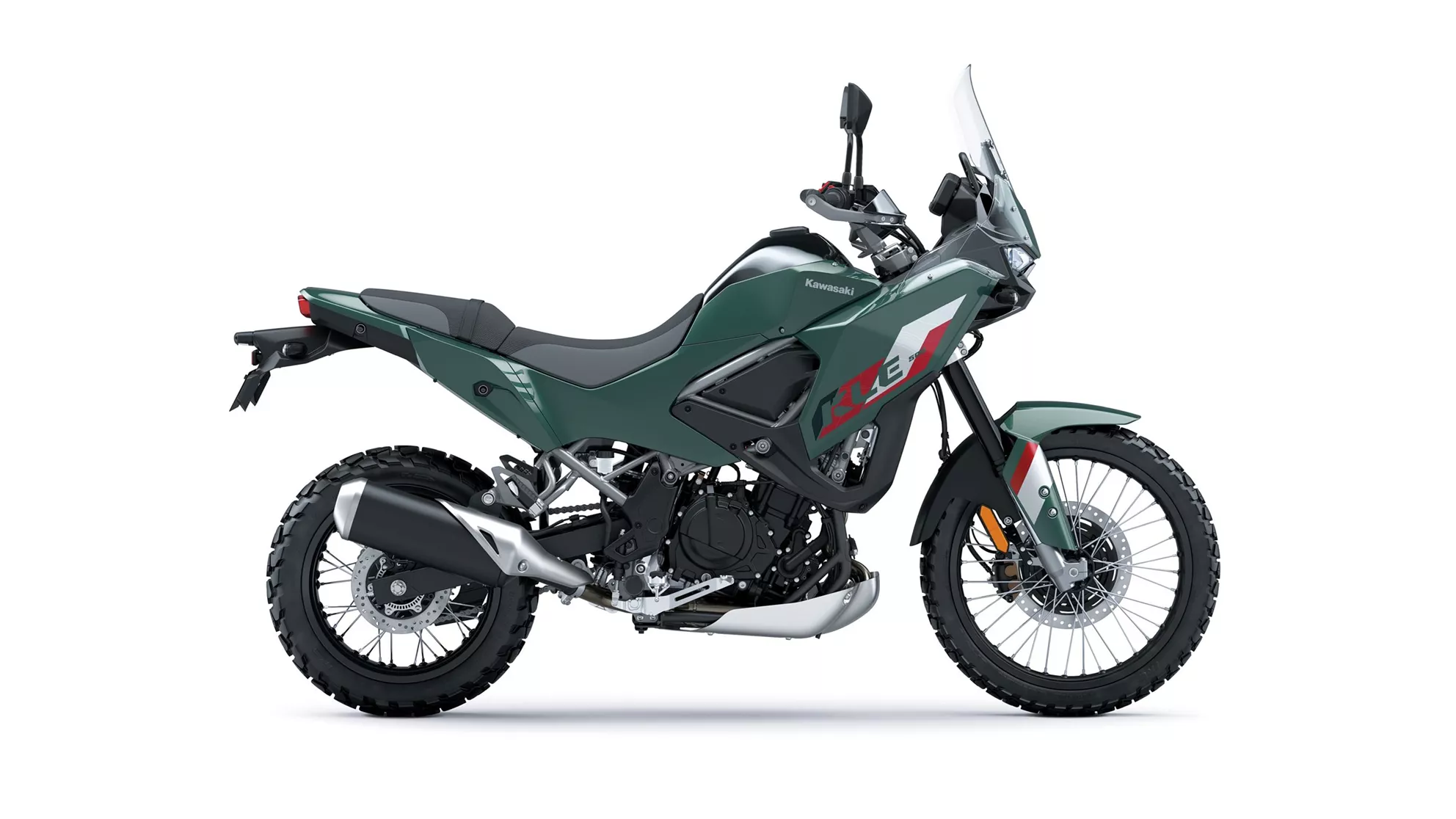
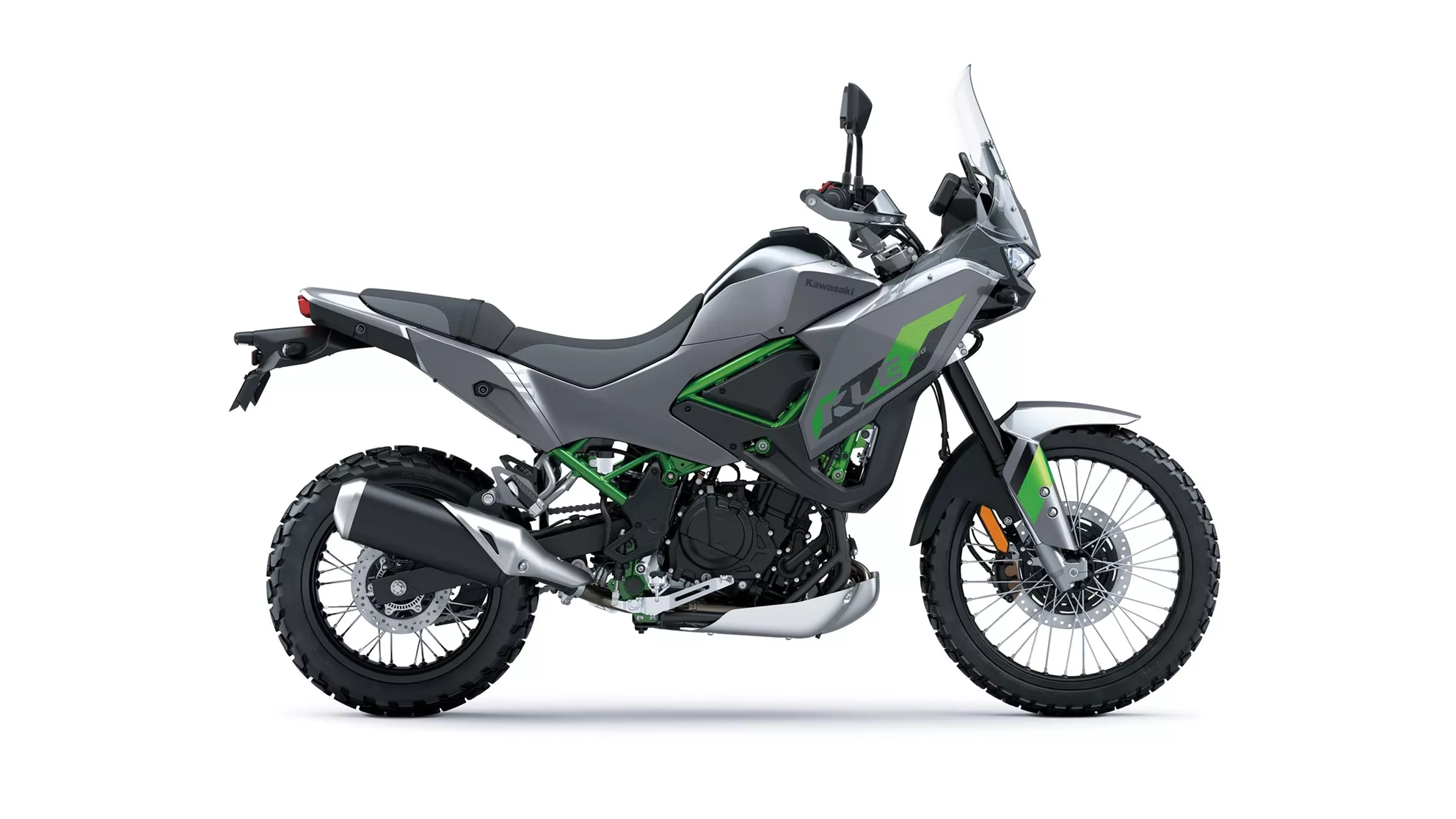
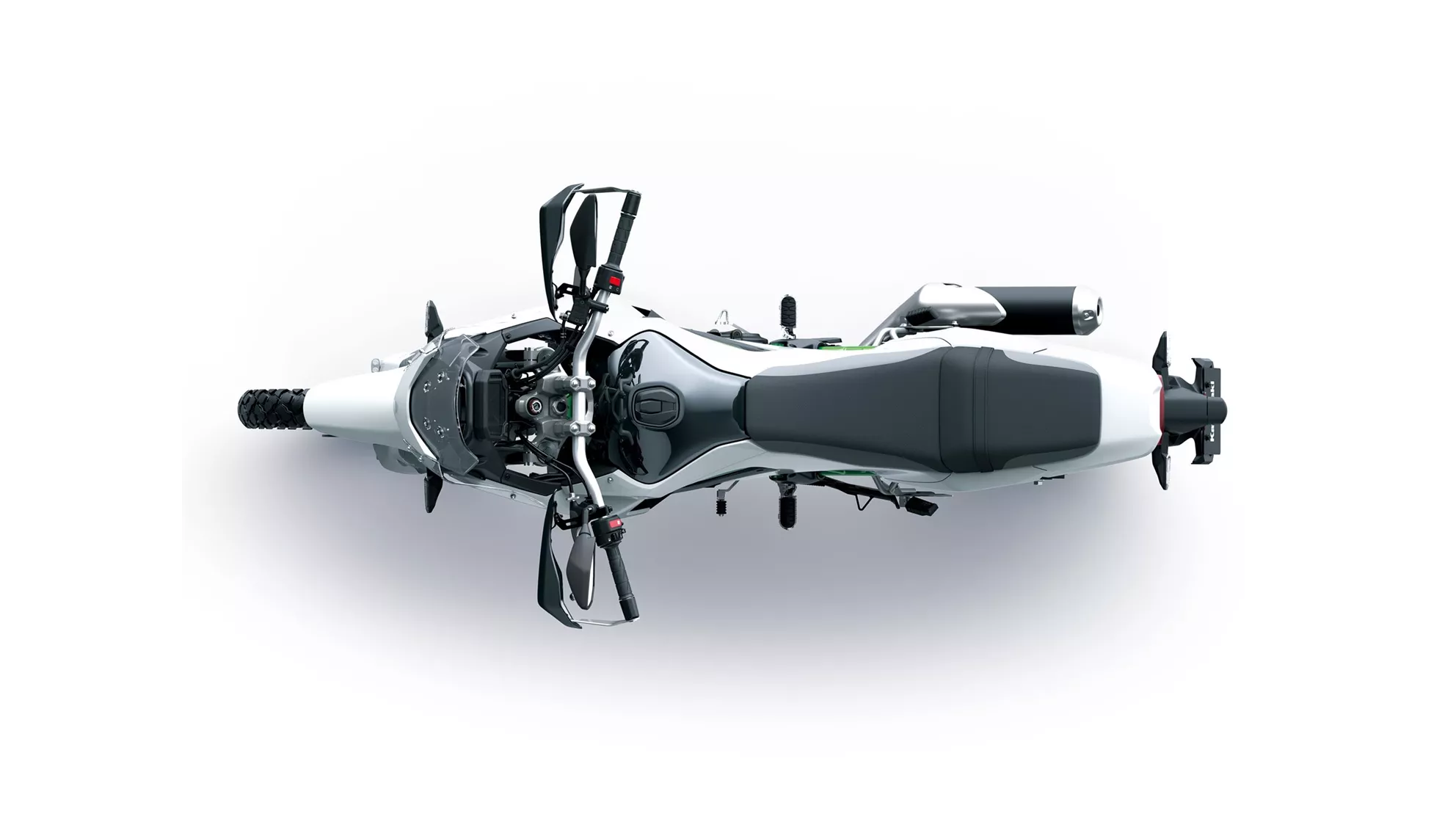
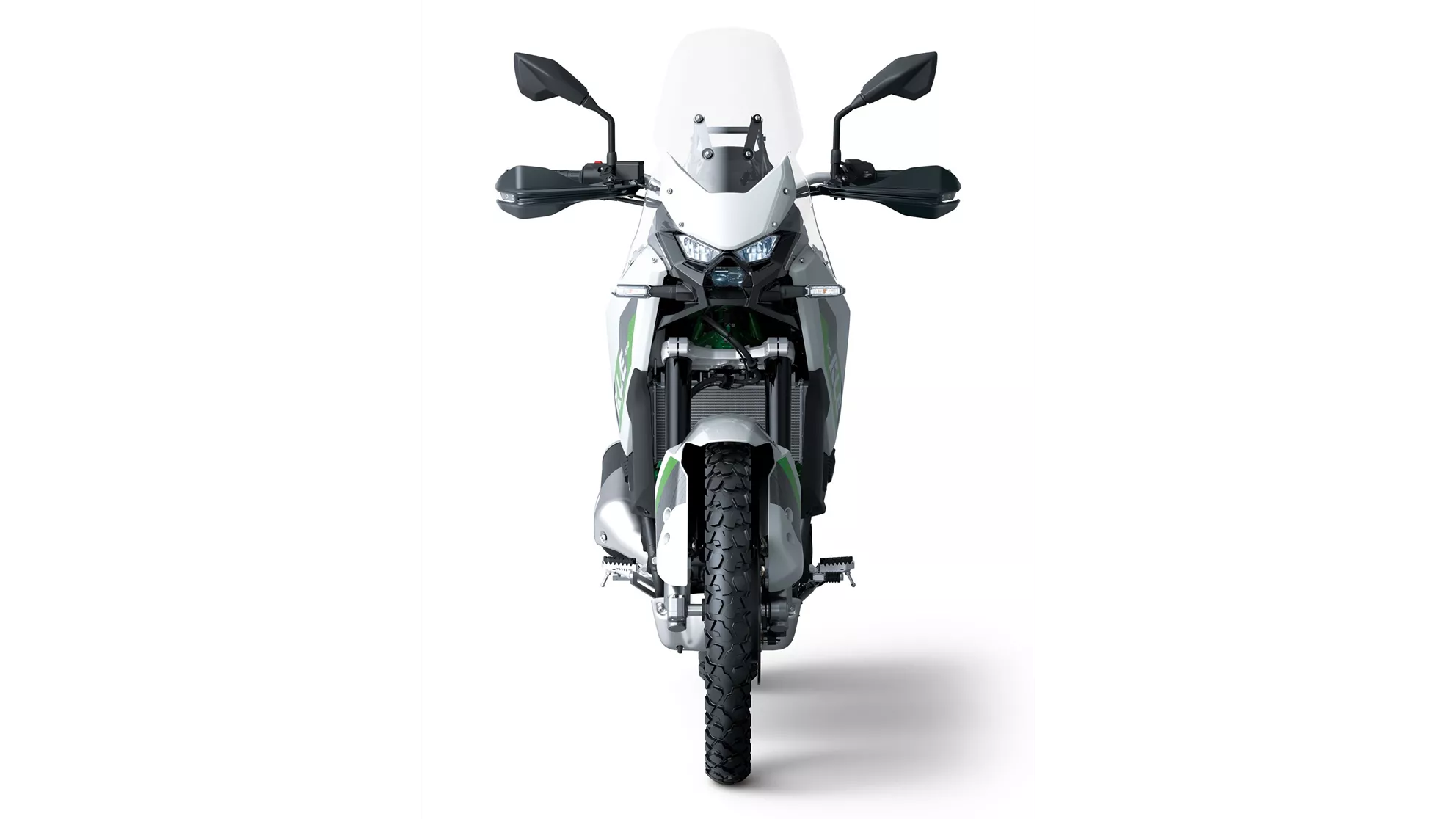
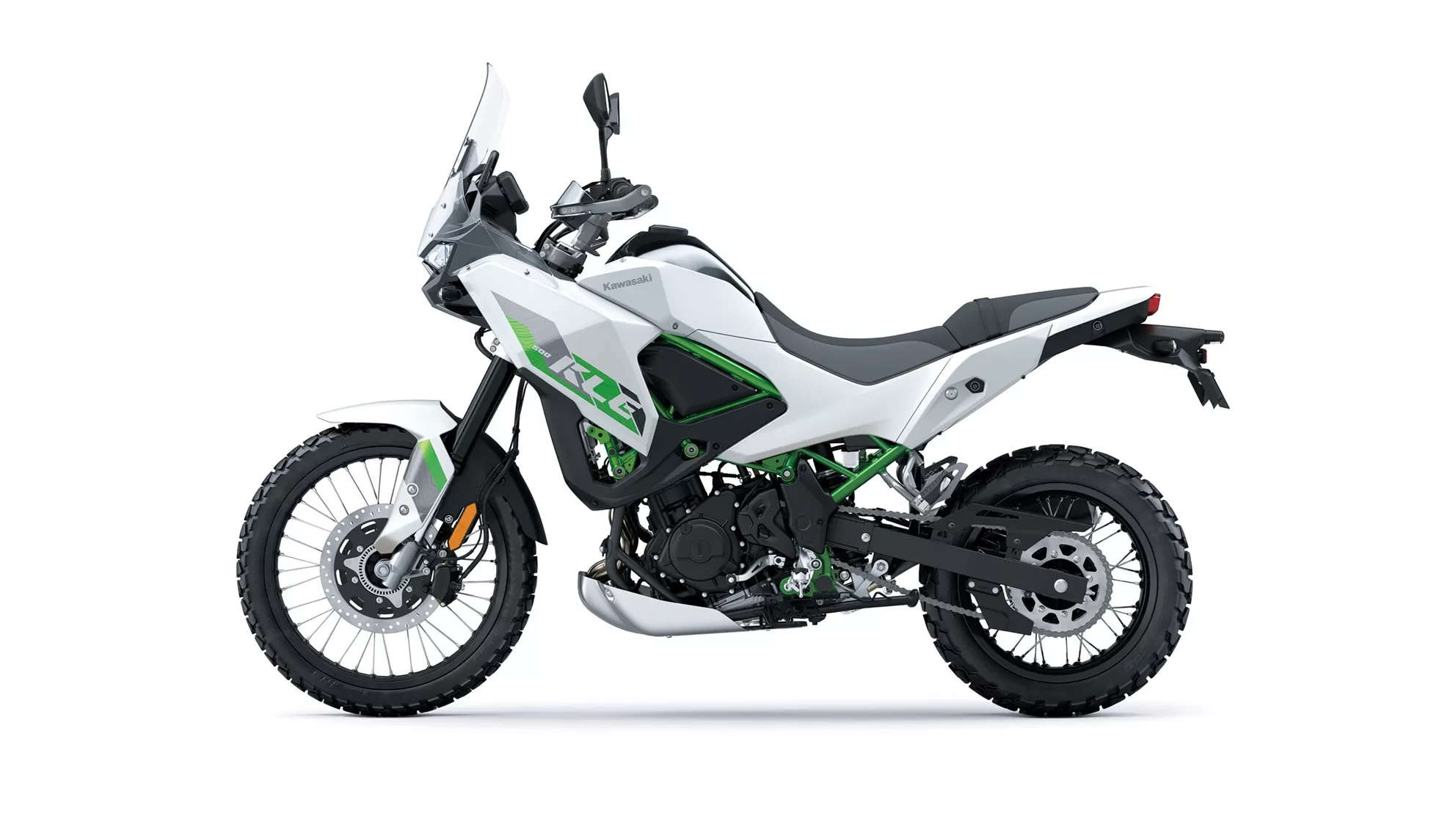
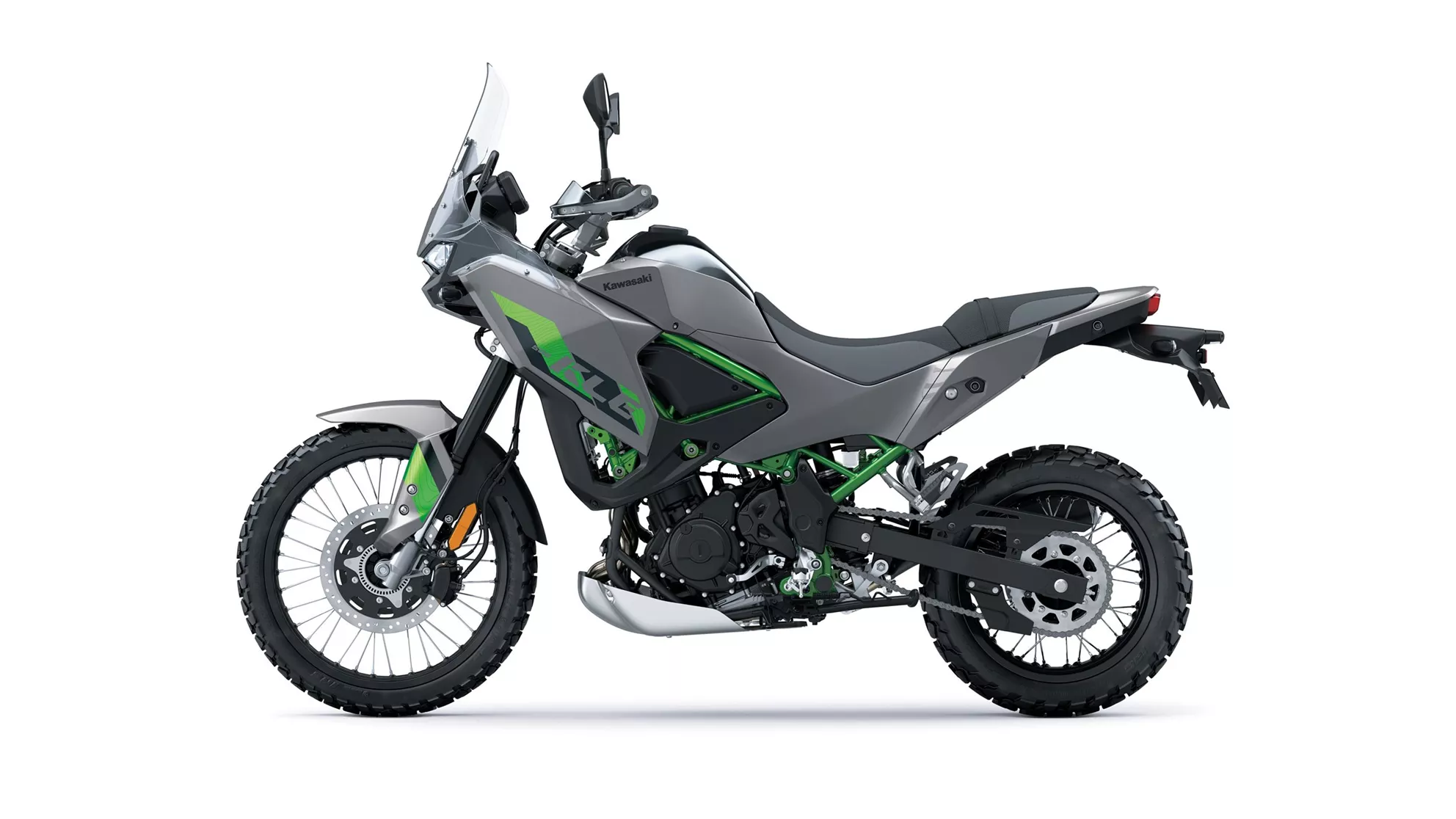
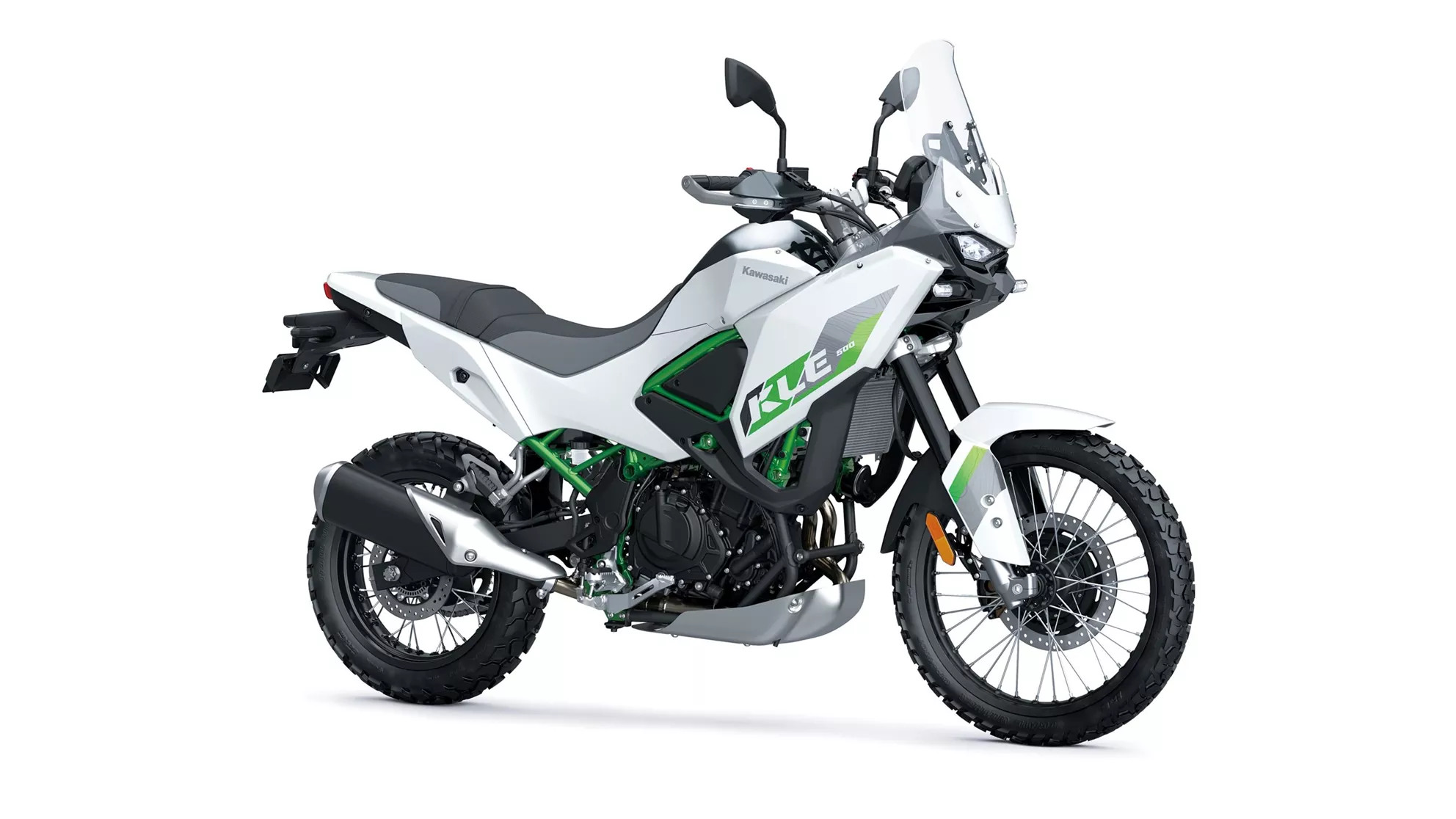
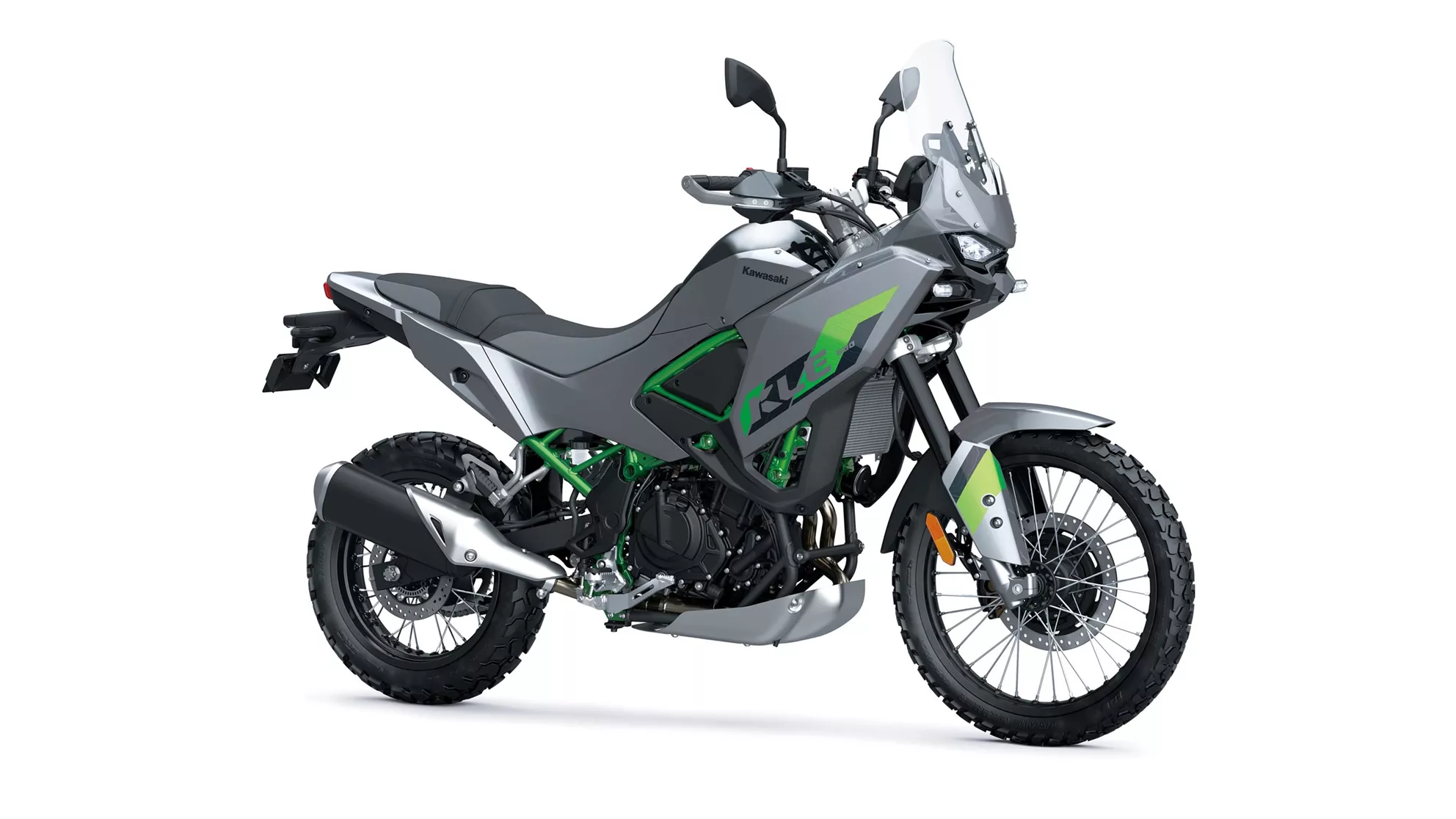
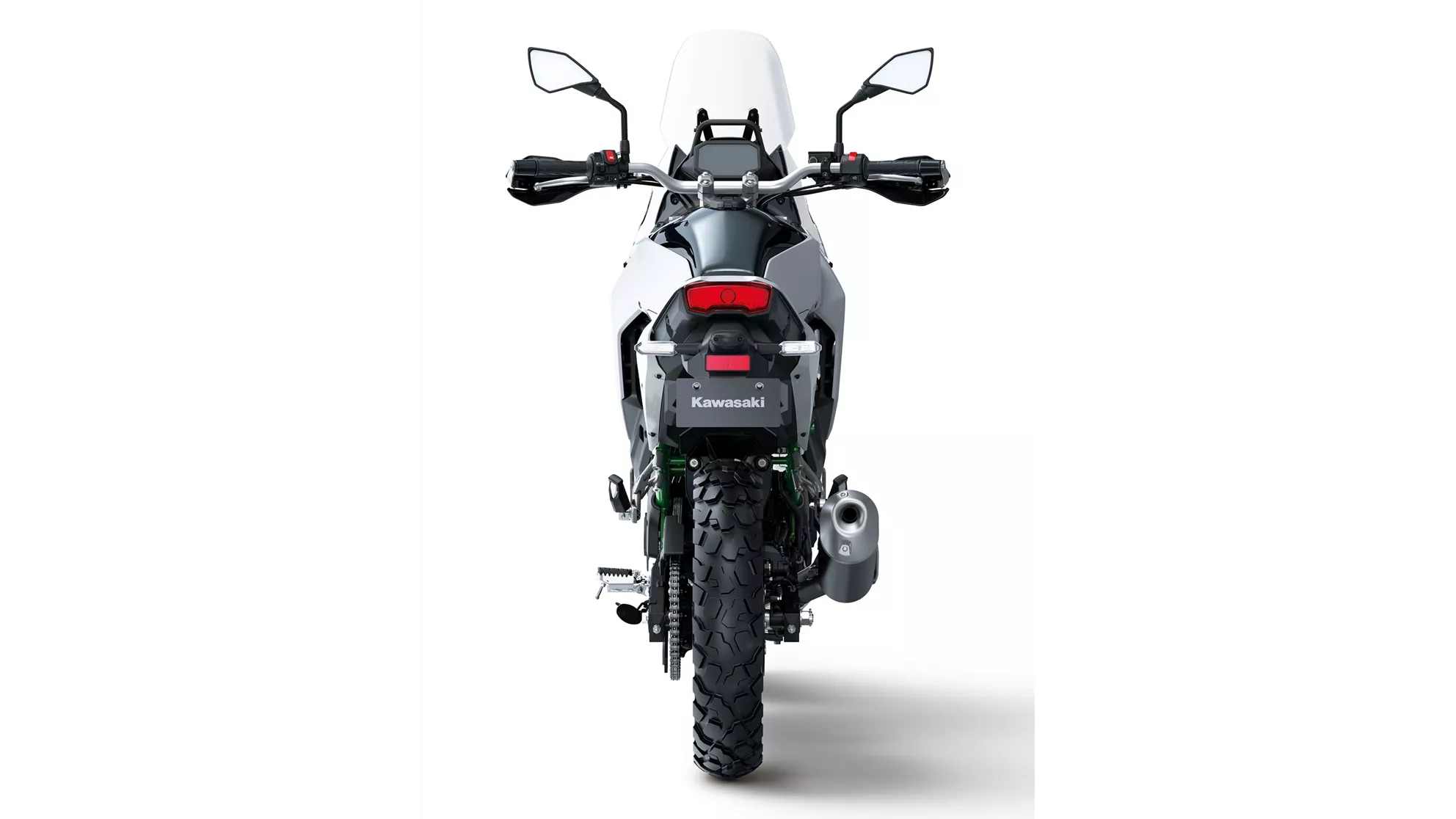
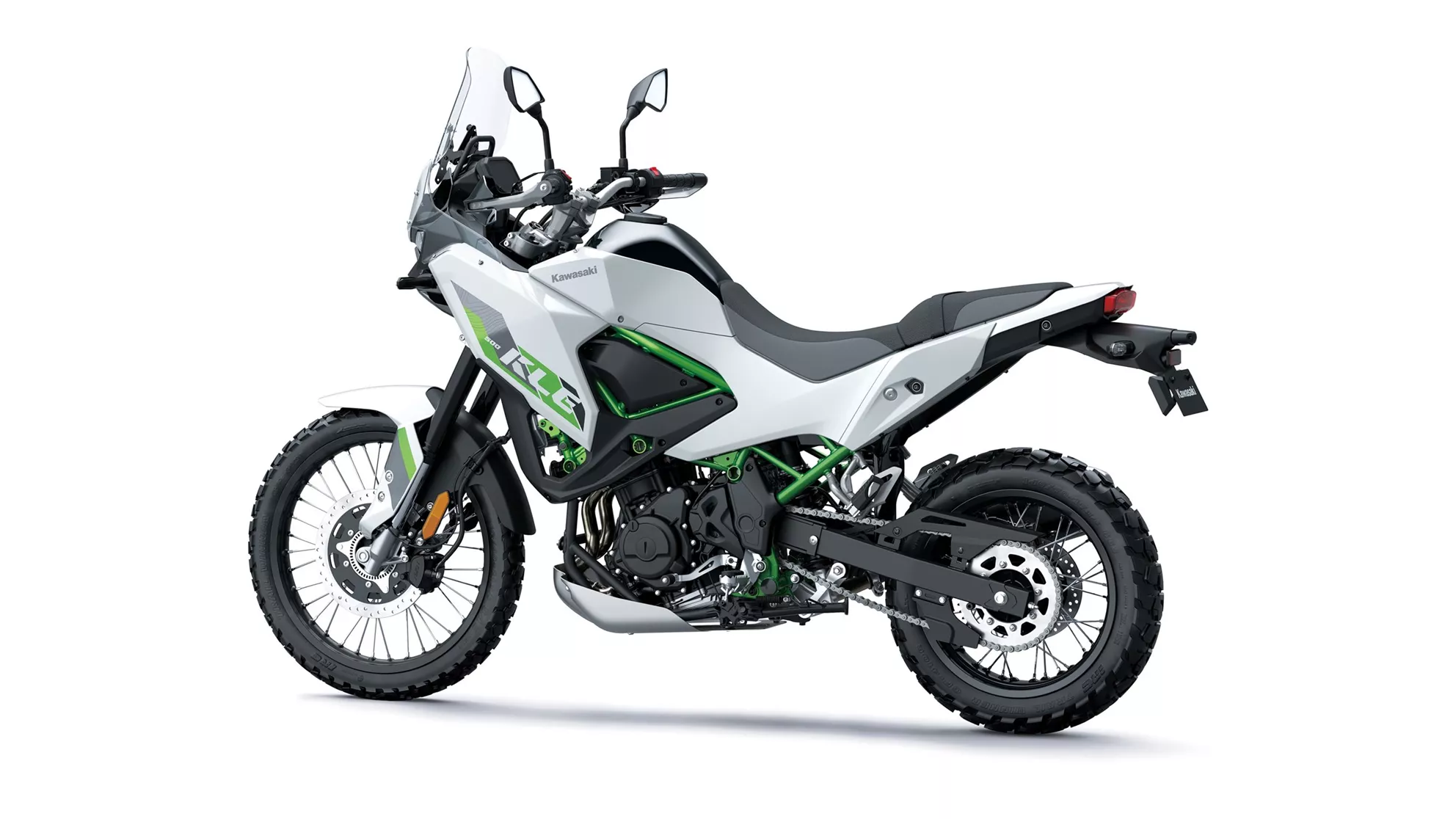
In the early nineties, with my licence fresh in my pocket, I bought a Kawasaki KLE 500. Dark green and orange, first as a restricted bike with 27 hp, and after the 1,000 km service it was 50. Things weren't as strict back then as they are today. More than thirty years later, there's a KLE 500 in our garage again, and I had a whole season to find out what's left of the old days. That's why I'm writing this finale and not one of my colleagues: I have a score to settle with this bike.
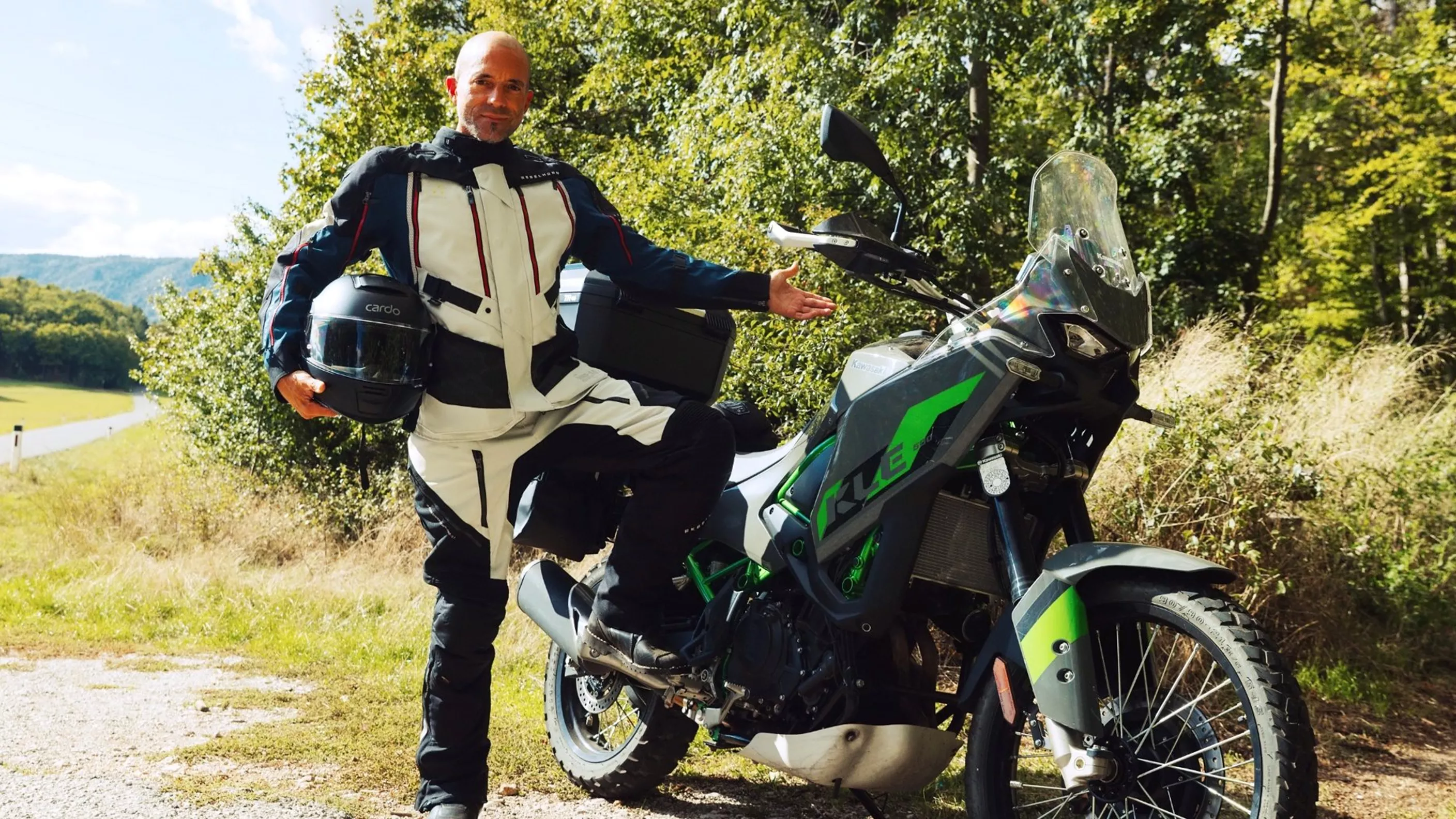
Kawasaki KLE 500 long-term test: the 3 problems after one year
Ground clearance, rear wheel, ABS: which of them really matters
A year of continuous use: the Kawasaki KLE 500 travelled from Spain to Austria, and five testers rode it. Ten findings remain, seven good ones and three that hurt. Why the much-debated 185 mm ground clearance was a non-issue in practice, while the 140/70-17 rear wheel very much was.
&width=72&height=72&bgcolor=rgba_39_42_44_0&mode=crop "Author: NoPain")
NoPain
published on 10/8/2026
10,949 Views
The Kawasaki KLE 500 was the most hotly debated bike in our fleet in 2026 – although its spec sheet generated more talk than its riding qualities. 185 millimetres of ground clearance with 210 millimetres of suspension travel up front, plus a rear wheel in the unusual 140/70-17 size: people argued about that online for a whole year, often people who had never sat on the machine. So I'm parking the loudest question right here: Is ground clearance really the problem with this adventure bike? The answer comes further down, and it's different from what the comment sections would have you believe.
Five testers, three countries, five reports
This long-term test consists of five individual tests carried out between February and September 2026. Gregor was at the world premiere in Almería and chased the KLE 500 for two days over Spanish mountain roads and through the Tabernas Desert; his verdict on the marketing was moderately enthusiastic at best. In Switzerland, FunkyFrankee didn't judge it on lap times but with five fit checks for body, nerves, everyday use, adventure and heart, and arrived at 36 out of 50 points. NastyNils put it on the tight supermoto circuit at Motorsportarena Bad Fischau. Wolf took it to the Newchurch Summit, on mountain passes and enduro terrain, accompanied by riding technique pro Bernd Hiemer. And I rode it in everyday life, in town, on gravel tracks and with my daughter Alva as pillion.
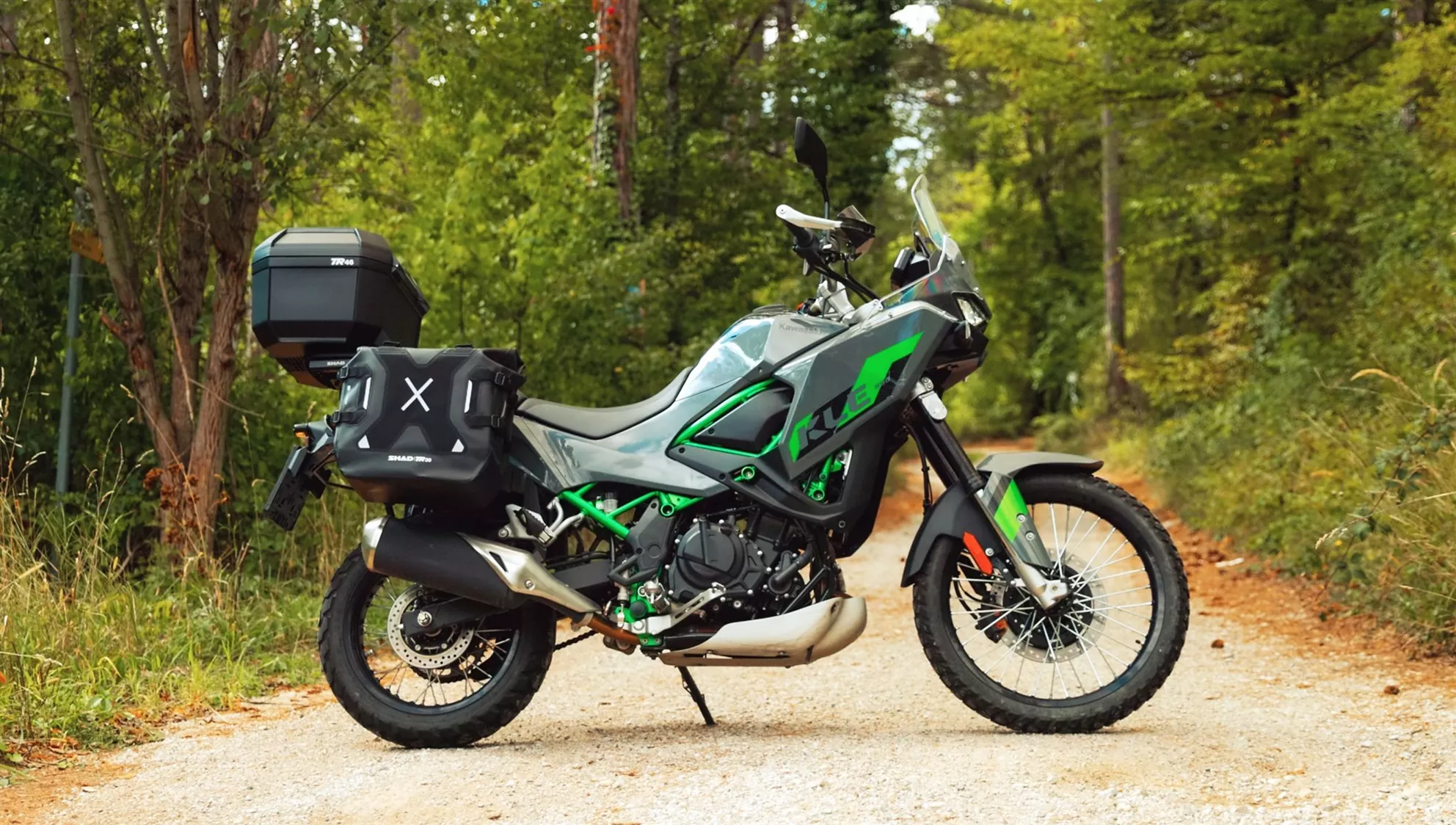
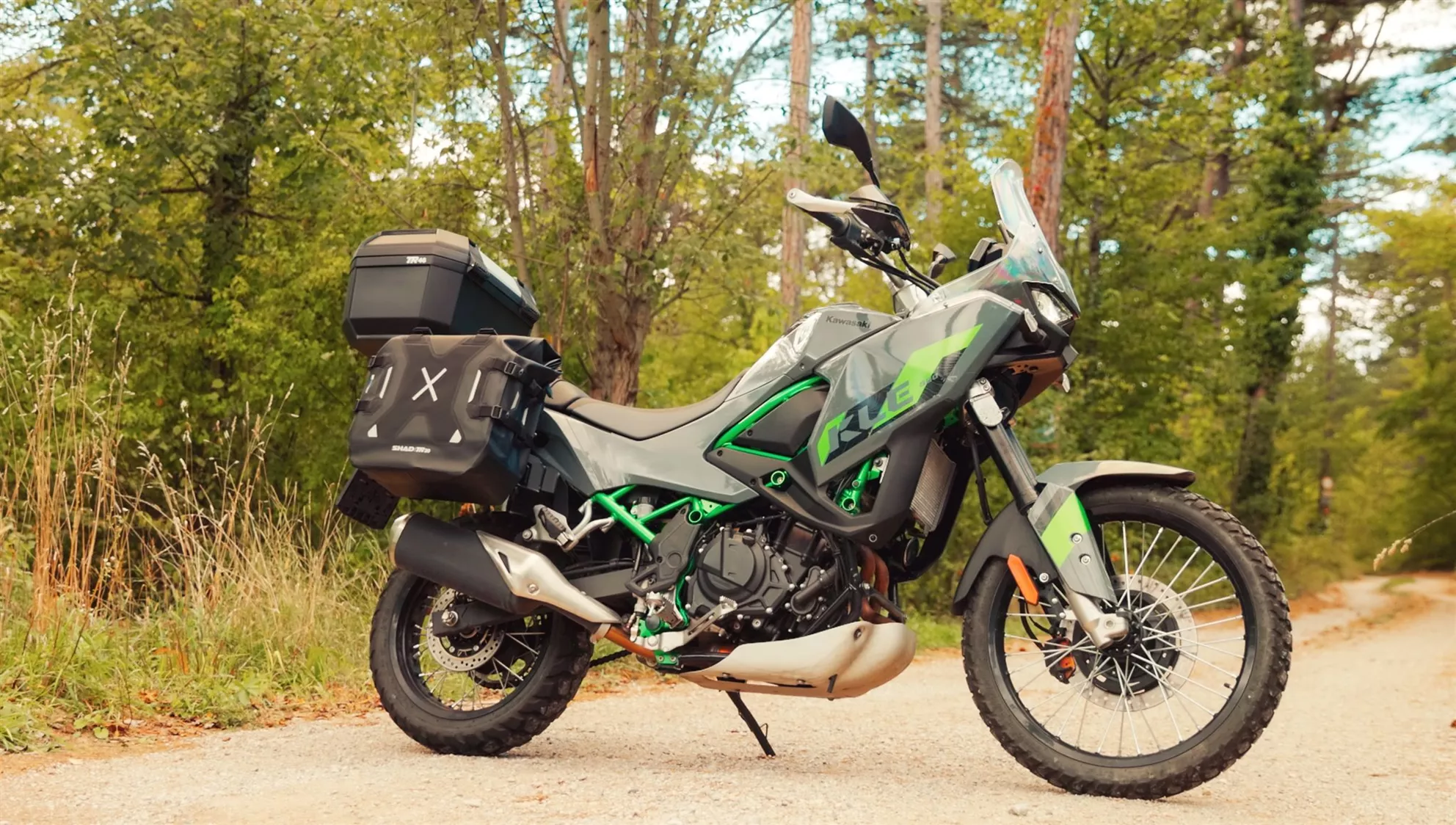
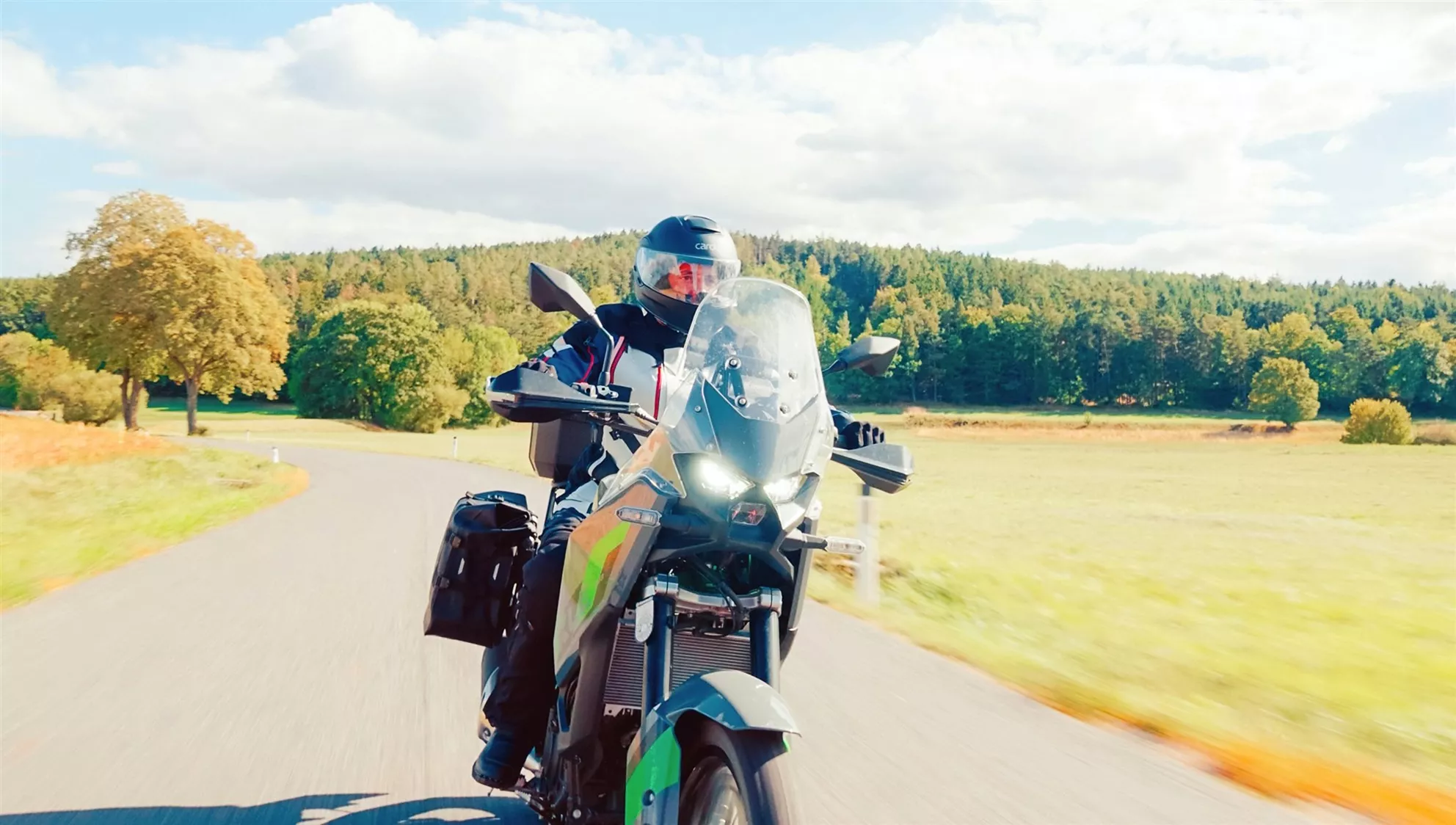
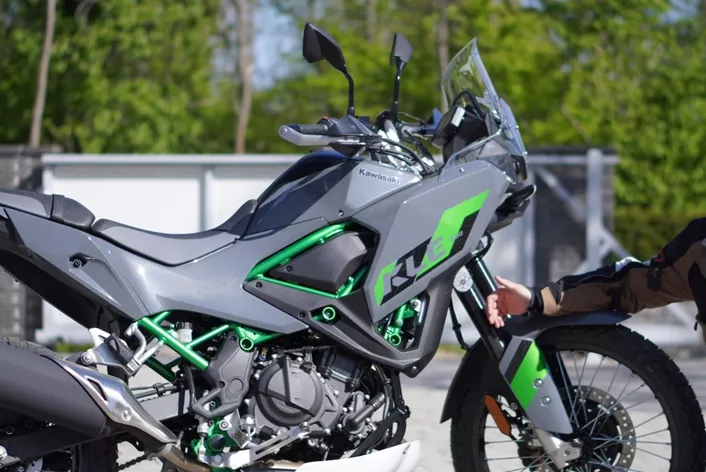
Throughout, we rode the Kawasaki KLE 500 SE, the better-equipped version with colour TFT display, taller windscreen, reinforced handguards and a large aluminium bash plate. Two deviations from stock belong here because they colour the verdict: our machine had soft luggage side bags fitted almost all the time, which makes the centre of gravity and handling slightly more sluggish in tight hairpins. And the Swiss test bike ran a 150/70 rear tyre instead of the stock width, which took the edge off the tyre issue there, but isn't permitted like that in Austria and Germany. Everything said below about tyre choice therefore refers to the stock tyres.
Seven findings in favour of the Kawasaki KLE 500
First, the engine is the secret boss.
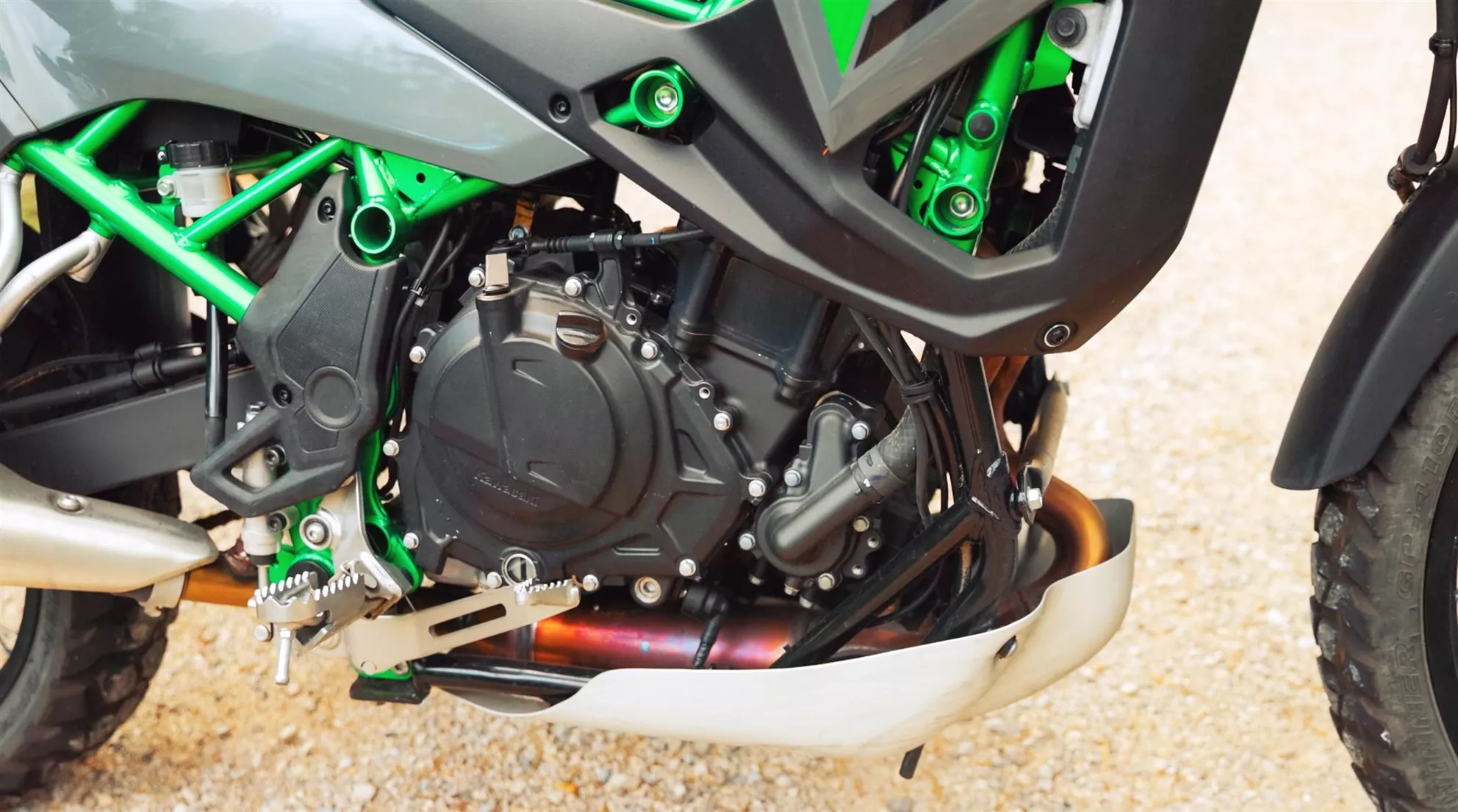
The 451 cc parallel twin makes 45 hp at 9,000 rpm and is, on paper, the most boring paragraph in this report. In practice, it's the reason five testers independently came to the same conclusion. You can putter through town in sixth gear at fifty without any judder, and be sloppy with clutch and throttle at the traffic lights without the machine holding it against you. Frankee calls it an engine that forgives mistakes. None of us found anything wrong with its responsiveness, and we looked.
Second, the 870 millimetre seat height doesn't feel like 870.
If you read that at 1.75 metres tall, you grit your teeth – and then you sit on it. The seat is very narrow at the waist, so more leg reaches the ground. Gregor stands firmly at 1.85, Frankee at 1.80 too, and so do I at 1.75. From 1.70 to well over 1.90, almost everyone finds their position on the Kawasaki KLE 500. If it's still too tall for you, there's the ErgoFit seat at 840 millimetres, for both rider and pillion.
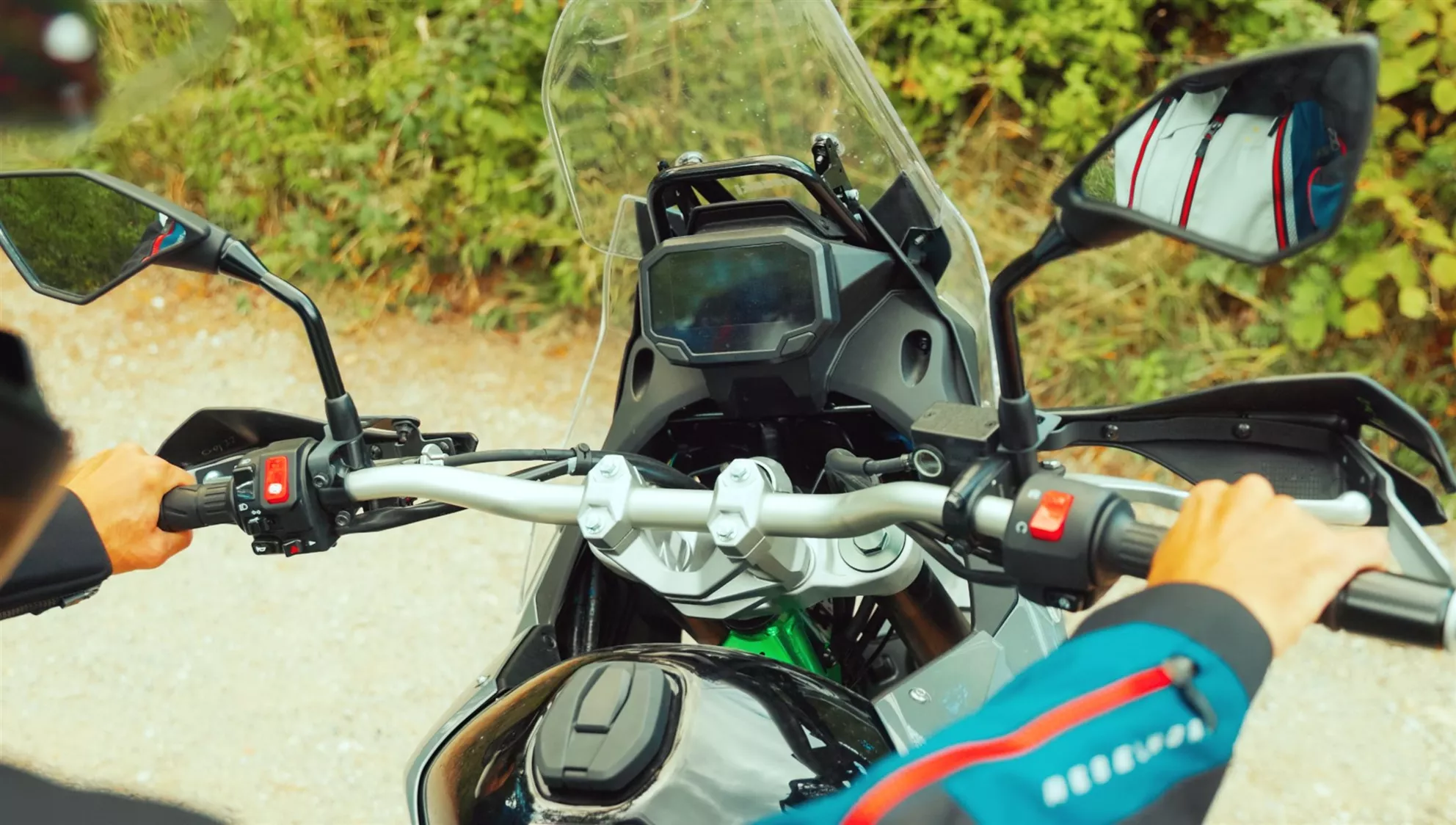
Third, the wide handlebar is the best component on the whole bike.
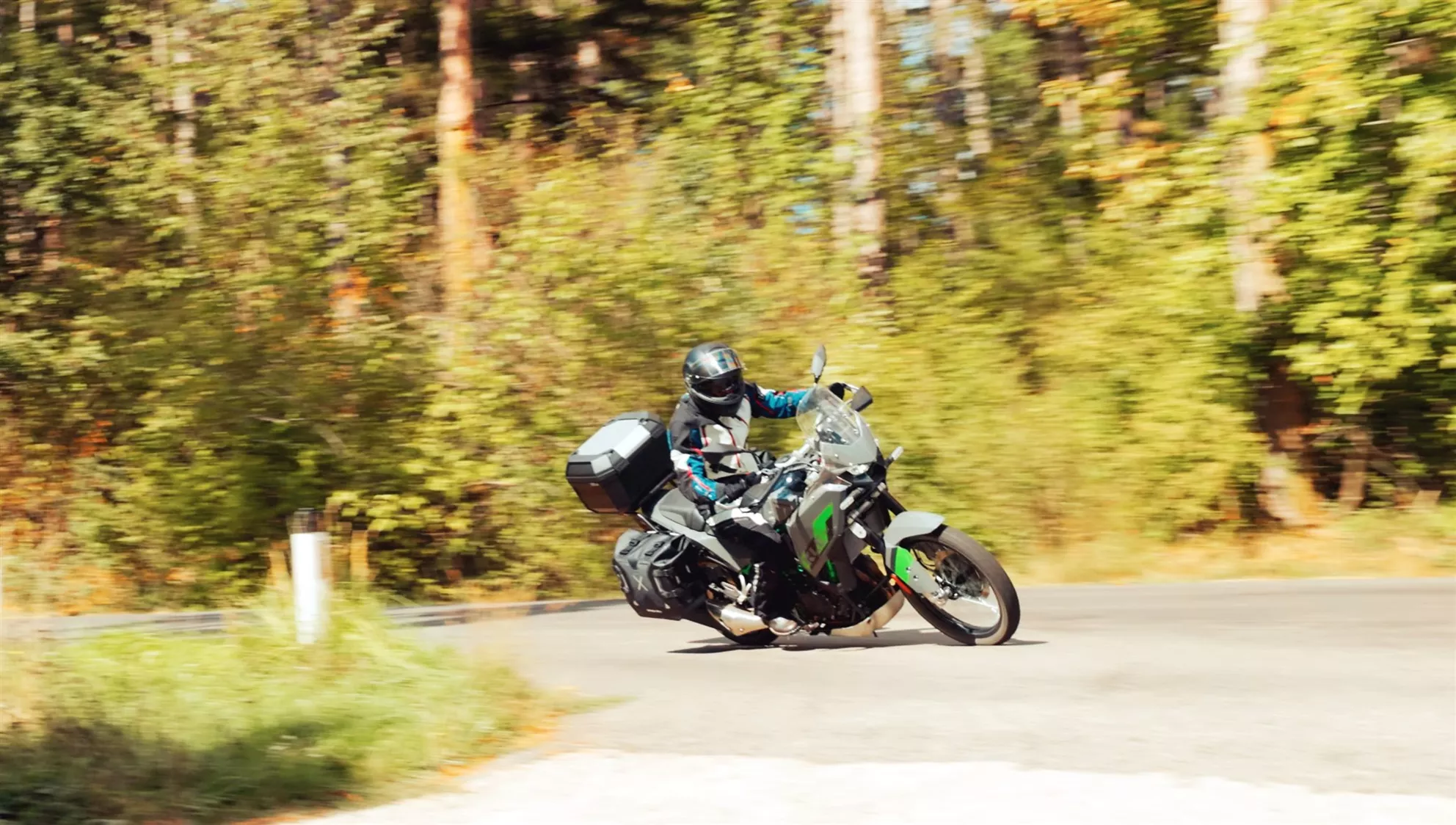
That sounds unspectacular, but it isn't. After his session in Bad Fischau, Nils described it as directing the machine rather than being directed by it. Frankee calls the same motion spooning, Gregor says when standing you're as solid as a rock. Two completely different situations, one component: the rut in the corner, out of which a single input puts you back on course, and the uphill gravel hairpin where the front wheel goes exactly where it should without any effort. Gregor finds the bar too high, Bernd Hiemer finds it just right – that's a question of body size, not a weakness.
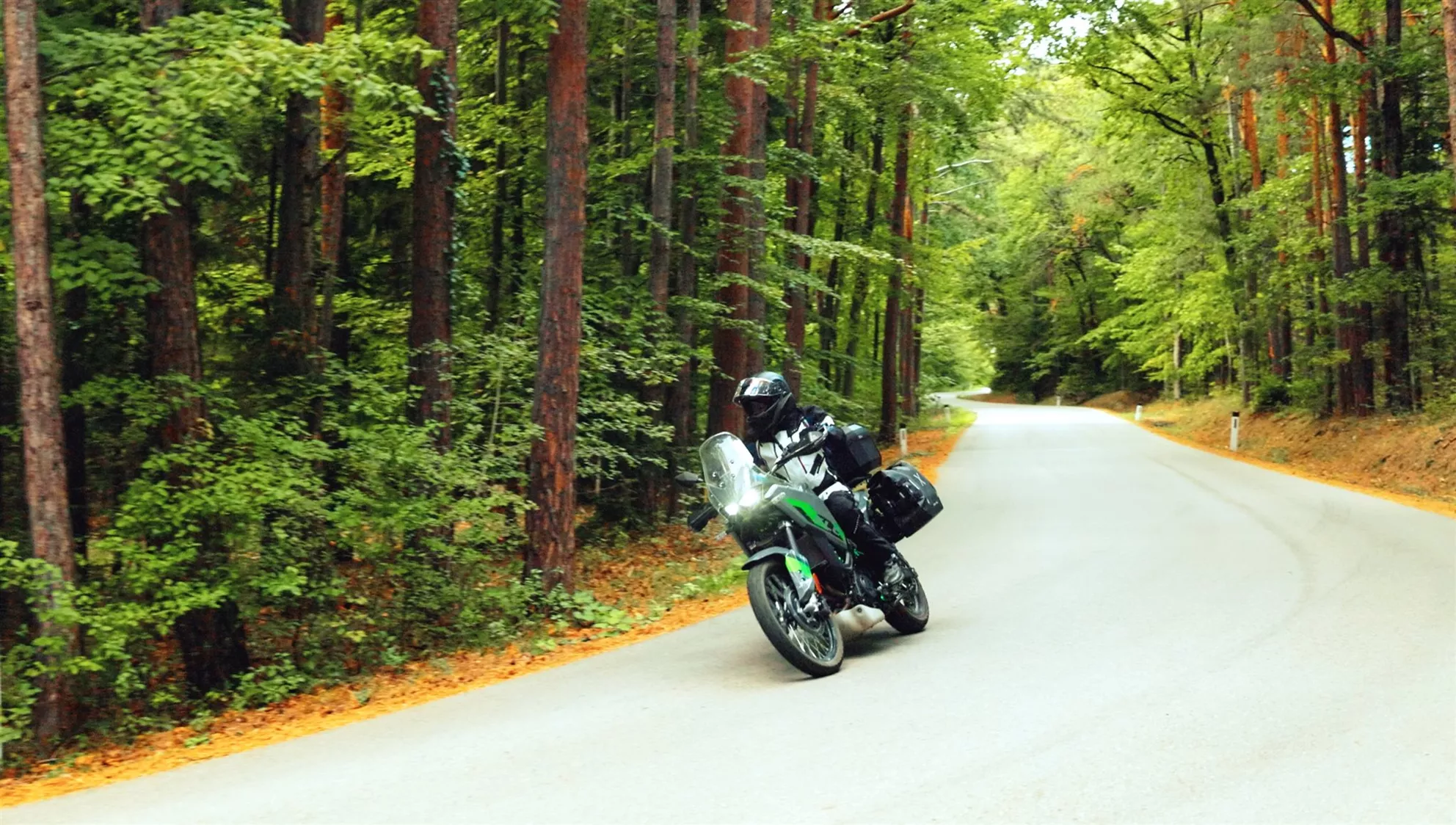
Fourth, at touring pace the suspension is rock solid.
210 millimetres up front and 196 at the rear, with only the preload on the shock adjustable. What I hadn't expected: it irons out bumps without wallowing afterwards. Frankee makes the best point of the whole year on this, namely that the KLE 500 almost shines on gravel ridden at a relaxed pace, because the big adventure bikes are often set up too firm from the factory and tire the rider out faster. The honest counter-question is: how often do you really go to the limit on a trip?
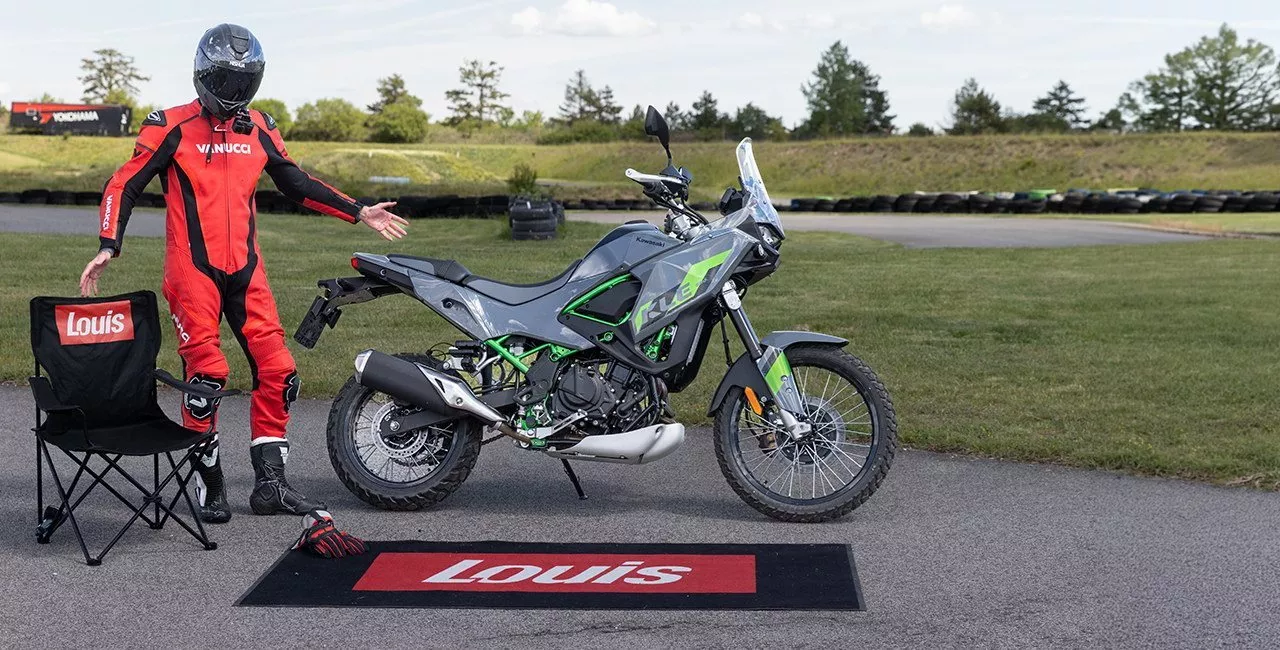
Fifth, you don't have to earn your confidence on this machine.
This is my favourite finding from twelve months, and it comes from the 1000PS Bestzeit. On the tight supermoto circuit in Bad Fischau, Nils rode a 1:12.419 on knobbly tyres at 31 degrees asphalt temperature. A BMW R 1300 GS sits at 1:07.2 there, a Honda XL750 Transalp at 1:08.7, both on road tyres and with considerably more power. The number itself isn't actually the exciting part.
I think I could have ridden it after just one lap and I'd have been just as fast.
NastyNils on the Kawasaki KLE 500 in the 1000PS Bestzeit test
On other bikes, he needs several laps for that, sometimes several sessions. Nils puts it down to the accessible responsiveness, the comfortable seating position and confidence in a solid Japanese product, and that is worth more in everyday life than any lap time. How quickly you feel at home on a bike matters more in the city, on tour and in tight mountain bends than the stopwatch.
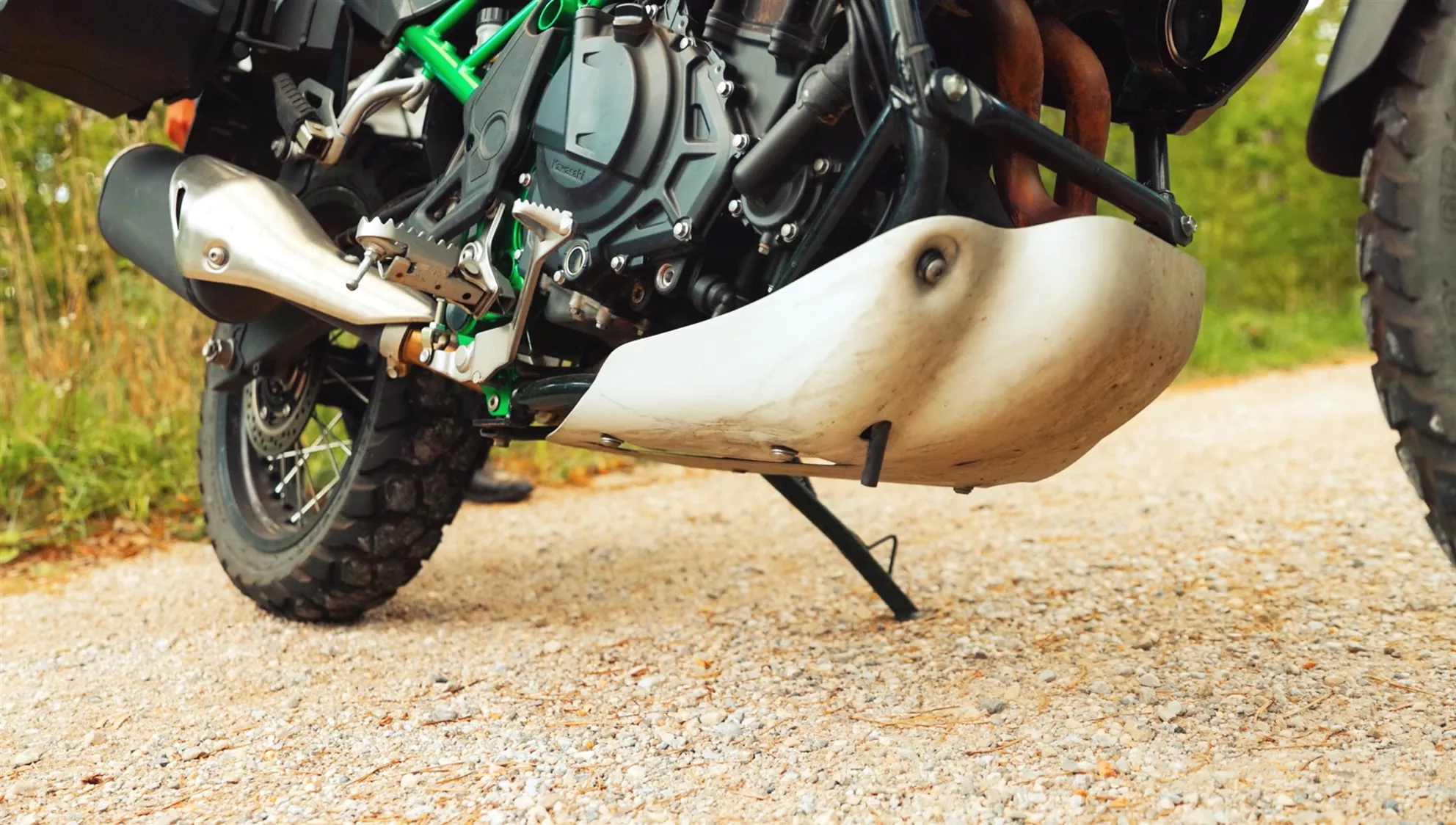
Sixth, ground clearance is the outrage that wasn't.
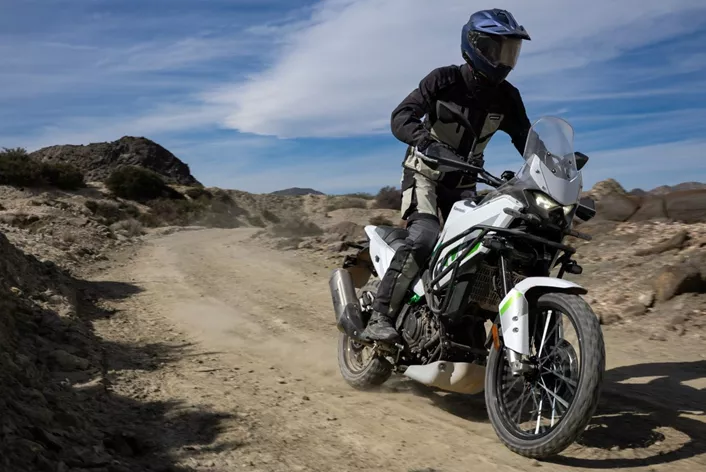
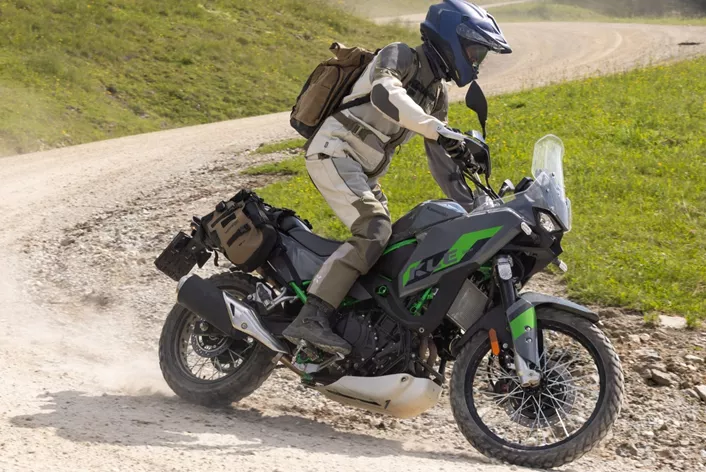
This brings me back to the question I asked at the start – and the answer is: no. 185 millimetres is less than the front suspension travel, that's true, and the reason is mundane: the KLE 500 uses the parts kit of the Z500 and Ninja 500, and the header runs underneath the engine. A different routing would have meant a new homologation and therefore a different price. In practice, Gregor actively tried to push the ground clearance to the limit in Spain, and Wolf rode in Slovenia and on the enduro course without touching down a single time. You only notice it on big rock steps, and that raises the honest question of whether you ever ride that kind of thing at all.
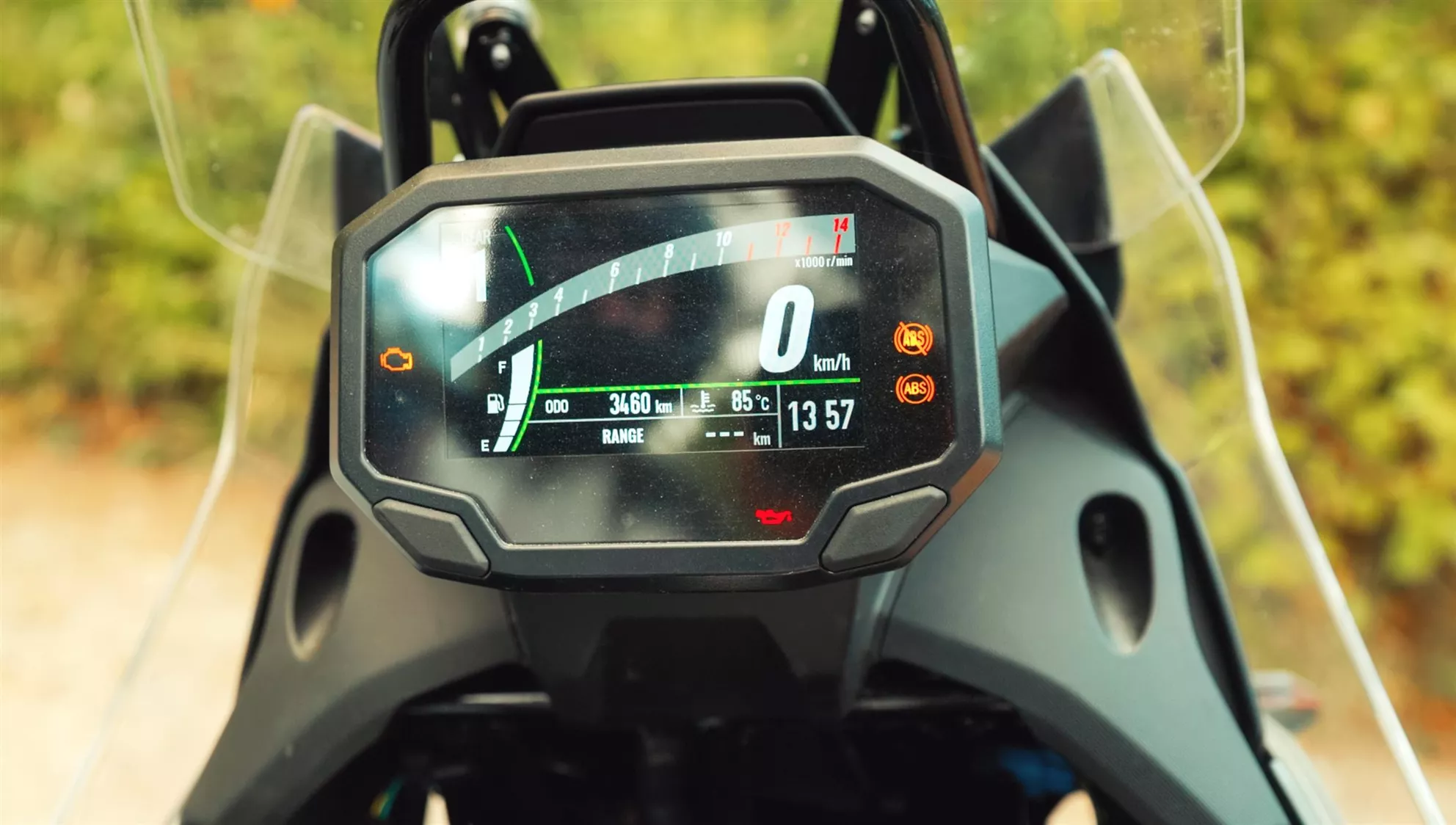
Seventh, purism is a feature here, not a cost-cutting exercise.
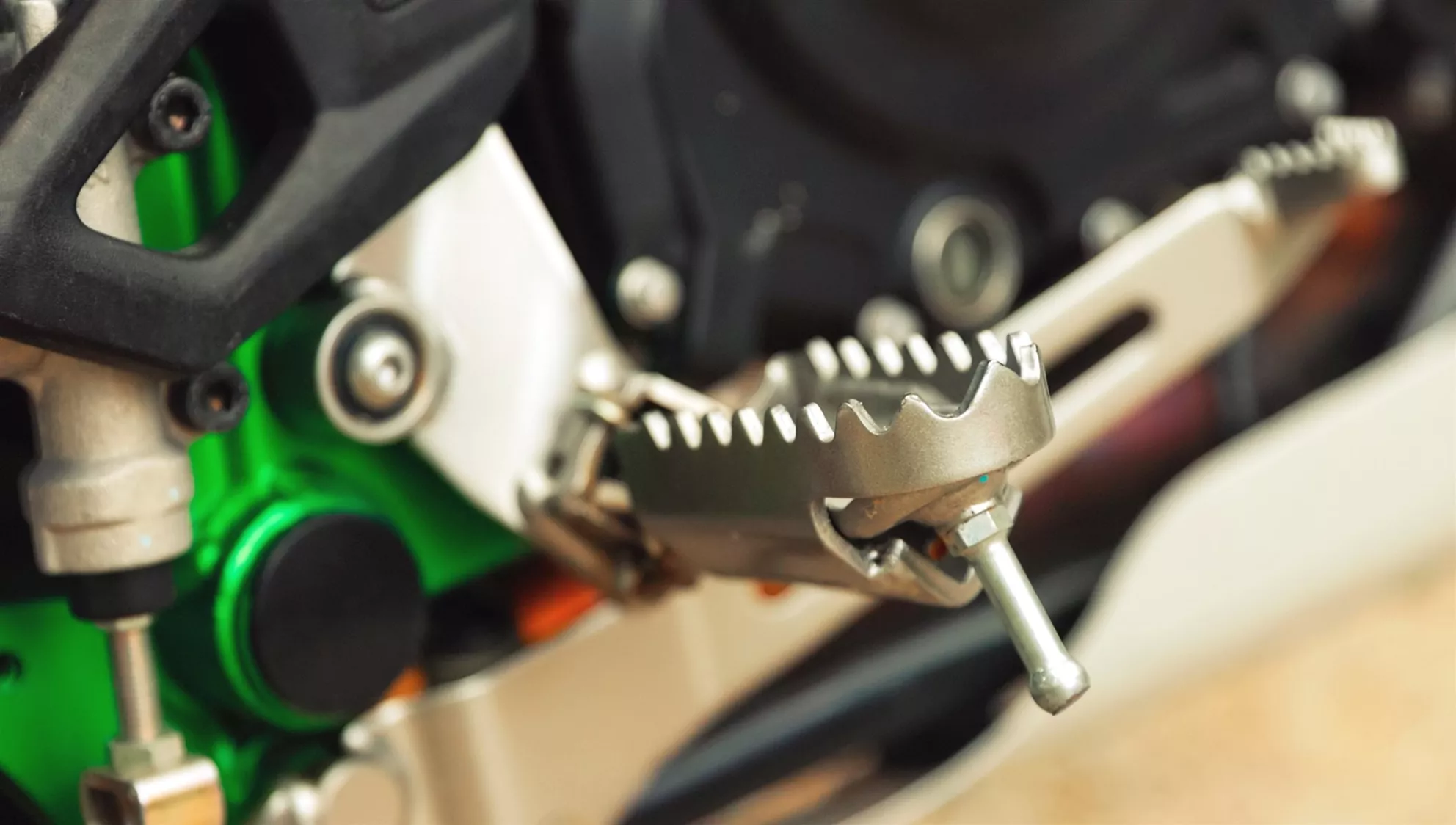
No traction control, no riding modes, no menu to get lost in. Get on, button, go. For the forest track, you press the big red button once briefly and once long, then the ABS is off, and after the next ignition cycle it's automatically back on. You pull out the rubber inserts of the footpegs without tools and have instant grip. These are small things, but they explain why several people in our fleet regularly reach for the cheaper machine, even though the expensive ones are parked right next to it.
Less electronics, less display, less brochure. But that doesn't make it any less of a bike!
NoPain on the Kawasaki KLE 500
Three problems with the Kawasaki KLE 500 in everyday use
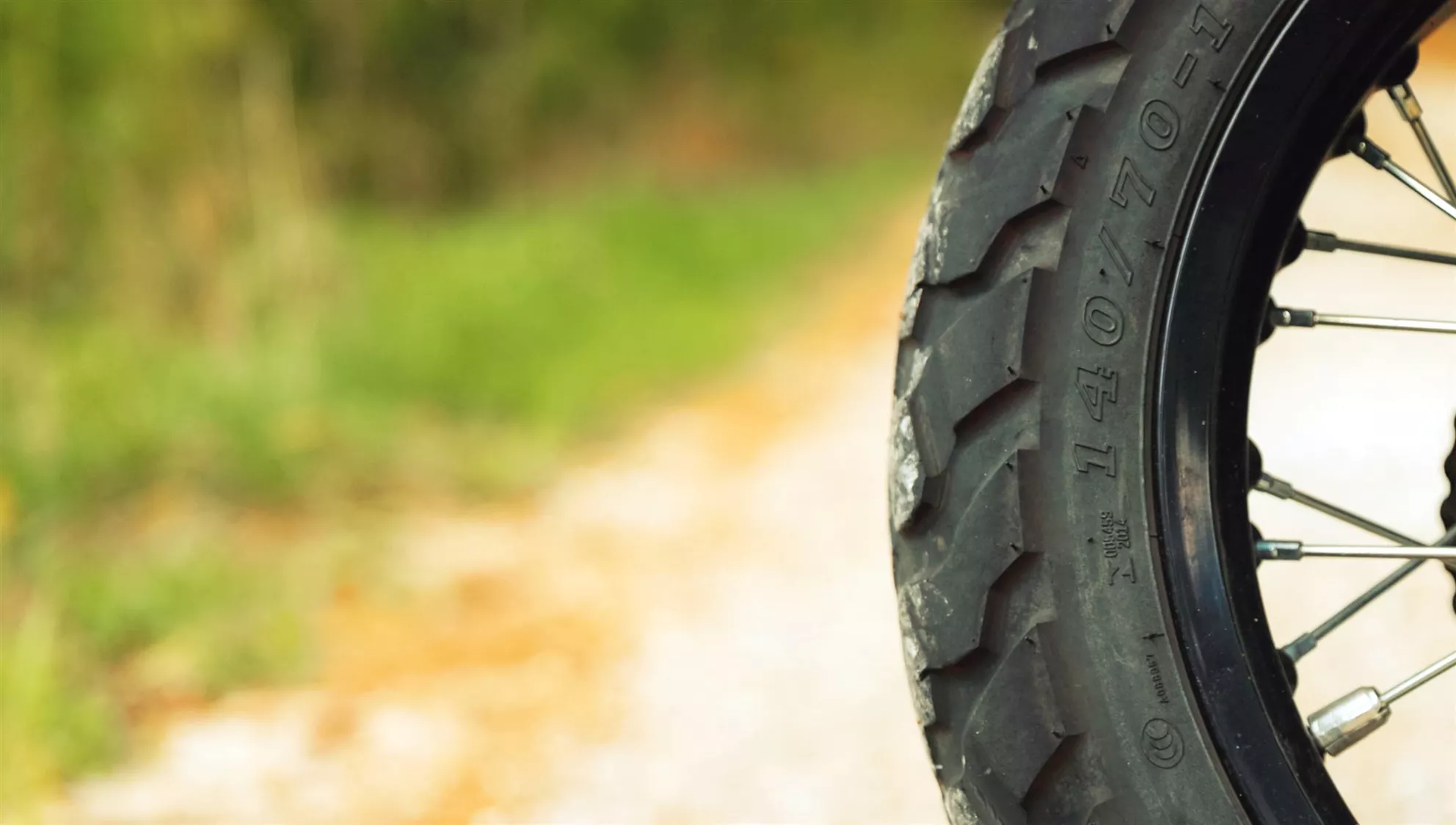
The first and by far the biggest problem is the 140/70-17 tubed rear wheel size.
At the front, with 90/90-21, everything is fine, but at the rear there are practically no aggressive knobbly tyres in this size. The stock IRC Trail Winner is good, on road as well as gravel, but in Europe it doesn't even have an official importer. 140/80-17 or 150/70-17 would have been adventure bike standard. The quickest way to make a bike more off-road capable is through the tyres, and that's exactly the route Kawasaki has blocked here. Unlike the ground clearance, there's no understandable reason for it: a different wheel size would have been perfectly feasible both technically and economically. This is the only point in this long-term test that I absolutely cannot play down.
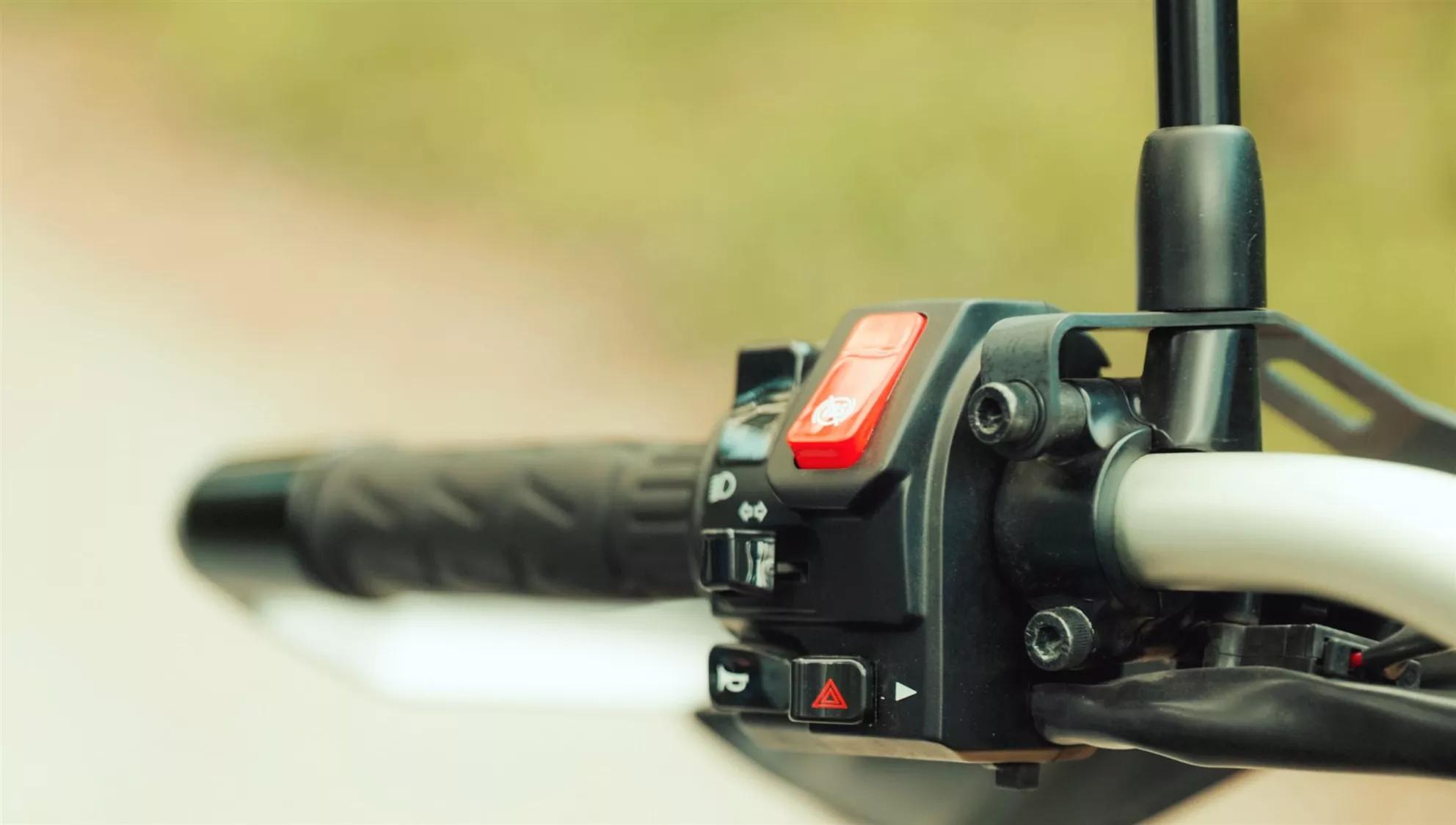
The second problem is the ABS, which can only be switched off completely.
What's missing is an off-road mode that only releases the rear wheel. That's exactly what would be right for this target group: learning to lock the rear is harmless, locking the front is the fastest way to end up on your face. Gregor counts this among the two criticisms that can't be explained away with the target group, Wolf sees it the same way, and even Bernd Hiemer says beginners will miss it off-road. The point can still be softened, though: the Yamaha Ténéré 700 was exactly the same at first, and the function was added with the model update.
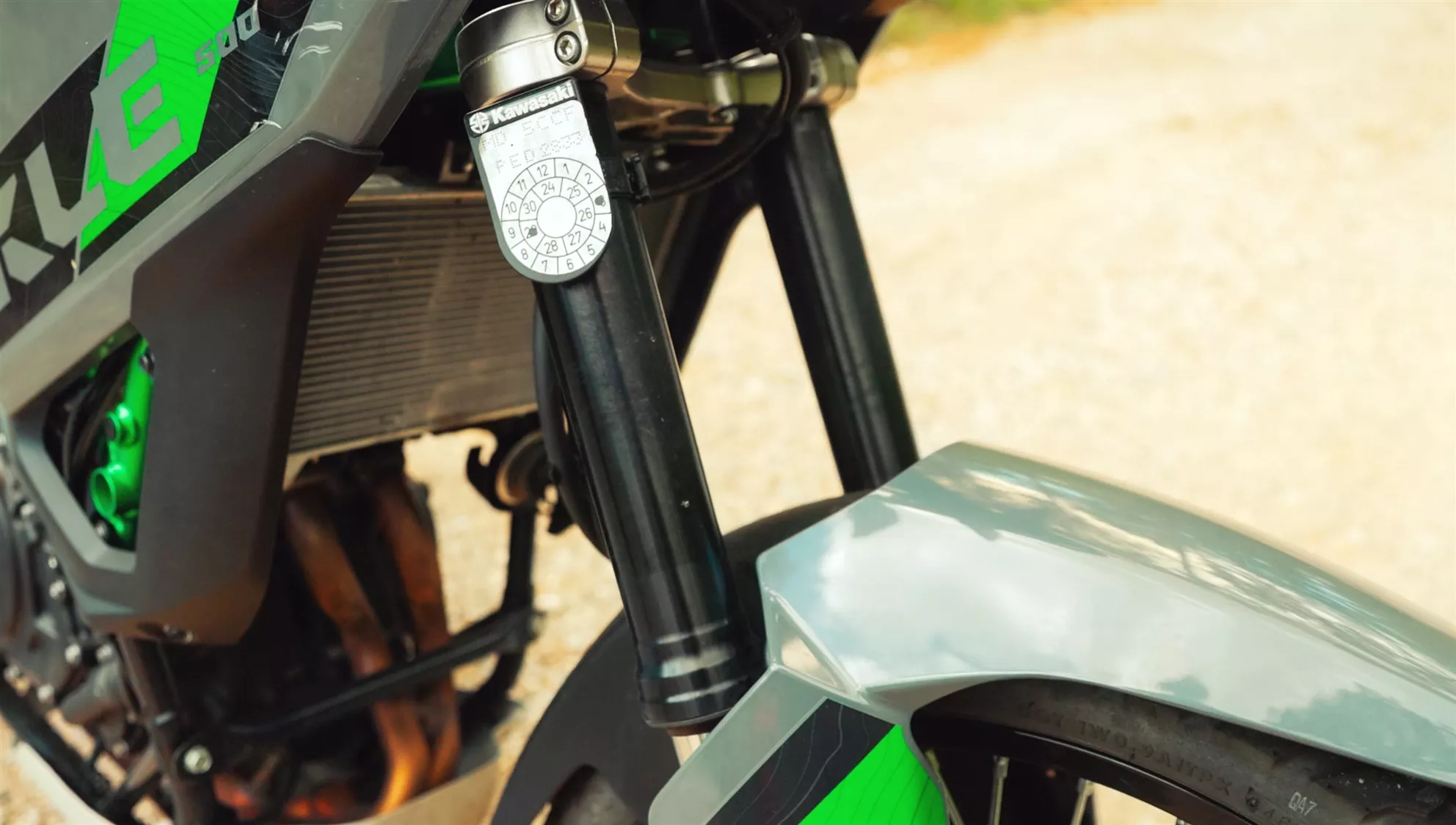
The third problem is the fork, as soon as you're in a hurry.
The same suspension that's rock solid at touring pace has a limit, and it comes sooner than 210 millimetres of travel would suggest. Under full braking, the fork dives all the way to the stop, and there's nothing left beyond that: exactly when you'd need some reserve at the front, there isn't any. On hard transverse ruts off-road, it bottoms out if you don't unweight the front wheel. For anyone riding really ambitiously, a trip to a suspension specialist pays off. On top of that, maximum lean angle runs out quickly, although there are also three centimetres of hero blobs stuck to the pegs from the factory.
What else came up in the 1000PS Community verdict: cruise control, tyre pressure monitoring, quickshifter and USB socket are missing entirely. That's fair, and anyone commuting on the motorway every day will notice. For me it's not a deal-breaker, because at none of these points does the Kawasaki KLE 500 lose riding pleasure, only comfort. What we didn't test is durability over several seasons and fuel consumption under controlled conditions: Frankee calculated 4.25 litres per 100 kilometres in Switzerland, Gregor got 5.3 litres at the press event in Spain – those are two snapshots, not a reliable series of measurements.
Why we test-ride bikes in the browser
And that brings me to my actual topic. Frankee writes that the Kawasaki KLE 500 disappointed him on the spec sheet and then won him over in the saddle. Nils came in with the old KLE in his head, a nimble-as-a-weasel fun bike for country road duels from his youth, his mate on the KLE, himself on a KTM LC4. Then he got on the 2026 model year and found knobbly tyres. Shortly afterwards, on his way home from work, he spontaneously took a gravel track, with a grin on his face. For both of them, the disappointment came before riding, and for both of them it was gone afterwards. We've become a generation that test-rides bikes in the browser and trashes them in the comment field, and I don't exclude myself from that.
My everyday life with the KLE 500: seat, gravel, pillion
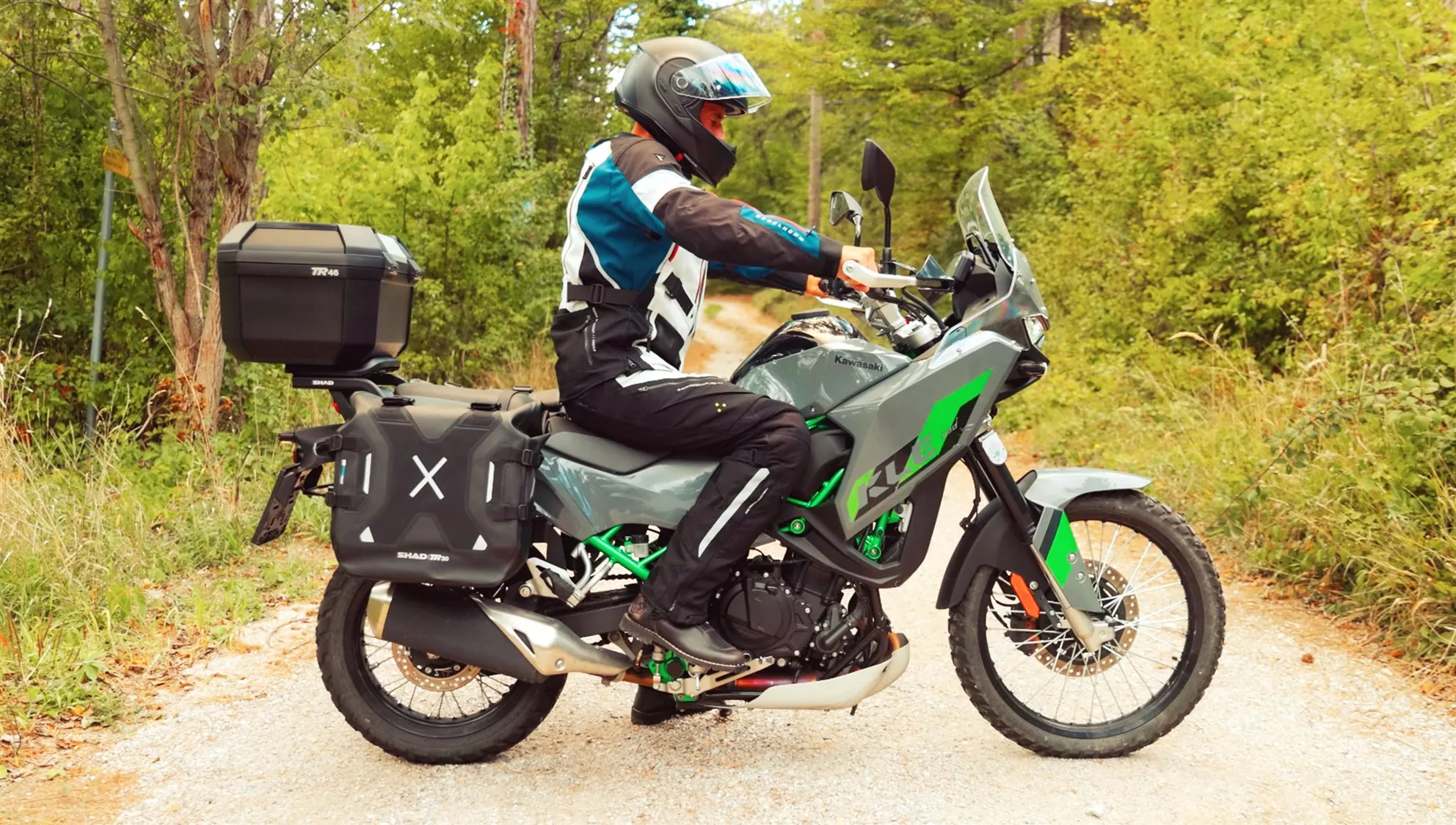
Let's start with getting on, because that honestly surprised me. On the new Kawasaki KLE 500, I get both feet cleanly on the ground. On my old one thirty years ago, that's exactly what I struggled with, and today I'm three centimetres shorter than I was back then. Either I've filled out so much in the meantime that it balances out, or the seat is much better shaped at the crotch. Gregor describes exactly that in his report from Spain. Back then it was a slog, today it's a non-issue.
Second: the feeling of safety. Whether deep truck ruts at the junction or loose gravel under the wheels – I never felt uneasy on this bike. And the caveat belongs here before someone writes it in the comments: I myself almost never ride off-road. My gravel outings are no benchmark for the off-road qualities of the Kawasaki KLE 500; Bernd Hiemer, Wolf and Gregor vouch for that. All I can judge is how this machine feels when someone who can't do anything off-road is sitting on it. And to that I say: it'll do just fine.
The most important thing comes last. I rode with my daughter as pillion, and of all the bikes we've ridden together, she liked the KLE 500 best. Quiet, comfortable, silky-smooth drive and high enough for a good view ahead. Hardly anyone ever talks about pillion suitability in tests, yet it decides whether a ride for two gets repeated. If whoever is behind you feels comfortable, you're already halfway there.
SHAD soft luggage on the KLE 500: the drop test
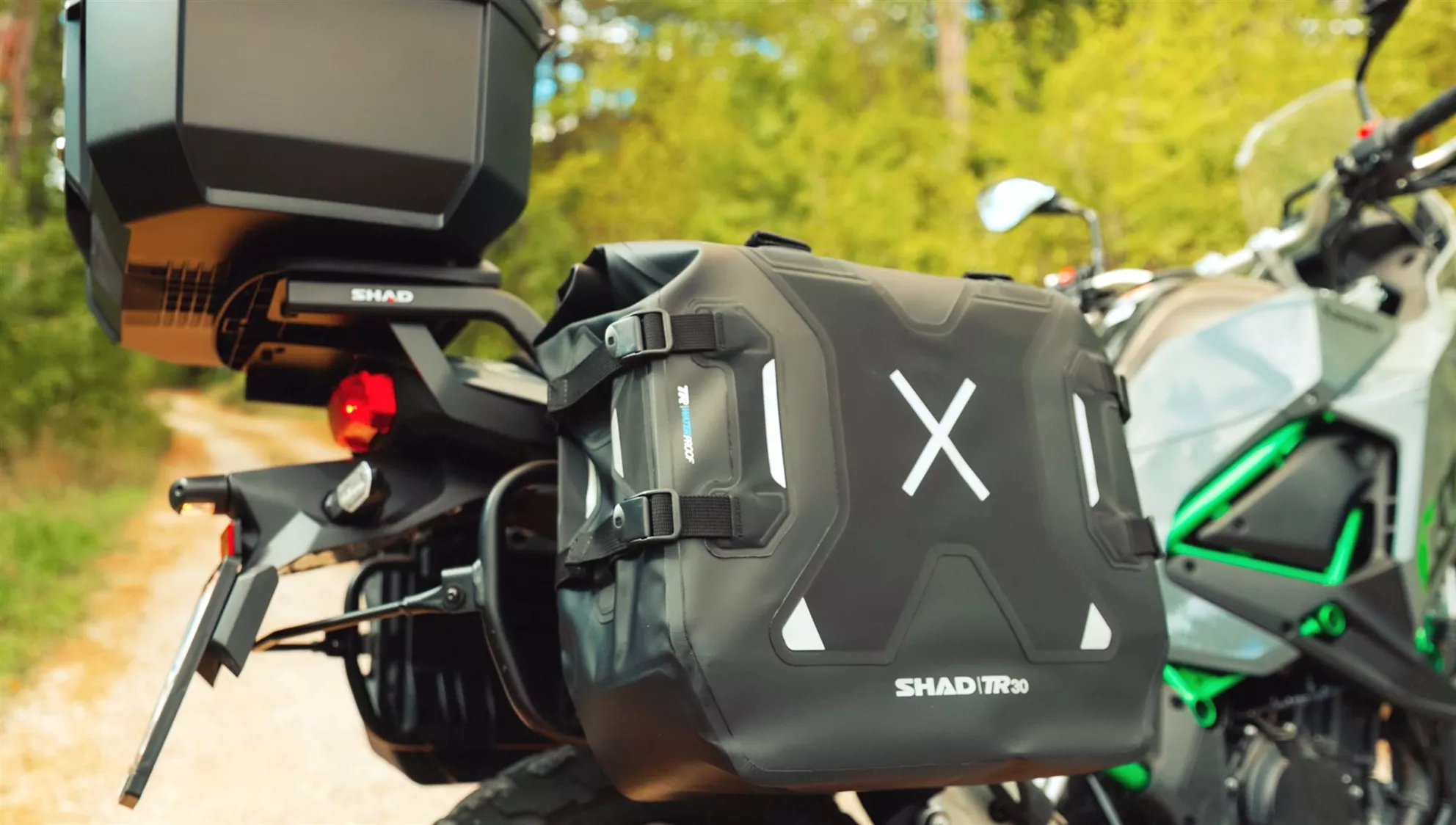
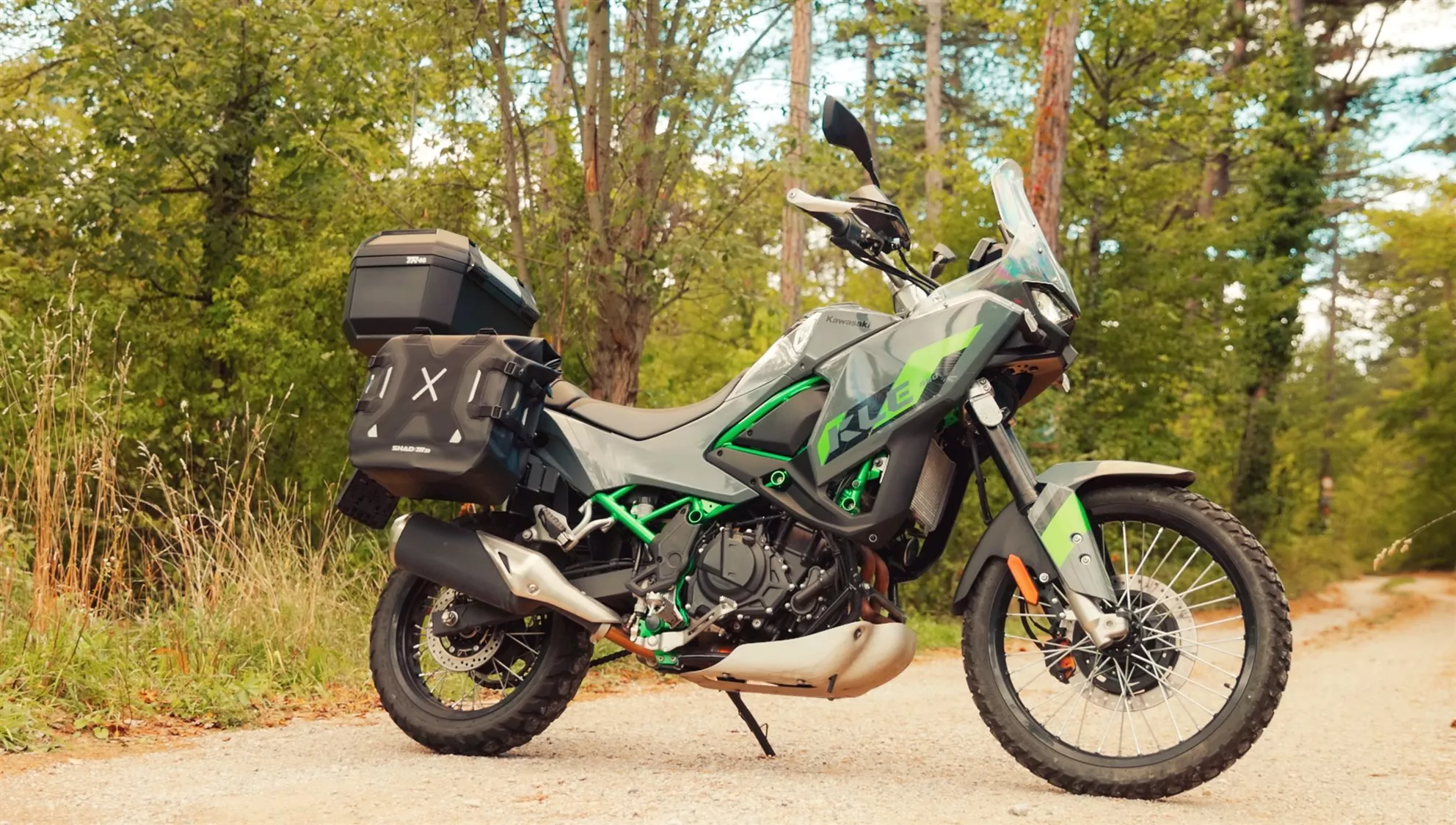
A word on luggage, because I rode with it a lot. The Kawasaki KLE 500 had the SHAD soft luggage side bags fitted throughout and the top case some of the time. What isn't in any brochure: during a tip-over at a standstill, the bags took the first contact, and afterwards nothing was bent or broken on either the bag or the bike. Otherwise, they packed neatly, kept their shape and stayed dry inside.
Visually, I'm no fan of the top case because it ruins the lines. With the little one on the back, I still appreciated it, because helmet and gloves simply go in and because it works as a backrest. Despite an ambitious riding style, I never lost her over the speed bumps in the 30 km/h zones. The test limit belongs here: I didn't experience hours of continuous rain or a whole winter with these bags, so I can't say anything about durability after three seasons.
Verdict on the Kawasaki KLE 500 after one year
So you can put my verdict into context: I'm 1.75 metres tall, ride around 99.9 per cent of my kilometres on asphalt between everyday use and relaxed country roads, only occasionally go on gravel and grew up with bikes without riding modes. A bike that doesn't ask me anything when I set off therefore automatically scores points with me. If you spend ten weekends a year off-road, you'll need to recalculate my rating accordingly.
If you travel at a relaxed pace, commute every day, like to take a gravel track and aren't riding at the limit while you do it, then the Kawasaki KLE 500 is one of the most honest recommendations we can make for the 2026 season. It suits returning riders, A2 riders and anyone fed up with every bike getting bigger, heavier and more complicated. If, on the other hand, you regularly want to head into hard off-road terrain and change your own tyres in the middle of nowhere, then look elsewhere, because the rear wheel size will annoy you for good. And if you send it on the road until the pegs scrape, the suspension will be too soft for you, though that can be fixed without spending a fortune with different fork springs and suitable oil.
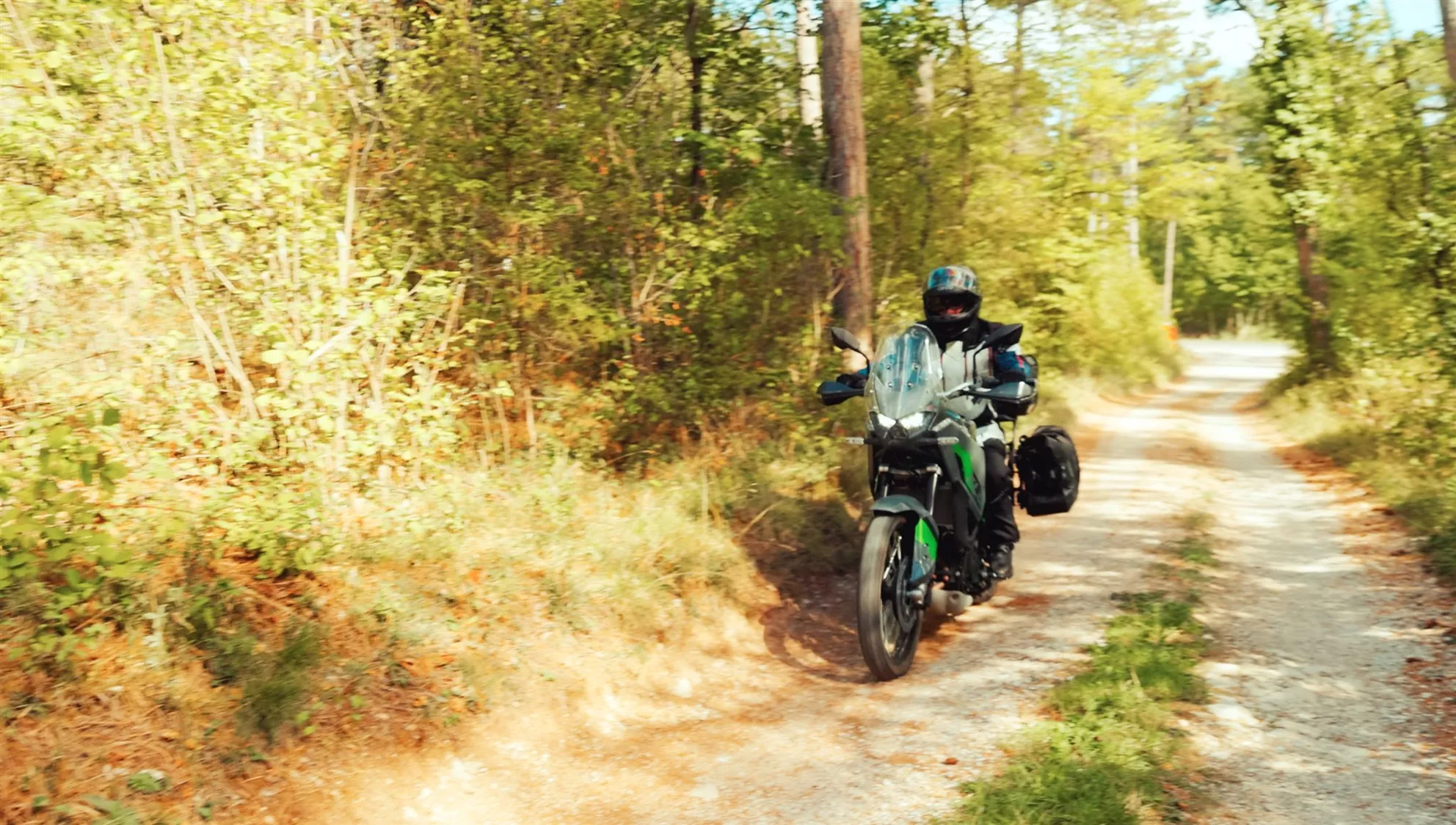
My question from the start, whether the KLE is still the KLE, I answer with a qualified yes: it's no longer the bike I wanted to conquer the world with at twenty, but one for every weekday and for the holiday when you turn off onto the gravel after all.
FAQ on the Kawasaki KLE 500
How much does the 2026 Kawasaki KLE 500 cost?
The standard version costs 7,099 euros in Austria and 6,895 euros in Germany. The tested Kawasaki KLE 500 SE costs 7,899 euros in Austria and 7,695 euros in Germany. The surcharge gets you a colour TFT display, taller windscreen, reinforced handguards, LED indicators and a large aluminium bash plate. As of September 2026.
What problems does the Kawasaki KLE 500 have?
The most serious problem is the 140/70-17 rear wheel size, for which there are practically no aggressive knobbly tyres. In addition, there's ABS that can only be switched off completely rather than just at the rear wheel, and a fork that dives all the way to the stop under full braking with no reserve.
Is the ground clearance of the Kawasaki KLE 500 too low?
No, in practice the 185 mm ground clearance was not a problem. In a year of continuous use across Spain, Switzerland and Austria, the Kawasaki KLE 500 never touched down once, not even on the enduro course. The figure only becomes critical on big rock steps, i.e. in terrain this adventure bike isn't intended for anyway.
What is the seat height of the Kawasaki KLE 500?
The seat height is 870 mm; the optional ErgoFit seat at 840 mm is available for rider and pillion. Thanks to the very narrow seat waist, more leg reaches the ground than the figure suggests: in the test, riders from 1.75 m to 1.85 m stood securely on both feet.
How fast is the Kawasaki KLE 500 on the race track?
In the 1000PS Bestzeit test on the supermoto circuit in Bad Fischau, the Kawasaki KLE 500 set a lap time of 1:12.419, measured on stock IRC Trail Winner tyres at 31 degrees asphalt temperature. For comparison: a BMW R 1300 GS sits at 1:07.2 there, a Honda XL750 Transalp at 1:08.7, both on road tyres.
Who is the Kawasaki KLE 500 suited to?
The Kawasaki KLE 500 is suited to commuters, returning riders and A2 riders who travel at a relaxed pace and occasionally take gravel tracks. At 195 kg wet weight, it's one of the light adventure bikes under 200 kg. Anyone wanting to head into hard off-road terrain regularly will find better alternatives because of the tyre choice.
- How much does a Kawasaki KLE500 SE cost?
- Here you will find an overview of the price level of new and used motorbikes!
&width=60&height=60&bgcolor=rgba_39_42_44_0&mode=crop "Author: NoPain")
Kawasaki KLE500 SE 2026 - Experiences and Expert Review
NoPain
The 2026 Kawasaki KLE500 is no off-road monster, but a well-balanced A2 adventure bike with a clear all-round focus. It impresses with stable suspension, a good-natured engine and well-judged ergonomics, and marks a solid new start for Kawasaki in the adventure segment. It makes a few small slip-ups, but only one of them is really annoying.
Alternatives to the Kawasaki KLE 500 in the A2 class
Kawasaki KLE 500 long-term test: the 3 problems after one year Images
Source: 1000PS


The tire sidewall with the embossed size 140/70-17, that unusual dimension for which there are hardly any knobby tires available.

The serrated steel footpeg of the Kawasaki KLE 500, designed for off-road use and easily removable without tools.

Undershot of the large aluminum engine guard of the SE variant and the side stand, alongside the low-hanging exhaust pipe.

View from below the engine, showcasing the exhaust routing and bash plate of the Kawasaki KLE 500, which explains the remaining 185 mm ground clearance.