With the Tracker 400, Triumph expands its successful 400 platform with a fourth variant, presenting a bike consistently designed for riding dynamics. Royal Enfield, on the other hand, takes a completely different approach with the Guerrilla 450. While its Sherpa single-cylinder engine comes directly from the convincing Himalayan 450, the focus here is on everyday usability and uncomplicated riding pleasure rather than adventure genes. Both bikes sit right in the middle of the fiercely contested A2 segment, produce around 40 hp, weigh under 190 kilograms, and cost well under 7,000 euros. At first glance, it seems like a duel on equal footing. However, on the roads around Neukirchen am Großvenediger, the venue for the "Newchurch Summit" motorcycle festival, two completely different characters reveal themselves.
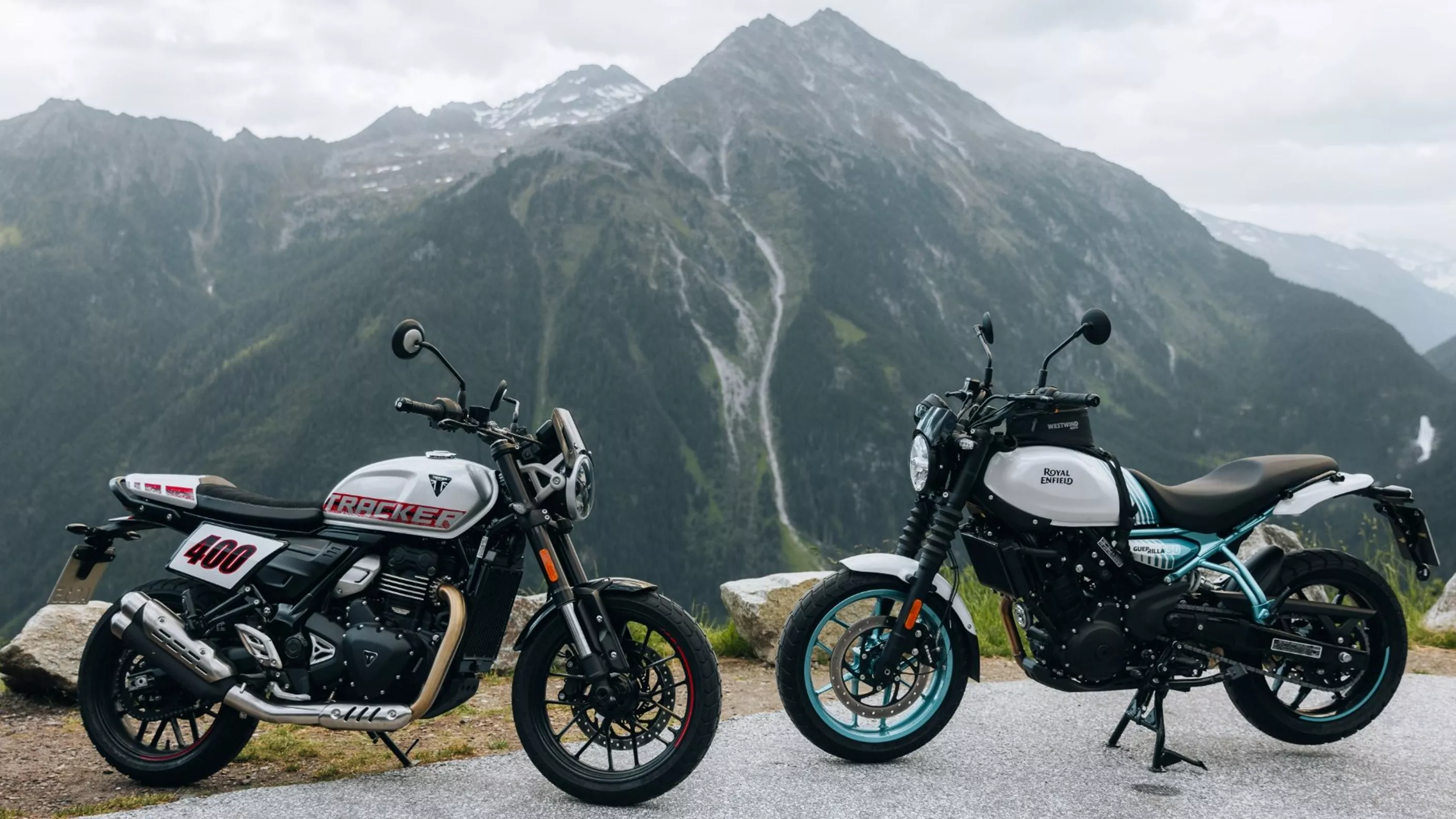
Triumph Tracker 400 vs. Royal Enfield Guerrilla 450
Two A2 Singles, Two Philosophies
Both bikes sit right in the middle of the fiercely contested A2 segment, produce around 40 hp, weigh under 190 kilograms, and cost less than 7,000 euros. At first glance, it therefore seems like a duel on equal footing. On the road, however, two completely different characters reveal themselves.
&width=72&height=72&bgcolor=rgba_39_42_44_0&mode=crop "Author: Clemo")
Clemo
published on 7/16/2026
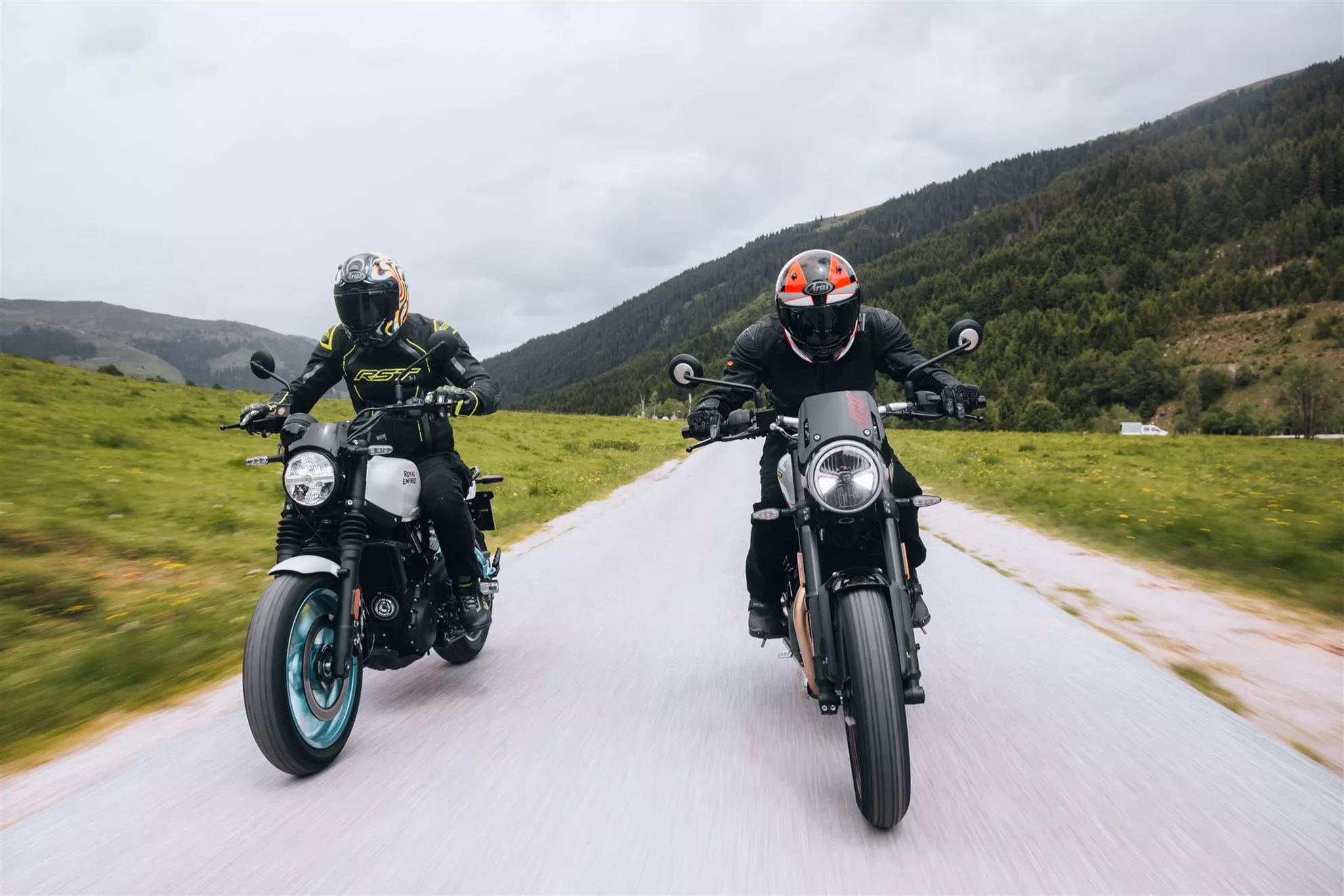
Test ride in the alpine backdrop around the "Newchurch Summit"
Build Quality and Design
Even at a standstill, it's clear that both manufacturers set different priorities. The Triumph looks like it was cast from a single mold and even meets premium standards. Clean welds, high-quality painted components, and material quality that sets benchmarks in this class create almost the impression of a significantly more expensive bike. Especially the completely blacked-out components, the compact 13-liter tank, the number boards, and the raised dual exhaust give the Tracker a distinctive presence. Although it's based on the well-known 400 platform, it in no way feels like a slightly modified Speed 400, but possesses its own clear identity. The Guerrilla 450, on the other hand, pursues a pleasantly uncomplicated retro approach. Round headlight, classic tank, and simple lines are reminiscent of traditional naked bikes, while the modern TFT display and LED lighting create a contemporary impression. The build quality is absolutely convincing for the price and represents a massive step forward for Royal Enfield, though it doesn't quite reach the finish of the Triumph. Especially with the simple brake and clutch levers or some plastic parts, you notice that Royal Enfield has consistently kept the attractive sales price in mind.
Ergonomics – Sport vs. Comfort
As soon as you sit on both bikes, the different philosophies become immediately apparent. The Guerrilla welcomes its rider in an extremely relaxed way. With a seat height of just 780 millimeters, it's one of the lowest bikes in its class. The wide handlebar sits comfortably in your hands, the knee angle stays relaxed, and the narrow midsection of the bike ensures a secure stance even for shorter riders. Especially in city traffic, it immediately instills confidence. The Tracker takes a completely different approach. Triumph positioned the handlebar around 13 centimeters lower compared to the Speed 400, while simultaneously widening it. The footpegs move noticeably further back and up. As a result, the rider sits much more actively on the bike. More weight rests on the front wheel, which initially feels somewhat sportier, but pays off at the latest on winding country roads. The front wheel provides more feedback, and the rider feels more integrated into the riding experience. Nevertheless, the Tracker remains surprisingly practical for everyday use. The seat height of 805 millimeters sounds higher at first, but thanks to the narrow seat, ground contact is achieved without any problems. Even longer stretches can be completed without discomfort, although the Guerrilla overall offers the more relaxed, almost cruiser-like riding position.
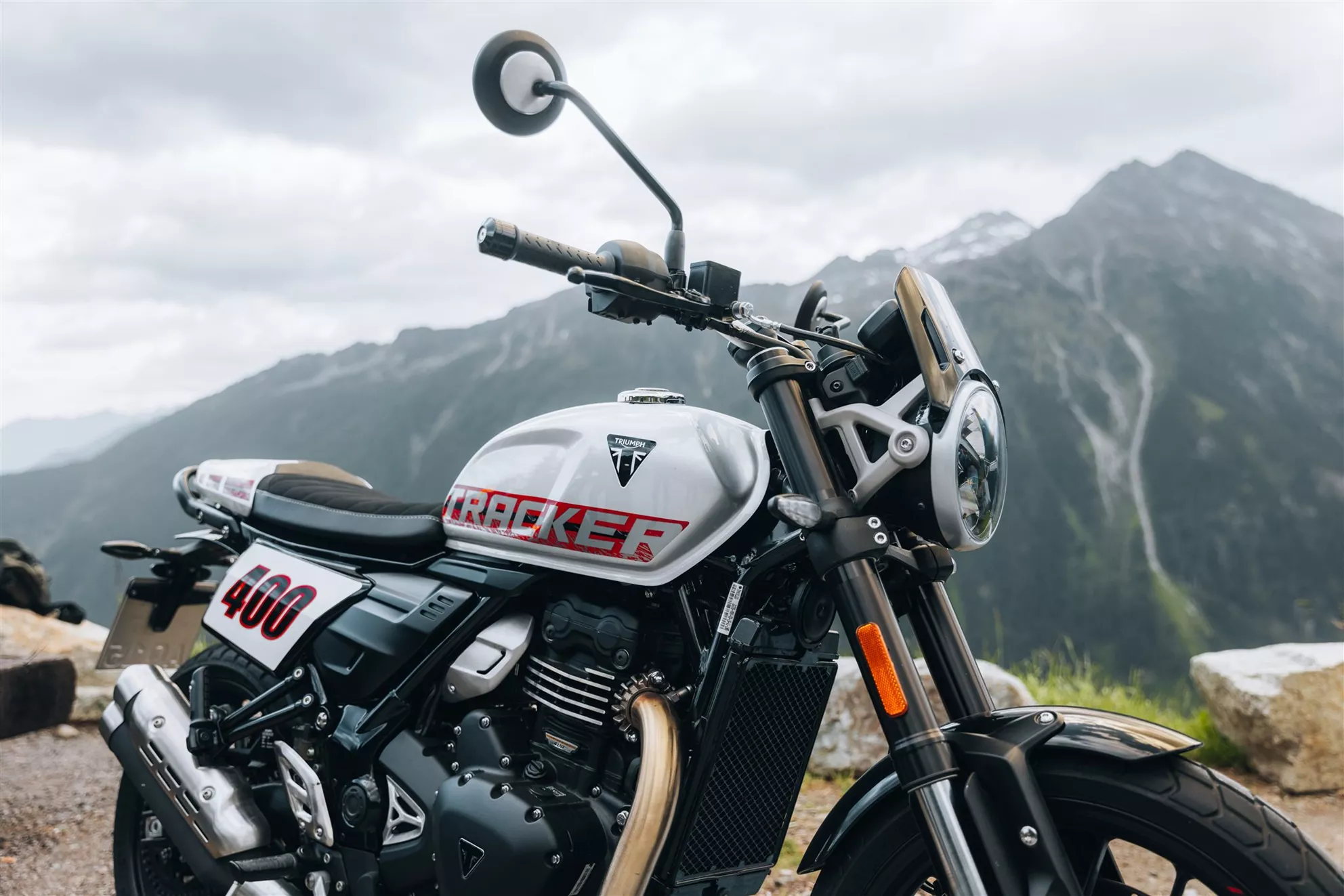
Exemplary build quality on the Triumph Tracker 400
Single-Cylinder Engines with Contrasting Characters
Although both bikes nominally offer nearly identical performance figures, their engines could hardly feel more different. The Royal Enfield's Sherpa 450 draws 40 hp and 40 Newton-meters from 452 cubic centimeters. Its strength clearly lies in the low and mid rev range. Just above idle, the single-cylinder runs smoothly and without jerking. In everyday use, this means relaxed cruising without constant shifting. Especially in city traffic or on winding country roads, the Guerrilla lets you get away with being pleasantly lazy about shifting gears. Only in the upper rev range does the engine lose some punch. It never demands the rider wind it out, but rather conveys composure. The Triumph's 398cc single-cylinder presents itself quite differently. Through the new camshaft and modified valve timing, its character has been deliberately sharpened. Peak power also increases to "only" 42 hp, but the way power is delivered is more decisive. The engine responds more spontaneously to throttle input, revs up noticeably more eagerly, and encourages the rider to wind out the gears longer. Where the Royal Enfield motivates you to shift up early, the Triumph wants to be revved to high RPM. In direct comparison, the Guerrilla feels stronger coming out of tight hairpins, while the Tracker accelerates more lively and sportily. Neither engine has power in abundance, but that's exactly where their appeal lies: both can be ridden almost permanently at the limit without overwhelming the rider. Both manufacturers also put in a convincing performance with their transmissions. The Royal Enfield shifts extremely smoothly, the Triumph a bit crisper and more mechanical. However, a quickshifter is nowhere to be found on either comparison test contender. Both clutches, on the other hand, work pleasantly light and make city traffic child's play even without needing lumberjack forearms.
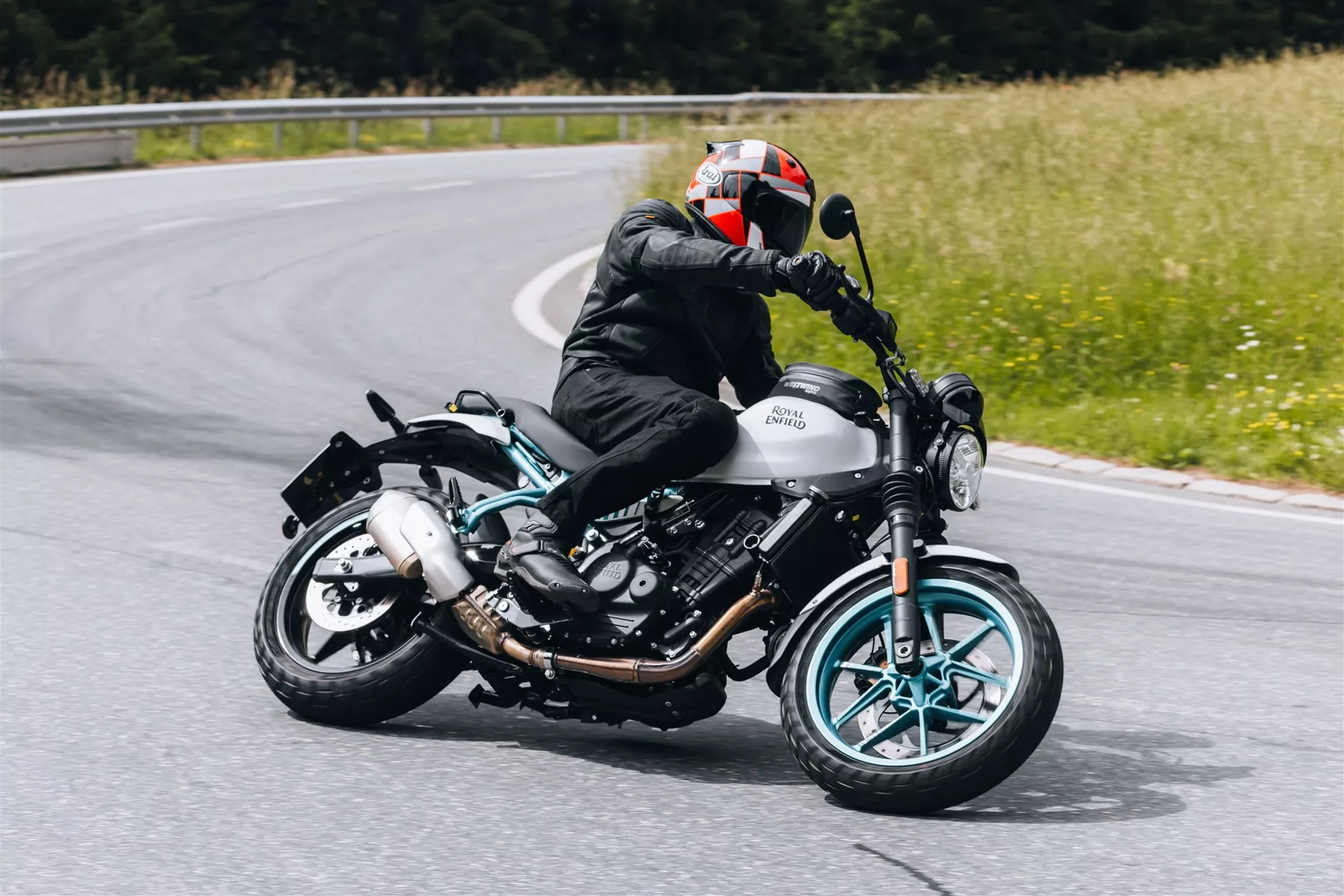
The good-natured Guerrilla 450 requires hardly any adjustment time
Chassis – Comfort and Precision
The differences continue seamlessly with the chassis. The Guerrilla initially surprises with a remarkably comfortable base setup. It solidly filters out manhole covers and rough patches of asphalt without feeling spongy. Especially on poor country roads or in the urban everyday grind, the bike feels extremely composed, if it weren't for the slightly underdamped fork, which occasionally causes some unrest while leaned over. The Triumph, on the other hand, pursues a distinctly firmer setup. However, this by no means implies a lack of comfort. The chassis responds sensitively to small bumps, yet overall conveys significantly more feedback. Especially during quick direction changes or hard braking into corners, the Tracker stays calmer and conveys noticeably more confidence in the front wheel. Add to that the weight advantage. At just 173 kilograms wet weight, the Triumph weighs around eleven kilograms less than the Guerrilla. On paper, this difference sounds manageable, but in practice the Tracker feels significantly lighter. It falls playfully into lean angle, requires hardly any force on the handlebar, and changes its line almost intuitively. The Guerrilla remains pleasantly nimble as well, but in direct comparison feels somewhat more settled and calmer.
Riding Dynamics – Two Paths to Riding Pleasure
At the latest on a winding country road, it becomes clear that Triumph and Royal Enfield interpret the topic of riding pleasure completely differently. The Guerrilla 450 convinces with its balance. It requires hardly any adjustment period from its rider and conveys a familiar feeling after just a few kilometers. The Sherpa single-cylinder pushes strongly from mid-range revs, the comfortably tuned chassis diligently irons out bumps, and the neutral geometry ensures predictable turn-in behavior. Especially on changing road surfaces, the Royal Enfield remains pleasantly composed. The Triumph, on the other hand, pursues a distinctly more active approach. Right from the first turn-in, it's noticeable how directly it responds to steering input. The lower handlebar, the further rearward-positioned footpegs, and the more front-wheel-oriented riding position ensure that the rider works much more intensively with the bike. The Tracker doesn't demand more skill, but conveys significantly more feedback. Especially when trail braking into a corner, the front wheel remains crystal-clear and comprehensible, while it can be held precisely on the chosen line while leaned over. The weight advantage further reinforces this impression. Eleven kilograms doesn't sound dramatic on the spec sheet, but in direct comparison the Tracker feels almost a class lighter. Direction changes succeed playfully, tight hairpins lose their terror, and even spontaneous line corrections cost hardly any effort. This creates an interesting difference: the Guerrilla rides in an extremely comfortable manner, while the Tracker, in contrast, is addictive. With it, you automatically look for the next combination of corners, brake a bit later, turn in a bit more decisively, and accelerate out earlier again. Not because it's significantly faster, but because it conveys a touch more confidence to the rider.
The Royal Enfield's brake system decelerates reliably and offers sufficient reserves for its performance class. However, the lever requires a bit more hand force before solid deceleration sets in. This is by no means bad, but rather conveys the impression of a comfortably tuned, beginner-friendly everyday brake rather than a sporty anchor. The Triumph's ByBre brake system, on the other hand, feels more direct. Pressure point and modulation convince right away and harmonize excellently with the precise front end. Especially on winding roads, this creates a coherent overall package. The Tracker conveys more confidence when trail braking late, without being nervous or excessively grabby.
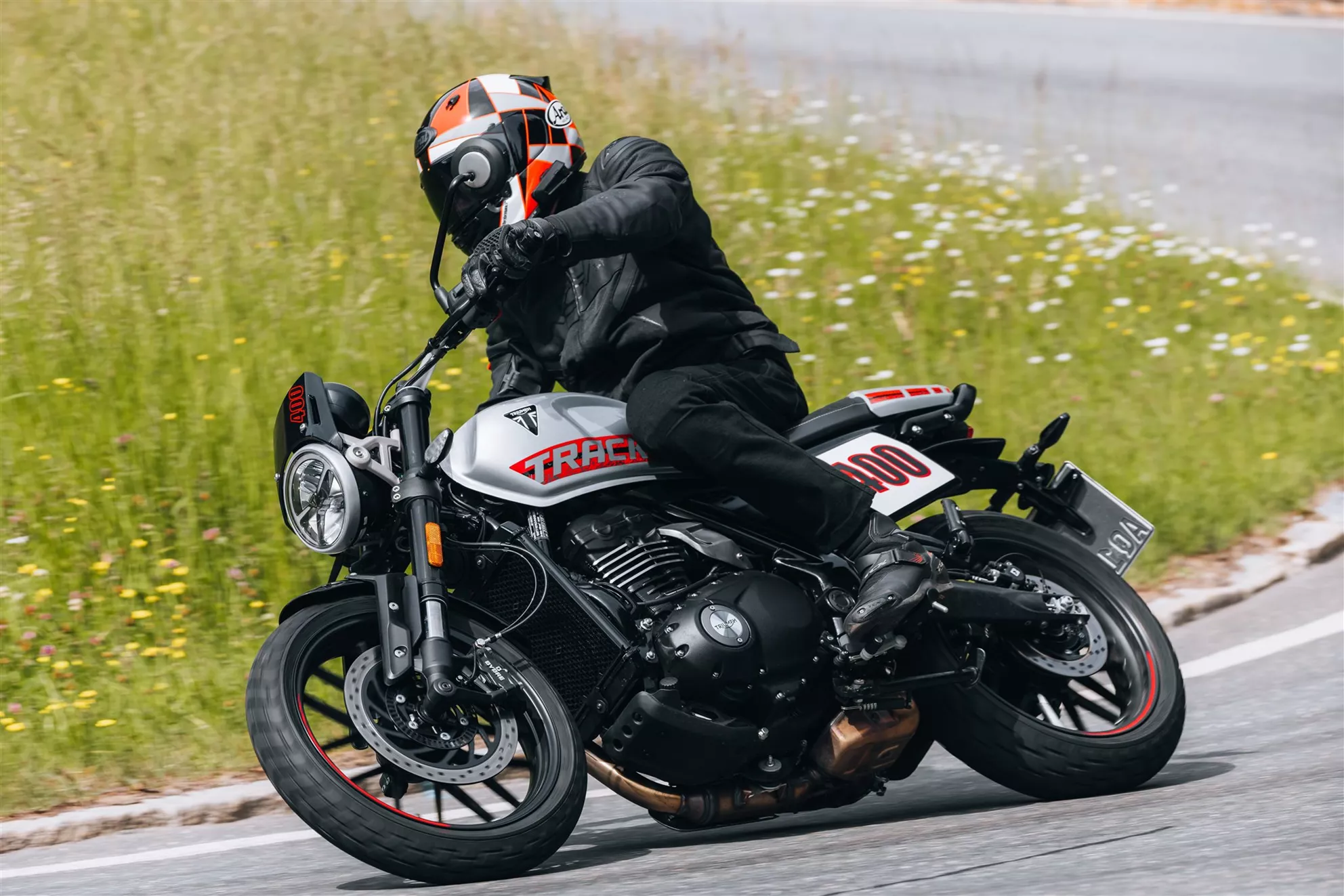
In terms of agility and liveliness, Triumph sets the bar high
Everyday Use – The Guerrilla Scores with Composure
In daily use, the picture partly shifts. The low seat height of just 780 millimeters, the relaxed ergonomics, and the smooth engine character make the Guerrilla an extremely uncomplicated companion. It plays to its strengths especially in dense city traffic. Clutch and gearbox operate smoothly, the engine takes throttle cleanly even from low revs, and heat development remains pleasantly low even in summer temperatures. The comfortable chassis confidently absorbs potholes and further enhances riding comfort. The Triumph's sportier knee angle and more forward-oriented seating position, on the other hand, demand a bit more effort, but remain surprisingly acceptable in everyday use. The low weight makes maneuvering and tight turning easier, while the narrow silhouette also fits through dense traffic without any problems. Anyone who mainly commutes or drives through the city center daily is likely to feel at home a bit faster on the Royal Enfield. The Triumph requires a somewhat longer adjustment period.
Despite all the differences, both bikes share one commonality: long highway stretches are not among their forte. The Guerrilla confidently holds cruising speeds around 130 km/h and remains pleasantly stable while doing so. However, the vibrations typical of single-cylinder engines increase noticeably with rising speed. This is completely sufficient for occasional highway stretches, but hours-long journeys quickly become tiring. The Triumph also feels less at home on the highway. Its revvy engine has to work harder for high speeds, which likewise causes noticeable vibrations at the handlebar and footpegs. Add to that the practically nonexistent wind protection, which places additional strain on the rider. Both bikes primarily see themselves as country road and city machines – and that's exactly where they feel most at home.
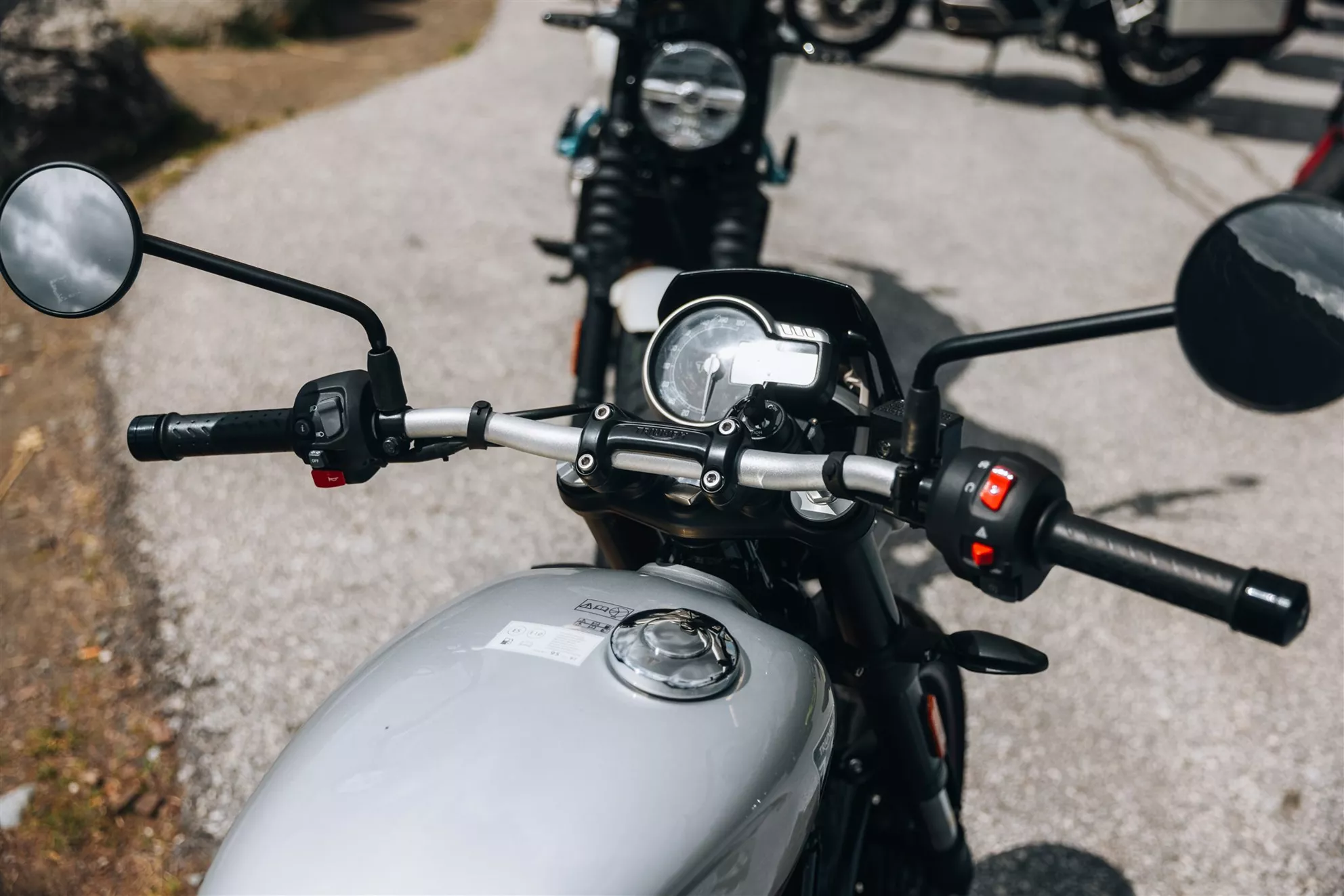
A TFT display like the one on the Guerrilla is nowhere to be found in the Triumph's cockpit
Features and Price
In terms of features, the point clearly goes to Royal Enfield. The Guerrilla's modern TFT display looks high-quality, offers smartphone connectivity, and even allows navigation via Google Maps directly in the cockpit. Add to that a USB-C port, ride-by-wire, and riding modes – features that are by no means standard in this price class. Triumph remains deliberately purist. The classic round speedometer fits the Tracker's style excellently and convinces with excellent readability, but appears noticeably simpler in direct comparison. ABS, switchable traction control, LED lighting, and a USB port cover the most important functions, while Triumph deliberately forgoes riding modes or connectivity. Interestingly, you hardly miss these extras while riding. The Tracker consistently focuses on the essentials and doesn't even try to impress with technology. Value for Money Price-wise, both bikes are closer together than one might initially assume. The Royal Enfield Guerrilla 450 starts in Germany at approximately 5,700 euros (Austria 6,300 euros), making it one of the cheapest bikes in its performance class. In return, the buyer receives not only a strong single-cylinder engine but also a surprisingly comprehensive set of features. The Triumph Tracker 400 costs around 6,245 euros in Germany or 6,895 euros in Austria. The price premium over the Royal Enfield is noticeable, but is quite understandable given the higher-quality build, lower weight, and more dynamically tuned setup.
Verdict – Heart or Head?
Although both bikes are surprisingly similar on paper, they appeal to different types of riders. The Royal Enfield Guerrilla 450 is the relaxed all-rounder. It combines an elastic engine with comfortable ergonomics, a balanced chassis, and modern features into a bike that instills confidence in practically anyone immediately. Especially beginners, commuters, or riders looking for uncomplicated riding pleasure will find an extremely attractive overall package here with an excellent price-performance ratio. The Triumph Tracker 400, on the other hand, is aimed at riders who deliberately seek out corners. It feels lighter than the data suggests, conveys excellent feedback, and impresses with a precision that is by no means a given in this displacement class. The revvier engine, the more active ergonomics, and the high-quality build give it a distinctly sportier character. In the end, it's less about engine power and more about personal riding philosophy. Anyone who wants to be as relaxed as possible on the road and values comfort as well as modern features will be happy with the Guerrilla 450. Anyone who, on the other hand, wants to enjoy every corner and is looking for a nimble bike with excellent riding feel will find in the Tracker 400 one of the most riding-active A2 naked bikes on the market. Both roadsters impressively prove that riding pleasure no longer depends on 100 hp or complex electronics. The Royal Enfield makes everyday life more pleasant, the Triumph makes country roads more exciting. And that's exactly why both have their absolutely justified existence.
- How much does a Triumph Tracker 400 cost?
- Here you will find an overview of the price level of new and used motorbikes!
&width=60&height=60&bgcolor=rgba_39_42_44_0&mode=crop "Author: Clemo")
Triumph Tracker 400 2026 - Experiences and Expert Review
Clemo
The Triumph Tracker 400 is clearly the sportiest variant within the British 400 lineup. It combines simple, proven technology with a deliberately more dynamically oriented setup than its sister models. The focus is clearly on agility, direct feedback, and an entertaining riding experience. Features and long-distance capability are deliberately relegated to the background here. This makes it the first choice for all those looking for a light, accessible A2 bike with a clear focus on riding pleasure – without any claim to explosive performance or high-tech electronics.
Royal Enfield Guerilla 450 APEX 2026 - Experiences and Expert Review
Clemo
The Royal Enfield Guerrilla 450 convinces as a versatile naked bike with an accessible engine and easy riding behavior. Its comfortable chassis and light-action clutch make it city-suitable, while it scores on country roads with stable, dynamic riding behavior. The retro design with modern elements such as LED lighting and a TFT display including connectivity is a success; compromises only need to be made with the brake and clutch levers, which are not adjustable. Overall, the Guerrilla 450 offers an excellent price-performance ratio and is ideal for beginners and all-round riders looking for a fundamentally solid bike.
More from 1000PS Magazine

Triumph Tracker 400 vs. Royal Enfield Guerrilla 450 Images
Source: 1000PS


