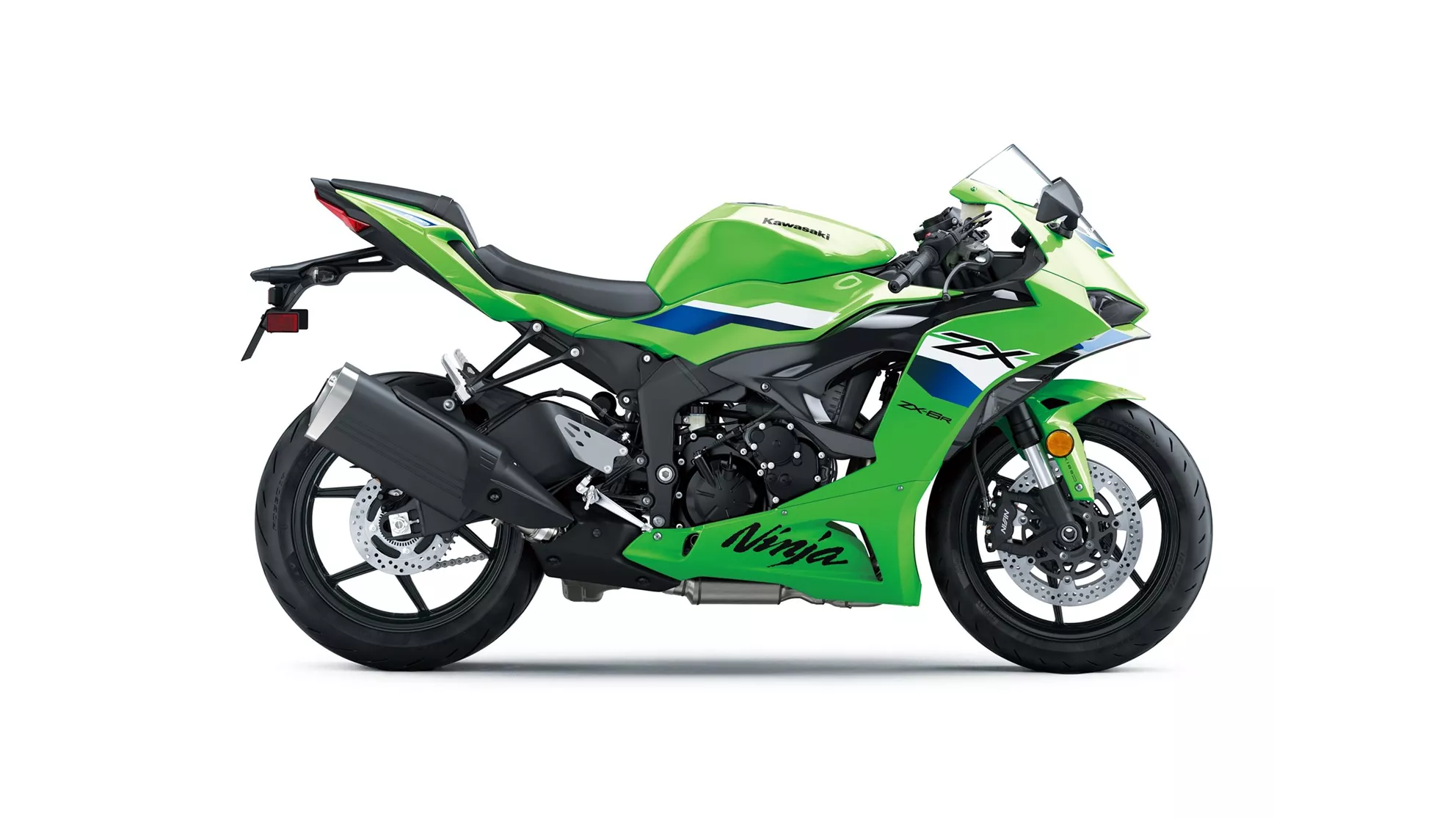
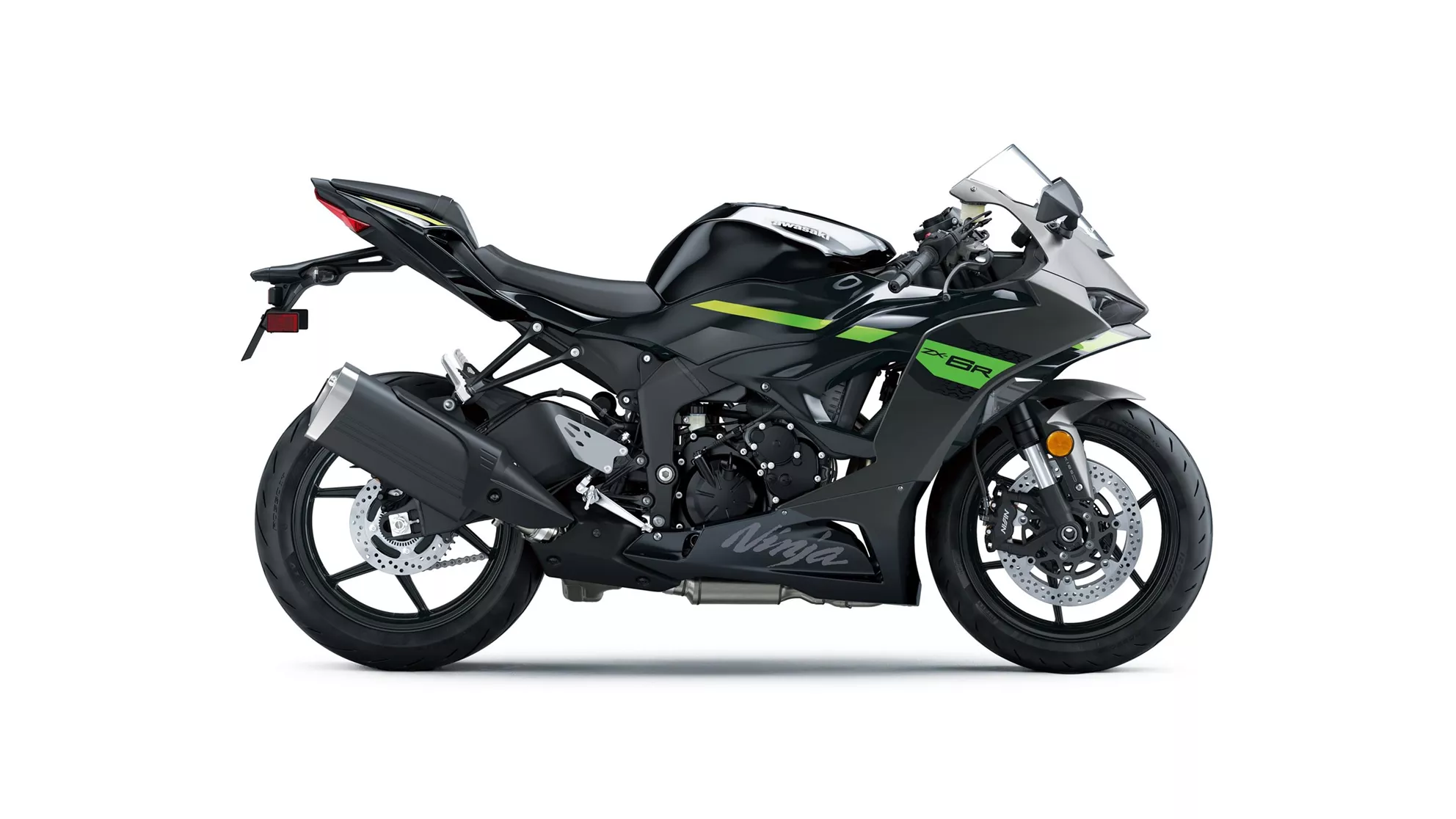
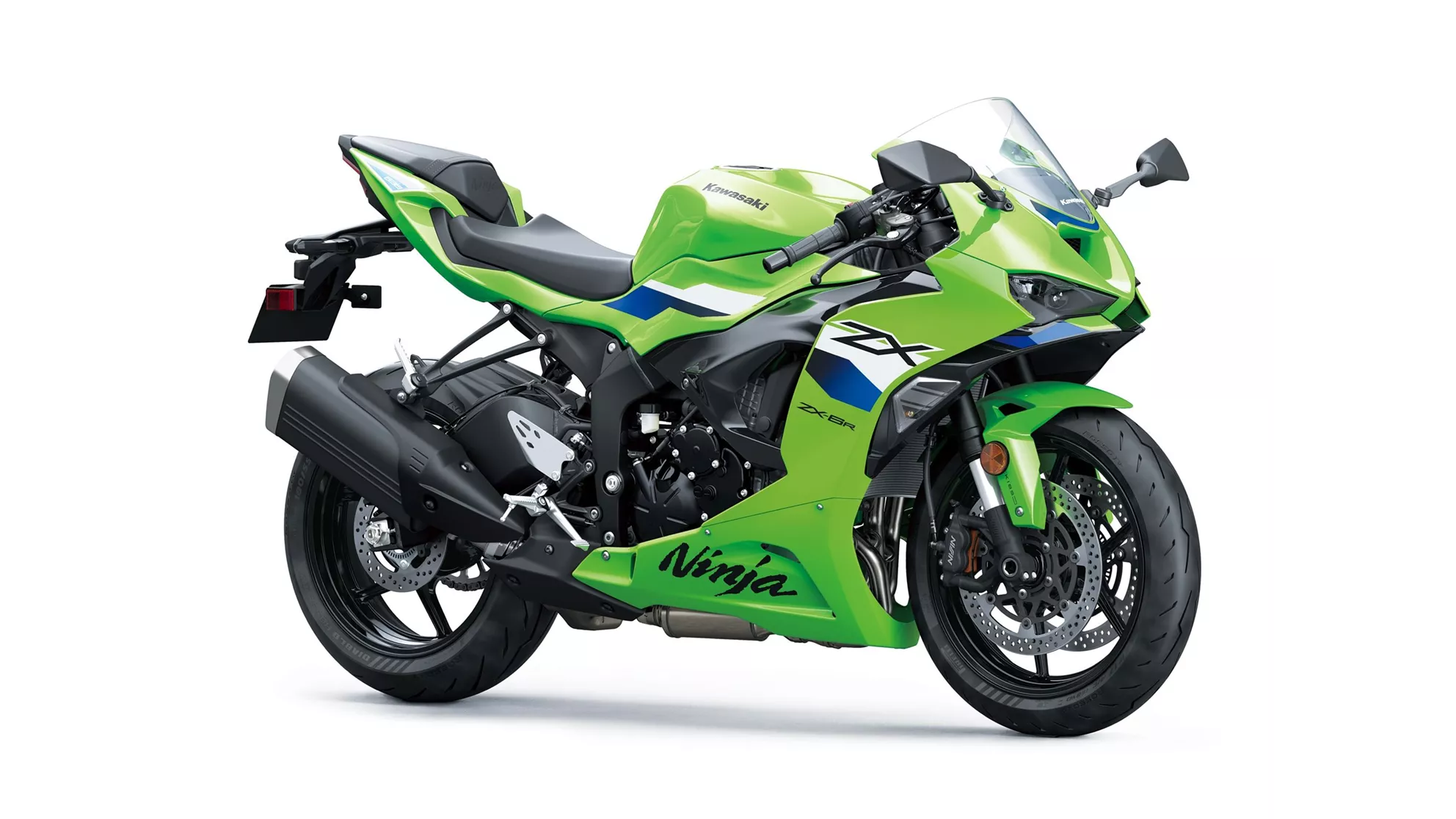
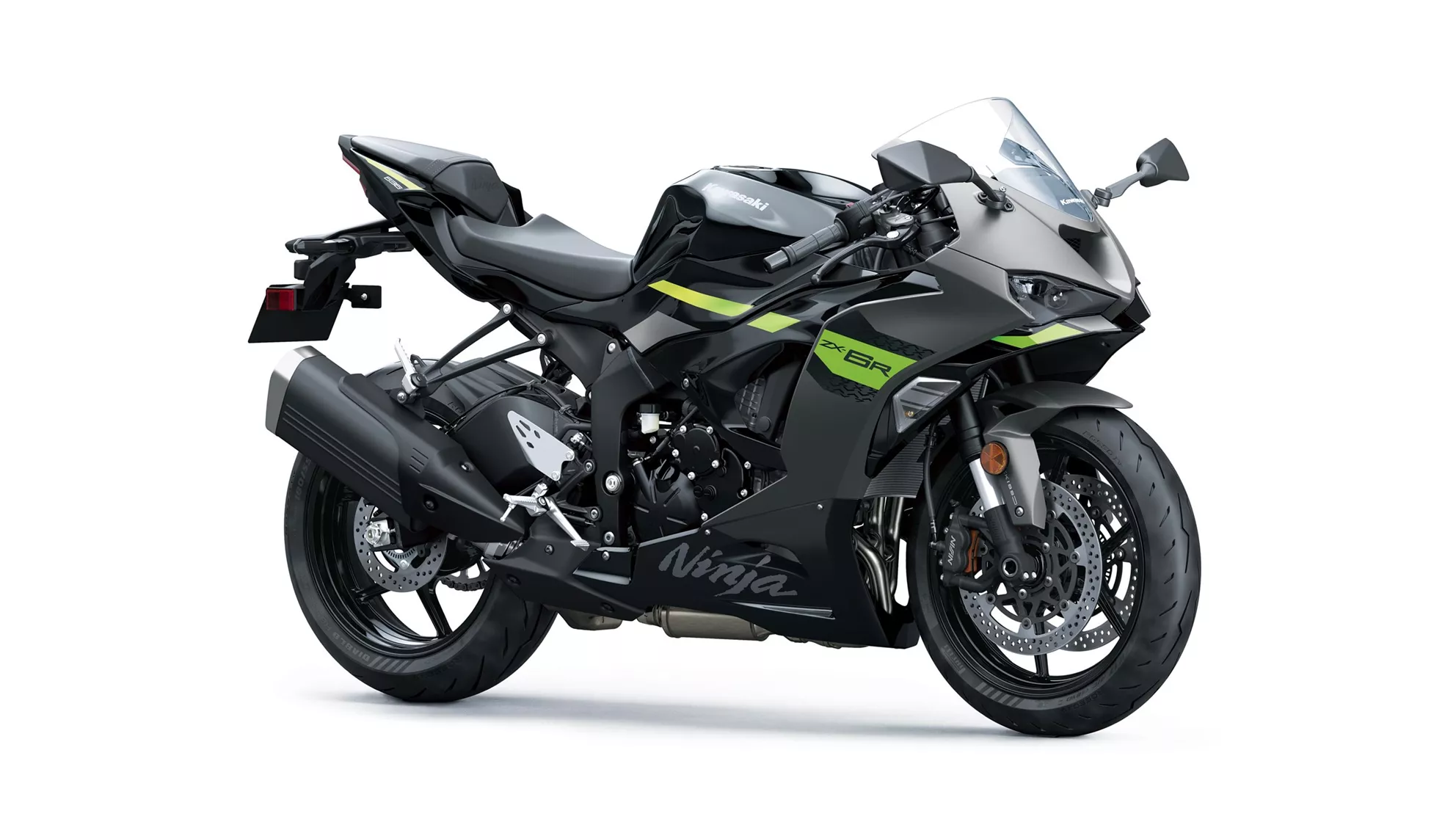
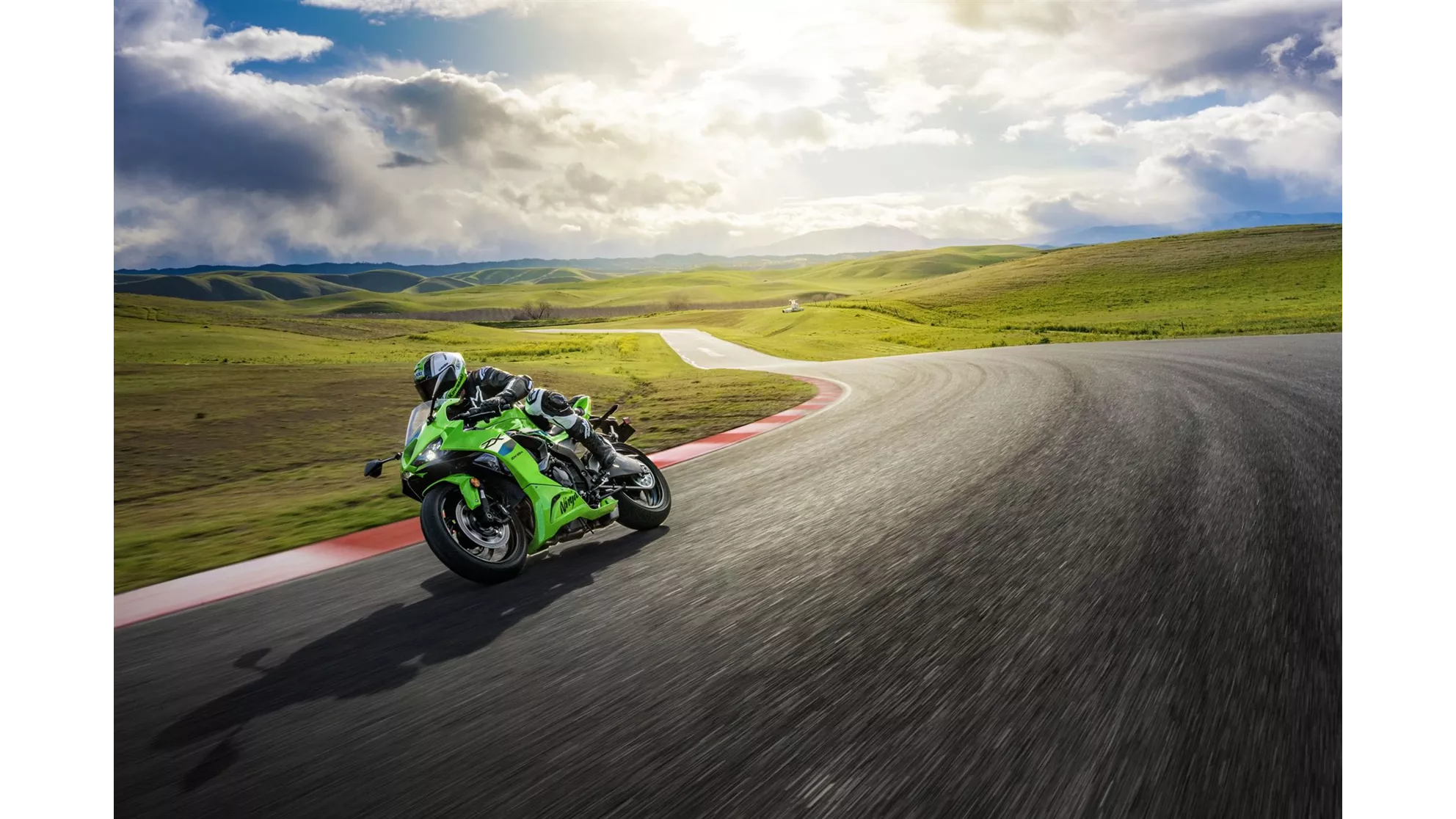
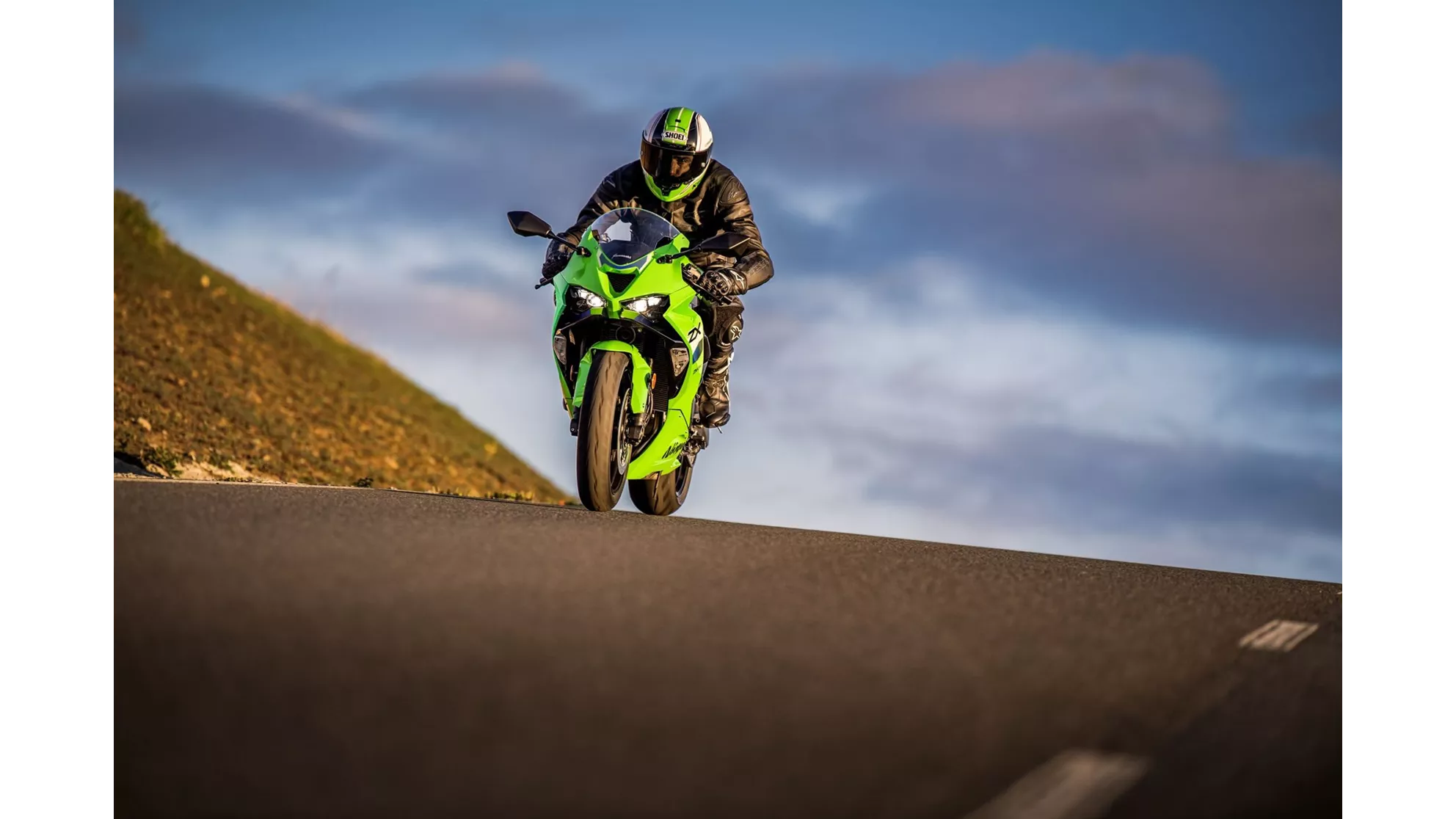
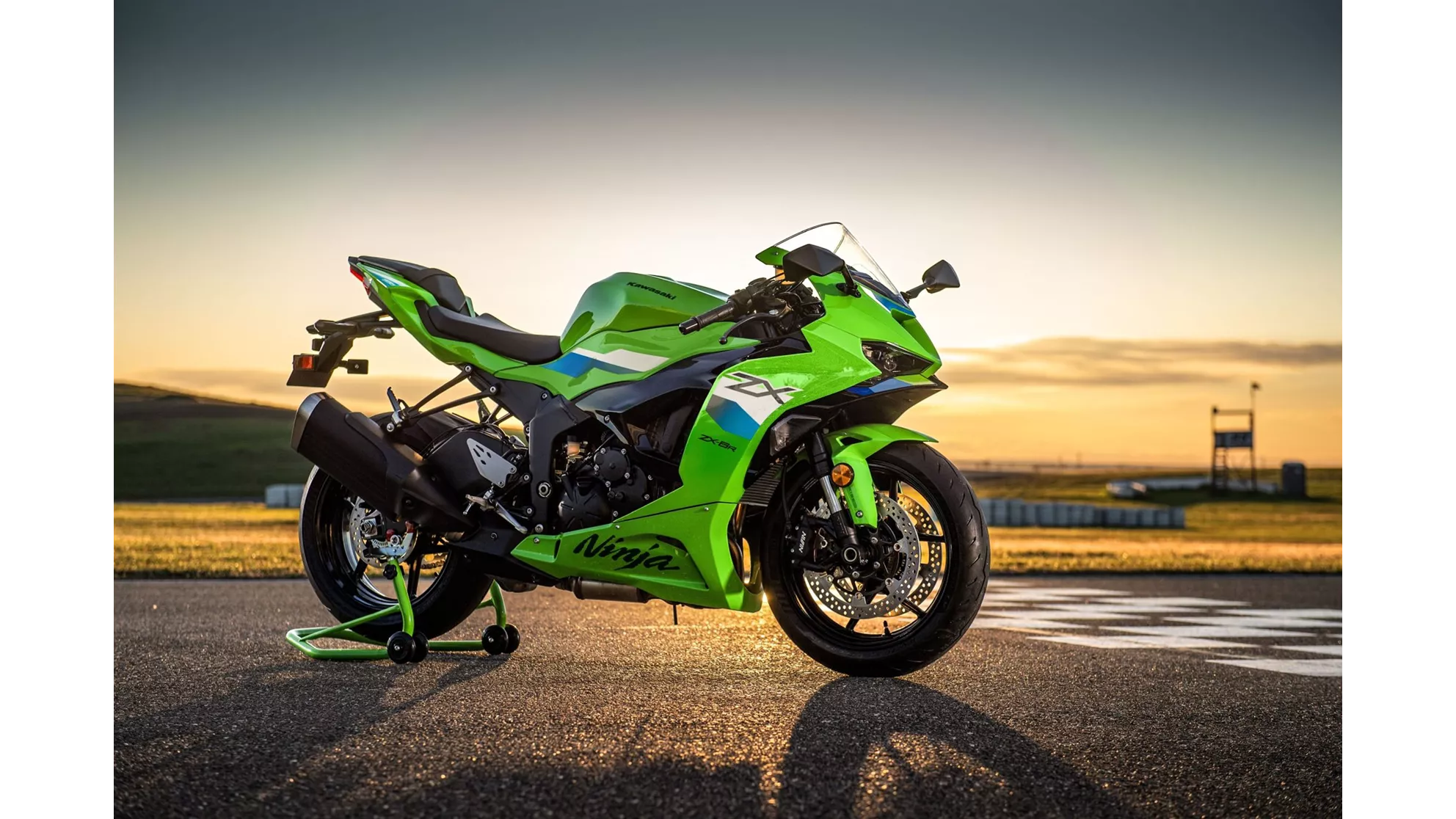
It's been more than 30 years since Kawasaki first introduced the ZX-6R. In 1995 it arrived with 105 hp and was a real statement at the time in the fiercely contested supersport class. The 600s were the benchmark of the era when it came to maximum riding dynamics: light, narrow, revvy, and noticeably more nimble than the big superbikes. Today this class has shrunk, but Kawasaki continues to fly the 600cc flag with the Ninja ZX-6R. And that's a good thing.
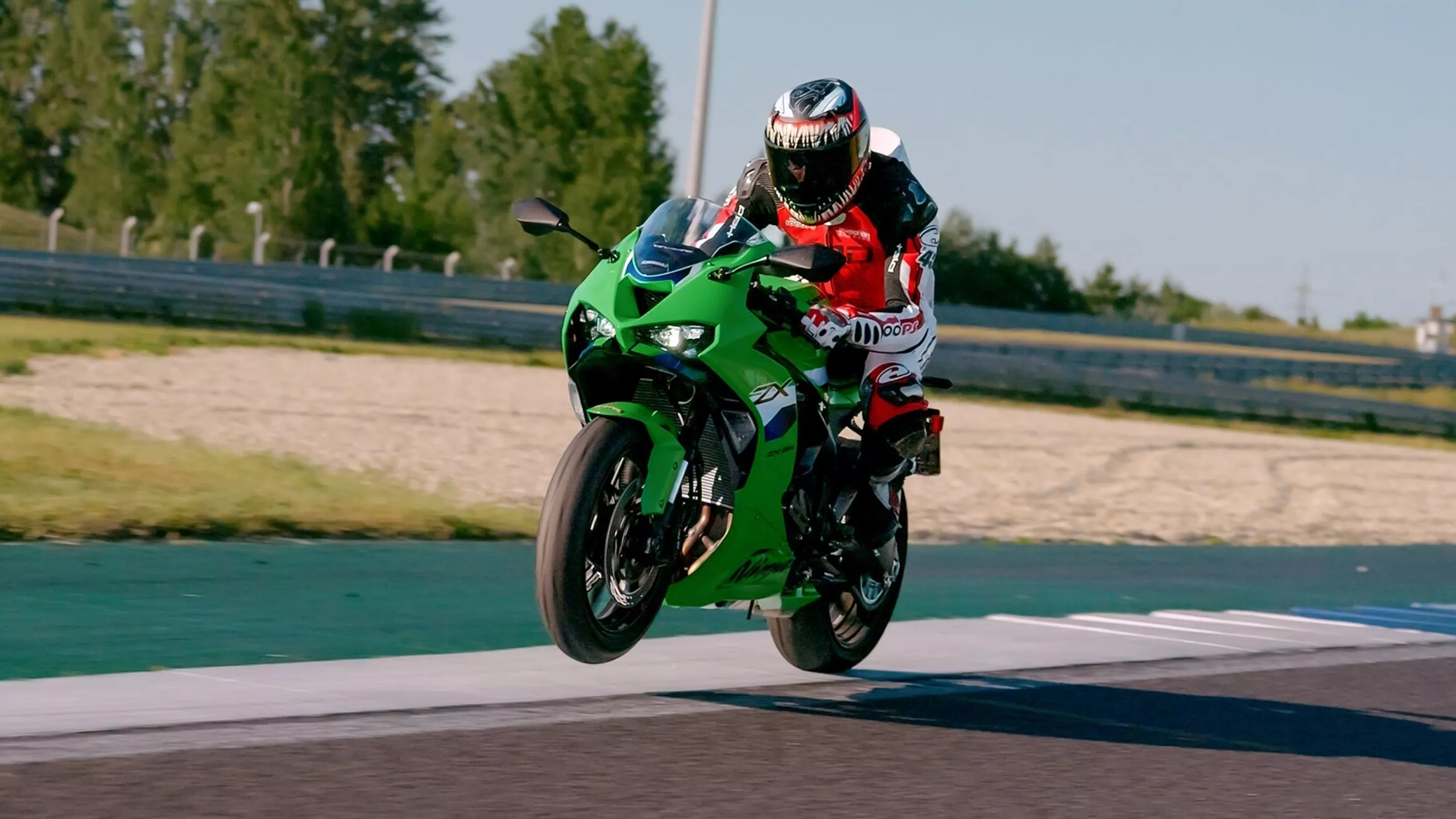
Kawasaki Ninja ZX-6R 2026 Test: Supersport Lives On!
636cc, Revs and Race Track Feeling Put to the Test
The Kawasaki Ninja ZX-6R keeps the supersport flag flying in 2026. With 636cc, a revvy inline-four, precise chassis and genuine race track character, it shows why this class is far from dead.
&width=72&height=72&bgcolor=rgba_39_42_44_0&mode=crop "Author: Martin_Bauer")
Martin_Bauer
published on 6/20/2026
16,723 Views
The current Kawasaki Ninja ZX-6R comes with 636 cm³ of displacement, 124 hp at 13,000 rpm and 69 Nm at 10,800 rpm. With Ram Air, Kawasaki even claims 129 hp. That keeps it clearly a genuine supersport bike, but thanks to the displacement advantage over classic 600s, it brings a bit more grunt in the lower and mid rev range. That was exactly the reason why Kawasaki took the step to the 636 back then: more everyday usability and more pull, without losing the character of a revvy supersport machine.
Kawasaki ZX-6R History: From the 600cc Battle of the 90s to Today
In the 90s, the supersport class was one of the most important stages for manufacturers. Kawasaki, Honda, Yamaha, Suzuki and others invested enormous energy in this highly sought-after category. The Supersport World Championship was fully booked, at times with over 40 starters, and manufacturers wanted to show who was technically at the top. The specific output of the 600cc engines put every other engine in the shade. Back then, 600s with around 105 hp weren't all that far behind the big sport bikes. At the same time they were lighter, more compact and more nimble. That's exactly where the appeal of this class came from. Later, the superbikes caught up strongly in power, handling and rideability, while the 600s increasingly lost significance. To keep the ZX-6R attractive for everyday use nonetheless, Kawasaki went its own way and increased displacement to 636 cm³. The goal: more usable power from lower revs, without watering down the supersport DNA. That was a balancing act back then, since the supersport regulations limited displacement for 4-cylinder engines to 600cc. That's why Kawasaki offered the ZX-6R in two variants: the regulation-compliant 600 for racing activities and the 636 for road use.
Today the Ninja ZX-6R is no longer a pure regulation bike, but stands as a supersports machine in its own right. The 600cc racing class has changed, displacement limits have been relaxed, and the classic 600cc world no longer exists the way it used to. Precisely because of that, the ZX-6R feels today almost like a relic from another era – but one that still works remarkably well.
Engine: Silky smooth, revvy, and still clearly Supersport
The 636 cm³ inline-four is the heart of the Ninja ZX-6R. Kawasaki quotes 124 hp at 13,000 rpm, and 129 hp with Ram Air. Maximum torque of 69 Nm arrives at 10,800 rpm. On paper it's already clear: despite the displacement advantage, the ZX-6R remains a bike that loves revs.
If you want real forward thrust, you have to keep the engine happy. Below 9,000 rpm it does pull along, but only from around 9,000 to 10,000 revs does the Ninja turn into a genuine supersports machine. Then it pulls cleanly, energetically and with plenty of joy right up to the limiter. Power delivery remains very controllable throughout, and the limiter takes power away gently. You can clearly feel when the right shift point has been reached.
The engine's refinement stands out in particular. The inline-four runs extremely smoothly, with minimal vibration and very cleanly. You can feel the decades of development here. At times, after starting it up, you almost get the feeling the engine isn't even running. Despite Euro 5 Plus requirements, the engine doesn't feel strangled or rough. It responds softly, can be dosed with precision, and gives you plenty of control.
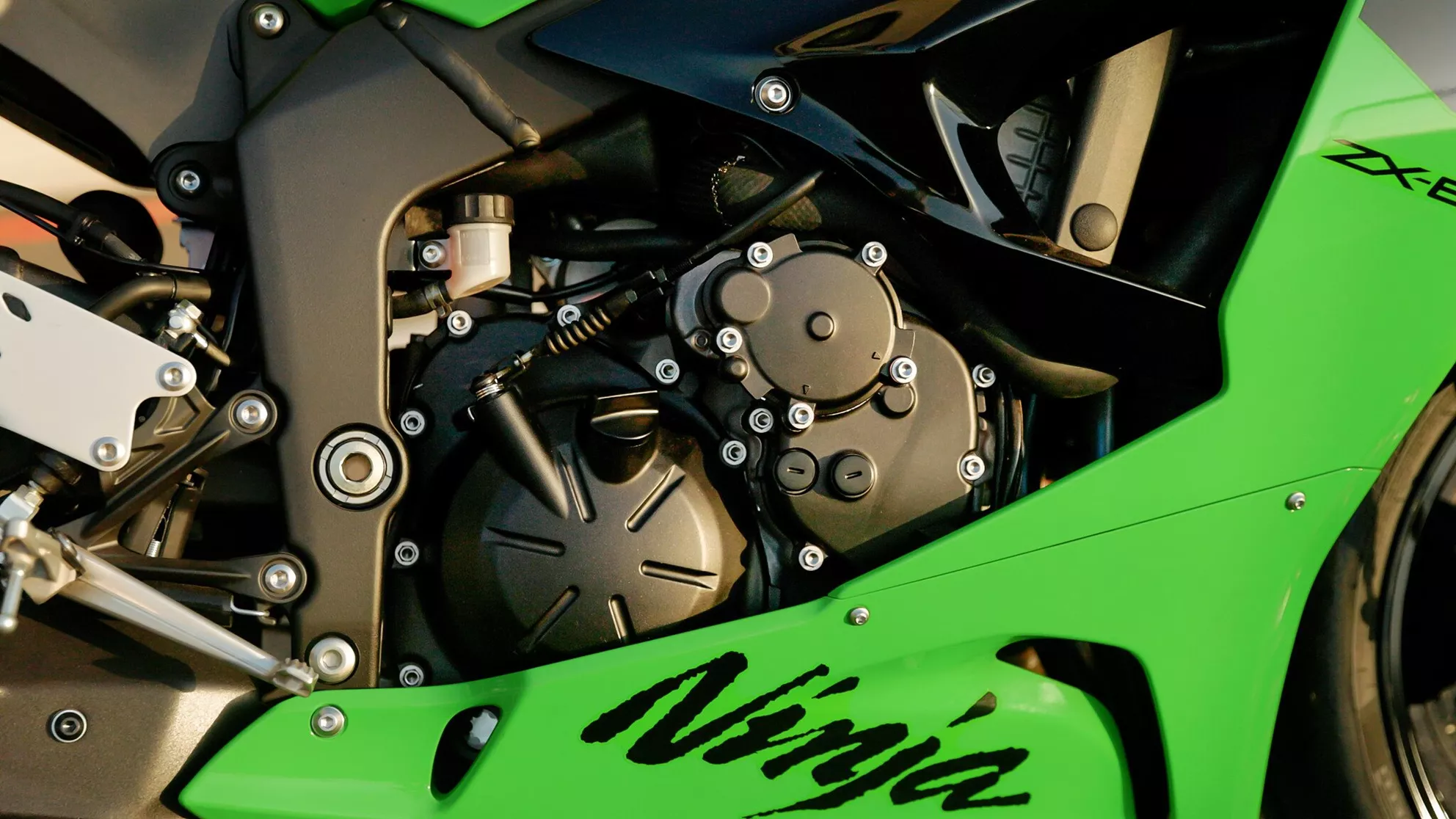
The familiar engine still convinces in 2026.
Quickshifter and Gearbox: Excellent, but only in one direction
The gearbox on the Kawasaki Ninja ZX-6R works excellently. Gear changes are mechanically very light and precise. Combined with the standard-fitted Kawasaki Quick Shifter, this makes for a lot of fun especially on the race track, where this class involves frequent shifting.
However, the quickshifter only works for upshifts. There's (still) no blipper for clutchless downshifting. The reason lies in the electronics architecture: the ZX-6R doesn't have a ride-by-wire system. Without electronically controlled throttle bodies, the ECU can't deliver automatic throttle blips when downshifting. That's no big drama in everyday use, but on the race track it's a point where you notice the ZX-6R isn't quite at the electronic cutting edge anymore. For me, though, that's not a big disadvantage, since on the one hand there's plenty of time when downshifting and it doesn't come down to every tenth of a second the way it does with upshifts, and on the other hand I still like using the clutch to be able to modulate engine braking force when downshifting. That's particularly easy on the Kawasaki, since the clutch itself is very light and can be operated effortlessly with a single finger. As a result, the bike remains pleasant and cleanly controllable even without a blipper.
Ergonomics: Compact, sporty – too tight for taller riders
One criticism, on the other hand, is the ergonomics, especially for somewhat taller riders. The current Ninja ZX-6R is cut very compactly. The distance between seat, footpegs and clip-on handlebars is tight, the knee angle is narrow, and the clip-ons sit low and are swept back sharply. That can suit shorter riders well, but for taller pilots it quickly becomes cramped.
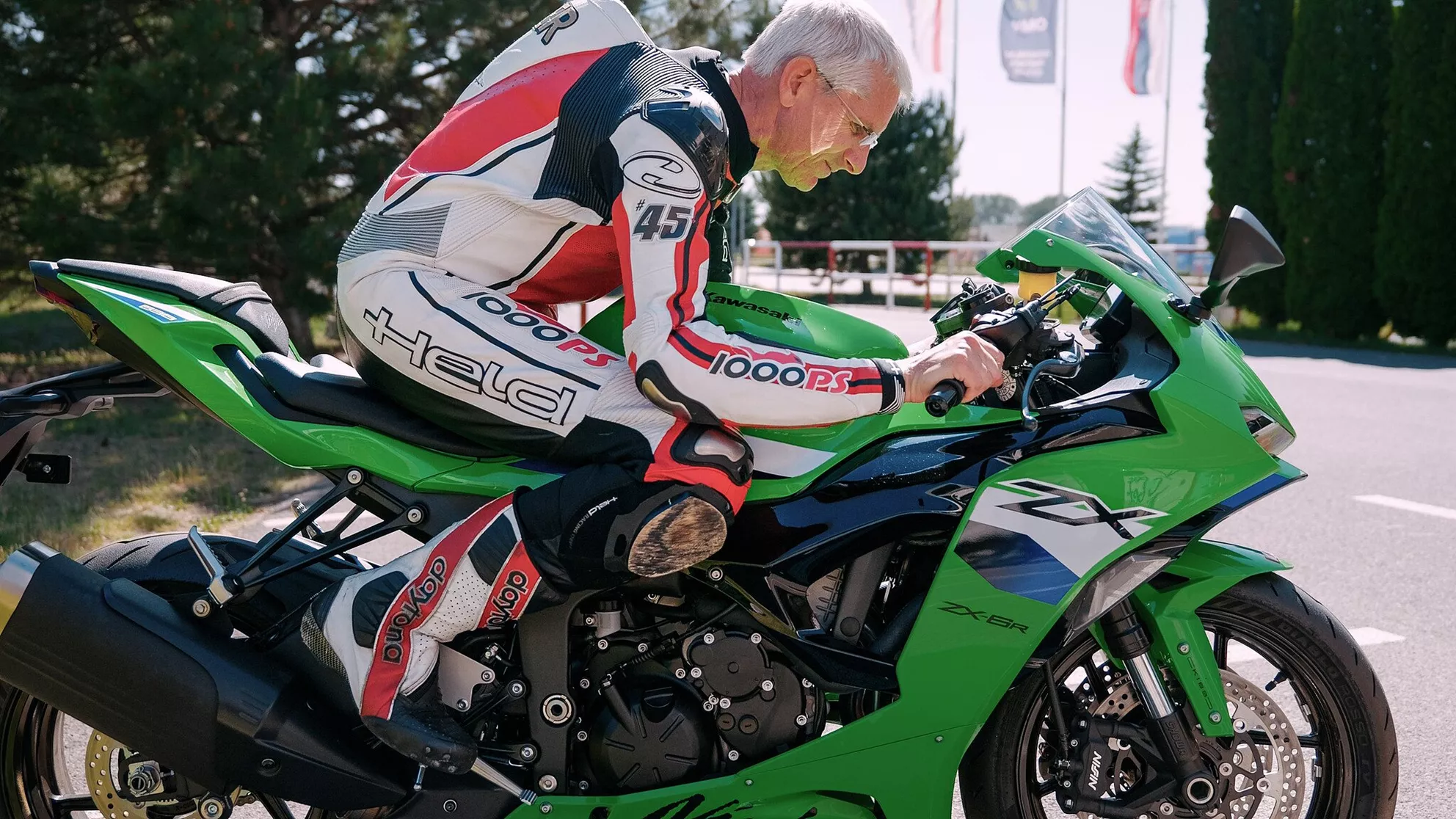
At 1.80 m tall, things get tight.
At around 1.80 m in height, it's already noticeable that knees and elbows can come into conflict in certain situations. That's not ideal especially when turning in and during sporty riding on the race track. Anyone wanting to put more pressure through the handlebar would appreciate a bit more room and a less sharply swept-back handlebar position.
The wind protection is also very sport-oriented. The front is low and compact, the screen short. At high speeds you have to tuck in tightly to make yourself small. That's exactly when the tight ergonomics stand out even more, because you want to tuck down low toward the tank but have little room to do so.
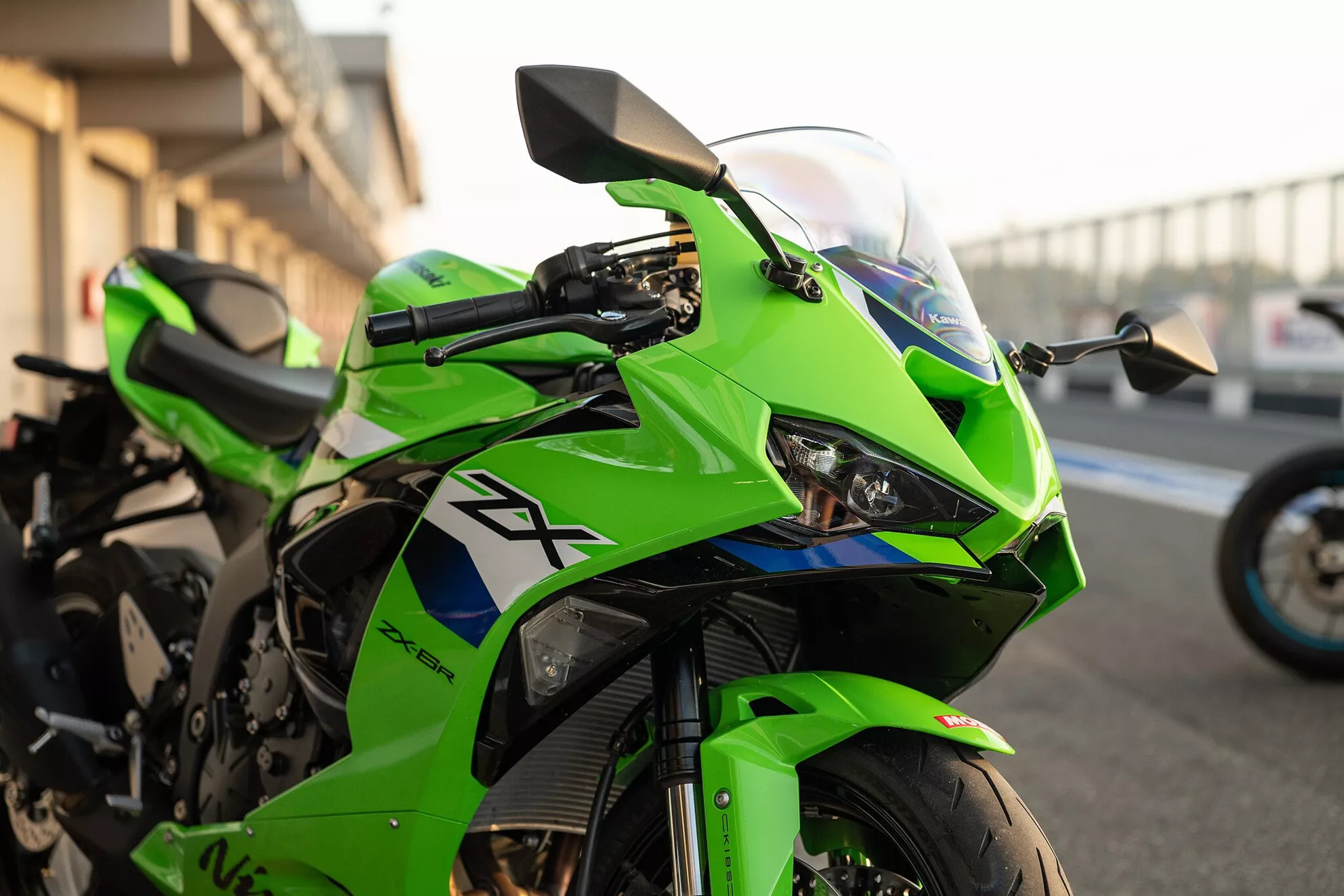
The compact front of the ZX-6R.
The good news: this problem can be solved relatively easily. Different clip-ons, mounted a bit further forward and possibly a bit higher, along with an adapted footpeg setup, can significantly relax the ergonomic triangle and give taller riders the room they're looking for. A taller bubble screen would also help. We carried out this conversion on our Tune Up ZX-6R and combined it with a slightly higher seat as well. It now fits wonderfully.
Chassis and Handling: Precise, confidence-inspiring with lots of feedback
The Ninja ZX-6R stays true to its reputation: it's nimble, precise and very transparent. The aluminum perimeter frame, the Showa SFF-BP fork and the Uni-Trak shock deliver a sporty but not brutal foundation. The bike leans into corners easily, holds its line cleanly, and inspires a lot of confidence.
On the race track, the chassis shows no disruptive tendency to pump and stays composed even at a hard pace. At the same time it brings enough comfort so it doesn't feel completely uncompromising on the road either. That's exactly one of the ZX-6R's great strengths: it's a genuine supersports machine, but not one that punishes the rider unnecessarily.
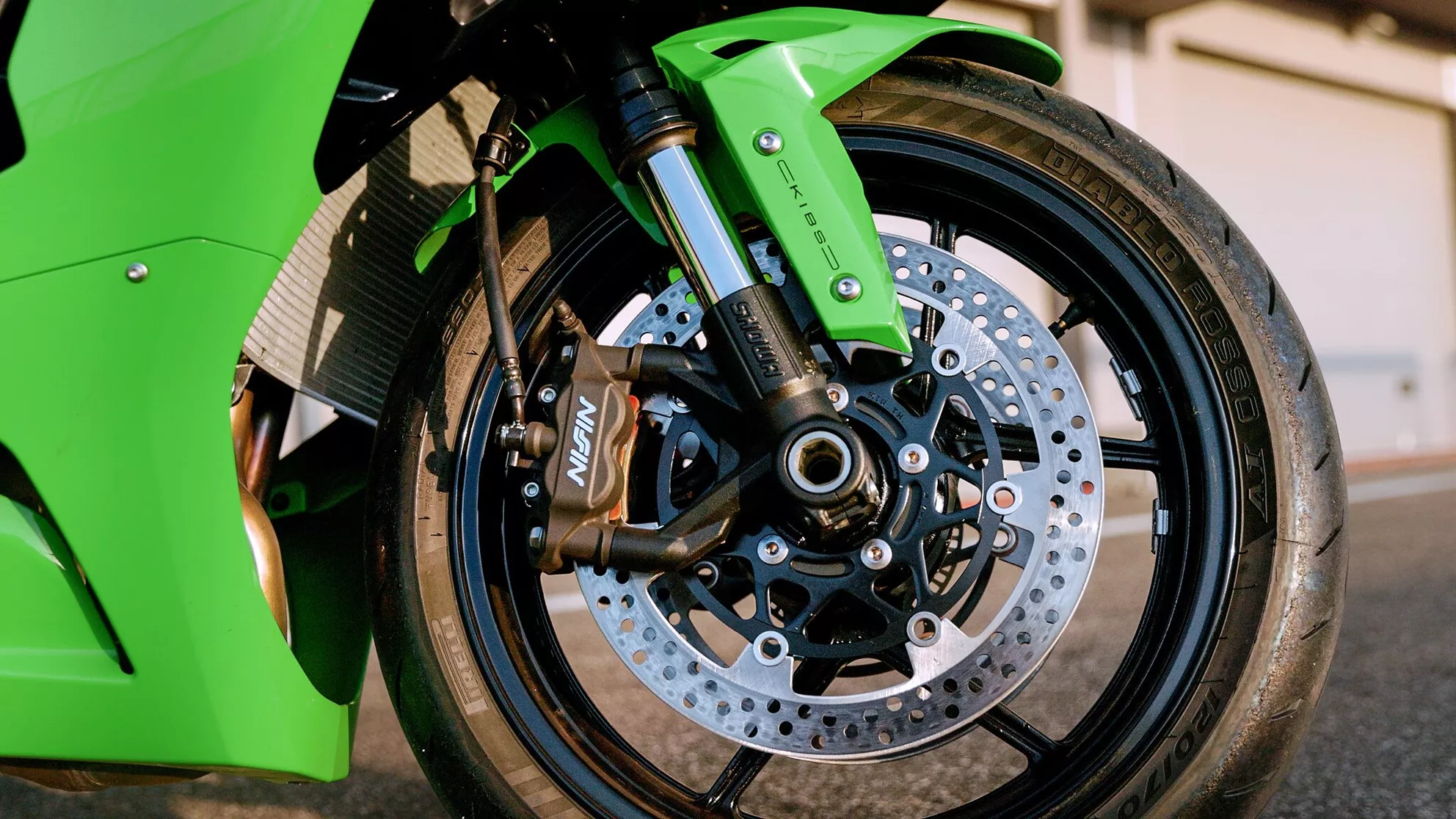
High-quality components on the 600cc Ninja.
Especially newcomers to track riding can build up a lot of confidence with the ZX-6R. Feedback is clear, reactions are predictable, and the bike never feels treacherous. With optimized ergonomics, handling would be even lighter and more direct, but even in stock form the Kawasaki shows a very strong base setup.
Brakes: Strong, stable, but ABS not perfect for the race track
The braking system on the Kawasaki Ninja ZX-6R is convincing. Up front, 310 mm dual discs work with radially mounted monobloc four-piston calipers, while a 220 mm disc handles rear duty. Even after many fast laps on the race track, the pressure point stayed stable. Deceleration is strong, feel at the lever is very good, and the brakes show no weaknesses in terms of durability.
The criticism doesn't concern the hardware, but rather the ABS tuning, or more precisely the lack of an option to deactivate it. For the race track it would be desirable to at least be able to switch off the rear-wheel ABS separately. Under dry conditions and in sporty use, that would allow for more braking performance. In stock configuration the system doesn't fundamentally intervene in a disruptive way, but you can tell there's still potential here.
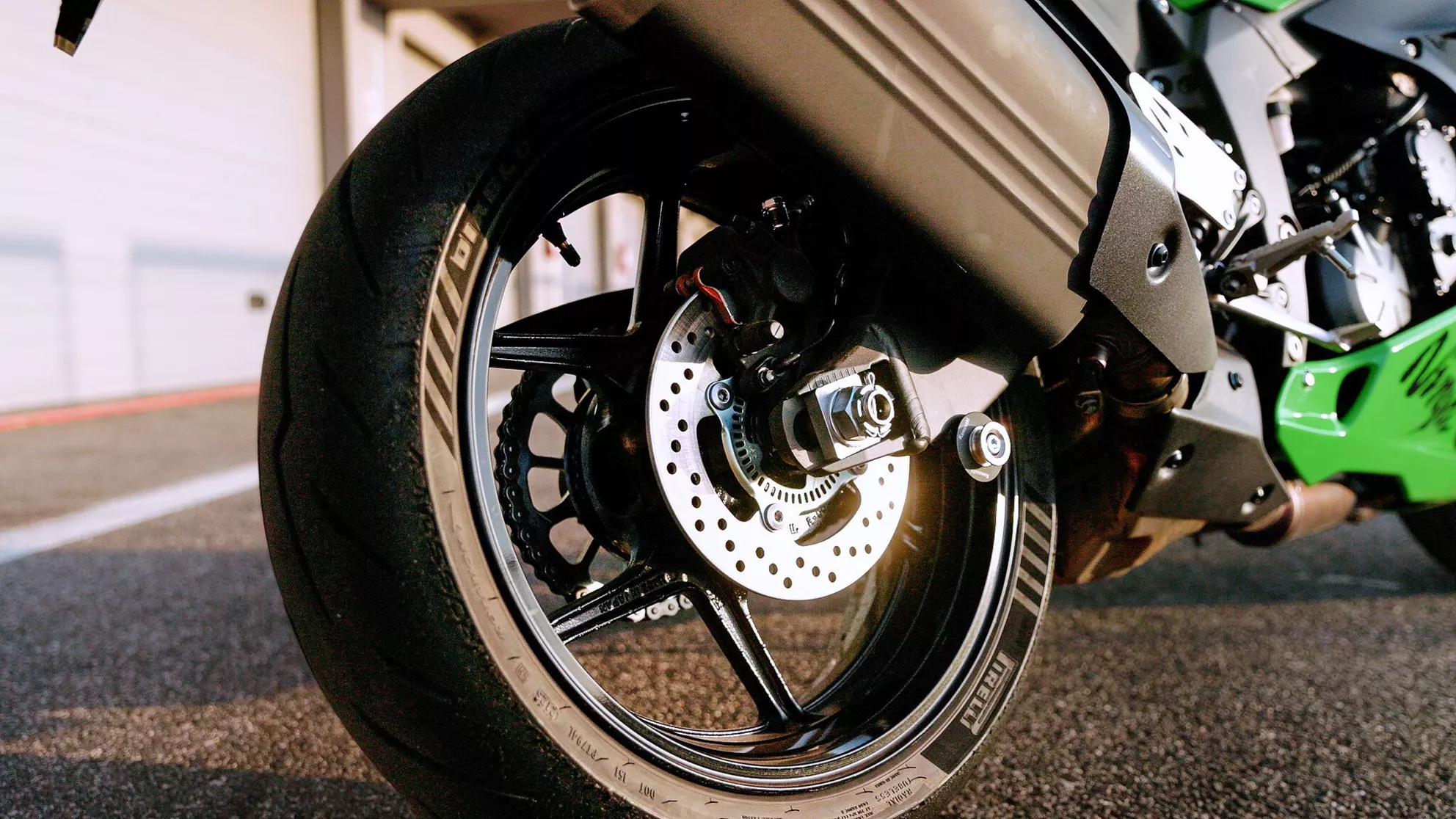
The rear-wheel ABS can't be deactivated here.
For road use, the ABS is of course a safety benefit. For ambitious trackday riders, though, a finer adjustment option would be welcome.
Electronics: Sufficient, but not cutting-edge
The ZX-6R offers KTRC traction control, power modes, integrated riding modes, ABS, a quickshifter and a 4.3-inch TFT display with smartphone connectivity. The Sport, Road, Rain and Rider riding modes cover the most important use cases. In Rider mode, traction control and power mode can be set individually.
In practice, the system works well. Sport mode in particular is well-tuned and doesn't hold you back unnecessarily on the race track. The traction control doesn't intervene overly early, but steps in where it makes sense. Because the engine can be dosed so cleanly, you miss ride-by-wire less during actual riding than you'd expect on paper. Since the engine mapping has turned out excellently, you can pick the throttle back up at the apex without any disruptive jolt or load-change reaction. Even ride-by-wire couldn't do it any better.
Still, it has to be said: electronically, the ZX-6R isn't quite on the level of modern superbikes. No blipper, no ride-by-wire, no deactivatable rear-wheel ABS. These are points that would be desirable for a future update. The new TFT display, however, is easy to read and provides the most important information.
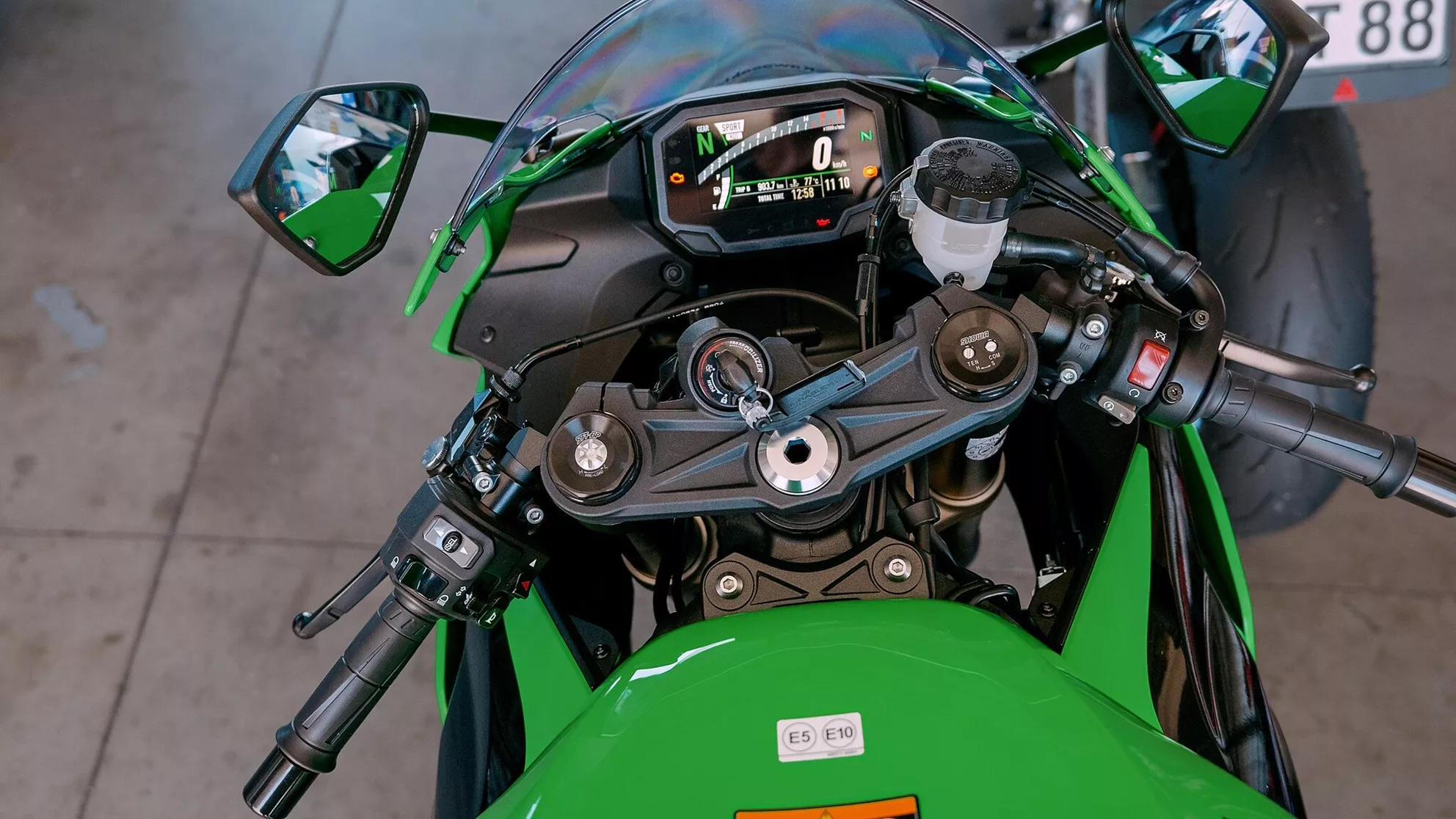
The command center of the Kawasaki Ninja ZX-6R.
Design and Features: New Ninja look with ZX-10R touches
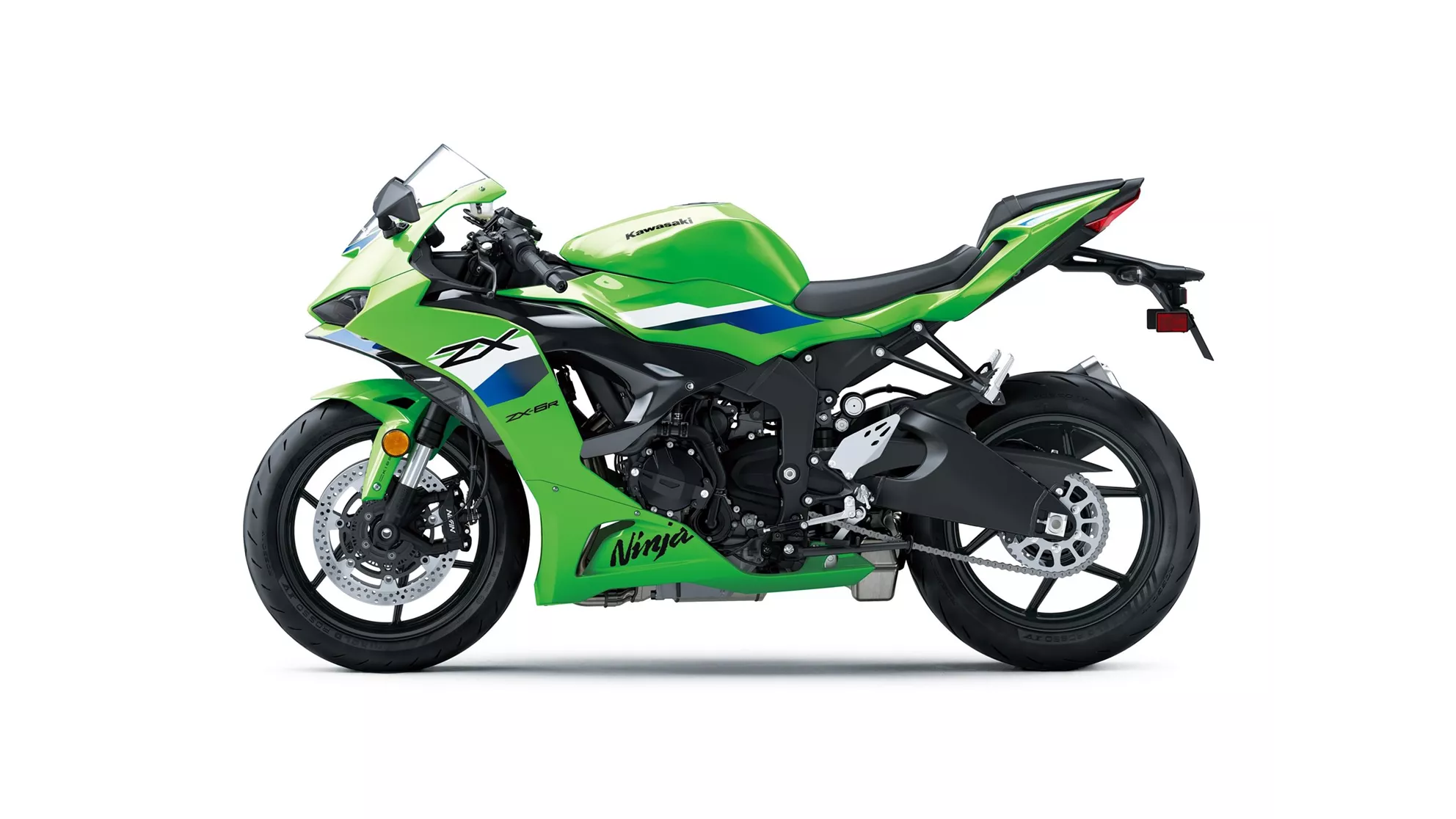
Visually, the Ninja ZX-6R was significantly modernized for the 2024 model year. The design takes cues from the ZX-10R, but appears somewhat more flowing and less uncompromisingly geared toward pure function. The compact front with new LED headlights, the layered fairing elements and the black engine covers give it a modern, aggressive appearance.
All the lighting is executed in LED technology. New too is the 4.3-inch TFT color display with Bluetooth connectivity via Kawasaki's Rideology app. Among other things, this lets you display vehicle data, trip logs and notifications. For a supersport bike in this class, that's a sensible modernization without changing the character of the bike.
- How much does a Kawasaki Ninja ZX-6R cost?
- Here you will find an overview of the price level of new and used motorbikes!
&width=60&height=60&bgcolor=rgba_39_42_44_0&mode=crop "Author: Martin_Bauer")
Kawasaki Ninja ZX-6R 2026 - Experiences and Expert Review
Martin_Bauer
In 2026, the Kawasaki Ninja ZX-6R is a bike that rides almost against the spirit of the times, and that's exactly why it's so appealing. While many manufacturers have long since abandoned the classic supersport class, Kawasaki sticks to the idea of a light, revvy, precise and uncompromising sport bike. The 636 engine runs wonderfully smoothly, delivers genuine supersport emotion up top, and thanks to the slightly larger displacement offers more usability than classic 600s. The chassis is precise, confidence-inspiring and works strongly both on the road and on the race track. The brakes are durable and powerful. The electronics aren't the most modern, but in practice they're sufficient and well-tuned.
Kawasaki Ninja ZX-6R 2026 Test: Supersport Lives On! Images
Source: 1000PS