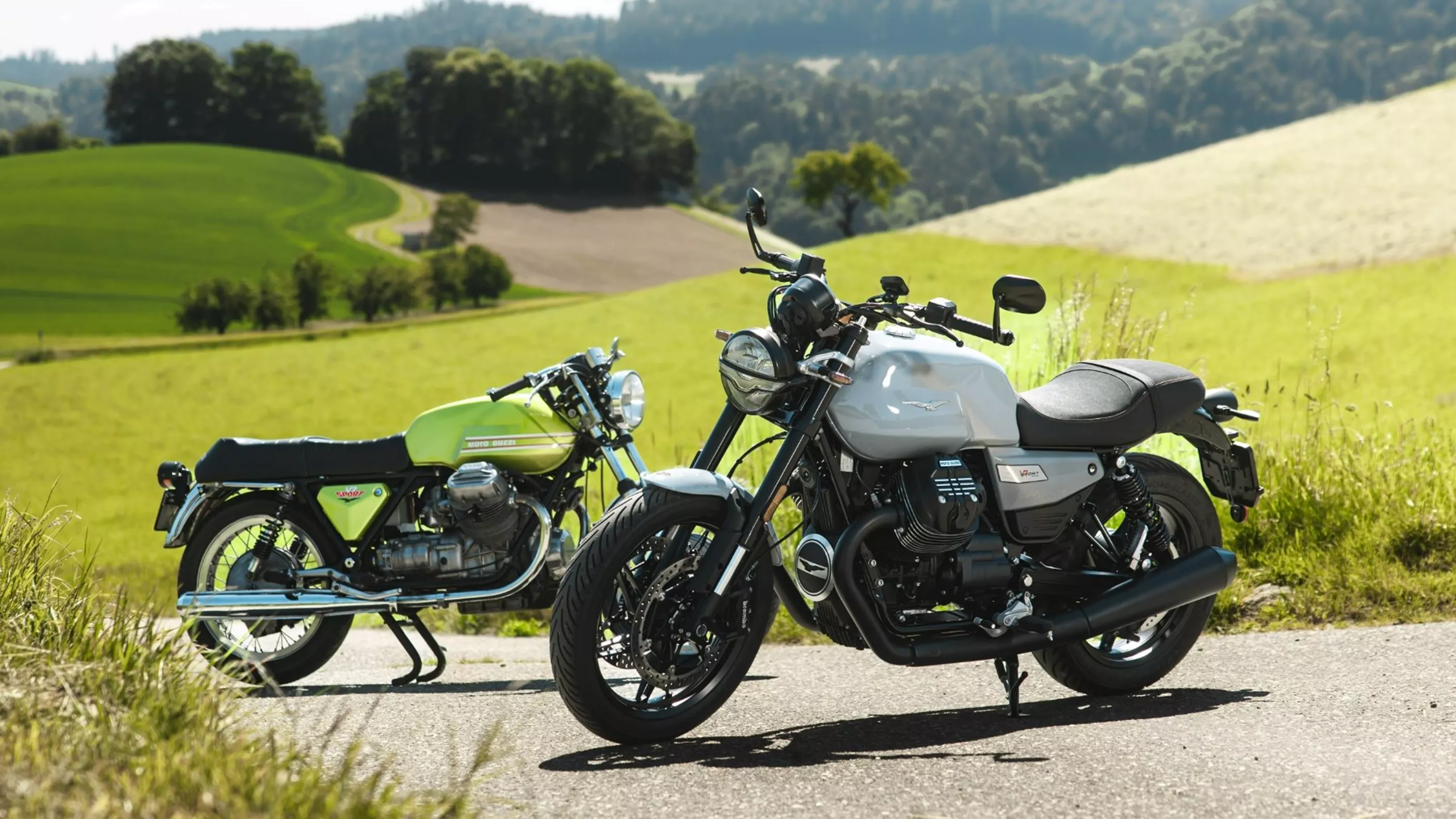
It rarely happens that you have two generations of an icon standing directly side by side, and it's even rarer when 54 years lie between them. For us, this constellation came about because Max, active on Instagram as @lasermax01, asked his uncle. He has been a passionate Moto Guzzi collector for quite some time and keeps a small treasure chamber in his garage, housing several old Mandello machines. One of them is a V7 Sport from 1972, a genuine rarity that today is ridden with great care and understandably isn't handed to just anyone, because such a machine has long since become more than just a bike, representing a piece of brand history on two wheels. That's why only Max rode it, while I was there as observer, listener, and with the camera. What began as an idea turned into a day in the Bernese Oberland, where between twisty roads, V2 sound, and the smell of petrol, something became palpable that has become rare.
Moto Guzzi V7 Sport 2026 meets its roots from 1972
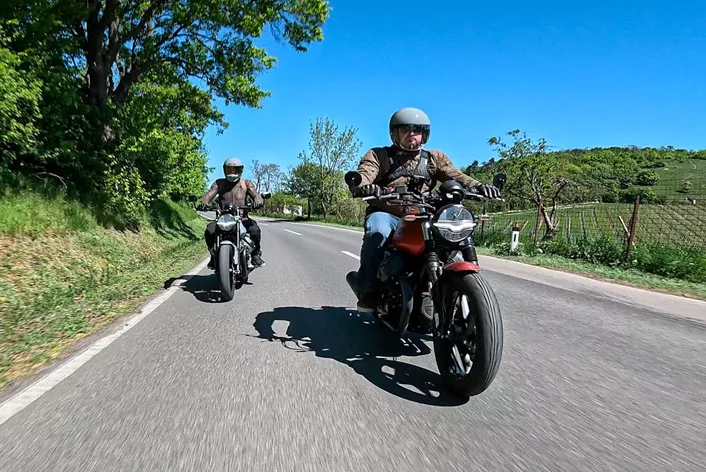
On the road in the Bernese Oberland with two generations of the V7
The new Moto Guzzi V7 Sport 2026 in the Bernese Oberland, alongside an original 1972 V7 Sport from family ownership. How 54 years of brand history on two wheels come together.
&width=72&height=72&bgcolor=rgba_39_42_44_0&mode=crop "Author: FunkyFrankee")
FunkyFrankee
published on 5/31/2026
1971 in Mandello del Lario, an engineer and his plan
To understand why the V7 Sport still has a special ring to it in motorcycling circles today, you have to go back to Italy for a moment. More precisely, to Mandello del Lario, on Lake Como, where Moto Guzzi has been at home since 1921. At the end of the sixties, the brand stood at a crossroads. Japanese competition was pushing into the market with ever more cylinders and ever more power, and in Italy people were looking for an answer that wasn't simply a copy, but something of its own.
This answer came in the person of Lino Tonti, an engineer with stints at Aermacchi, Benelli, Bianchi, Gilera and Mondial, who joined Moto Guzzi in 1969. His brief was clearly formulated and at the same time almost brazenly direct, because it could be reduced to three numbers. The new machine was to reach 200 km/h, weigh less than 200 kilograms, and have five gears. No more specification was needed.
Tonti took the existing longitudinally mounted 90-degree V2, made it flatter, moved the generator to the front, and built a completely new double-cradle frame made of chromium-molybdenum steel around this engine, drawn so low that the seat height came in at just 750 millimetres. This very frame, later known simply as the Tonti frame, would remain the design and technical backbone of almost all major Guzzis for decades to come.
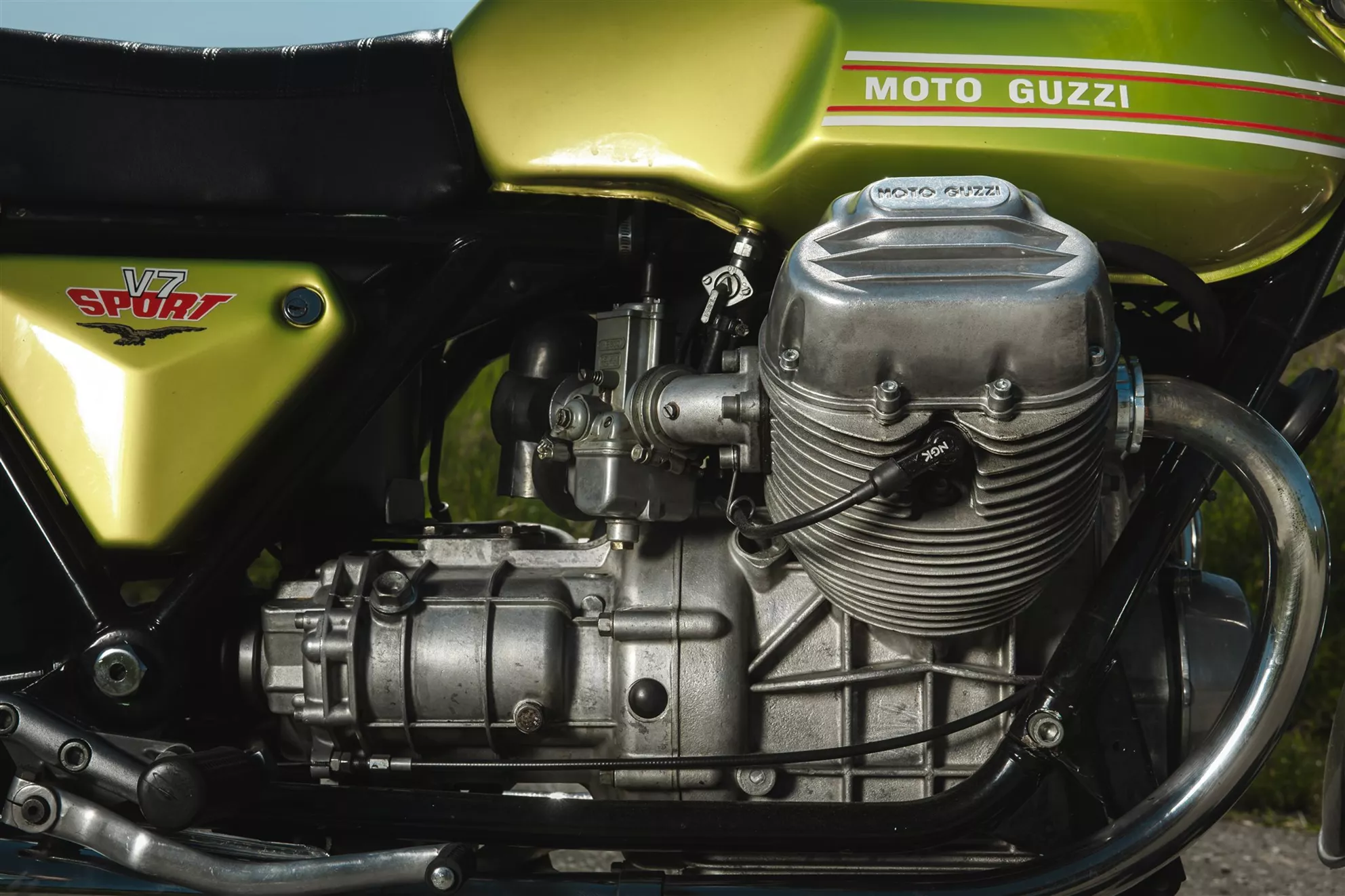
Lino Tonti's signature, visible to this day. The longitudinally mounted 90-degree V2 in its characteristic double-cradle frame, the technical foundation of an entire brand generation.
The V7 Sport celebrated its premiere in June 1971, right on time for the brand's 50th anniversary. The first roughly 150 units were hand-built in the racing department in Mandello and wore a red-painted frame combined with lime-green bodywork. These first machines are still called Telaio Rosso to this day and are the holy grail among collectors of the brand. Italy had, at that moment, its first genuine sport superbike, and the V7 Sport was indeed considered one of the fastest production machines of its time, with a top speed of around 206 km/h according to factory figures.
One of these machines from the early production phase was made available to us. A V7 Sport from 1972, finished in that characteristic lime green that catches the eye just as instantly today as it did then. A machine that has long since become more than just a motorcycle, but rather rolling proof that a clear idea, a stubborn engineer, and a factory on Lake Como can together create something that still has an effect half a century later.
A different character from a different era: Moto Guzzi V7 Sport 1972
Before a 1972 V7 Sport can even be moved, there's a little ritual involved that today seems almost forgotten. Max kneels down on the left side of the machine and opens the fuel tap, then goes over to the right side and does the same thing again. Both carburettors need their fuel supply, otherwise nothing happens. Then comes the choke, again on both sides, and only then may the starter get to work. What is a single button press on a modern bike takes half a minute here, and in that half minute there's always a little tingle of anticipation about whether the machine will play along today or not. On this day, it really let us savour that tingle. Max went through the ritual, the starter turned, but the engine stayed silent. Not even a cough or a splutter, nothing. The piston had probably stopped in an unfavourable position, compression was too high, and the starter simply couldn't get through. A few pushes later, then a second attempt, and it came back to life.
Once it's standing there alive in front of you, the first impression is an acoustic one. The V2 thumps deep and raw from the chrome exhaust pipes, louder than you'd expect from a Moto Guzzi, with that unmistakable sideways rocking on throttle blips that instantly gives away the longitudinally mounted engine to any brand connoisseur. It smells of petrol, very faintly of oil, and when starting up you can see a fine wisp of smoke drifting from the tailpipes. That's what Mandello del Lario sounds like when it's writing in 1972.
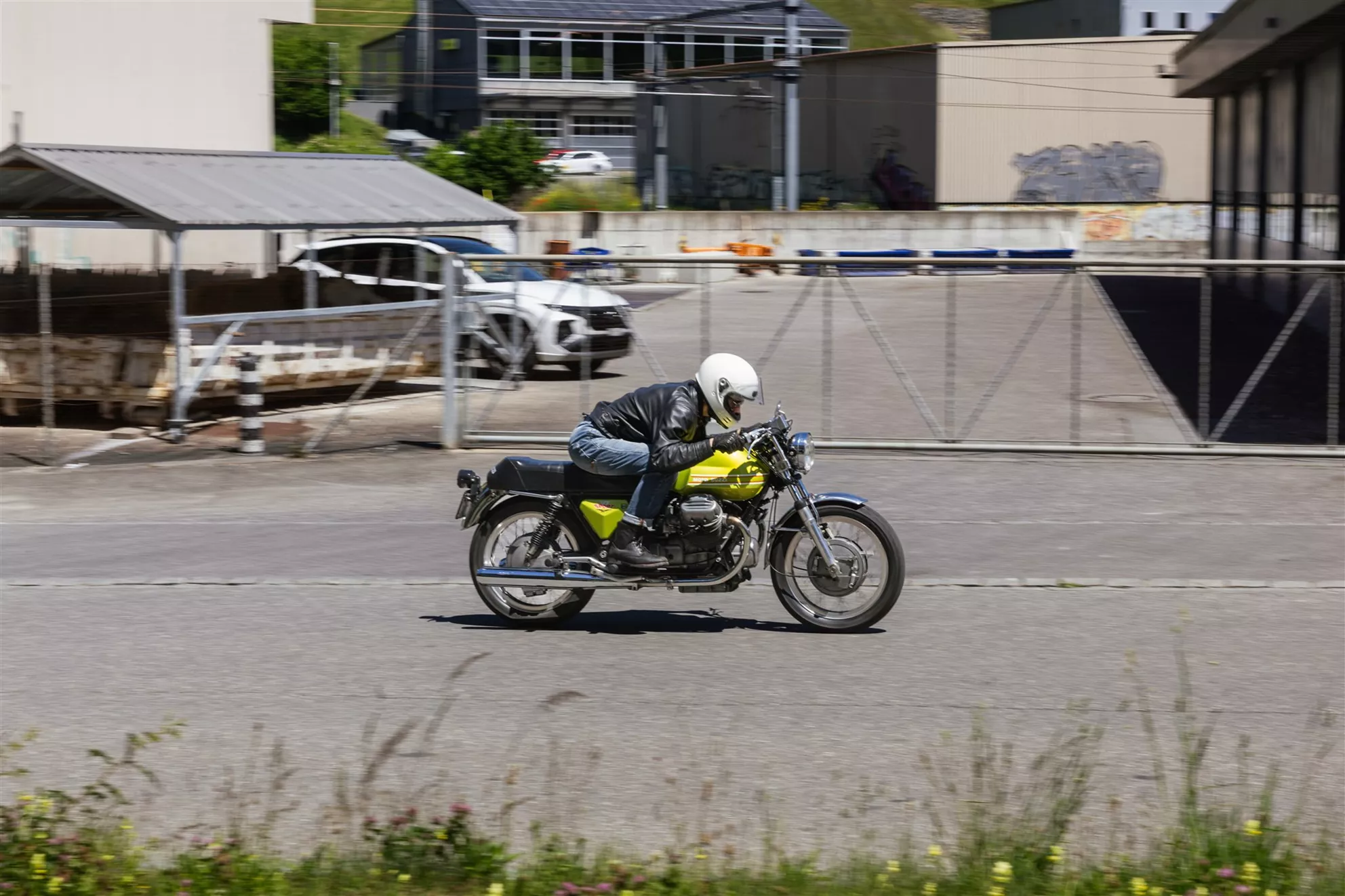
Sport position from an era when a caf\u00e9 racer really was built for speed. Max in the saddle of the 1972 V7 Sport, gazing over the long tank into the next corner.
Max sits on, and the riding position is another word for a statement. The clip-ons sit roughly ten to twenty centimetres lower than on the modern V7 Sport, the pelvis tips forward, the gaze goes out over the long tank. A sports bike in the most literal sense, no retro attempt, but the original from a time when a caf\u00e9 racer really was built for speed, not weekend comfort. On a short trip through town, this posture would probably start pinching in the shoulders after a few minutes, but on the open road, in the Bernese Oberland, looking at a corner opening up ahead, it suddenly makes complete sense.
The machine is operated via a classic cable-actuated throttle, and that's one of the points Max mentions to me right after the first kilometres. The throttle response, he says, is more direct, more honest, closer to what's actually happening in the combustion chamber than anything he's held in recent years. No sensors, no electronic translation, simply thumb on the grip and throttle bodies on the carburettor, connected by a taut steel cable. Anyone who's ridden that understands why some riders get sentimental over this detail.
What the machine also demands is revs. The gearing is tall, clearly tuned for sport, meaning there isn't much to expect down in the rev cellar. Anyone wanting power has to let the engine work, wind it up and keep it where it belongs. Do that, and the old bike rewards you with a straight-line stability that Max, after returning, describes almost rapturously. It lies like a plank, is absolutely stable, and you notice in every second that Tonti didn't think just a little sporty here, but really sporty.
Braking, incidentally, is still done in classic fashion via drum brakes, at the front in the more elaborate duplex design with two brake shoes per side, at the rear also a drum. Anyone used to that gets along fine with it. Anyone switching over from a modern bike very quickly learns that braking has to start earlier than with today's Brembo twin-disc setup, and that too is part of the picture of this era and makes riding more deliberate.
Moto Guzzi V7 Sport 2026 - The modern daughter with her own profile
Anyone switching over from the 1972 V7 Sport to the current generation sees familiar things at first. Longitudinally mounted 90-degree V2, air-cooled, two valves per cylinder, shaft drive. Moto Guzzi hasn't tampered with these fundamentals, and that's a deliberate decision, because this architecture gives the brand its identity. What has changed lies in the detail, in the electronics, and in a whole series of tangible upgrades that came with the 2025 model year and continue unchanged into 2026.
Displacement today stands at 853 cubic centimetres, roughly a hundred cc more than the 1972 original. Power is rated at 67 hp at 6900 rpm, maximum torque is 73 Nm at 4400 rpm. On paper these aren't figures that turn heads in the class, but Moto Guzzi states that 95 percent of this torque is already available from 3500 rpm, and that's what makes itself felt on the road.
With the 2025 update, the V7 Sport has reached the Euro 5+ standard, which means a revised exhaust system with three lambda sensors, expanded onboard diagnostics, and a smoother engine run. The airbox was enlarged by 27 percent, the throttle bodies are now 52 millimetres instead of 38, and the entire drivetrain is now controlled via an electronic throttle system. With ride-by-wire come three riding modes as well, Road, Rain and Sport, with the Sport mode reserved exclusively for the V7 Sport, setting it apart from the rest of the V7 family.
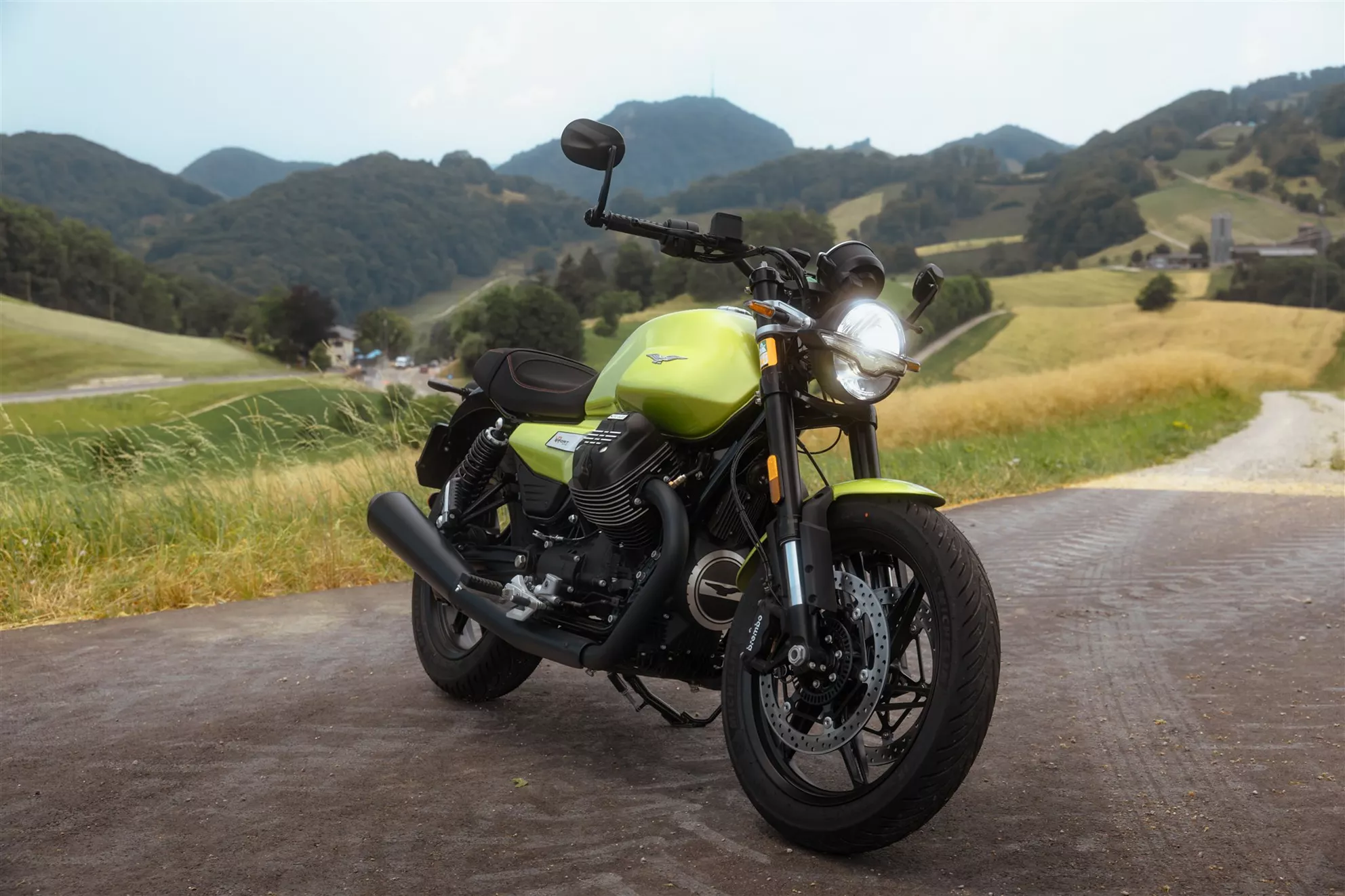
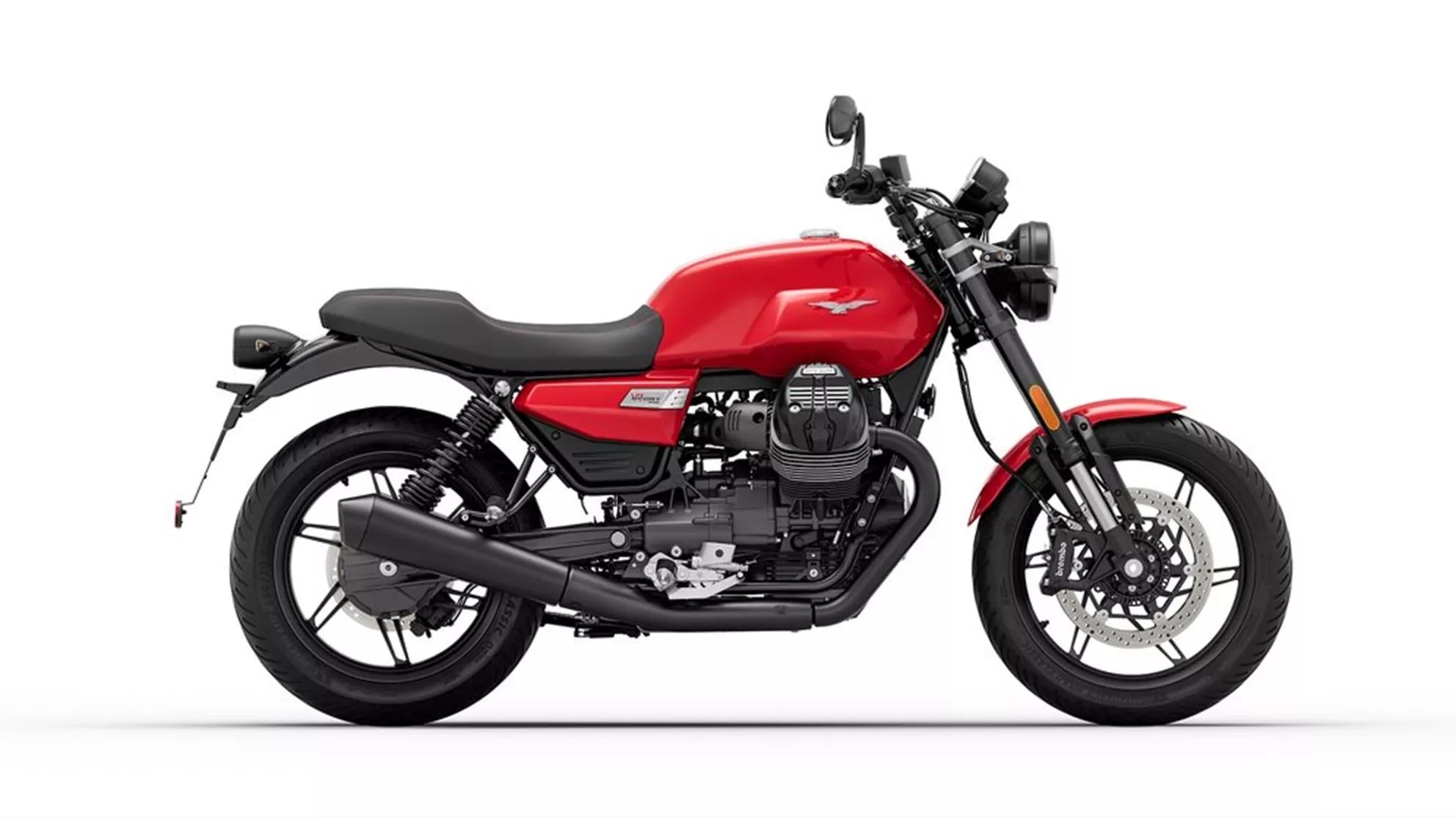
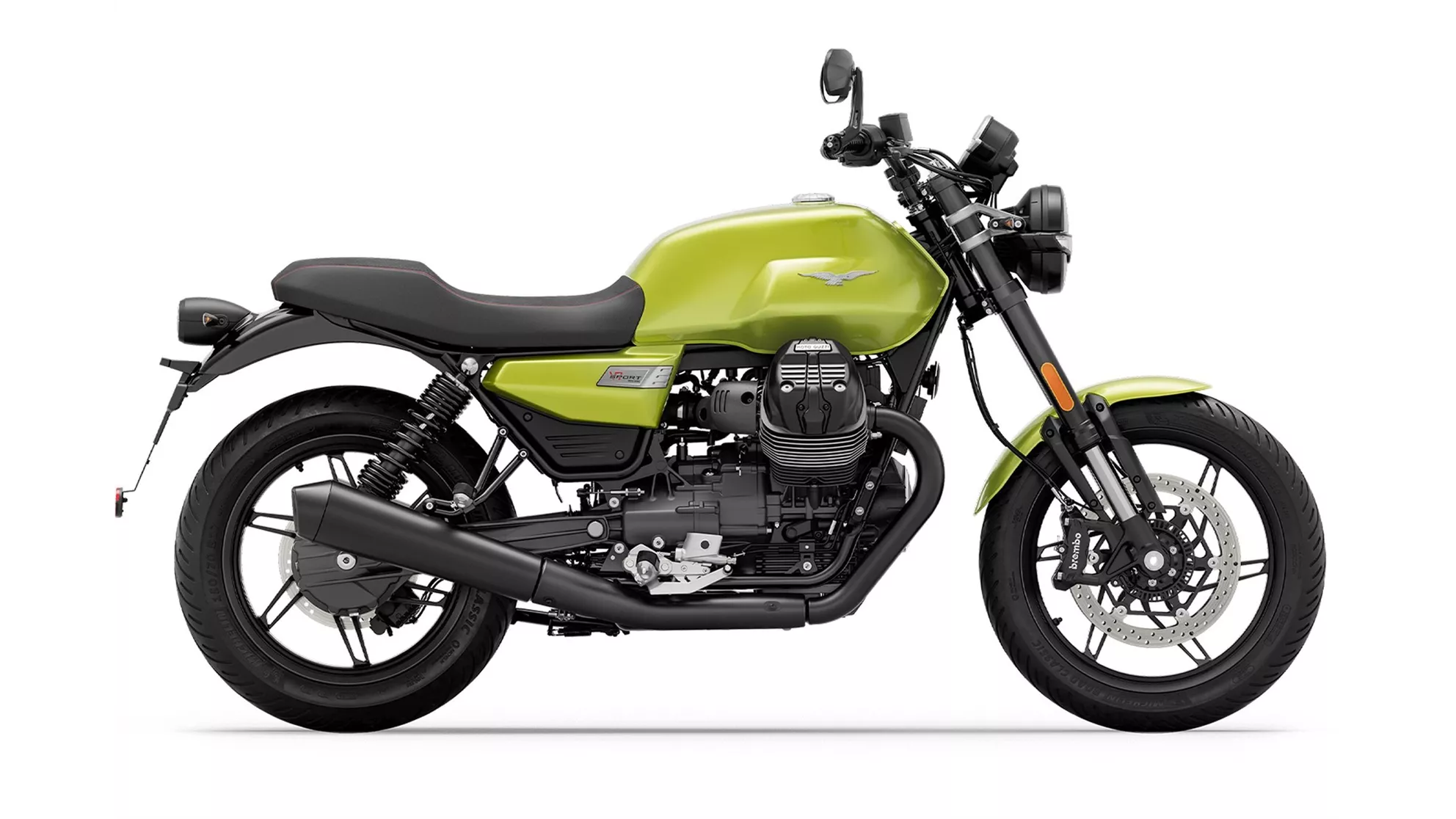
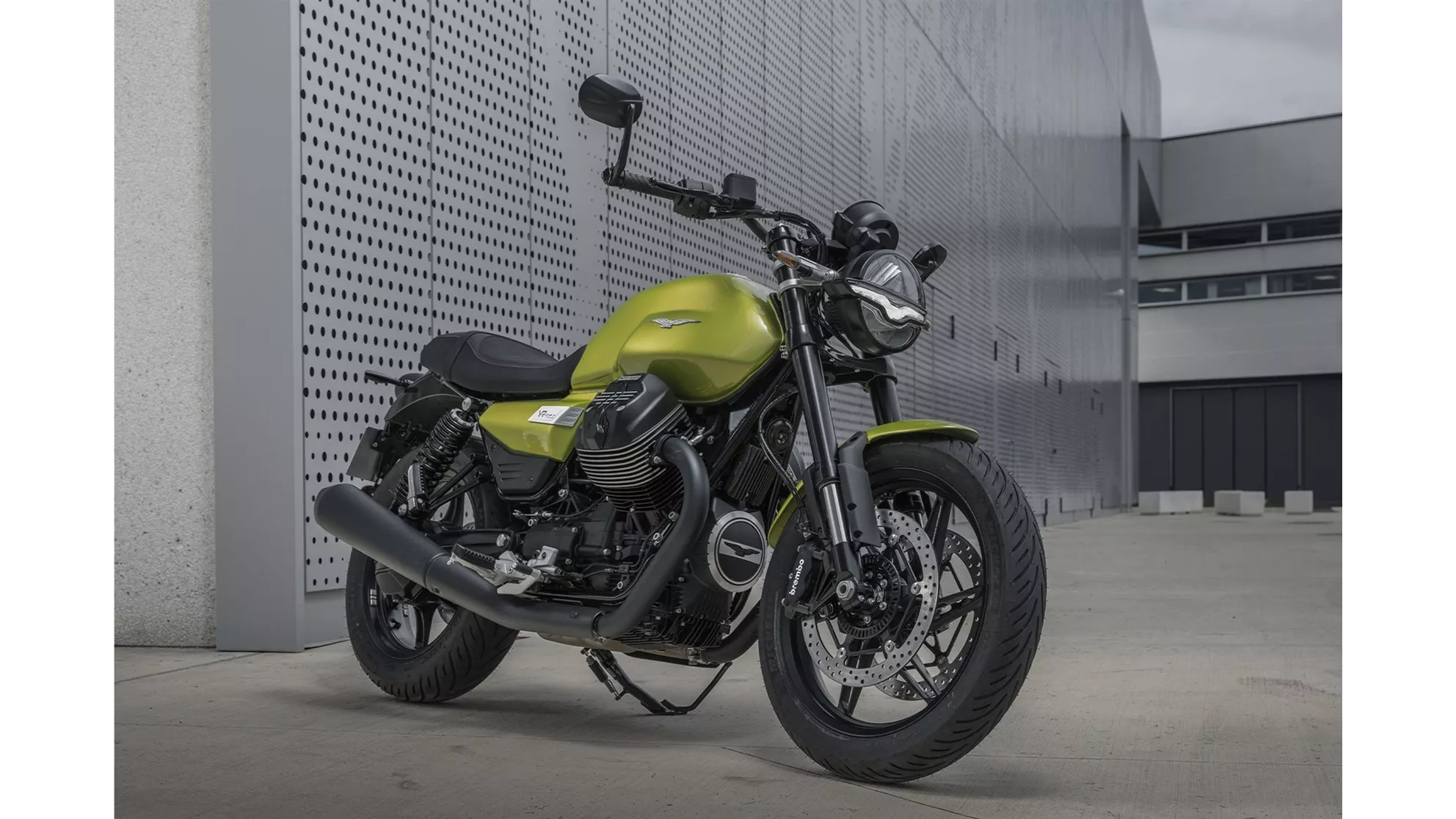
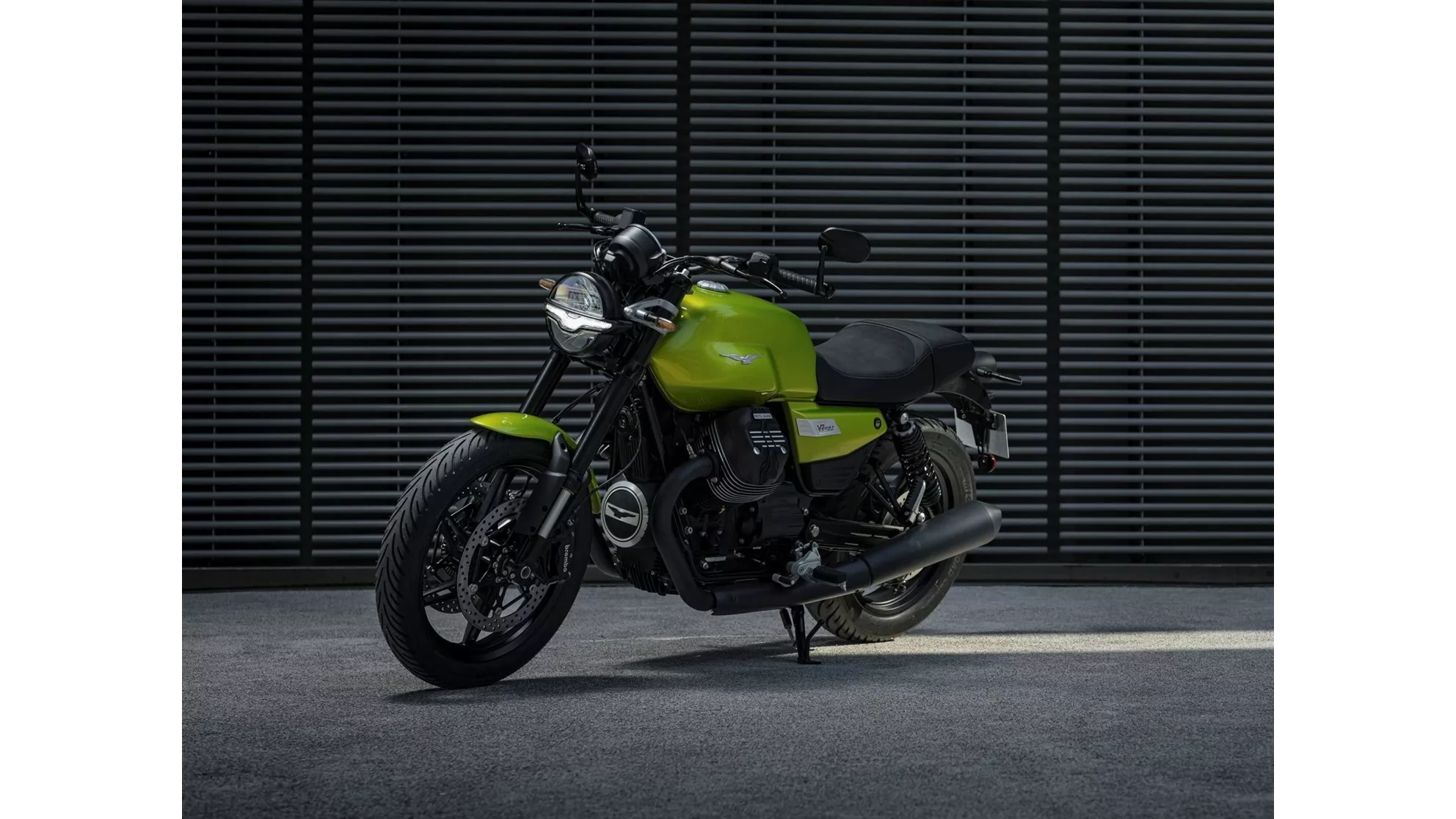
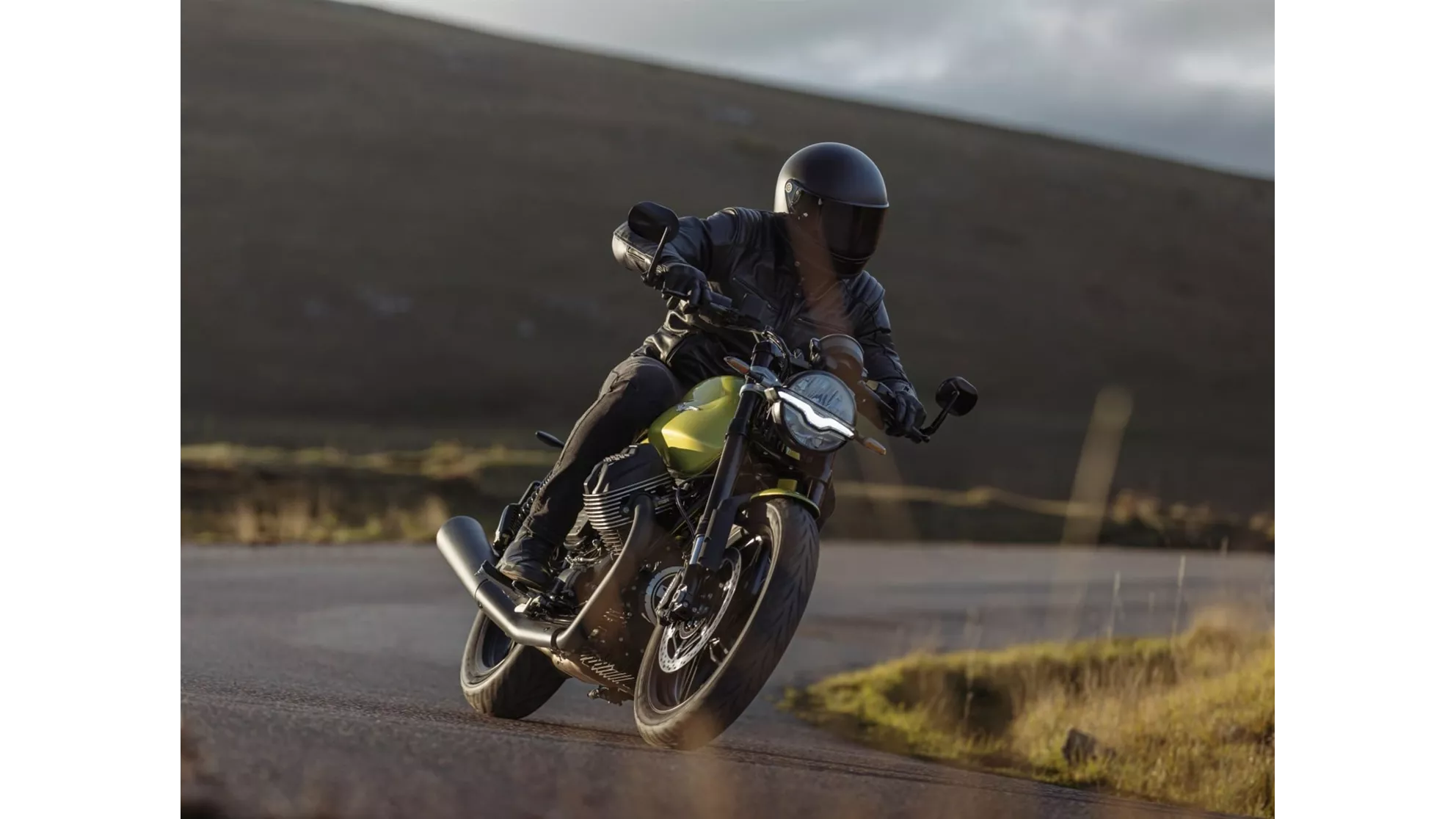
Lime green as a deliberate homage. The new V7 Sport in Verde Legnano, a colour scheme that leads directly back to the first Telaio Rosso machines from Mandello.
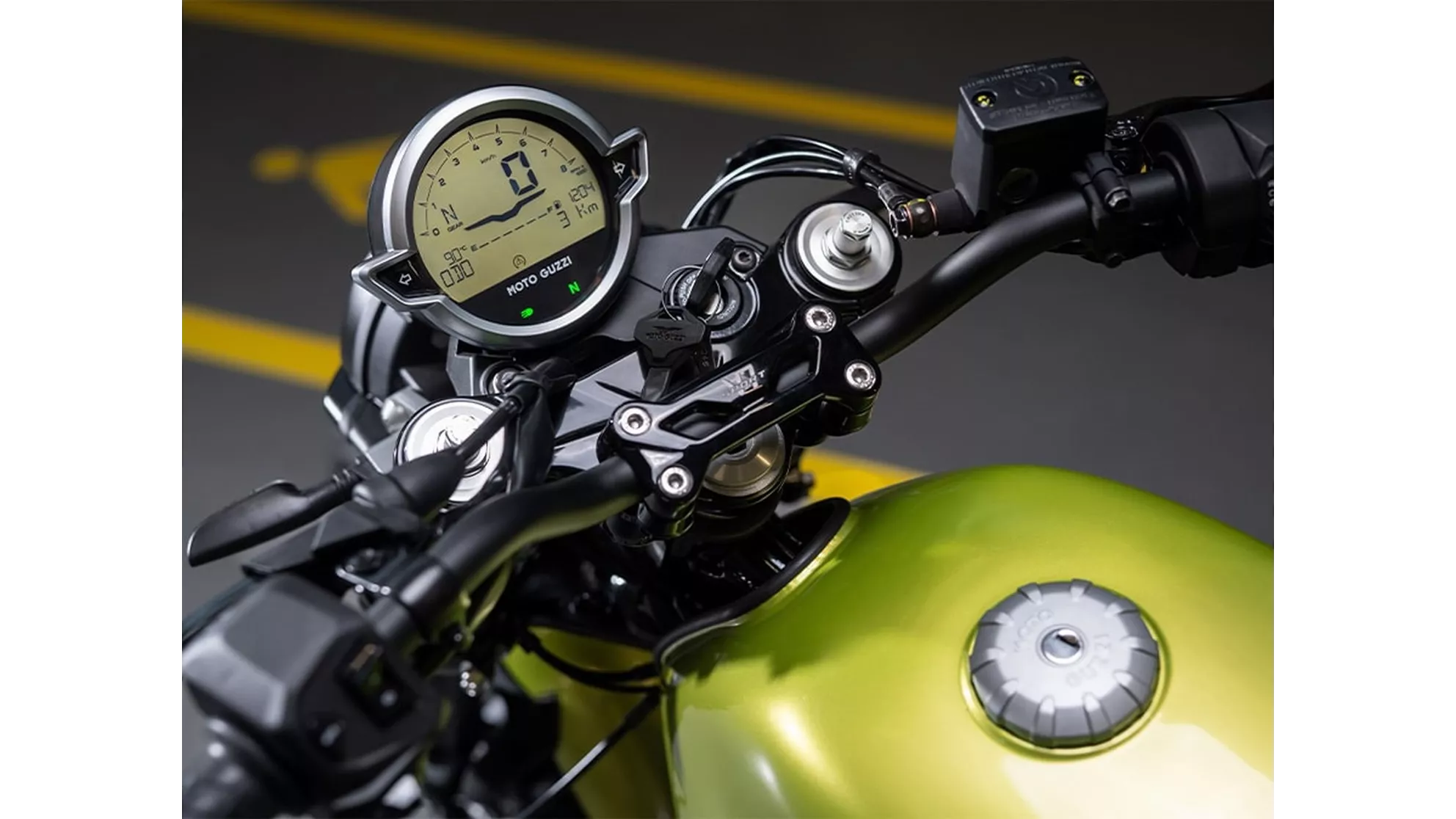
On top of that comes a six-axis inertial measurement platform, which enables cornering ABS and lean-angle-dependent traction control. Cruise control comes as standard, and an LCD display replaces the predecessor's analogue round gauges. Up front works an upside-down fork, the front brake is a 320-millimetre Brembo twin-disc with four-piston monobloc calipers, exactly the brake package you'd expect from a modern sport-oriented machine.
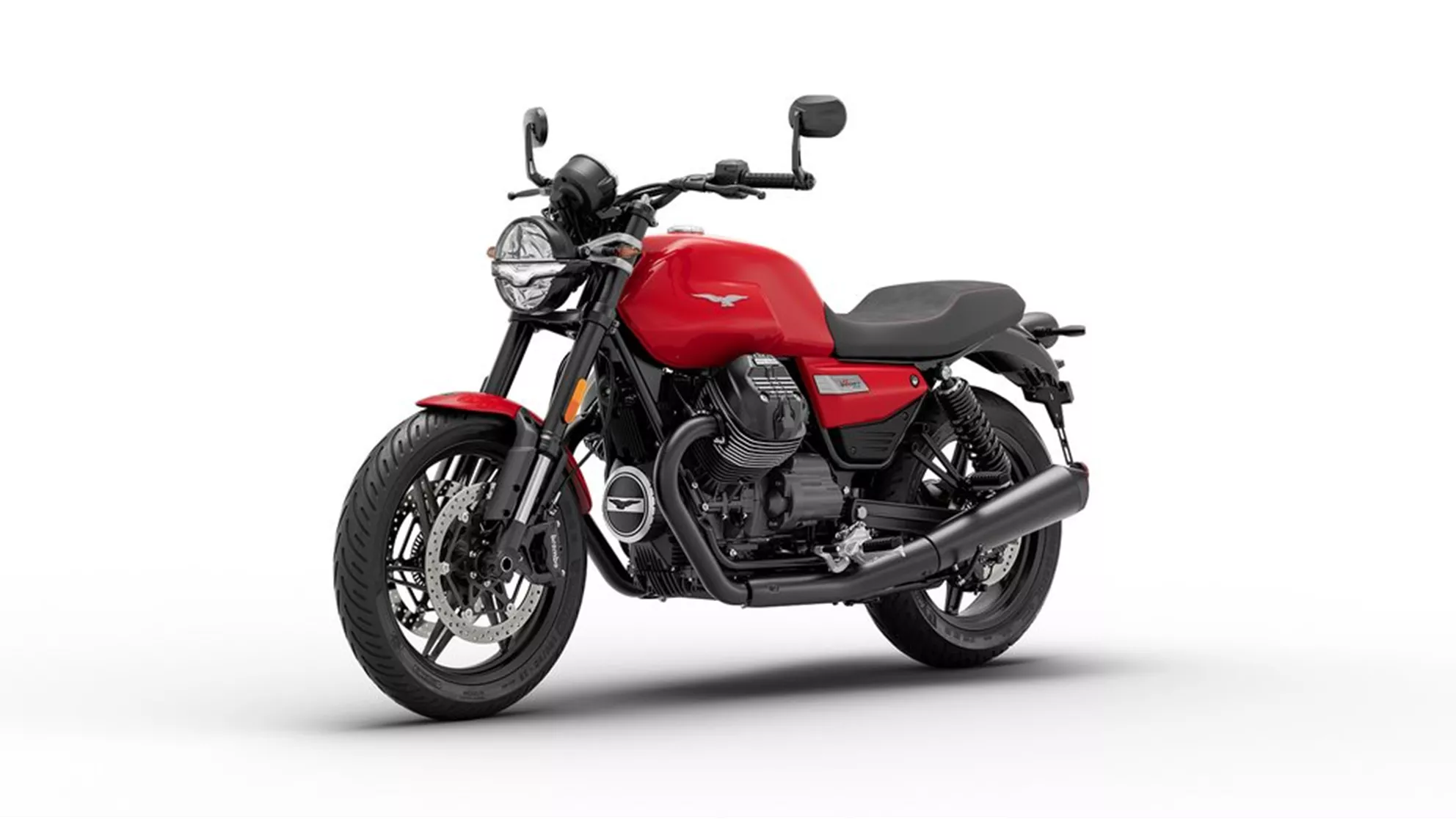
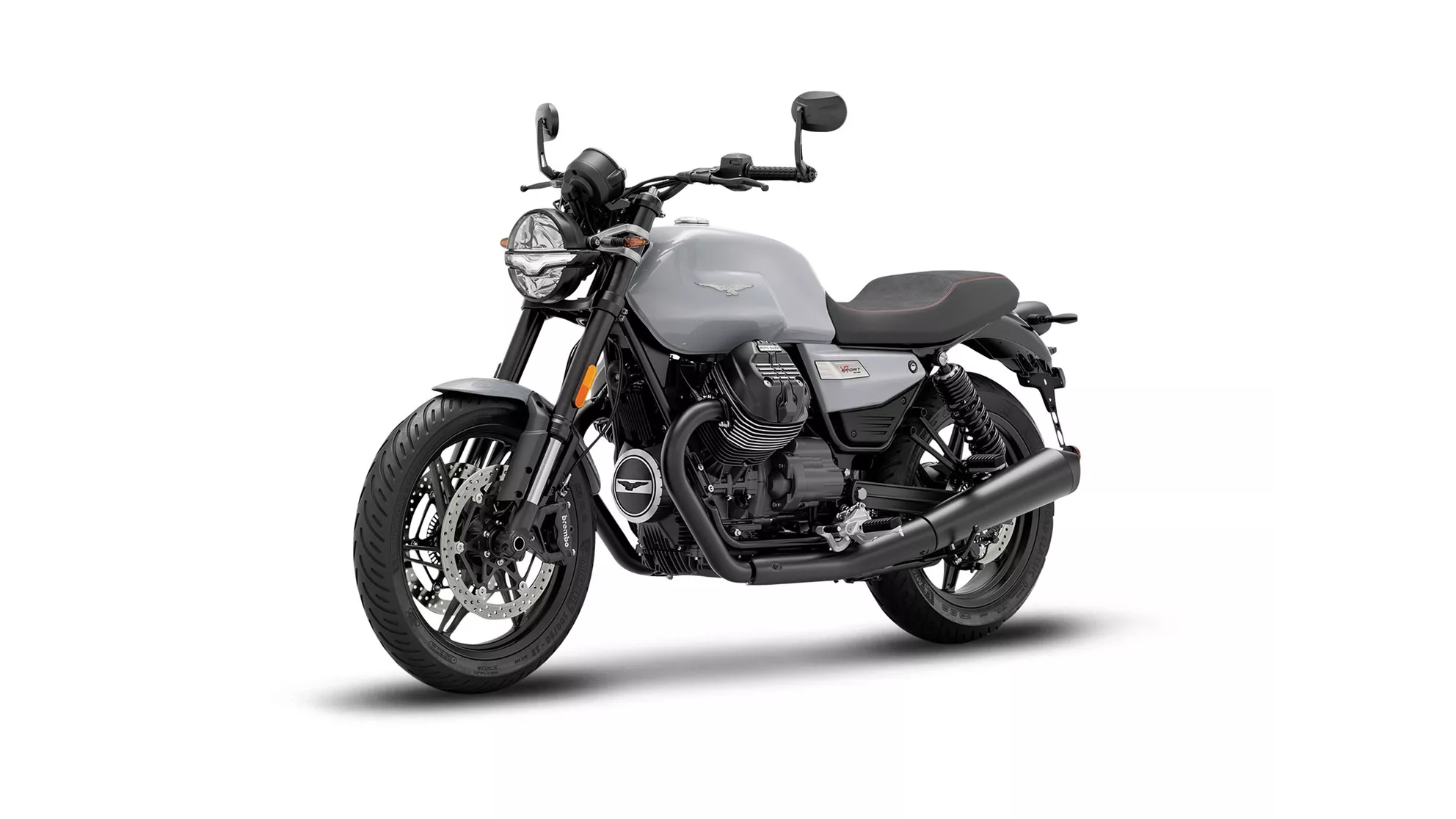
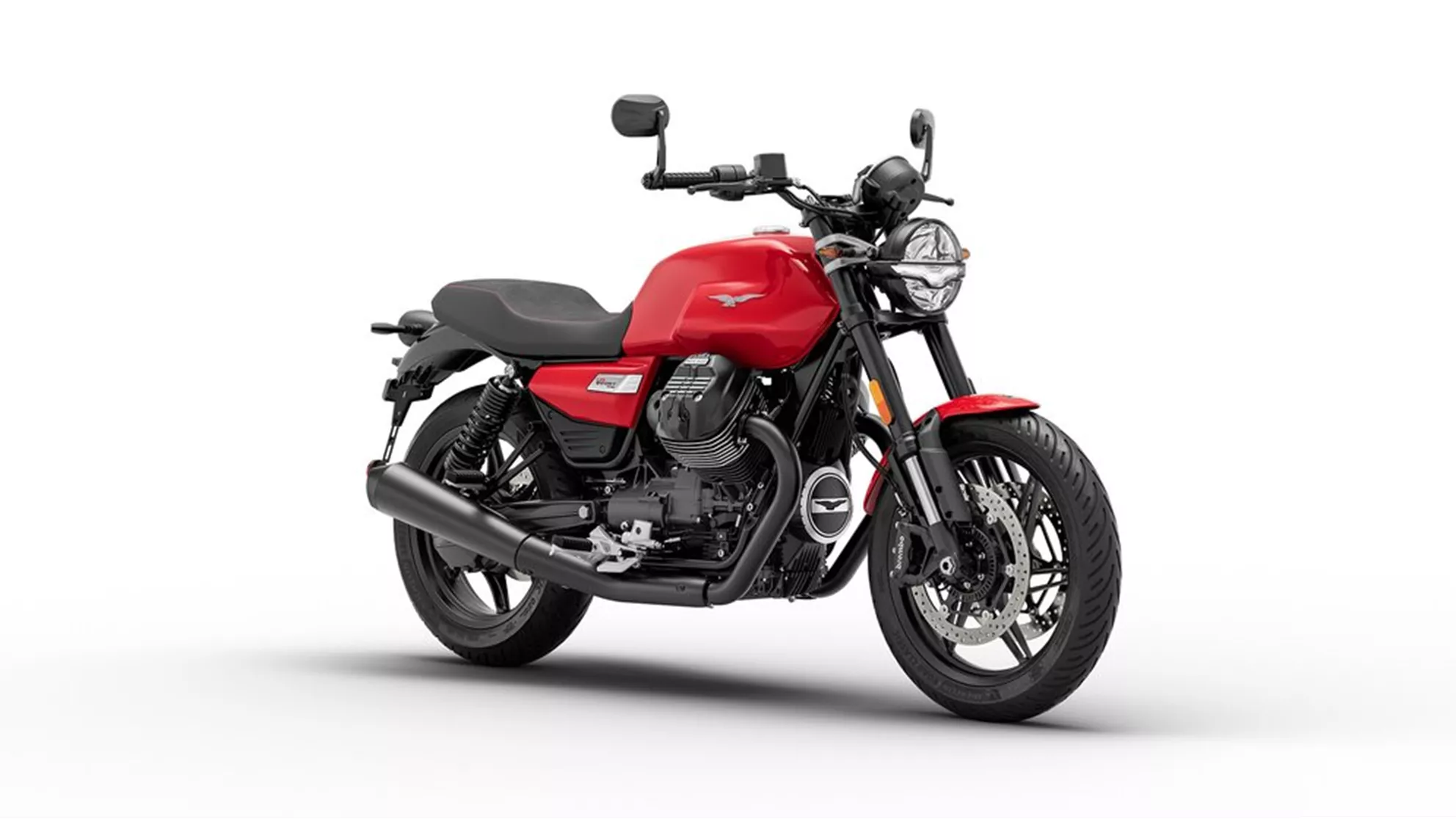
Standing still, it looks slimmer and tidier than the figures suggest. At 220 kilograms wet weight, it weighs almost identically to the old bike, but the weight distribution and the slim tail mean it feels noticeably lighter. The all-round LED lighting, the eagle-shaped daytime running light, the small aluminium accents and the bar-end mirrors give it a modern appearance without dissolving the classic caf\u00e9 racer character. And with the colour Verde Legnano, Moto Guzzi has deliberately built a bridge back to the first Telaio Rosso machines, which instantly sends the right signals to connoisseurs.
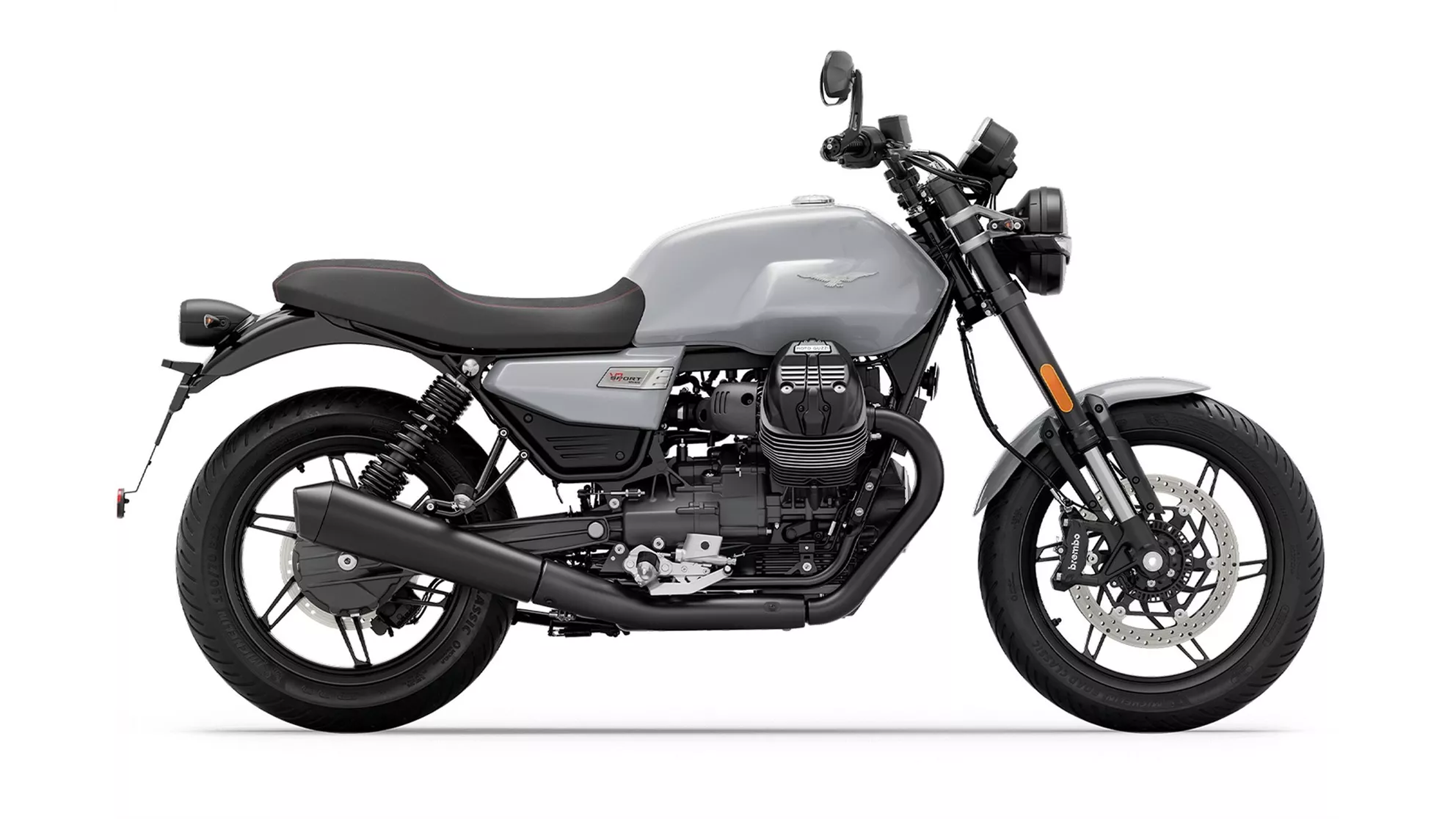
For our test, we had the grey variant in Lario Grey available, because the green one wasn't in the Swiss demo fleet stock. Fortunately I already shot photos of the green version last year, so the iconic lime green also appears in the image material, once as a historical original and once as a modern homage.
In the saddle of the new one, in the Bernese Oberland
The switch from the old bike to the 2026 V7 Sport is no culture shock for Max, but it's noticeable. The geometry changes perceptibly as soon as you sit on it. The handlebar sits higher and closer to the rider, the upper body stays more upright, the knees have more room at the tank. What comes across as a sporty statement on the old bike feels relaxed and everyday-usable here. You immediately notice that the modern V7 Sport isn't just designed for a great Sunday blast, but for longer days in the saddle.
Starting it up requires just a button press, no tap and no choke. The V2 still wakes up with the same sideways rocking that also marks the old bike's identity, and that's one of those bridges across the decades that immediately catches an observer's eye. Acoustically too, the new one delivers surprisingly much, given that it has to meet Euro 5+. It doesn't thump quite as raw as the old one, sounds altogether a bit more civilised, but on a closed throttle a fine crackling and burbling sets in that immediately reveals the character. Anyone who wants to hear a Moto Guzzi gets one here too.
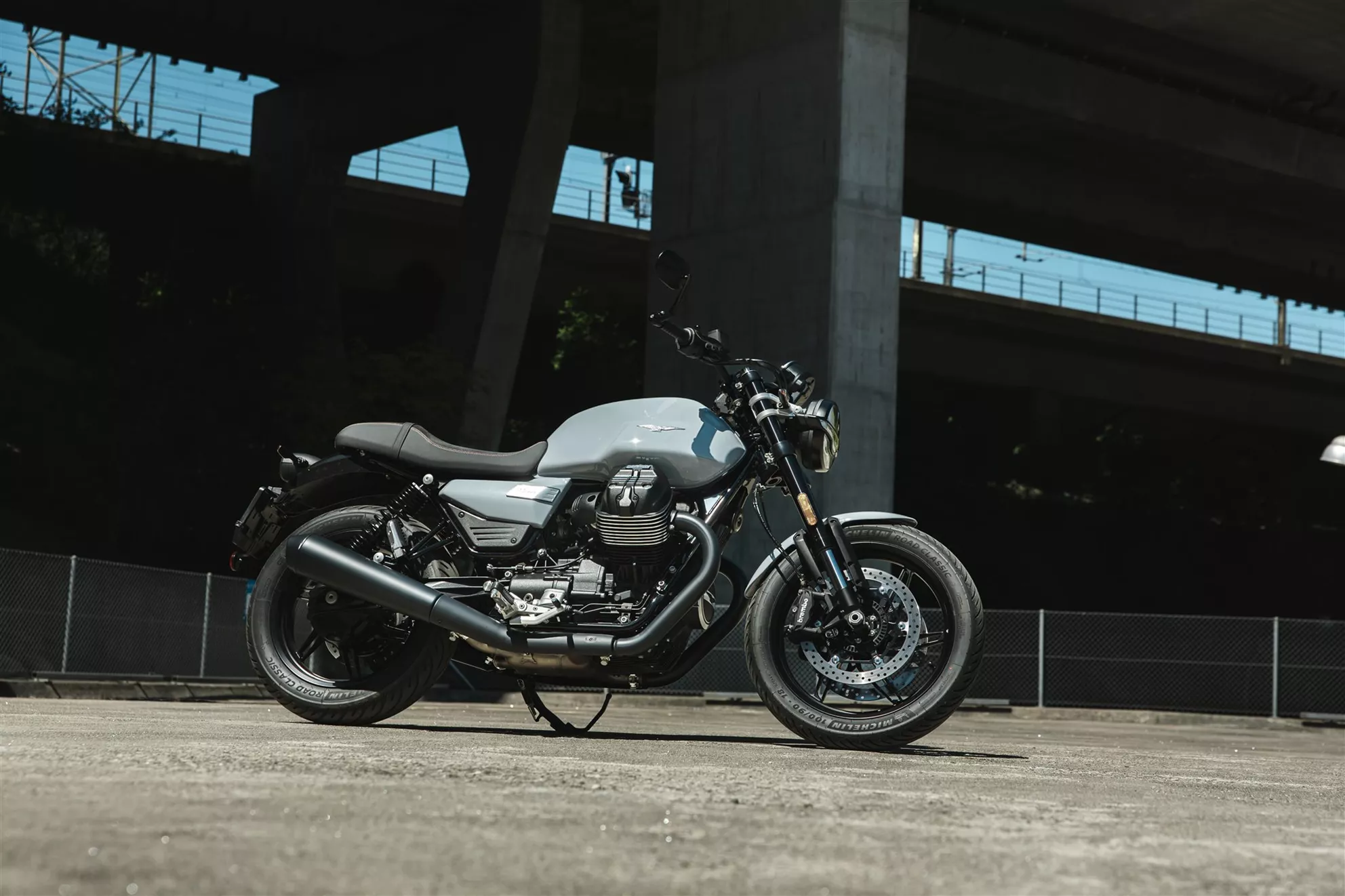
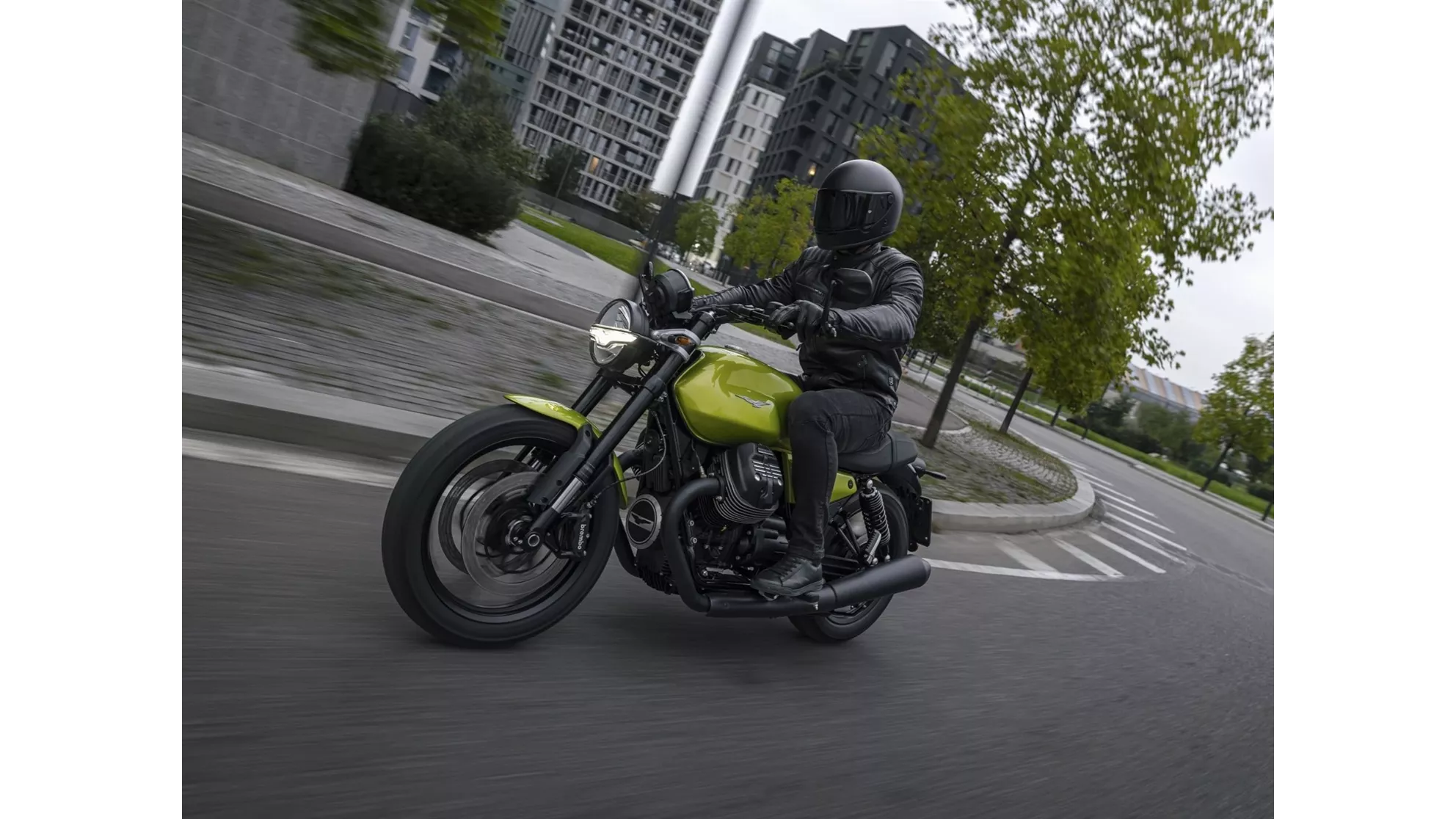
The V7 Sport 2026 in Lario Grey, photographed against an urban backdrop. A machine that feels at home not only on scenic roads but also in daily surroundings.
On the first kilometres through the Bernese Oberland, it becomes clear what the modernisation has really brought. Torque arrives noticeably earlier, the machine pulls cleanly through from the rev cellar and doesn't constantly demand high revs. Where Max had to concentrate on shifting and revving on the old bike, he simply lets the new one run in sixth gear and takes gradients with a relaxed twist of the throttle. This difference in character is probably the biggest between the two machines, and at the same time the most important clue as to who the new one is aimed at today.
In tight corners, of which there are plenty in the Bernese Oberland, the 2026 model feels noticeably more agile and easier to manoeuvre than its ancestor. The upside-down fork works cleanly, the chassis remains predictable at all times, and the Brembo twin-disc brake up front decelerates at a level that's incomparable to the drum of 1972. Cornering ABS and traction control stay in the background but are there when needed.
One point, however, Max holds honestly against the new bike, and it's one of those moments where a bridge to the old bike closes in an unexpected way. The rear brake still decelerates almost as poorly as on the 1972 model, or at least noticeably less sharply than you'd expect from a modern motorcycle. It lacks a clear pressure point, the well-dosable bite, and for riders who use the rear wheel to stabilise or lightly brake into a corner, that's a noticeable shortcoming. On the old bike, a weak rear brake belongs to the technical context of the era. On the new one, you wonder why this detail didn't get more attention.
Overall, though, the verdict on the road is clearly positive. The 2026 V7 Sport offers riding performance that's easy in everyday use and secure through corners, without the character of the V2 getting lost along the way. Max sums it up after several hours. It's tamer than the old one, yes, but tamer in a positive sense, because it really lends itself to long day tours and doesn't hurt in the shoulders or wrists after the first hundred kilometres.
Two machines, one DNA - Moto Guzzi V7 Sport
What remains after this day in the Bernese Oberland is less a winner or loser, and more a remarkably clear answer to the question of how much of 1972 is still in a V7 Sport of 2026. The honest verdict is: quite a lot, but in a form that has adapted to today's times without betraying itself.
The old bike was an uncompromising sports machine of its era, designed for speed, straight-line stability, tall gearing and high revs. It demands attention from the rider, physical effort and knowledge of its ritual. It rewards all of that with an experience that can barely be recreated today, because due to modern regulations, neither the starting ritual, nor the direct cable-actuated throttle, nor the raw sound from the chrome pipes would survive in this form.
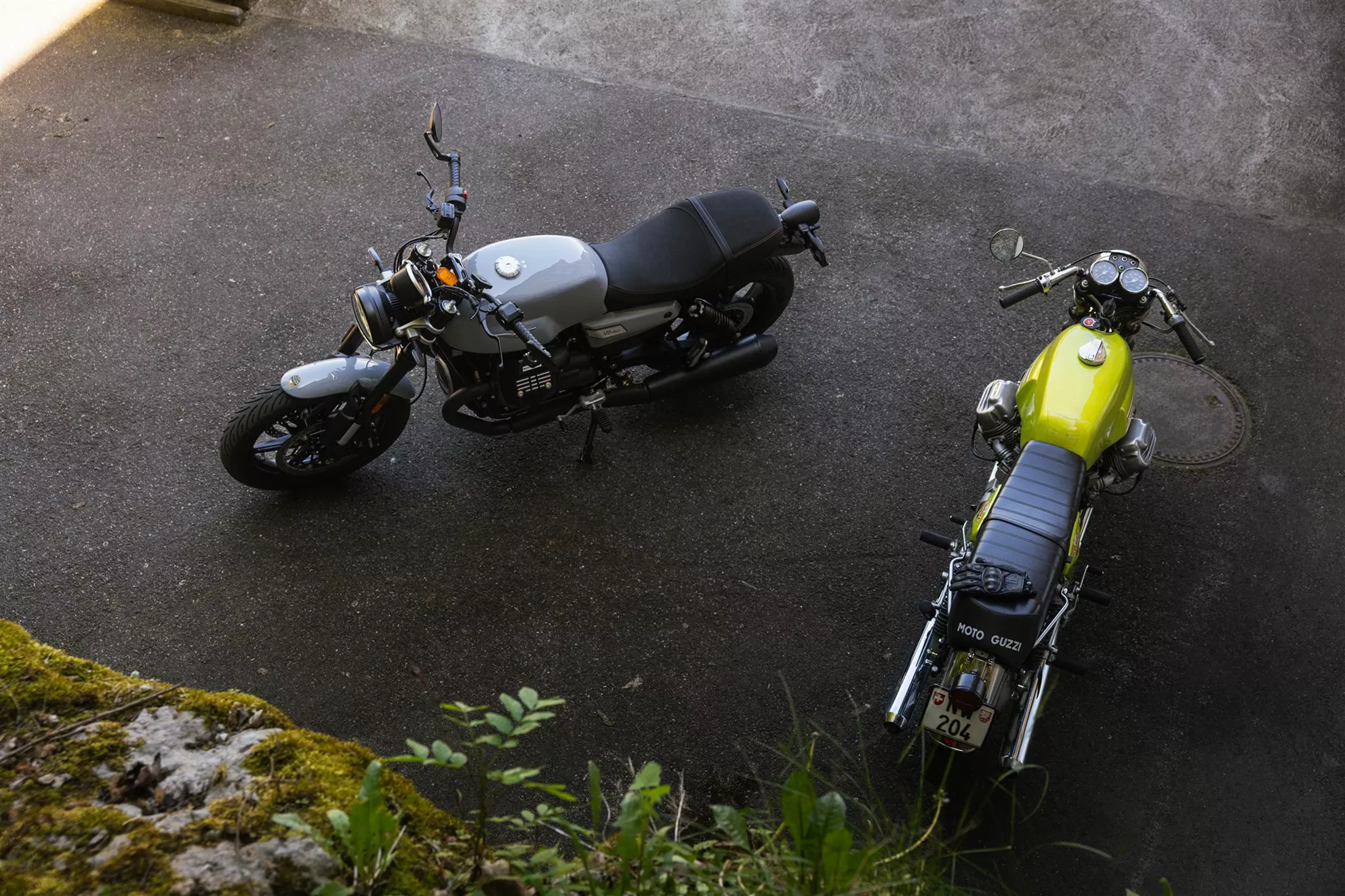
Two generations, one idea. What was conceived in Mandello in 1971 lives on 54 years later in altered form, proving how enduring a clear design can be.
The new bike doesn't need to deliver that anymore, because it has a different job. It's the V7 Sport you take out of the garage in spring and ride all summer long, take along in everyday life, and at the same time send on a day trip to Ticino. It has the torque needed for that, it has the riding position that lets you dismount relaxed even after a hundred and fifty kilometres, and it has a chassis plus brake package that gives you confidence on tight mountain roads. Yet it still carries the V2 character, the sideways rocking on throttle blips, and the unmistakable sound within it, and that's precisely what makes it a machine that really still stands in the tradition of its ancestor.
What kept going through my head during the day: why do brands like Moto Guzzi manage so little to connect with the younger generation. A V7 Sport has everything that should actually appeal to them, it's rebellious, it's visually strong, it has a real history, it stands for something, and on Swiss roads it looks like a statement. Compared to many competitors who today compete for attention with ever more screen, ever more modes and ever more connectivity, the V7 Sport takes a quieter and more honest path. Maybe that's what's worth rediscovering among younger riders. A machine that doesn't want to convince through spec sheets, but through character, sound and a clear design vocabulary that has worked for over fifty years.
Anyone who rides home at the end of such a tour with images of both machines in their head will hardly want to claim the old one is better, or the new one. They're both exactly what they need to be in their own time. And that's probably the finest compliment you can pay the works in Mandello del Lario today.
- How much does a Moto Guzzi V7 Sport cost?
- Here you will find an overview of the price level of new and used motorbikes!
&width=60&height=60&bgcolor=rgba_39_42_44_0&mode=crop "Author: FunkyFrankee")
Moto Guzzi V7 Sport 2026 - Experiences and Expert Review
FunkyFrankee
Moto Guzzi got a great many things right in the reorientation of the V7. The changes to the engine for Euro5+ deserve great praise, because not only has the typical character of the air-cooled V2 been preserved, but especially in the mid-range there's now noticeably more torque and power available. The fact that the V7 Sport even has a 6-axis IMU including cornering ABS fits perfectly with the new 320mm twin-disc brake, which lifts the V7's braking level by two classes. What remains are the relatively firm shocks and the LC gauge cluster, which doesn't suit the V7 Special as well as the previous analogue dials did. All in all, the 2025 V7 range is very well done.
More from 1000PS Magazine
Moto Guzzi V7 Sport 2026 meets its roots from 1972 Images
Source: 1000PS