Is the automated gearbox on the BMW R 1300 GS just a nice comfort feature, or can you actually ride the bike seriously hard with it? That's exactly the question hanging over the 1000PS Bestzeit outing in Bad Fischau. The bike: the current R 1300 GS in ASA configuration; on the rear wheel: the Bridgestone T33, which several adventure bikes are also running in our big 2026 comparison test. Conditions at the start of the season are cool, 12 degrees track temperature, on a compact supermoto track with tight hairpins and short straights. Just the right setting to find out whether an electronically shifted gearbox helps the GS on a tight track or rather turns you into a passenger.

BMW R 1300 GS with ASA automatic in the Bestzeit test
Comfort gadget or real speed advantage at 12 degrees?
The BMW R 1300 GS with the ASA automated gearbox on the 1000PS Bestzeit track in Bad Fischau. 12 degrees track temperature, Bridgestone T33, 2026 season opener: is the electronic shifting just a comfort feature, or does it bring a real speed advantage on tight corners?

nastynils
published on 8/14/2026
13,590 Views
First laps on the GS around the supermoto track
Lapping on the GS, you immediately notice why this bike has become the benchmark in the adventure segment: you climb on, pick your line, and confidence in both the front and rear wheel builds very quickly - even on such a cool morning. Once you've got the hang of the GS world and the quirks of the boxer, you're riding at a good level and feel like you're sitting on the right bike. I hadn't been on a race track over the winter, so I didn't go into this in top form, and yet the GS made getting up to speed very easy for me. In the Bestzeit context, that's the key indicator of how accessible a bike really is.
ASA automatic put through the sporty Bestzeit stress test
Now for the really interesting part: the automated gearbox. In normal automatic mode it doesn't quite work out on the tight track - through the tricky corner combinations it's better if I decide myself when to change gear. So I switched to manual mode, and that works much more harmoniously on the Bestzeit track. You can shift up and down without the clutch and without blipping the throttle, the system does everything itself, and the shifts come quickly. On the road in normal traffic, on the other hand, the automatic is the right choice. But if you're riding very hard, be it on the Bestzeit track or charging up the Stelvio Pass, you're clearly better off in manual mode.
Standing start with an automatic remains a mystery
What happens at the Bestzeit standing start if you go full throttle in neutral and then knock it into first, I honestly don't know - I didn't try it that way. My approach: first gear in, a bit of throttle to take up the slack in the drivetrain, then wide open. It feels relatively unspectacular, because you need neither clutch nor rev control. It can definitely be quick, because there's little you can get wrong, but there may well be better options.
Honda DCT as the direct benchmark
Because the question about a direct comparison always comes up: the system on the Honda Africa Twin with DCT simply shifts faster. Gear changes on the Honda system are quicker, but the trade-off is a clearly different operating concept. With ASA, BMW deliberately takes a different route: a classic gear lever for shifting up and down manually is retained, plus the option to let the bike shift automatically whenever you like. For people who value the familiar gear lever layout but still want to glide along in automatic mode 95 percent of the day, it's a neat upgrade. In the 1000PS editorial team it has become clear that most testers leave the automatic switched on for everyday touring and simply enjoy the comfort.
Bridgestone T33 and 12 degrees track temperature
What worked surprisingly well in these conditions is the partnership between the GS and the Bridgestone T33. The tyre gets up to operating temperature quickly, doesn't hold the GS back and delivers neutral, pleasant handling with great stability - a really successful combination. With a track temperature of just 12 degrees, though, the fact remains: tyre and temperature hurt the lap time, and that has to be factored into any ranking. But that very comparability is the added value of the 2026 season-opener comparison test: all adventure bikes are running on the same Bridgestone T33 today, on the same track, at the same track temperature. Anyone who wants to see the GS, Multistrada, Africa Twin and co. under the same cool conditions will find a clean data set here.
Boxer torque and gear selection in detail
As for the engine, I kept going back and forth between first and second gear. In first you have a bit more headroom and a bit more restlessness, in second a bit less torque - which on the GS is of course relative, as power and torque are available in abundance. At the end of the day it hardly mattered, the boxer delivers enough in both gears for the tight hairpins in Bad Fischau. The practical rider assistance systems supported me well on track without being intrusive, and the brakes deliver what you'd expect from the brand. All in all, a bike that shows the high level adventure bikes in this big-displacement class have now reached, not only in price but also in accessibility.
Composed and sweat-free in Bestzeit mode
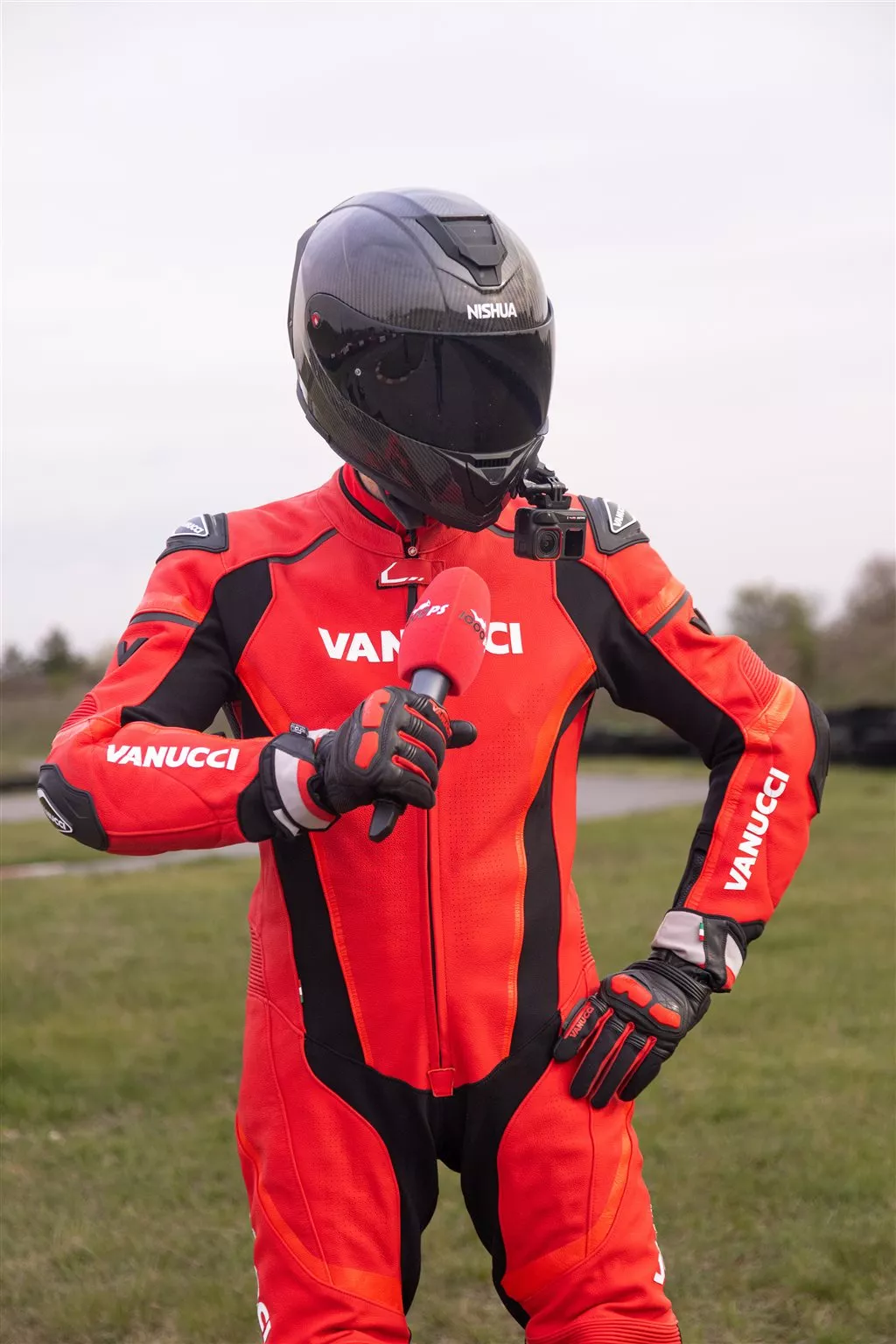
If I had to guess, I set a very, very good time on the GS today - and without breaking a sweat. Pleasant, composed, no fear, and that on a bike weighing 237 kilograms with 145 hp from a 1,300 cc boxer. That's exactly the point: this GS puts you into a sporty mode without challenging you, without making you nervous, without warning you that you're crossing a limit. In the YouTube video on the 1000PS channel you'll see how cleanly the GS moves around the tight track. I'm curious where the time will end up - and I'm especially looking forward to comparing it soberly with the other adventure bikes from the same test day.
Lap time and ranking in the Bestzeit table
With a lap time of 1:08.0 on Bridgestone T33 at 12 °C track temperature, the BMW R 1300 GS slots into a clearly readable region of the Bestzeit table. Above it is the BMW R 1300 GS in summer temperatures (MY 2024, Bridgestone A41, 31 °C) at 1:07.2, as well as the Yamaha MT-07 Y-AMT (MY 2025, Dunlop Sportmax Q5A, 39 °C) at 1:07.760. In the same range is the Triumph Speed Twin 1200 (MY 2022, Metzeler Racetec RR, 42 °C) at 1:08.0. Below it are the KTM 890 Duke (MY 2021, Michelin Power GP, 12 °C) at 1:08.3 and the Honda Transalp 750 (MY 2024, Pirelli Scorpion Trail II, 33 °C) at 1:08.7. Anyone comparing the times directly should always factor in tyres and track temperature - both shift the result noticeably.
About the 1000PS Bestzeit on the supermoto track
The 1000PS Bestzeit is a test series that has been running for years at the Motorsportarena in Bad Fischau - a compact supermoto track with tight hairpins, esses and short straights, deliberately not meant to replicate a big race track. Instead, the track simulates city traffic, Alpine passes and narrow country roads - exactly the terrain where bikes have to show what they can do in everyday riding. The procedure is always the same: around ten warm-up laps, then a flying lap following a standing start. This means clutch control, traction and above all the speed at which you build confidence in the bike all feed into the lap time. Tyres and track temperature have a massive influence on every time - a fact that must never be overlooked when ranking bikes in the long-term table.
Further links on the Bestzeit
- Ridelink Wingman - our data recording tool
- SP Connect motorcycle mounts at a glance
- Onboard footage: Insta360 Ace Pro 2
- NastyNils gear at Louis
- All videos of the 1000PS Bestzeit series - you'll also find the lap time achieved at the end of each video. Sometimes we only put the videos online a few weeks after the report.
- Want to ride the track yourself? Book here!
- About the author NastyNils
BMW R 1300 GS 2026 - Key Facts
Engine and Drive Train
| Engine type | Boxer |
|---|---|
| Bore | 106.5 mm |
| Stroke | 73 mm |
| Engine power | 145 HP |
| Rpm at Max. Power | 7,750 rpm |
| Torque | 149 Nm |
| Rpm at Torque | 6,500 rpm |
| Compression Ratio | 13.3 |
| Fuel system | Injection |
| Throttle Bore | 52 mm |
| Starter | Electric |
| Clutch Type | Antihopping, Clutch systems |
| Transmission | Prop shaft |
| Transmission Type | Gearshift |
| Number of gears | 6 |
| Cylinders | 2 |
| Strokes | 4-Stroke |
| Valves per cylinder | 4 |
| Valves | DOHC |
| Cooling | liquid-air |
| Can be restricted for A2 licence | Yes |
| Displacement | 1,300 ccm |
Suspension Front
| Front suspension | Telelever |
|---|---|
| Travel | 190 mm |
Suspension Rear
| Suspension | Paralever |
|---|---|
| Shock absorber | Monoshock |
| Travel | 200 mm |
| Adjustment | Preload |
| Material | Aluminium |
Chassis
| Frame | Steel |
|---|---|
| Frame type | Load-bearing engine |
| Rake | 63.8 degree |
| Trail | 112 mm |
Brakes Front
| Type | Double disk |
|---|---|
| Diameter | 310 mm |
| Piston | Four pistons |
| Actuation | Hydraulic |
| Technology | radial |
Brakes Rear
| Type | Disc |
|---|---|
| Diameter | 285 mm |
| Piston | Double piston |
| Shock mount | Floating caliper |
Assistance Systems
| Advanced Rider Assistance Systems | ABS, Anti-slipping control, Hill start assist, Riding modes, Combined Brake System, Cornering ABS, Ride by Wire, Cruise control, Traction control, Modern electronics, Comfort |
|---|
Dimensions and Weights
| Front tyre width | 120 mm |
|---|---|
| Front tyre height | 70 % |
| Front tyre diameter | 19 inch |
| Rear tyre width | 170 mm |
| Rear tyre height | 60 % |
| Rear tyre diameter | 17 inch |
| Length | 2,212 mm |
| Width | 1,000 mm |
| Wheelbase | 1,518 mm |
| Seat Height | 850 mm |
| Kerb Weight (with ABS) | 237 kg |
| Fuel Tank Capacity | 19 l |
| Top Speed | 200 km/h |
| License compliancy | A |
| Range | 395 km |
| Battery power (Volts V) | 12 V |
| Battery capacity (Amp-hours Ah) | 10 Ah |
| Combined CO2 emissions | 110 g/km |
| Combined fuel consumption | 4.8 l/100km |
Equipment
| Equipment | LED-Headlights, TFT display, Modern electronics, Lighting |
|---|
- How much does a BMW R 1300 GS cost?
- Here you will find an overview of the price level of new and used motorbikes!

BMW R 1300 GS 2026 - Experiences and Expert Review
nastynils
BMW developed the new R 1300 GS with a wealth of experience and know-how, which shows in its advanced technology and versatility. The model appeals to experienced and new riders alike and offers an impressive combination of performance, comfort and state-of-the-art features. It's a successful blend of compactness, power and luxury that performs both off-road and on the road.
Similar adventure bikes to the BMW R 1300 GS

BMW R 1300 GS with ASA automatic in the Bestzeit test Images
Source: 1000PS


