For decades, the motorcycle world has been split into camps: on one side, adventure bikes with a large front wheel for genuine off-road adventures, and on the other, pure road machines whose 17-inch wheels promise maximum cornering performance on asphalt. In between lingers a stubborn prejudice: a 21-incher simply can't be as good on the road. It supposedly steers more sluggishly, runs onto the tyre's flank too early when leaned over, and costs precision. The Suzuki V-Strom 800 DE takes advantage of this discussion and disproves the prejudice on every stretch of tarmac. With its 776cc parallel-twin featuring a 270° crank offset, thoughtfully designed geometry and the characteristic large front wheel, Suzuki has created a machine that convinces on the road not despite its adventure genes, but because of them. Why does the 21-inch front wheel not just make sense on the road, but is actually a lot of fun?
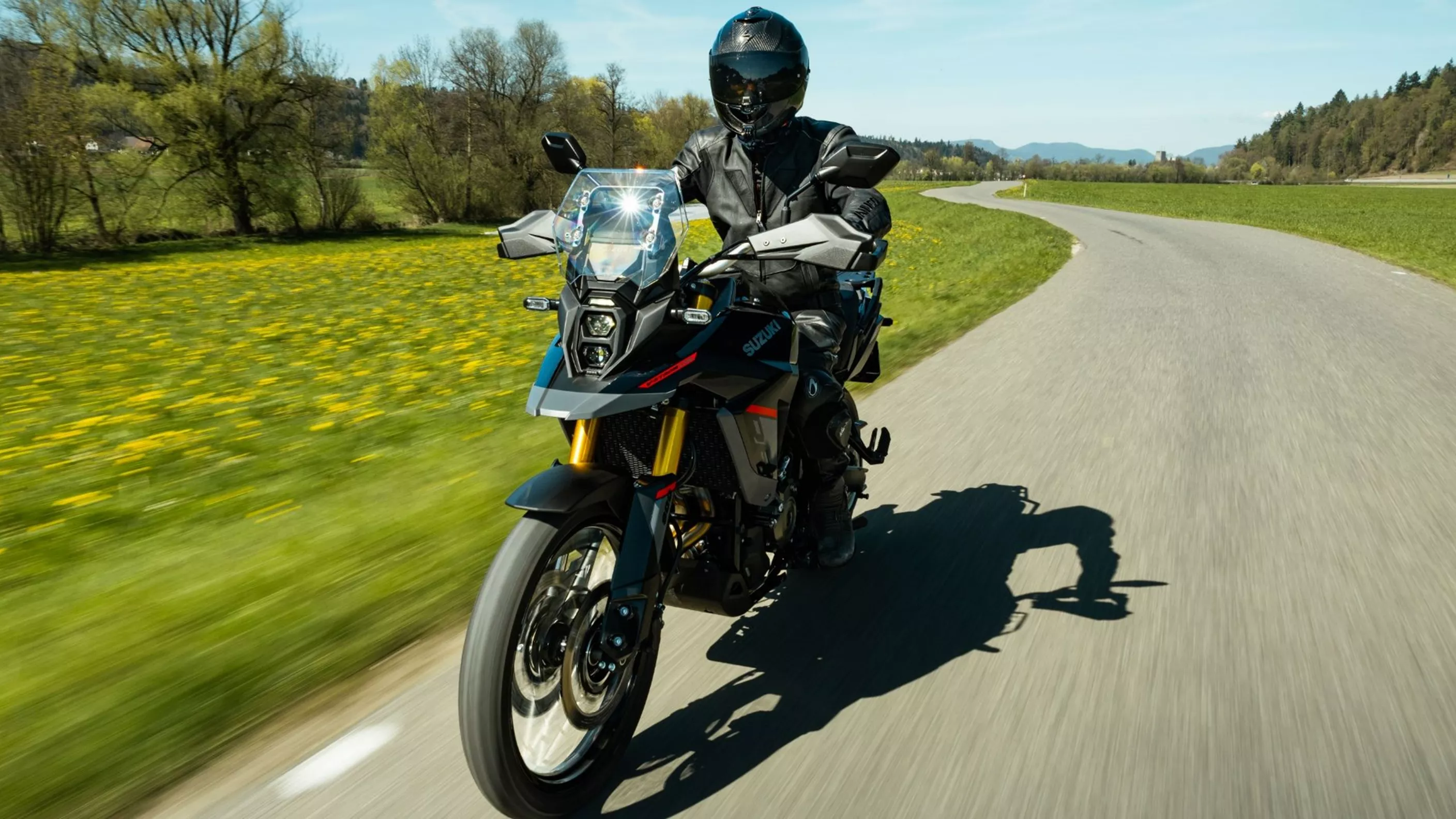
Suzuki V-Strom 800 DE Test: 21-Inch Front Wheel on the Road?
Why the Big Front Wheel Isn't a Compromise
A 21-inch front wheel on the road? Sounds like a compromise. The price you pay if you also want to venture into the dirt sometimes. But anyone who's ridden the Suzuki V-Strom 800 DE thinks quite differently about it afterwards. At the centre of this test, therefore, is not just the new 776cc parallel-twin with its 84hp and 78Nm, but the central question: what does the 21-inch front wheel mean in everyday use — physically, in terms of riding dynamics, and practically? The answers are surprising.
&width=72&height=72&bgcolor=rgba_39_42_44_0&mode=crop "Author: Alessio")
Alessio
published on 5/22/2026
The False Assumption
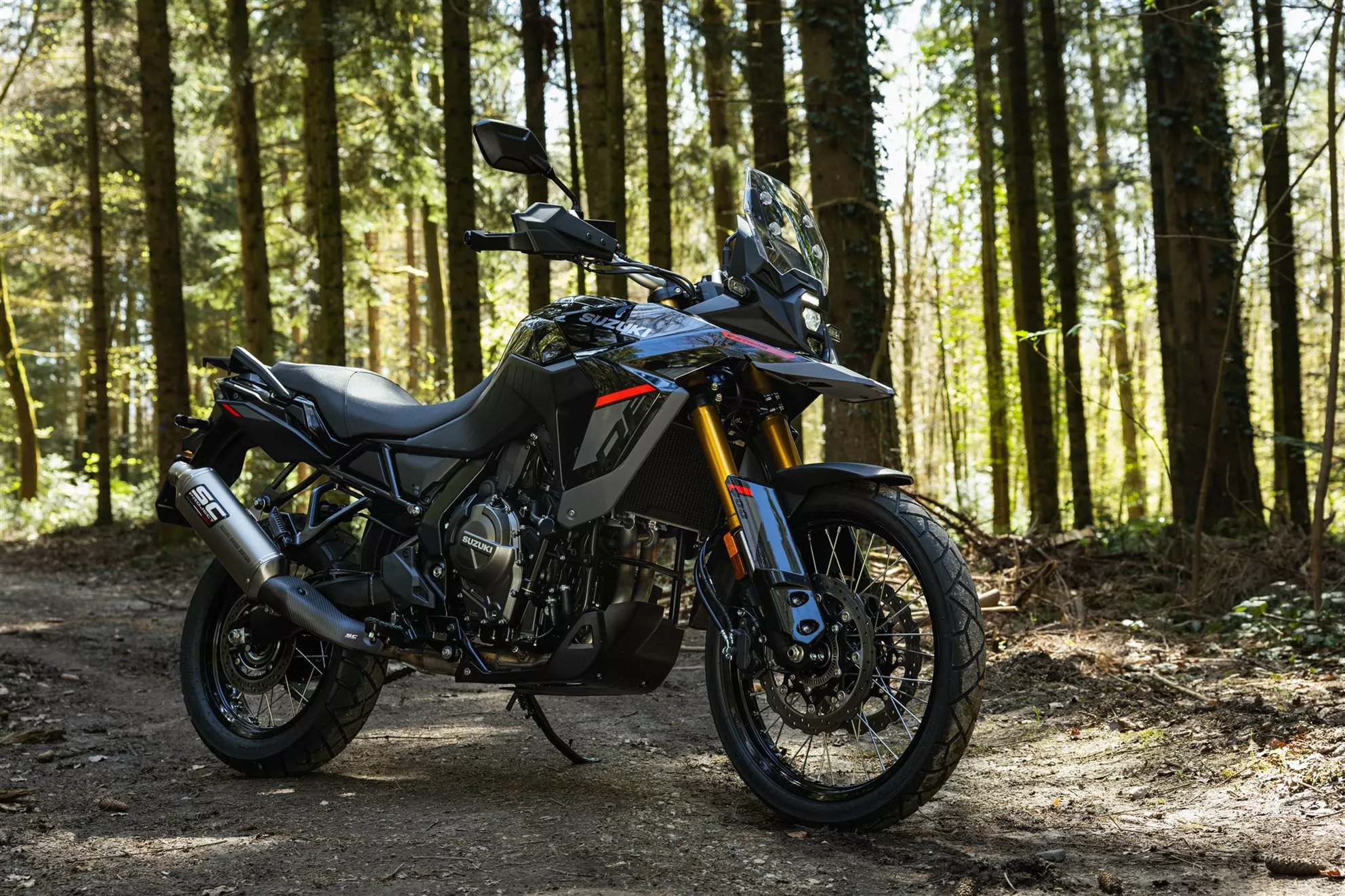
Suzuki V-Strom 800 DE in its natural habitat
The Engine: 776cc Parallel-Twin with Character
Suzuki developed the new engine completely from scratch — you'll also find it in the GSX-8S, GSX-8R and GSX-8T — and it was specifically tuned for adventure bike application. The result is an engine that responds across a broad range but focuses on low-rpm torque, delivering power in an extremely amenable way. From as low as 3,000 rpm there's enough drive available to glide relaxed through city traffic in a high gear. The consequence, combined with the V-Strom 800 DE's generous suspension travel? A playful, mild inclination toward wheelies. Between 4,500 and 7,500 rpm the engine is in its element: powerful, direct, with a shove in the back that isn't brutal but is always convincing. The 270-degree firing order gives the twin additional character. The sound feels gutsy without being artificially tuned for drama.
The so-called "Cross Balancer" is a patent registered by Suzuki and one of the technically most interesting details of the 800cc Suzuki twin. Instead of a classic balancer shaft, Suzuki uses two crosswise-arranged balancer shafts that reduce vibrations especially efficiently. As a result, the parallel-twin runs noticeably more refined than many other twins in this class, without losing its characteristic pulse. Particularly clever: thanks to the 270-degree crank offset, the engine feels almost like a V2 while riding. It delivers that rich, torquey character from down low in the rev range and the pleasant pulsation that many riders love about V2 engines. At the same time, Suzuki avoids many of the typical drawbacks of a genuine V2: the engine stays compact, narrow, easier to package, and less thermally problematic. The Cross Balancer also ensures that, despite its emotional character, the engine runs surprisingly smoothly. Fewer disturbing vibrations on longer stretches, yet still enough mechanical feedback that the engine never feels sterile. Precisely this mix currently makes the 800cc twin one of the strongest engines in the midsize class.

The 776cc Suzuki inline twin
Riding Modes and Engine Control
The V-Strom 800 DE features three riding modes, each affecting throttle response, engine braking torque and traction control. Mode A sharpens throttle response and is recommended for spirited riding on good roads. B is balanced, responsive without getting worked up. Mode C noticeably dampens throttle response, which builds confidence on slick surfaces or in the rain. Added to this is the Suzuki Drive Mode Selector System (SDMS-α), which allows traction control to be adjusted across three levels. Anyone wanting to let the rear wheel dance a little on gravel simply selects level 3, letting the electronics pull back without disappearing entirely. A balance that rewards skill without endangering the careless.
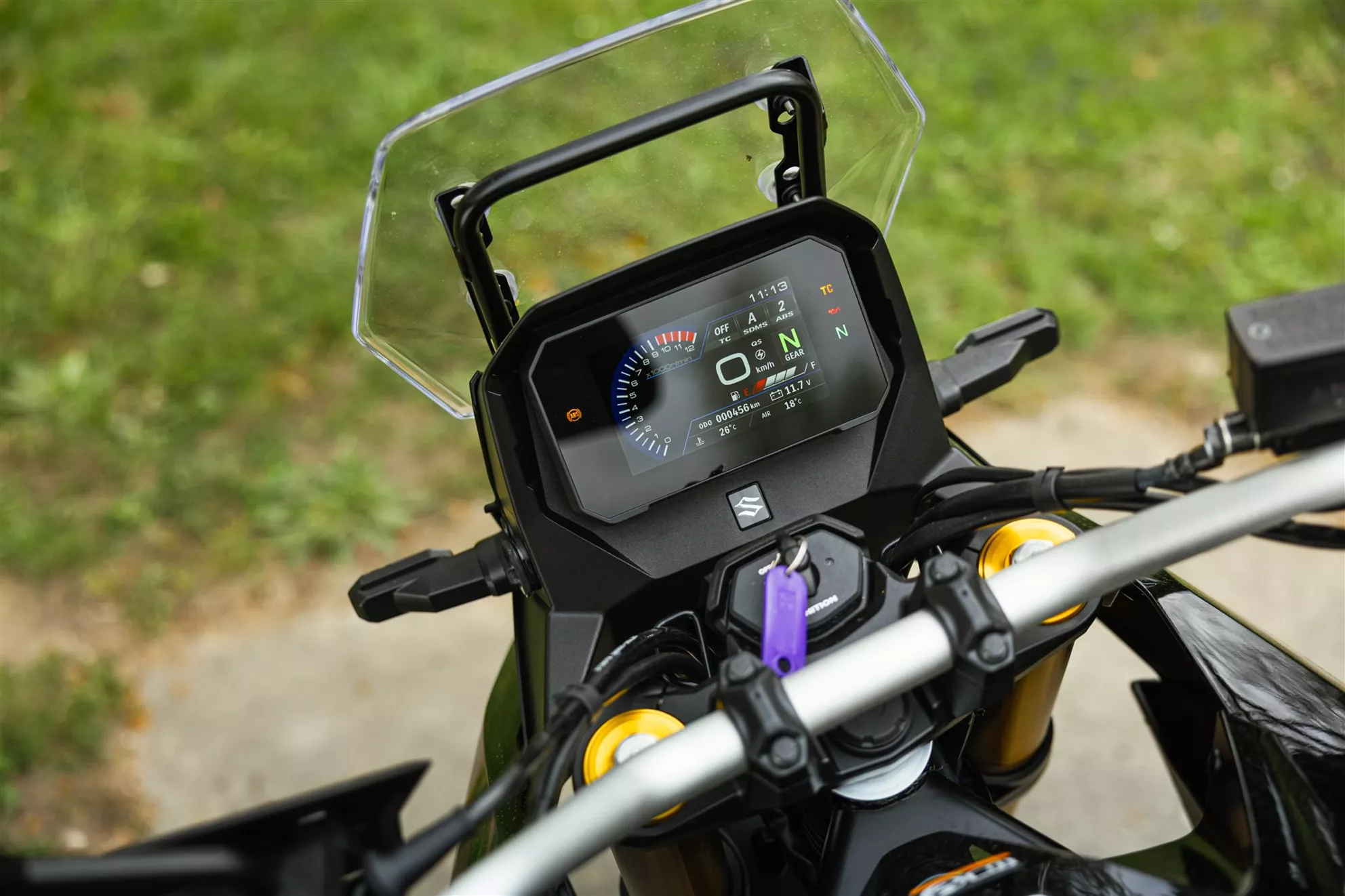
Suzuki's software is super easy to use
Chassis, Geometry, Brakes and Setup
Suzuki keeps the weight at 229 kilograms wet, not exactly a lightweight, but competitive for the category. The riding position is upright, the handlebar wide and pulled slightly toward the rider: a posture that conveys control and takes strain off the upper body. Up front, an adjustable Showa upside-down fork works with a 43mm stanchion diameter and 220mm of travel. At the rear, a central shock with adjustable preload and rebound damping takes over the job. Travel there is also 220mm. That signals off-road capability, but never tempts the bike into wallowing on the road if the base setup is right. Depending on the rider's weight, it's worth taking the time to fine-tune the setup.
Up front, the DE rolls on a 90/90-21-inch tyre — that's the big question we'll address in detail in the next chapter. At the rear, Suzuki opts for 150/70-17, which establishes a good balance between maximum lean angle and grip. Steering angle and trail are designed for all-round performance: the trail is moderate for an adventure bike, which makes turning in easier. This is exactly where the DE differs from older representatives of its class, which often reacted more sluggishly to steering inputs.
As for the brakes, we have two 310mm discs up front, a 260mm disc at the rear, combined with radial four-piston fixed calipers from Tokico. That's solid midsize class fare that does its job without issue in everyday use. The Bosch ABS operates in two modes: road-optimised and off-road capable, the latter allowing the rear wheel to briefly lock. Modulation is good; excessive hand force isn't required to reliably slow down.

The V-Strom 800 DE in its natural habitat
The 21-Inch Argument and Why the Big Wheel Impresses on the Road
Until recently, I myself was an advocate of smaller wheel sizes for those who ride mainly on the road, but that changed in the course of testing the V-Strom 800 DE.
The common criticism sounds plausible: a larger wheel diameter means a steeper tyre flank. A steeper flank means that when turning in, the flank makes contact with the road before the tread does. Ergo: less contact patch in the corner, worse handling, sluggish turn-in. Add to that the mass inertia of the larger wheel, which is harder to push into lean. Sounds logical. But in practice, at least with the V-Strom 800 DE, it's considerably more nuanced than the argument suggests.
On Swiss roads, tight hairpins, uneven asphalt, root-broken surfaces and the like, the V-Strom 800 DE reveals turn-in behaviour you simply wouldn't expect from a large front wheel. The first input on the handlebar transmits directly into lean, without the sluggish hesitation some anticipate. The wheel seems willing to play along. The trick lies in the sum of the setup: geometry, fork setup and tyre choice are all matched to one another. Suzuki didn't simply copy the DE's geometry from an off-road model, but calibrated it for the road. The trail is shorter than on pure off-road bikes, and the trail angle allows brisk turn-in.
Another aspect in favour of the 21-inch front wheel, which can matter to some, is the psychological factor.
A large front wheel is confidence-inspiring: you see how it visually dominates the front end and conveys strength, robustness, and the ability to overcome obstacles. That's not an unimportant factor, because only a rider who trusts their bike, feels comfortable and has the right body tension rides well and safely. In everyday use, this shows in city traffic: manhole covers, tram tracks, broken curbs, potholes, crumbling asphalt or patched roads — the profiled 21-inch wheel swallows all of that with a nonchalance that continuously reinforces trust in the machine. Instead of manoeuvring around many bumps, you can simply roll right over them.

170cm tall - no problems with the ergonomics
Ergonomics and Riding Position
The riding position of the V-Strom 800 DE is upright and affords good visibility. The handlebar sits wide and close, which gives control in stop-and-go traffic and allows an active riding style on country roads without straining the back. The seat height, at 855mm (or 835mm in the low setting), is easily reachable for medium-height riders; at my 170cm I had no problems on the V-Strom, and if I owned it I'd get used to it quickly, though a bit more height wouldn't hurt with this bike.
Seat comfort is convincing for a midsize adventure bike: the seat is contoured, the foam mixture firm enough not to feel worn out after many hours. On an eight-hour leg, an additional cushion or heating is advisable, but that applies to nearly all machines in this class.
Suzuki V-Strom 800 DE Test: 21-Inch Front Wheel on the Road? Images
Source: 1000PS


