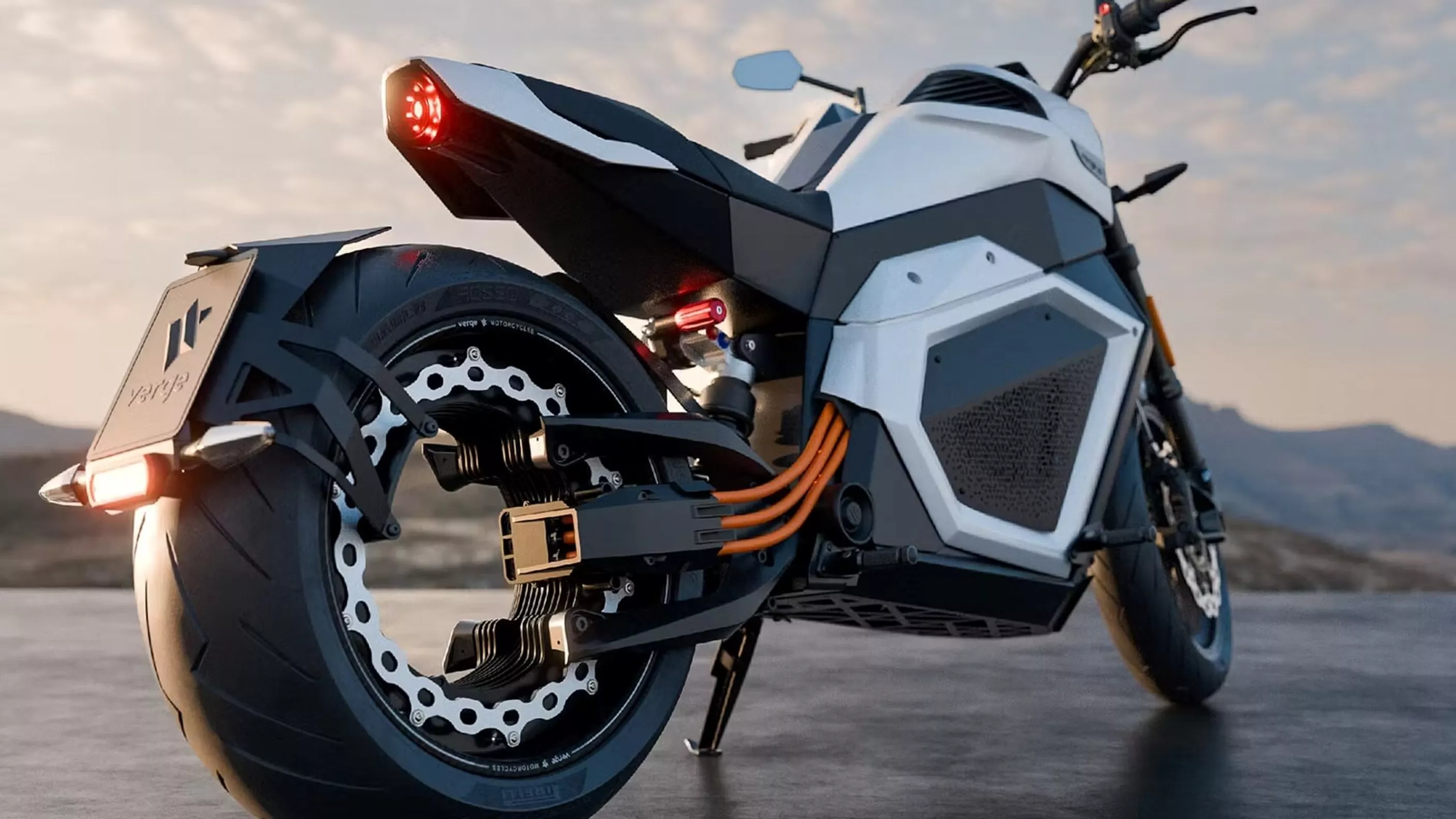
Verge motorcycles from Finland aim to be perceived as the most technologically advanced electric bikes on the market—even without the new solid-state battery. Featuring a distinctive hubless rear-wheel motor, they offer high performance at a surprisingly competitive weight. However, with the new "Donut Solid State" battery, the TS Pro, according to Verge, takes it a step further. Verge claims this battery boasts a capacity of up to 33.3 kWh, combining immense energy density with ultra-fast charging capability.
Solid-State Battery Gamechanger? Verge Claims 600km Range
Naked Bike Announced with 235 kg and Ultra-Fast CCS Charging
The Verge TS Pro aims to be one of the most technologically advanced electric motorcycles on the market. Can the solid-state battery solve all the e-bike problems?
&width=72&height=72&bgcolor=rgba_39_42_44_0&mode=crop "Author: Poky")
Poky
published on 1/21/2026
29,364 Views
Reimagining Electric Performance
Solid-State Battery: What Is It?
Solid-state batteries are regarded as a future technology because they combine several advantages over traditional lithium-ion cells. Instead of liquid electrolytes, solid-state technology employs a solid ion transport path, which reduces safety risks and significantly increases energy density. In the case of the TS Pro, the cells are sourced from the start-up Donut Lab, which, according to Verge, has achieved an energy density of about 400 Wh/kg. This is expected to enable not only greater ranges but also significantly shorter charging times.
According to the manufacturer, the new battery is supposed to provide a theoretical range of up to 600 kilometers. Even more impressive, however, is the promised charging capability: with up to 200 kW via CCS direct current, the TS Pro can reportedly recharge approximately 300 kilometers of range in just 10 minutes—a figure that is unmatched in the motorcycle world so far.
Electric Motorcycle: Charging Power Beats Range - Comparison with Competitors
In practice, this means: not just going far at once, but getting back on the road quickly. Especially on longer trips, charging power is often more crucial than nominal range. Thanks to CCS compatibility, the Verge TS Pro can be charged at common fast-charging stations across Europe and North America—a clear advantage over older systems with Type-2 connectors, which are gradually losing relevance on the road.
This new technology sets a benchmark: while models like the Energica Experia or the LiveWire One max out at around 22 to 24 kW charging power, and bikes like the Zero DSR/X or SR/F manage 11 kW, the Verge TS Pro hits a completely new level with up to 200 kW. Even compared to current electric cars, this sounds impressive, as many of them charge at lower power levels.
E-Motorcycles: Battery Capacity and Practical Comparison
In terms of capacity, the new TS Pro breaks into a new dimension. With a gross capacity of 33.3 kWh, it surpasses all currently available e-motorcycles. The next largest batteries are found in models like the Energica Experia with about 22.5 kWh (which is no longer available new since the bankruptcy) or the Zero DSR/X and SR/F with a maximum of 20.9 kWh. Even top models like the LiveWire One or the new Honda WN7 fall significantly behind with around 15 and 9 kWh, respectively.
It's important to note that these are gross values. In practice, manufacturers use only a portion of the available capacity to preserve the cells. This value typically ranges between about 85% and 95% of the gross value. Nonetheless, the high value of the Verge indicates where the development of high-performance batteries in motorcycle engineering is headed.
Advantages of Solid-State Batteries in Everyday Motorcycling
Solid-state cells offer a safety advantage alongside their energy density: by eliminating liquid electrolytes, the temperature at which thermal reactions occur increases from around 50 to up to 200 degrees Celsius, significantly reducing the risk of a cell fire. The solid separator also allows for the use of a lithium anode, further enhancing both energy density and charging performance.
A solid-state battery can be charged quickly because it doesn't use a liquid electrolyte, making it less sensitive to temperature. The solid electrolyte facilitates a stable and direct ion flow, even in cold or hot conditions. Additionally, the cell uses a lithium-metal anode instead of graphite, speeding up the ion storage and release process, which allows for extremely high charging rates. The material is also thermally stable above 150 degrees, enabling the battery to accept high currents without overheating.
The TS Pro combines these advantages with the renowned Donut motor in the rear wheel, now featured in version 2.0. It delivers 102 kW or 139 hp and is claimed to accelerate from 0 to 100 km/h in 3.5 seconds. Despite these figures, the total weight remains surprisingly moderate at 235 kilograms, making it lighter than many other electric models.
Verge Motorcycle with Solid-State Battery Availability & Test Rides
Verge motorcycles can be configured and ordered through the official website. Currently, the company operates in Germany, Finland, Estonia, France, Spain, Monaco, the UK, and Italy. Customers in these countries can already place orders. Showrooms are primarily located in the USA, while an official store in London is currently in the planning stage. In Hamburg, Verge has opened a pop-up in the Westfield Hamburg-Überseequartier shopping center.
According to the website, test rides are also available at this location. However, upon attempting to register for a test ride, you receive only a notification indicating that further contact will be made in the future. It remains to be seen how much of the promises will hold true.

Test Ride? The Excitement Continues
In the USA, the first deliveries of the new TS Pro generation with solid-state batteries are scheduled for spring 2026. Depending on the market and production batch, delivery times can range from three to twelve months.
Verge Isn't Cheap - Price & Government Incentives
The base version of the Verge TS Pro starts at around 29,900 euros net in Europe, while upgrading to the large solid-state battery costs an additional 3,000 euros. In Germany, this brings the total to 36,581 euros for the Pro with a 350 km range and 39,581 euros for the Pro with a maximum range of 600 km. This positions the TS Pro above the top models from Zero or Energica in terms of price, but on paper, it offers significantly higher battery capacity and charging performance.
In Austria, the purchase of e-motorcycles has been supported by government subsidies again since autumn 2025. Buyers can receive up to 2,300 euros per vehicle depending on the performance class and usage, provided the motorcycle is purely electric. This subsidy is available to individuals, businesses, and associations and can be combined with grants for charging infrastructure and wall boxes. This results in prices for end customers in Austria being slightly lower than those in Germany.
In Germany, there is currently no standalone purchase subsidy for e-motorcycles, but a new nationwide e-mobility program could offer grants of up to 4,000 euros per vehicle starting in 2026, including for electric two-wheelers. Additionally, there are tax benefits, such as vehicle tax exemption for e-vehicles, along with various regional programs to expand charging infrastructure.
Conclusion: Everything Different Thanks to Solid-State Battery?
With the new TS Pro, Verge aims to bring the first production motorcycle with a solid-state battery to the market—a potential technological leap that could elevate range, charging speed, and safety to a new level. On paper, the machine offers genuine everyday usability and, thanks to CCS charging, is compatible with almost any fast charger. The downside remains the high price; even though no expense is spared with components like premium Öhlins gear, the Verge will likely remain a dream for many potential buyers.
With the TS Pro, Verge aims to push the boundaries of electric mobility and demonstrate that the future of electric riding can be not only fast but also practical and suitable for everyday use. We're eagerly anticipating the first test, which Verge has yet to deliver.