Royal Enfield CEO B. Govindarajan explains how the brand plans its next growth phase, why it won't chase competitors, and how electrification will fit the company's DNA.
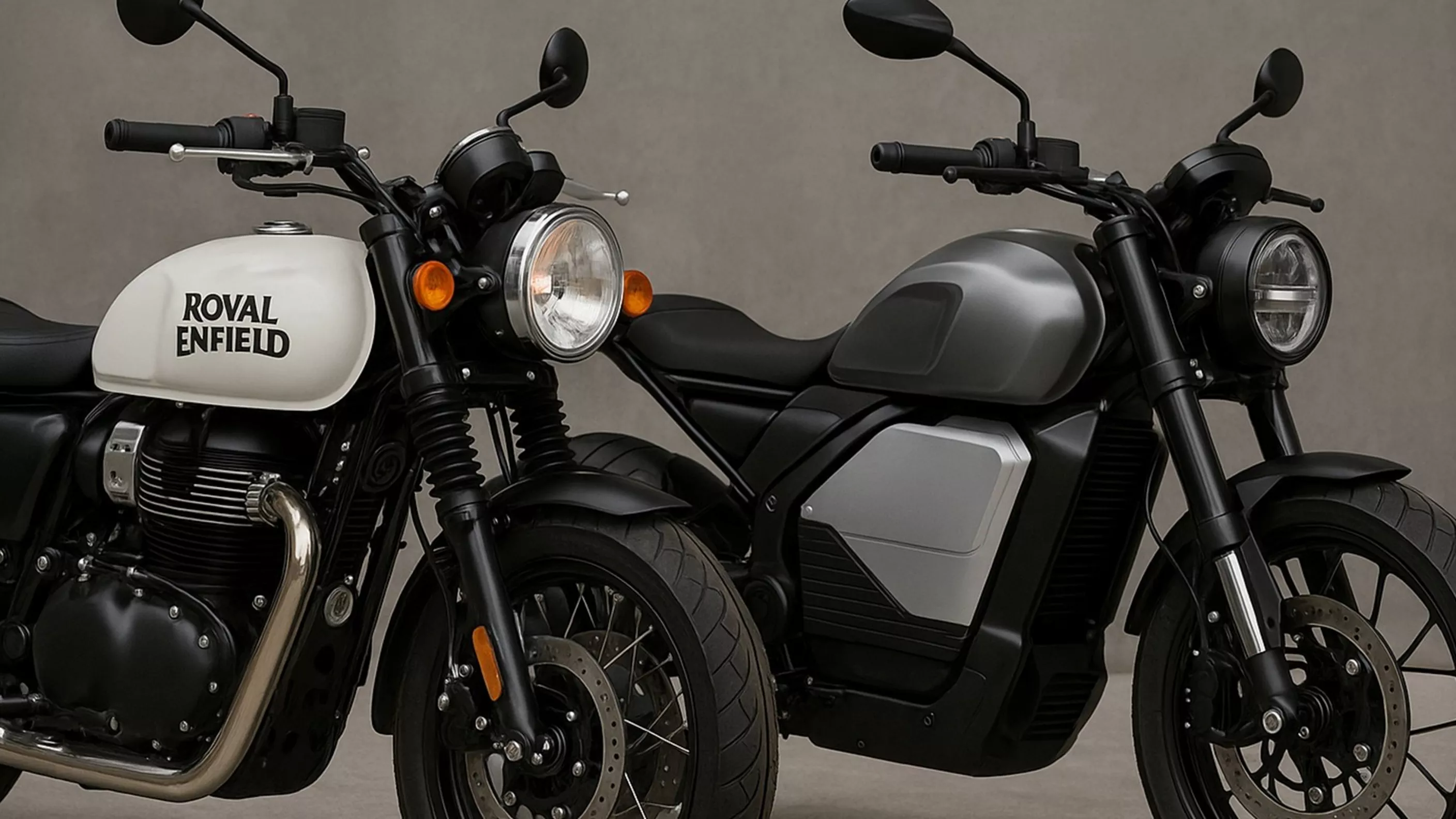
Royal Enfield's Path into the Future: Staying True While Growing
CEO Govindarajan on global growth and future projects
Royal Enfield CEO B. Govindarajan explains how the brand plans its next growth phase, why it won't chase competitors, and how electrification will fit the company's DNA.
&width=72&height=72&bgcolor=rgba_39_42_44_0&mode=crop "Author: Poky")
Poky
published on 1/6/2026
From a 47,000-unit maker in 2011 to a company producing over a million motorcycles today, Royal Enfield has built its rise on one clear focus: accessible middleweight bikes with real character. In this interview, CEO B. Govindarajan lays out the long-term plan behind that growth, the brand's approach to Europe, and how electric projects like Flying Flea and the electric Himalayan serve Royal Enfield's future strategy.
Poky, 1000PS: You mentioned that Royal Enfield's current market share in the middleweight segment is around eight to nine percent. Can you take us back to how this development started?
B. Govindarajan, CEO Royal Enfield: Yes. Right now, Royal Enfield produces more than one million motorcycles a year. It's been a great journey. Back in 2011, the company was building only around 46,000 to 47,000 motorcycles per year. At that time, we said: if we can make 100,000 motorcycles in a full year, we can truly call ourselves a motorcycling company.
We focused entirely on the middleweight category because we believed it was underserved. Either the bikes were too expensive or too big. We wanted to create motorcycles that are accessible, where the rider is in control. Everybody should control the motorcycle, and they should still feel when they are interacting with it. We call that pure motorcycling.
We worked on different products, on our brand building, and over time the numbers started coming. That's how we became a million-plus motorcycle company. We are a profitable company, but what drives us is the kind of motorcycle we bring in — it should be gorgeous looking, very differentiated, and we should create the market rather than just take share.
We work with the community, ride with them, learn from them, go back, and do corrections. We take time, but we come out with what's right for the middleweight category. Currently, we are the market leader in the middleweight segment across the globe.
Poky: When you say "middleweight," what exactly does that mean for Royal Enfield?
B. Govindarajan: Fifteen years ago, when we discussed and concluded this, we defined middleweight as 250 cc to 750 cc. Currently we have three platforms.
On the 350 cc platform we have the Hunter, an entry-level motorcycle for young audiences who wanted a different format from Royal Enfield. We have the Meteor cruiser, the Classic, and the Bullet on that platform.
On the 450 cc platform, we have a roadster, the Guerilla, and an adventure tourer, the Himalayan.
On the 650 cc platform, the roadster is the Interceptor. Then we have the Shotgun 650, Classic 650, and Bullet 650. We also have a full-fledged cruiser, the Super Meteor, and a sports classic, the Continental GT.
From one product - the Bullet - we have almost fourteen plus, and today about fifteen plus products across three different platforms, all very differentiated and giving different experiences. We are confident that 350 to 650 will grow, but we will never say never to anything. If at some point something beyond 650 is required, we will be there.
Poky: Are you still focusing on air-cooled engines, or is a larger liquid-cooled engine coming?
B. Govindarajan: Our 650 cc twin engine with a 270-degree firing order is air-cooled and currently meets all emission norms and power requirements for the motorcycles we have. If future statutory requirements or emissions require a modification, and if liquid cooling is needed, we will look at it. For now, our focus is on optimizing this platform.
Poky: You are already among the top six motorcycle manufacturers worldwide, without producing scooters or small bikes. But competition in the middleweight class is growing — especially from Chinese and European brands. How do you see this development?
B. Govindarajan: Competition is inevitable. Nobody can say we should not have competition. It is good because the consumer gets good motorcycles to ride.
We have been growing the market, and many people are trying to enter it. But as an organization, we will never react to every move of competitors. We have charted our own plan and will continue to focus on that plan without getting distracted.
Of course, we will learn from competitors, but we won't react because we don't know their strategy. Rather, we will continue to focus on what we have to do for the global motorcycling community, and our focus remains on the 250 to 750 cc middleweight.
Poky: You mentioned that in 2011 you had only one model, and now the range has grown significantly. Does that mean continuous growth also means adding more and more models?
B. Govindarajan: Not necessarily. At Royal Enfield, we believe less is more. We should not do too many things. Our 350, 450, and 650 platforms are sorted out. There is space to complete the middleweight definition up to 750 cc, but are we in a position that we have to do it immediately? No.
Outside India we still have only around eight to eight and a half percent market share, and only about a thousand retail outlets globally outside India. There is huge opportunity to grow.Within each platform we offer very differentiated motorcycles. We don't need to do too many things beyond that.
Poky: How important is the European market for Royal Enfield, not only in sales but also strategically?
B. Govindarajan: Europe is very important. The market has not been growing recently because of an OBD2-B issue, and there were many pre-registrations last year. Those pre-registered motorcycles are getting diluted now. But I expect the market will grow again by around four to five percent, and we are well equipped with products to be ahead of that curve.
In the UK, we took over the distributorship and now operate directly. We are connecting closer to consumers. In London we opened the European Riding Club, and around 35,000 people have signed up. That is strong brand love.
We are reaching consumers directly where we have direct operations, and in markets like France and Italy we work with strong distributors. With good partners and a strong product line, we are building the brand.
This year, our 125th anniversary, we will run a year-long brand planning exercise across all markets, including India, to take the brand to a different level.
Poky: We saw prototypes of an electric Himalayan being tested. Now you have the Flying Flea as a product family. Is there a plan to have the electric Himalayan under Flying Flea, or will it stay separate?
B. Govindarajan: Flying Flea is a lightweight, sophisticated, cutting-edge technology motorcycle for city and city-plus exploration.
The electric Himalayan project is a testbed for us to learn electric technology — battery charge and discharge — because we are a 125-year ICE motorcycle manufacturer. We believe Royal Enfield has to look at sustainable mobility. That's why we have committed to electrification.
The electric Himalayan is built for learning so that we can create very differentiated electric motorcycles for Flying Flea.
Poky: So the electric Himalayan is mainly a development platform for you?
B. Govindarajan: Yes. The Himalayas are our lab, and this is a testbed for us to learn. We also have a strategic investment in Stark. They helped us with some parts because they were ahead on the curve. The bike is a potent machine, and riding it shows how it behaves. But its key role is to help us learn electric technology and take that learning into Flying Flea.
Poky: Will the styling of future electric bikes remain classic, or will you move toward a more modern design language?
B. Govindarajan: Over time you will see vehicles that carry Royal Enfield DNA, but with a Flying Flea direction. The C6 we showed last year has classic inspiration. The ES6 Scrambler is quite modern.
Flying Flea is for young urban consumers who want to explore the city and city-plus environments, including some off-roading. We are working on different platforms, and all of them will be under the Flying Flea brand.
Poky, 1000PS: Thank you very much for your time, Mr. Govindarajan.
B. Govindarajan: Thank you. It was a pleasure.
Royal Enfield's Path into the Future: Staying True While Growing Images
Source: 1000PS

Royal Enfield Bullet 650

Royal Enfield Bullet 650

Royal Enfield Bullet 650

Royal Enfield Bullet 650

Royal Enfield Bullet 650

Royal Enfield Classic 650

Royal Enfield Classic 650

Royal Enfield Classic 650

Royal Enfield Classic 650

Royal Enfield Classic 650

Royal Enfield Flying Flea S6

Royal Enfield Flying Flea S6

Royal Enfield Flying Flea S6

Royal Enfield Flying Flea S6

Royal Enfield Flying Flea S6

Royal Enfield Himalayan Mana Black Edition 2026

Royal Enfield Himalayan Mana Black Edition 2026

Royal Enfield Himalayan Mana Black Edition 2026

Royal Enfield Himalayan Mana Black Edition 2026

Royal Enfield Himalayan Mana Black Edition 2026