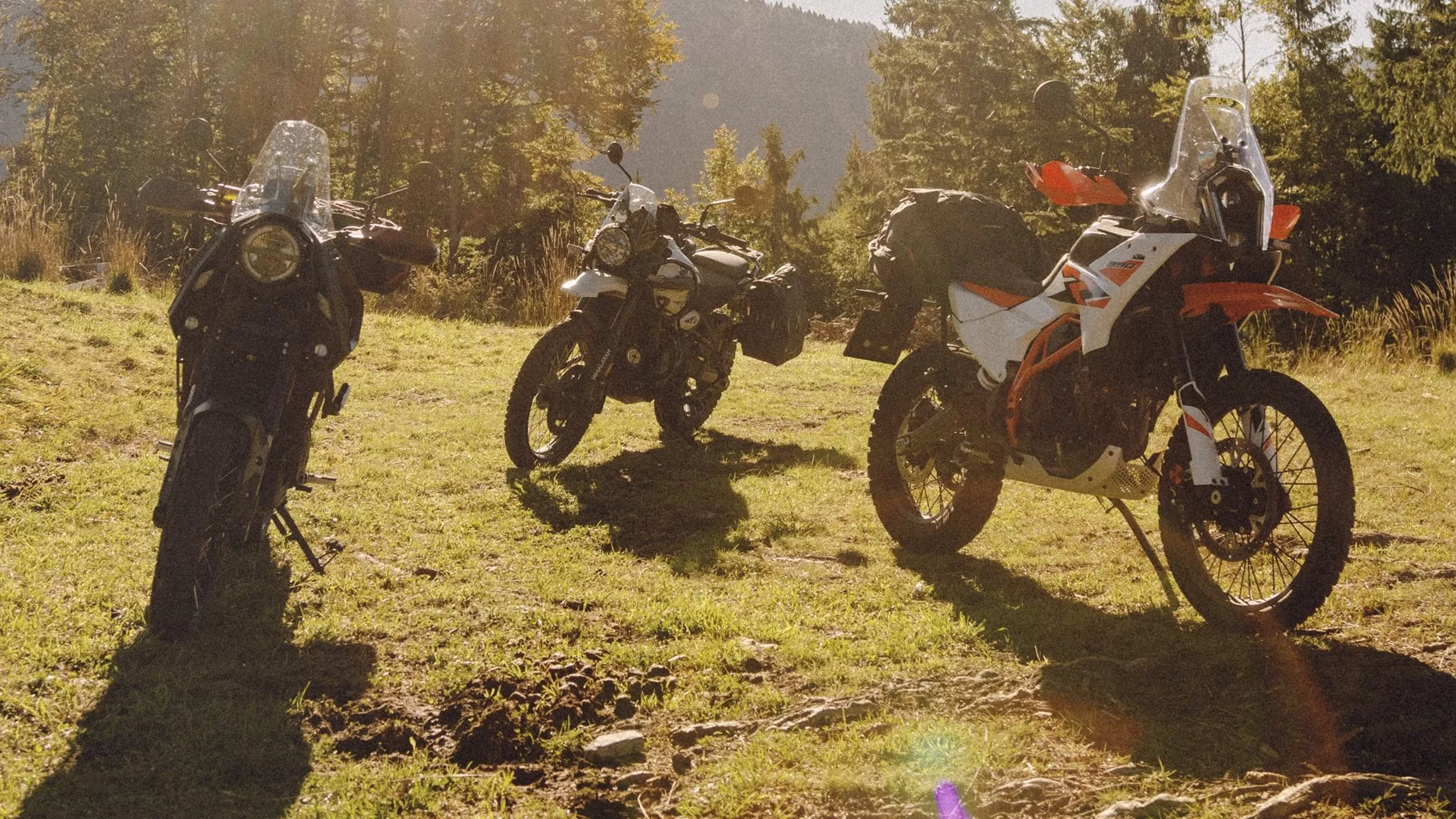
Less power, less weight, less fear for your first off-road trip: the allure of A2 adventure bikes is tempting. But does "less is more" still hold true when you want to embark on a proper tour with 48 horsepower and a modest budget? That’s exactly why we set out with three bikes that interpret the A2 adventure bike concept in completely different ways: the KTM 390 Adventure R as a nimble off-road specialist, the Royal Enfield Himalayan 450 as a tractor-like range king, and the Brixton Crossfire 500 Storr as the new twin-cylinder tourer on the block. Three days in Friuli, with highway stretches, the Nassfeld Pass, Monte Zoncolan, endless twisties, and gravel passes, were set to reveal who could really deliver.
A2 Adventure Touring Test: KTM 390 ADV R, Himalayan 450, Brixton Storr
Which A2 Adventure Bike is Fit for the Big Journey?
Less power, less weight, and less fear for the first off-road adventure—A2 adventure bikes promise a lot. We put the KTM 390 Adventure, Royal Enfield Himalayan 450, and Brixton Crossfire 500 Storr through their paces over three days in Friuli: tackling highways, the Nassfeld Pass, Monte Zoncolan, and gravel trails.
&width=72&height=72&bgcolor=rgba_39_42_44_0&mode=crop "Author: Gregor")
Gregor
published on 12/12/2025
18,565 Views
Less is More? Three A2 Adventure Bikes Put to the Test
Journey and Highway Stage: A2 Adventure Bikes in a Reality Test
Riders from Germany, Austria, or Switzerland looking to ride at least semi-legally on unpaved surfaces typically have to first tackle the highways. Our journey started along the asphalt ribbon of the A2 from Wiener Neustadt to Gail Valley. Nearly four hours of steady cruising at 125 to 130 km/h was the first endurance test for these compact adventure bikes. All three motorcycles feature a six-speed gearbox and maintain the 130 km/h cruising speed without issue, albeit at significantly higher rev ranges than larger adventure bikes. The Royal Enfield Himalayan 450 cruises at around 6500 RPM, while the KTM 390 Adventure and Brixton Storr hover just below 7000 RPM. This is noticeable in both noise levels and vibrations: the KTM communicates with clearly noticeable, high-frequency vibrations through the handlebars and foot pegs, though still within an acceptable range. On the highway, the Brixton surprises with remarkable calmness, with vibrations becoming more of an issue on backroads under full throttle. The Himalayan is overall the most tranquil, with slight vibrations but the smoothest engine operation overall.
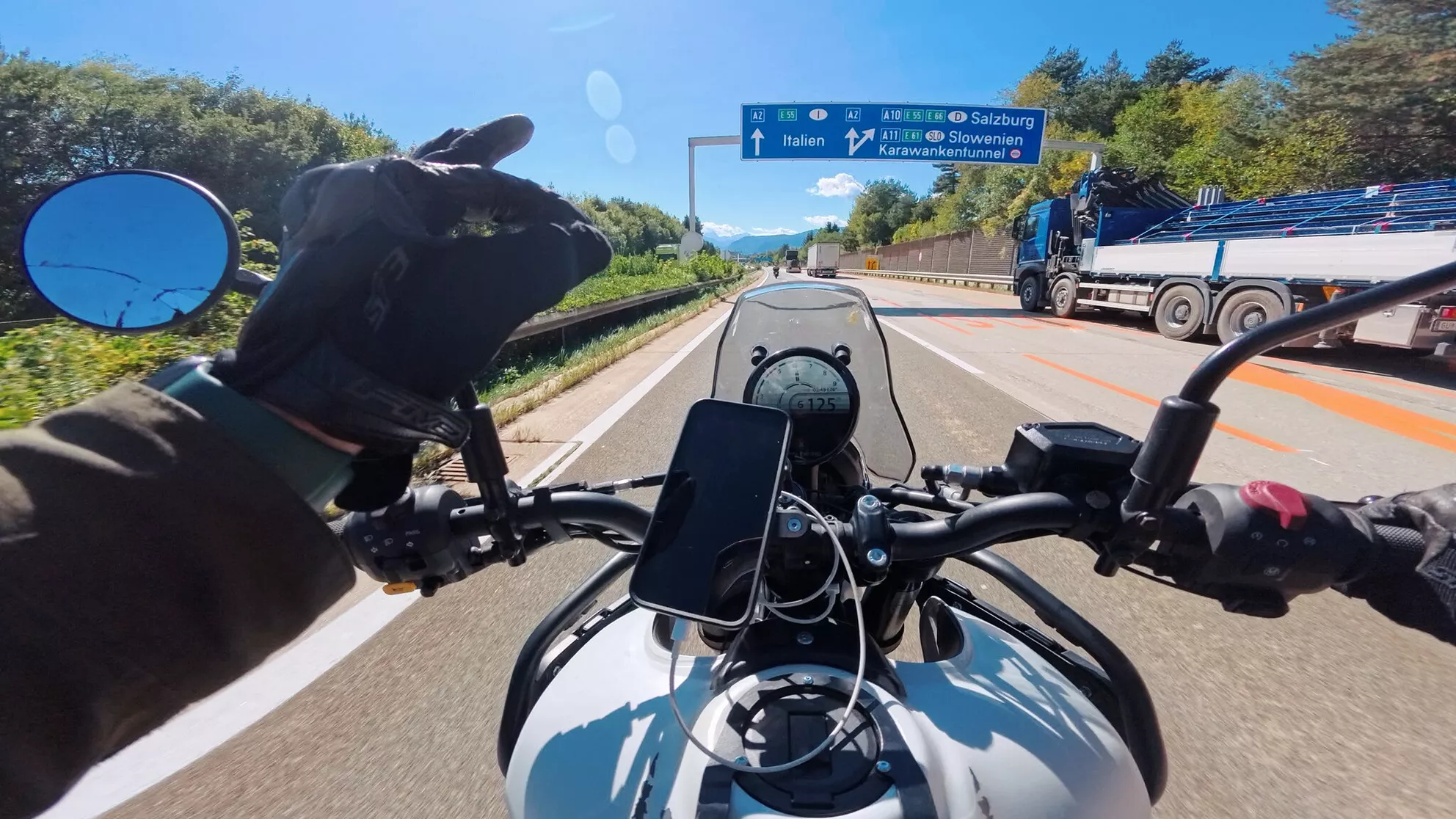
At just over 6,000 RPM, the Royal Enfield Himalayan maintains highway speeds with the most ease.
Perfect Base for Motorcycle Tours in Friuli
If you haven't yet explored Friuli on two wheels, this small province in the far northeast of Italy should definitely make it onto your must-ride list. While tourists crowd the famous passes in Lombardy and South Tyrol, Friuli still offers tranquility and authenticity. The Friulian Alps provide breathtaking panoramas, rugged mountain landscapes, winding pass roads, and even an above-average number of legal gravel trails. To make the most of this diverse offering during our three-day tour, we stayed at the Motorcycle Hotel Bellavista in Ravascletto. From there, you have direct access to some of the best roads in the region, such as the nearby Panoramica delle Vette or Monte Zoncolan. True to MoHo Motorcycle Hotels, the team took exceptional care of us and our bikes: friendly, helpful, and always ready to listen to our plans. It's an ideal base for anyone wanting to experience Friuli on two wheels.
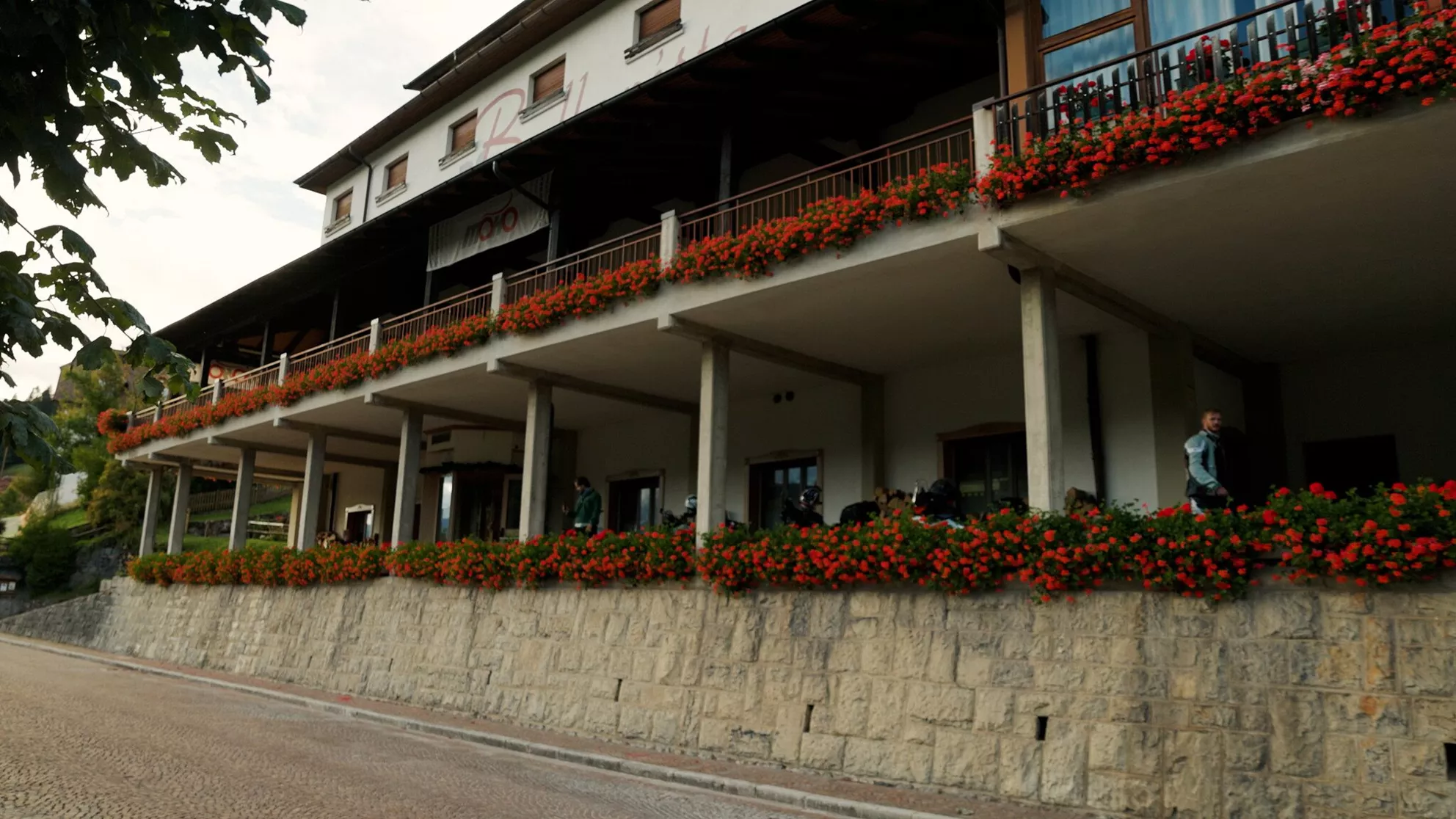
Motorcycles parked directly on the terrace, delicious meals enjoyed, and route tips gathered from locals—the MoHo Bellavista made our days in Friuli very pleasant.
Ergonomics and Riding Position: Three Philosophies for A2 Touring
When it comes to ergonomics, the three manufacturers take completely different approaches, although all three bikes offer fundamentally decent touring ergonomics. The KTM 390 Adventure R clearly provides the sportiest seating position. The foot pegs are relatively high and set back, resulting in a noticeably tighter knee angle. Thanks to the narrow front and a seat that extends far forward, you can sit very close to the handlebars. This feels active on the road and works excellently off-road because it offers plenty of freedom of movement. The Royal Enfield Himalayan 450 presents a much more relaxed demeanor. The foot pegs are in a more traditional position, the legs are less sharply angled, and the overall seating position feels more touring and laid-back. However, you sit more exposed on top, as if you're being carried through the landscape on a throne. The Brixton Storr scores with a surprisingly comfortable posture, where the pegs are relatively far forward, the thighs run almost horizontally, and the knee angle is nearly right-angled. The wider tank nicely integrates the rider into the motorcycle. At 1.85 meters tall, I can cover long distances on all three, without suffering, but the characters are so ergonomically diverse that you can hardly lump them together.
Fuel Consumption, Range, and Vibrations: Who is the Range King?
During our test, we measured fuel consumption across realistic usage scenarios. Alongside highway riding, a few hundred kilometers of country roads and gravel paths were included. The bikes were all loaded with light luggage. The Royal Enfield Himalayan 450, with its 17-liter tank and a consumption of 3.97 liters per 100 kilometers, clearly achieved the best range, remaining the only one under the four-liter mark. It is the undisputed range king in the test. The KTM 390 Adventure combines its smaller 14-liter tank with a consumption of 4.22 liters per 100 km. Nevertheless, realistic ranges of well over 300 kilometers are possible if you don't push it too hard. The Brixton Storr comes with a 16-liter tank and a consumption of 4.36 liters per 100 km, making it the thirstiest in the test, but still within a completely acceptable range. The onboard electronics show a full-tank range of 380 kilometers, which seems realistic given our test consumption. In summary, long stretches are feasible with all three motorcycles. However, those who simply want to ride without constantly looking for fuel stations will be happiest with the Himalayan.
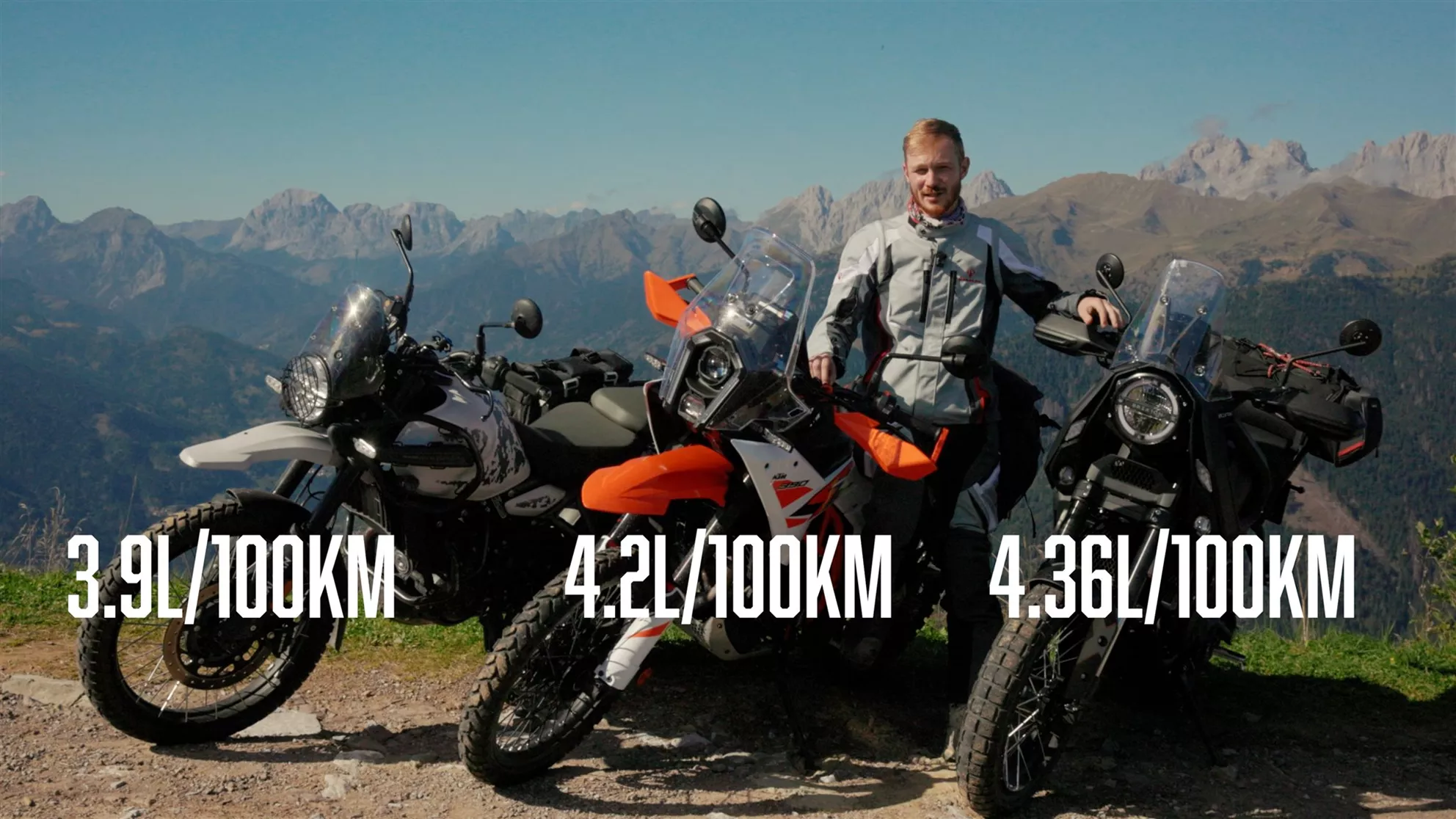
Our fuel consumption measurement after nearly 1,500 kilometers on tour.
Wind Protection, Seat Comfort, and Suspension on Long Rides
The wind protection shows a similar range as the ergonomics. The KTM 390 Adventure, with its large windshield, probably offers almost ideal protection for shorter riders. At 1.85 meters tall, the wind hits me just at the top of the helmet, accompanied by slight turbulence and increased noise levels. If I lower my position a bit, it gets noticeably quieter, and at 130 km/h, I mainly hear the single-cylinder engine revving at just under 7000 RPM. For an A2 enduro, that’s very good wind protection. On the Brixton Storr, the wind hits me right at helmet level, causing loud turbulence. However, the broader tank effectively shields the chest and torso from the wind, which is comfortable on long stretches. The Himalayan 450 offers the weakest wind protection of the trio. The windscreen is rather small, and you sit in the most exposed position. However, a taller or wider windscreen can be easily retrofitted.
- How much does a Royal Enfield Himalayan 450 cost?
- Here you will find an overview of the price level of new and used motorbikes!
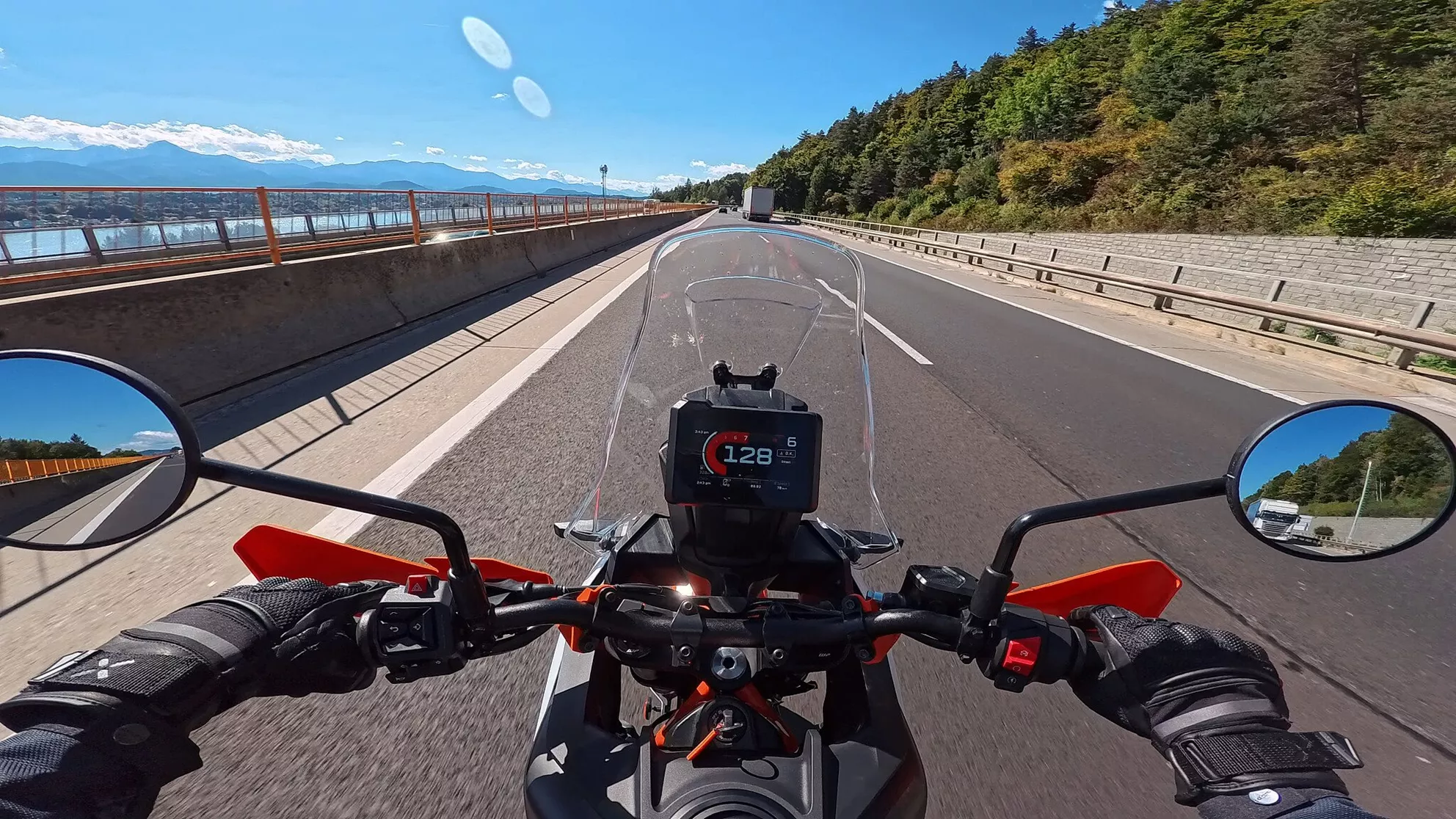
Exemplary Wind Protection on the KTM 390 Adventure R
There are clear differences in the seat comfort. The KTM has the firmest padding in the comparison, suiting its more radical off-road character. You can move around well and shift your weight, but after a while, the seat becomes uncomfortable. The Brixton isn't exactly a sofa either, but it offers a bit more room at the rear. When you slide back, you can noticeably relieve pressure. The Royal Enfield Himalayan 450 clearly has the most comfortable seat. It's well-padded and nicely cushioned, making it pleasant to sit on even after a long day.
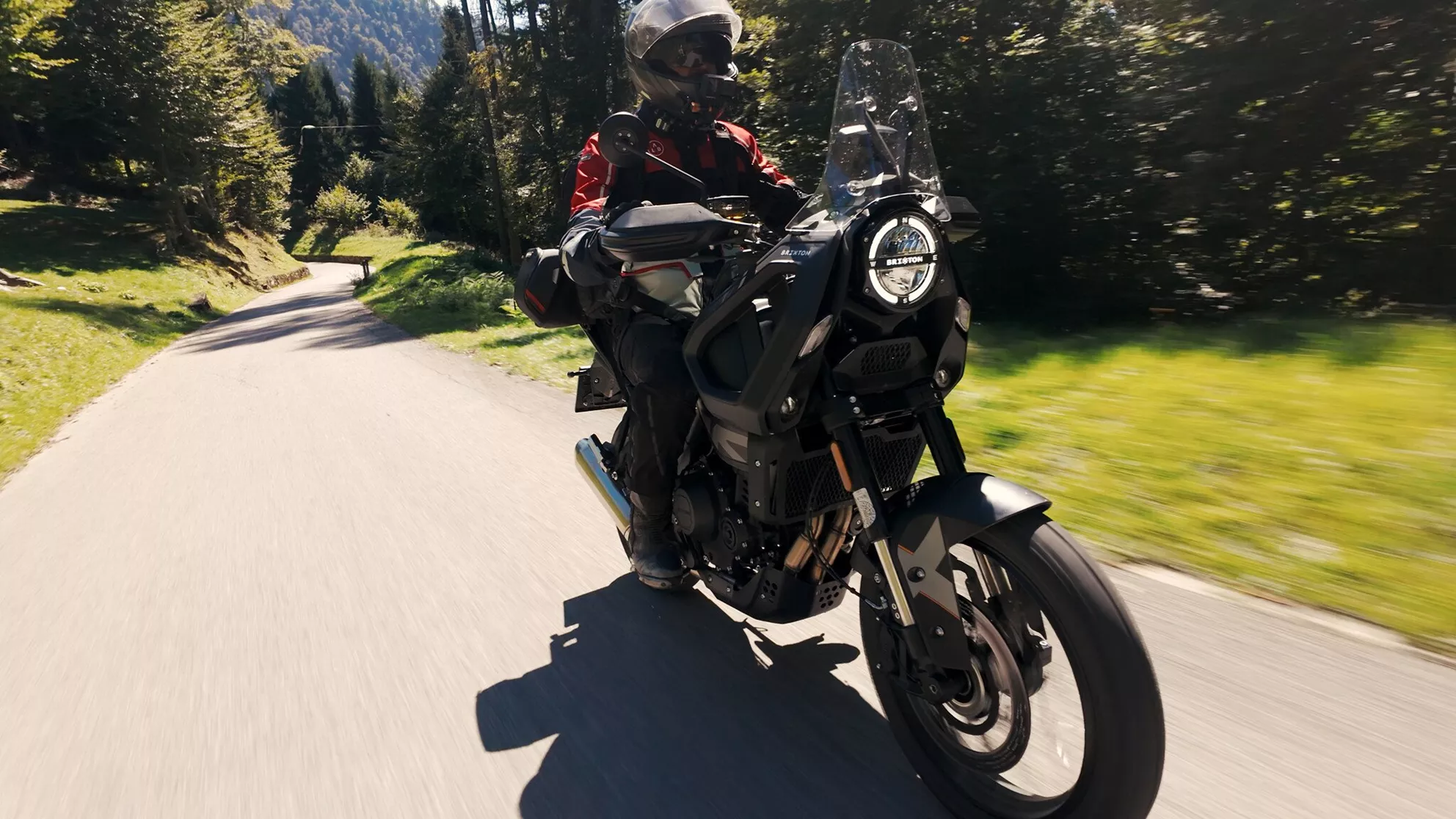
The affordable Brixton Storr surprises with a well-responsive and adjustable KYB suspension.
The KTM provides the sportiest setup with its WP suspension and wide adjustment range. It comes factory-tuned on the firmer side, but we softened it a bit for the test. It handles larger bumps smoothly, offering excellent stability, though you can feel some imperfections on smaller edges. The Brixton Storr surprises with a remarkably strong KYB suspension for the brand. With about 180mm of travel at the front and approximately 175 to 176mm at the rear, along with adjustability and a very pleasant response on both the road and light gravel, it becomes the secret tip in this discipline. The Himalayan 450 offers 200mm of travel, with no adjustment options at the front, but excellent responsiveness. Particularly for riders of average weight, the suspension performs extremely well, providing comfort and reserves. Heavier riders or those with a lot of luggage might deplete these reserves more quickly, but for our purposes, it earned clear praise.
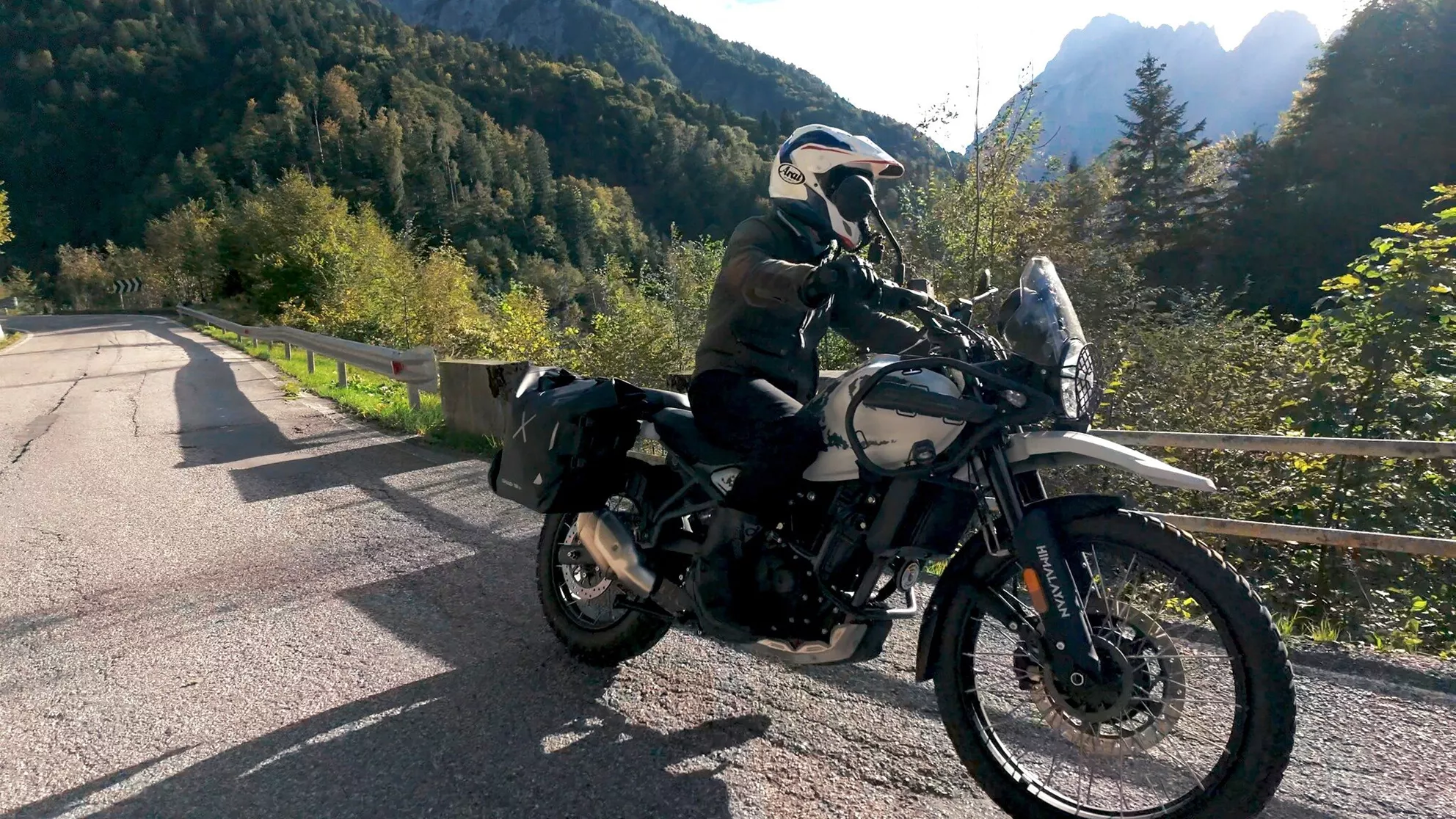
The Himalayan also offers nicely responsive suspension components but is the only one without adjustable suspension. This can become an issue for particularly heavy riders or tours with heavy luggage.
Nassfeld Pass and Monte Zoncolan: Handling, Engine, and Brakes in the Ultimate Test
The Nassfeld Pass from Carinthia to Italy is our salvation after the long journey and a motorcycle playground with one curve after another, sections of imperfect asphalt, and a constantly changing rhythm. It's the perfect setting to explore differences in handling, engine character, and braking performance. The test candidates vary widely in weight. Fully fueled, the Royal Enfield Himalayan 450 weighs in at 200.5 kg, the KTM 390 Adventure R remains an agile 176.5 kg, while the Brixton Storr tips the scales at around 215 kg. You can feel this in every corner. The KTM is extremely agile, allowing you to almost playfully push it into turns via the wide handlebars, while maintaining stability thanks to its sporty suspension. The Brixton feels harmonious and predictable in lean, but the nearly 48 horsepower have to move significantly more mass, particularly noticeable when climbing uphill as the engine struggles with the weight. The Himalayan sits in the middle weight-wise and rides just like that: not super light, but very predictable and stable.
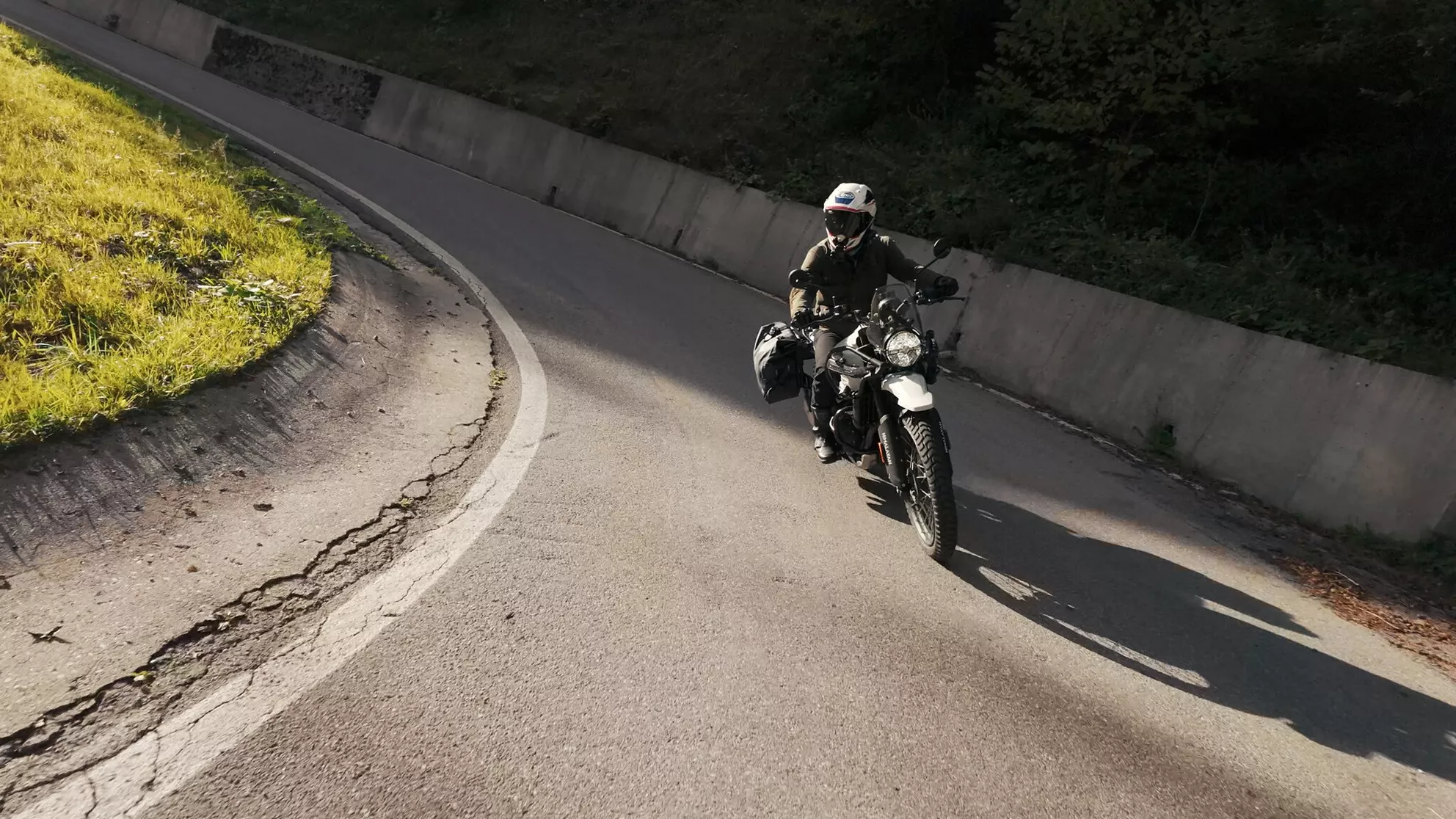
The Himalayan, with its torque-rich engine character, is the best bike for those who prefer a laid-back, low-shifting ride.
When it comes to engine character, the concepts separate the wheat from the chaff. The KTM 390 Adventure relies on the well-known rev-happy 390 single-cylinder, which clearly demands rpm when climbing uphill. At 50 to 55 km/h in third gear, you'd expect a single-cylinder to have a punchy pull, but there's relatively little going on at the lower end. It only really kicks in at around 7000 rpm. This means a lot of shifting. The quickshifter generally helps with this, although the shifting experience varies between noticeable resistance and buttery-smooth transitions. The Brixton Storr exhibits a similar rev-hungry character but carries more weight. You have to really work it and shift often too, but it's certainly not winning any uphill drag races. The Royal Enfield Himalayan 450 is the complete opposite here. Its tractor-like engine character sets it apart from the others. Coming out of a corner in third gear, with the revs in the basement, a quick twist of the throttle doesn't feel like the engine is about to stall; instead, you get a solid "tuk tuk tuk" and a confident, smooth surge from the low revs.
Tire dimensions and brakes also play a significant role in pass riding. The KTM and Himalayan roll on 90/90-21 tires at the front, which are true off-road dimensions. The Brixton, on the other hand, features a 19-inch front and a 17-inch rear, combined with a 110 front tire, 150 rear tire, and Pirelli Scorpion Rally STR, making it the most road-oriented setup in the test. This gives the Brixton almost the most harmonious steering behavior, with plenty of rubber and a wider front tire that inspires confidence.
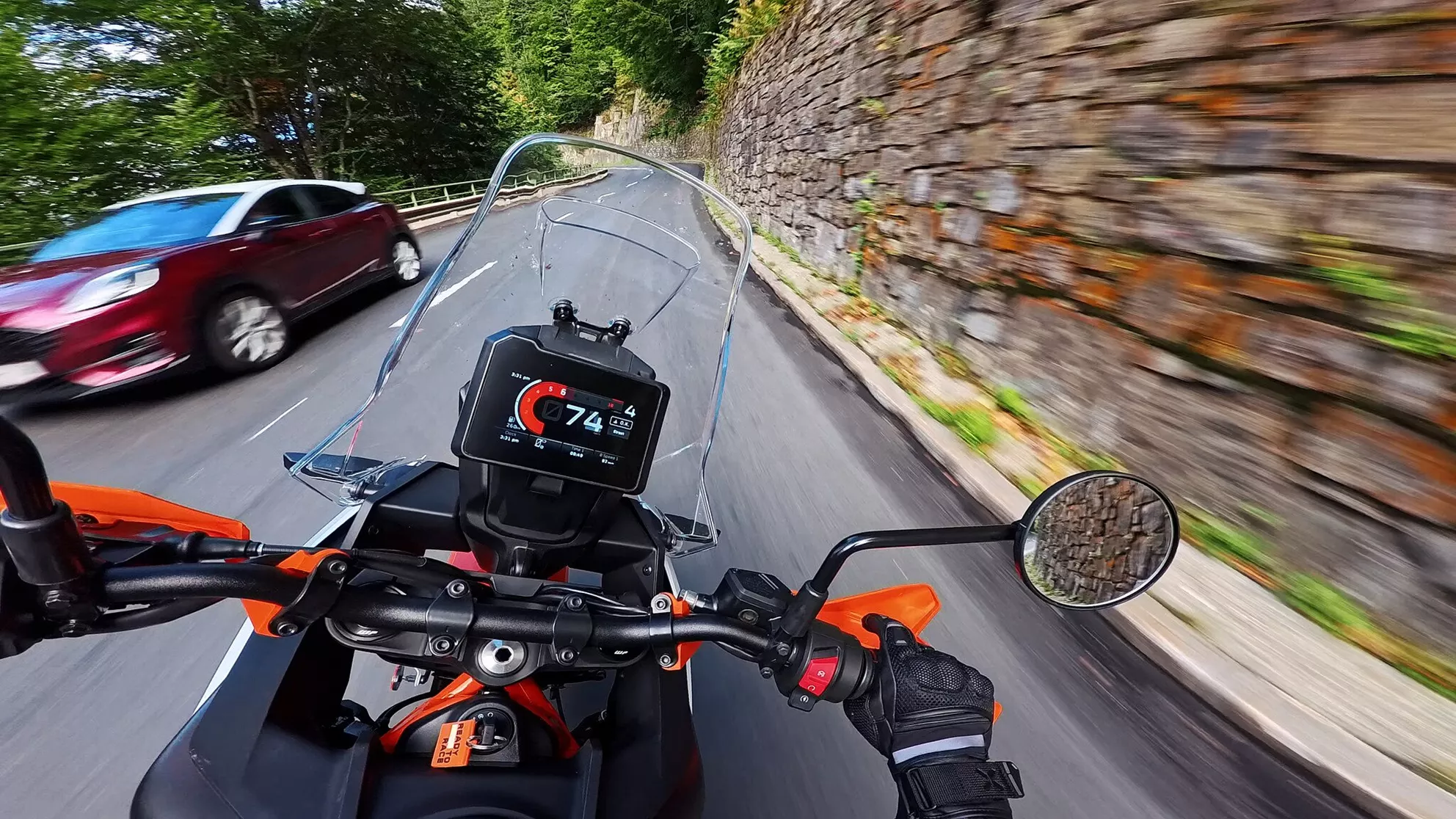
The lightweight 390 Adventure R can be pushed through the curves the fastest. However, repeated hard braking should be avoided, as the brakes are not very durable.
The brakes faced their own stress test on the Nassfeld descent. The front brake on the Brixton initially feels a bit soft and requires a firm hand for stronger deceleration, but it quickly builds good pressure. The rear brake is well-dosed, but about halfway down the pass, its effectiveness was nearly gone, with fading definitely being an issue. The KTM 390 Adventure features a typically off-road-oriented brake feel at the front, which is spongy and soft, making sharp braking difficult. The rear brake is positioned relatively high, requiring a noticeable leg lift to reach it comfortably while seated. Here too, the brake was almost gone by the end of the descent. The Himalayan 450 isn't designed for racetrack speeds on the pass either, but its overall package feels the most balanced. Even though its brake performance diminishes under very sporty riding, its dosing and character complement the bike well.
Electronics and Assistance Systems of A2 Adventure Bikes
In terms of electronics, the three A2 adventure bikes are worlds apart. The KTM 390 Adventure comes equipped with the most comprehensive electronics package. Riding modes, finely adjustable traction control, and excellent ABS that doesn’t intervene clumsily provide a lot of safety, especially for less experienced riders. However, the traction control acts rather conservatively on dry asphalt. For our riding style, it was too cautiously set, so we disabled it on grippy surfaces. Thanks to the high-revving power delivery, the KTM remains well-controllable nonetheless. The Brixton Storr also features traction control, but in everyday testing, it was quite challenging to even get it to activate. The twin-cylinder engine has enough on its plate with the high weight, leaving too little excess torque to overcome traction.
Royal Enfield takes a deliberately pragmatic approach with the Himalayan 450. There are two riding modes available: Eco and Performance. In Eco mode, the power is throttled, making the bike feel much like the old 411, which is frankly unnecessary. Hence, we consistently rode in Performance mode. Royal Enfield completely omits traction control—not as a cost-saving measure, but as a deliberate choice. With the tractor-like engine and its forgiving torque curve, the power delivery is so smooth that traction control is practically unnecessary. ABS is, of course, included, even with alternative off-road modes, but overall, this shows that more displays and modes aren't automatically the better concept; sometimes it's the simpler, well-tuned system that really impresses.
- How much does a KTM 390 Adventure R cost?
- Here you will find an overview of the price level of new and used motorbikes!
Off-Road in Friuli: Straniger Alm, Gravel, and a Crash
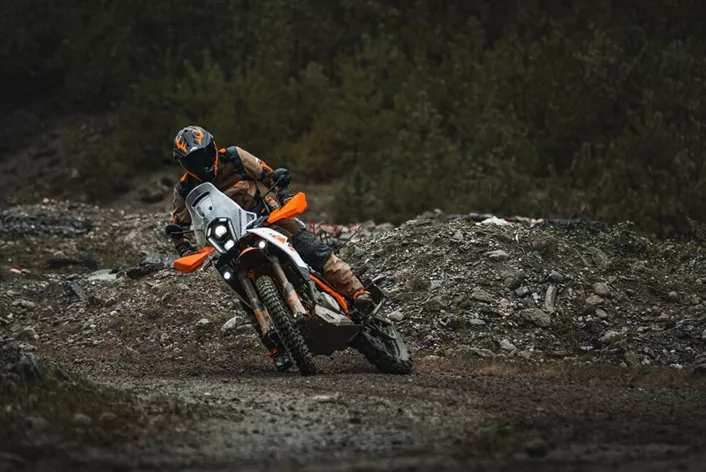
After two enjoyable riding days in Friuli, we headed back towards the border for the last night, up to Straniger Alm and into the loose terrain. Initially, we had planned to tackle some tougher off-road sections, but before it came to that, I ended up on the ground with the KTM in a gravel curve. No drama, but an honest reminder that we weren't riding through a brochure, but under real conditions with wet, slippery surfaces. Nevertheless, we covered several off-road kilometers to realistically assess the off-road capabilities of the three adventure bikes.
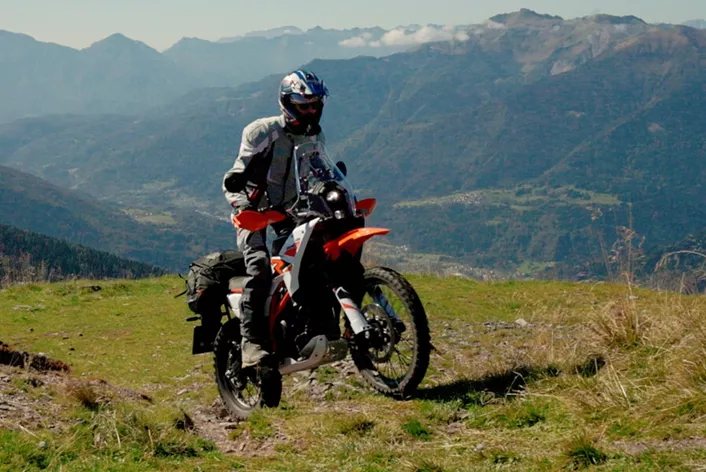
On paper, the KTM 390 Adventure offers the best off-road package by far. It's the lightest in the test, featuring the longest suspension travel, narrow bodywork, a long seat, and plenty of freedom of movement. The standing ergonomics are excellent, especially for riders up to about 1.85 meters tall. For those around 1.90 meters, the handlebars might feel a bit low, but risers can help if needed. The suspension offers long reserves that we didn't come close to exhausting this weekend, and the adjustment range is large enough to fine-tune to personal preferences. The sticking point for me, however, is the engine. While many love the rev-happy nature of the 390 Duke, in an off-road setting, the high-rev character seems a bit out of place. For enduro riding, I want spontaneous, punchy torque from the low end to overcome obstacles with a blip of the throttle or to break traction in a corner. On the KTM, you have to shift a lot and keep it in the upper rev range to achieve such maneuvers. Riders who are full-throttle enthusiasts will still be happy with it. However, those expecting a tractor-like engine with low-end torque will be less so. Additionally, the brakes are not very durable under hard use, and the price in the A2 segment is not exactly low. Still, there are few other A2 adventure bikes on the market that take off-roading as seriously. With a more torquey, tractor-like engine, the KTM would be my personal optimum.
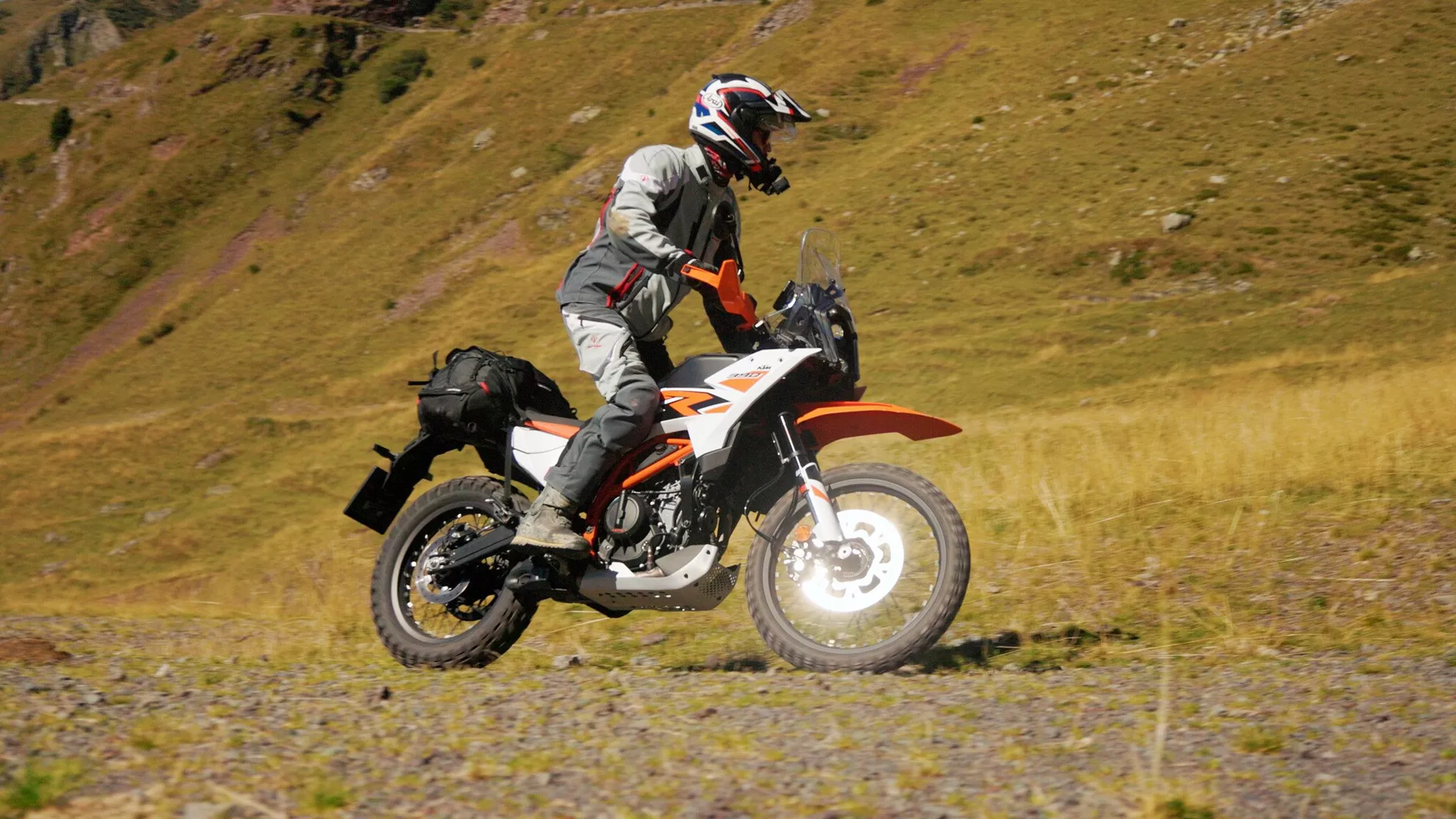
The KTM 390 Adventure R is definitely the most off-road capable adventure bike in the A2 segment. It's only the engine that divides opinions.
The Brixton Crossfire 500 Storr is clearly designed for touring rather than rallying based on its specifications. It has the highest weight, the shortest suspension travel, and rides on 19/17-inch wheels with road-oriented tires. It performs respectably off-road but is characteristically geared towards a leisurely pace. The KYB suspension is sensitive even on loose surfaces, the front brake is well-dosed, though initially a bit sharp, and the standing ergonomics are perfectly fine—not offering huge space, but sufficient for casual gravel tours. However, on slippery terrain, mud, and natural steps, you can clearly feel how the rev-hungry twin-cylinder struggles with the weight. When traction breaks or the rear wheel briefly lifts, it noticeably takes time for the engine to regain power. Serious sporty off-road ambitions are challenging with the Storr. For me, it's clearly a "leisurely, most leisurely" machine in the terrain: gravel paths, yes; ambitious enduro, not so much.
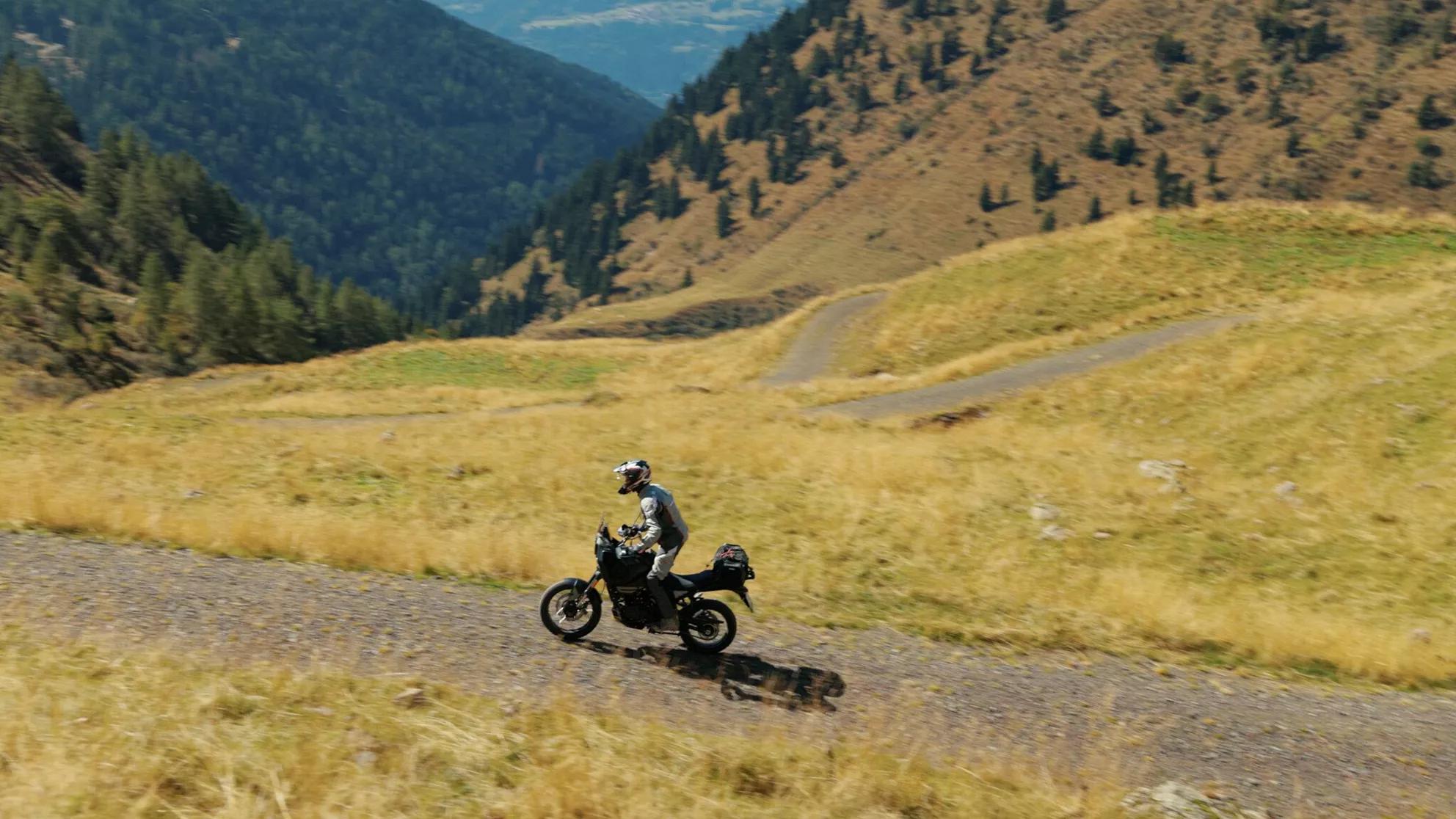
The Brixton Crossfire 500 Storr takes a leisurely approach even on loose terrain, which doesn't have to be a disadvantage.
The Royal Enfield Himalayan 450 is the all-rounder with a tractor heart. I've known it from other tours, and I was impressed once again after this trip. It’s the most affordable in the comparison, offers the largest tank and the best range, and delivers ergonomics that feel similarly balanced to the KTM, but more relaxed. It’s more laid-back than the uncompromising KTM, yet still active enough to enthusiastically tackle rough terrain. Despite the 17-liter tank, there’s ample room to move around. The star of the show is undoubtedly the engine. Whether you miss a gear, get momentarily distracted, find yourself in deep mud, or are on grippy asphalt, a twist of the throttle delivers confident power. The clutch is well-dosed, and while the suspension isn’t adjustable, it’s perfectly tuned from the factory, whether on asphalt or off-road. The Himalayan gives you the "it’s all good, I’ve got you" feeling that you look for in gravel tours, without needing to be an off-road pro.
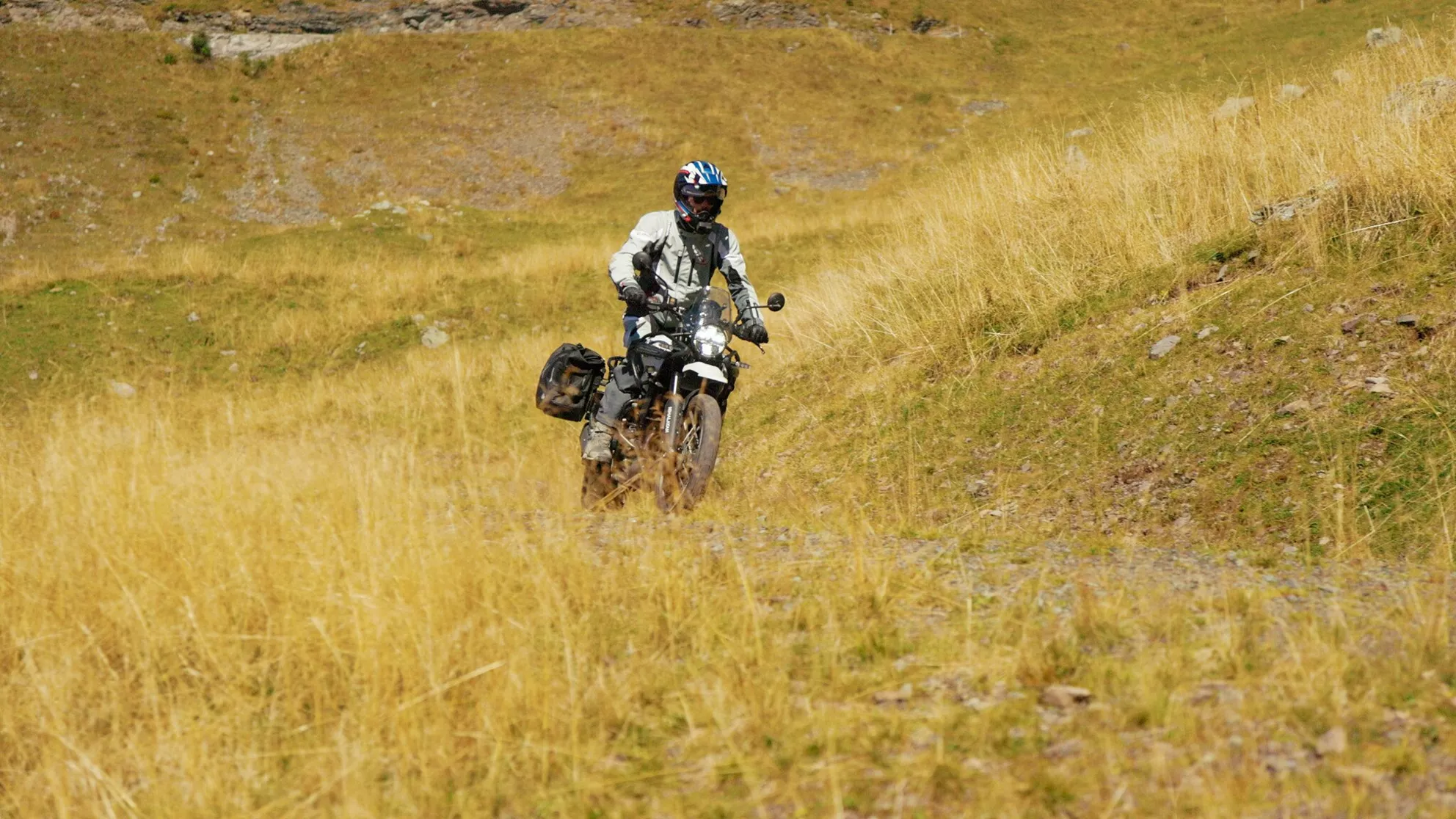
The Royal Enfield Himalayan is the all-rounder that excels in no single discipline but performs well across the board.
Features of the Three A2 Adventure Bikes
A look at the features shows that each manufacturer has its own unique touches. The Brixton Storr is priced around the 7000-euro mark in Austria and comes equipped with auxiliary lights, a USB port, a large display, and practical tank bags. This makes for a well-rounded package for its debut in this segment. The Royal Enfield Himalayan 450 combines its comfortable seat and large tank with a true standout feature in this class: a 3D navigation system based on Google Maps directly in the display. This is a modern feature that significantly eases everyday life, especially for adventure bikes. KTM, on the other hand, focuses on a clearly off-road-oriented chassis, a quickshifter, and extensive electronics with the 390 Adventure R.
Conclusion on the 2025 A2 Adventure Bike Comparison
After three intense days in Friuli, featuring highways, alpine passes, twisty roads, gravel, and a spill in the KTM gravel curve, three distinct character profiles emerge. The Royal Enfield Himalayan 450 is the most affordable and simultaneously the most well-rounded solution in the trio. It combines range, comfort, a friendly tractor-like engine, and a well-tuned suspension into a package that broadly appeals to A2 touring riders. The Brixton Storr is a respectable entry with a strong suspension, good features, and comfortable ergonomics. With a beefier engine and less weight in the next update, it could mature into a serious, albeit heavier, adventure bike. The KTM 390 Adventure R remains the most uncompromising off-road A2 adventure bike on the market, ideal for fans of the 390 engine and riders who deliberately seek a light, high-standing A2 adventure bike with a strong off-road focus and are willing to operate in the upper rev range when off-road.
Review: Stadler Transformer Enduro Suit in Test Use
For this test, I was equipped with the Stadler Transformer, a highly ventilated summer suit made from abrasion-resistant Cordura with large stretch panels and Level 2 protectors. Beyond Stadler's typical high quality, the Transformer jacket has a unique feature that makes it perfect for enthusiastic enduro tours: the sleeves can be removed. Combined with a protector vest, the Transformer suit offers an unprecedented level of ventilation and freedom of movement. The fit is close to the body but remains extremely flexible thanks to the stretch materials—particularly useful in off-road settings. The jacket's eleven ventilation openings and the well-positioned vents on the pants ensure strong airflow, which was a true comfort advantage in the warm climate of Friuli. A fall on gravel further demonstrated that the Transformer handles tough conditions with ease. For summer adventure tours, the Stadler Transformer is one of the highest quality options on the market. Read more in the detailed Stadler Transformer review.
- How much does a Brixton Crossfire 500 STORR cost?
- Here you will find an overview of the price level of new and used motorbikes!
&width=60&height=60&bgcolor=rgba_39_42_44_0&mode=crop "Author: Gregor")
Royal Enfield Himalayan 450 2025 - Experiences and Expert Review
Gregor
The Royal Enfield Himalayan 452 is a motorcycle with a unique character, standing out for its accessibility and reliability. It's ideal for riders looking for a straightforward yet capable enduro that performs well across different terrains. While it's not the most powerful or sporty bike, it impresses with easy handling, robust build, and reliable electronics. Its suspension remains stable at higher speeds but quickly reaches its limits. Overall, the Himalayan offers a pleasant riding experience for adventurers seeking a sturdy and forgiving machine.
KTM 390 Adventure R 2025 - Experiences and Expert Review
Gregor
The 390 Adventure has never been more uncompromisingly tuned for off-road use. With impressive suspension travel, modern electronics, and weighing less than 180 kg, the 390 Adventure R could be the long-sought versatile all-rounder among adventure bikes. It can effortlessly handle highway stretches, twisty roads, or rugged terrain. However, there's a potential drawback: the engine, borrowed from the 390 Duke, is very rev-hungry even in the Adventure R. This results in constant shifting and a lack of spontaneously available thrust, which can be bothersome in enduro riding. Whether the KTM 390 Adventure R can fulfill long-standing desires is a matter of personal preference.
Brixton Crossfire 500 STORR 2025 - Experiences and Expert Review
Gregor
The Brixton Crossfire 500 Storr demonstrates that A2 adventure bikes don't have to be boring. The suspension and features are impressive, though the engine demands engagement. A successful debut with room for refinement.
More from 1000PS Magazine
A2 Adventure Touring Test: KTM 390 ADV R, Himalayan 450, Brixton Storr Images
Source: 1000PS


