We actually had the SENA 60S in our office briefly before EICMA 2024, but back then it was still running a pre-production version of the software. That version still had several restrictions, which is why we postponed the test to the start of the 2025 season. Now, after several weeks of intensive use of the SENA 60S between Barcelona and Vienna, we present our test results. The new 60S has shining moments, some of which are accompanied by dark shadow sides. But one thing at a time...

SENA 60S Test of the new communication system for motorcycle helmets
Light and shadow with SENA's new flagship
The 60S is the new flagship communication system from SENA. Compared to the 50S, it's meant to perform better across the board and offers revolutionary technologies, such as communication with unlimited range. We tested how well the SENA 60S can keep these big promises in everyday motorcycle use.
&width=72&height=72&bgcolor=rgba_39_42_44_0&mode=crop "Author: Gregor")
Gregor
published on 4/22/2025
50,107 Views
Simple installation and flexible use – the clever hardware of the Sena 60S put to the test
We begin, as most customers probably will too, with the installation of the 60S. As with many current communication systems, the mount can either be glued to the outside of the helmet with adhesive pads or fixed to the helmet shell with a clamp. While the adhesive variant is compatible with almost any helmet, the suitability of the clamp depends on whether the helmet interior and the inside of the helmet shell are glued together and how wide the lower helmet edge is. A common practice, then – but SENA takes it a step further with the 60S.
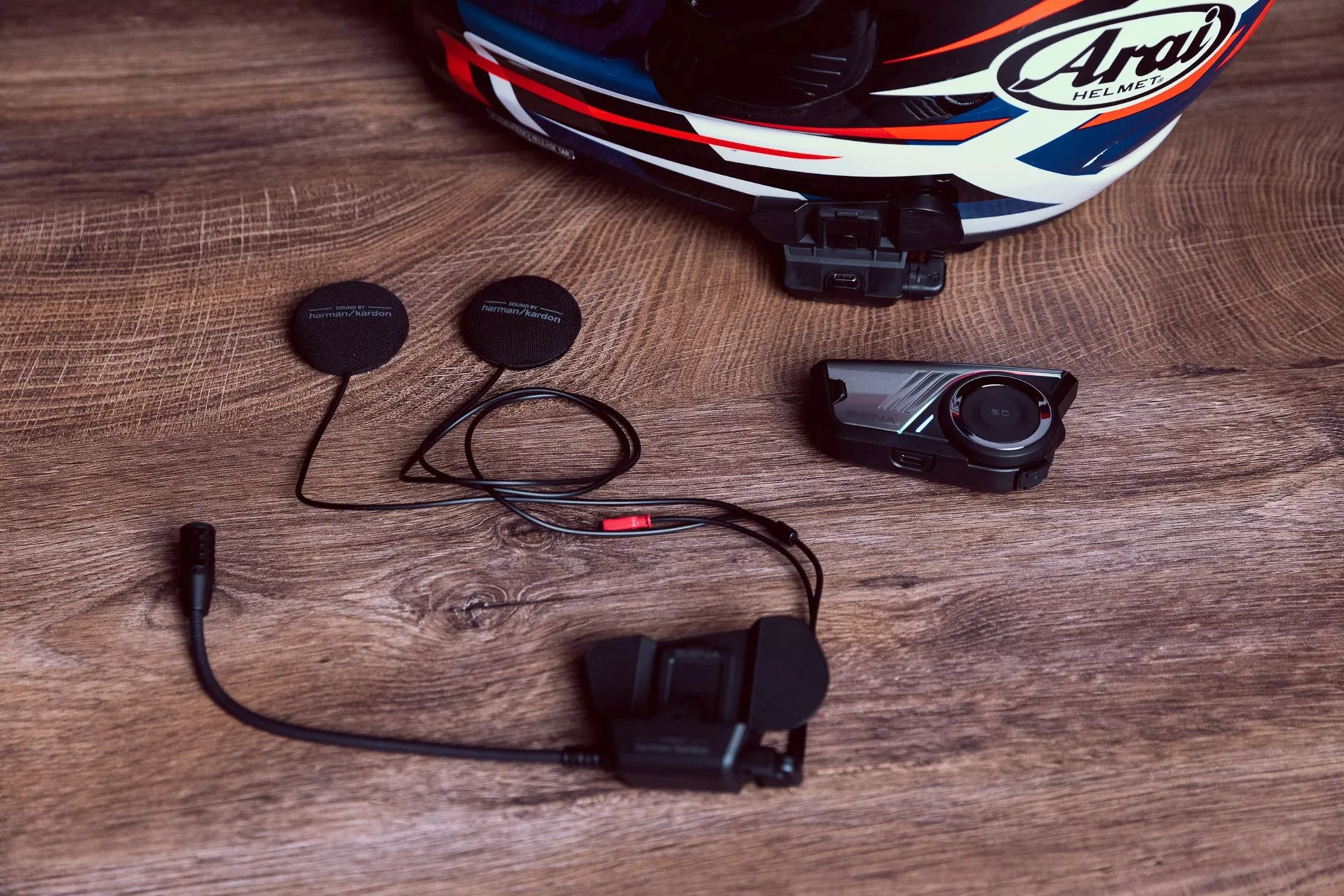
Two mounts come with every SENA 60S: one with a boom microphone and one with a wired microphone.
Particularly noteworthy is that two different helmet mounts are included in the scope of delivery. One mount comes with a fixed boom microphone, making it ideal for jet and other open-face helmets. The second uses a modular system: microphone and speaker are connected via USB-C and mounted directly inside the helmet – perfect for full-face or flip-up helmets. In practice, this offers real added value, especially for riders who regularly switch between different helmets. The trick: thanks to a new magnetic locking mechanism, the 60S can be transferred from one mount to another in a flash – a quick maneuver is enough, and the communication system sits securely on the new helmet. This saves time and greatly increases everyday usability.
Operation and haptics of the Sena 60S – familiar formula with slight weaknesses
With the operating concept of the 60S, Sena stays true to itself and relies on the by-now familiar control principle: a large dial wheel, with which you can, among other things, adjust the volume or skip music, plus three additional buttons – one for the intercom functions (usually Mesh), one for the smartphone, and one for special functions. Anyone who has already used a SENA system like the 50S will find their way around immediately. Everyone else needs a short familiarization period, but the most important basic functions like music control, call acceptance, or switching the Mesh intercom on and off are quickly internalized. The only truly new button is the switch for the flashlight now installed on the 60S for the first time. This gimmick can come in handy in the dark, but I barely used it in everyday life.
In practice, the operation works reliably. The controls are easy to feel, even with thick gloves. The haptics are solid, everything feels high-quality and robust – that checks out. What also stands out, however: really in-depth functions can hardly be meaningfully controlled directly via the buttons on the device anymore. Here it quickly becomes clear that full use of the 60S is really only intended in combination with the smartphone app – which makes sense for safety reasons too. The Sena Motorcycles app is clearly laid out and easy to operate while stationary. Particularly practical: the ability to connect with other riders via QR code. This saves time and puts an end to the often lengthy setup process of earlier intercom generations.
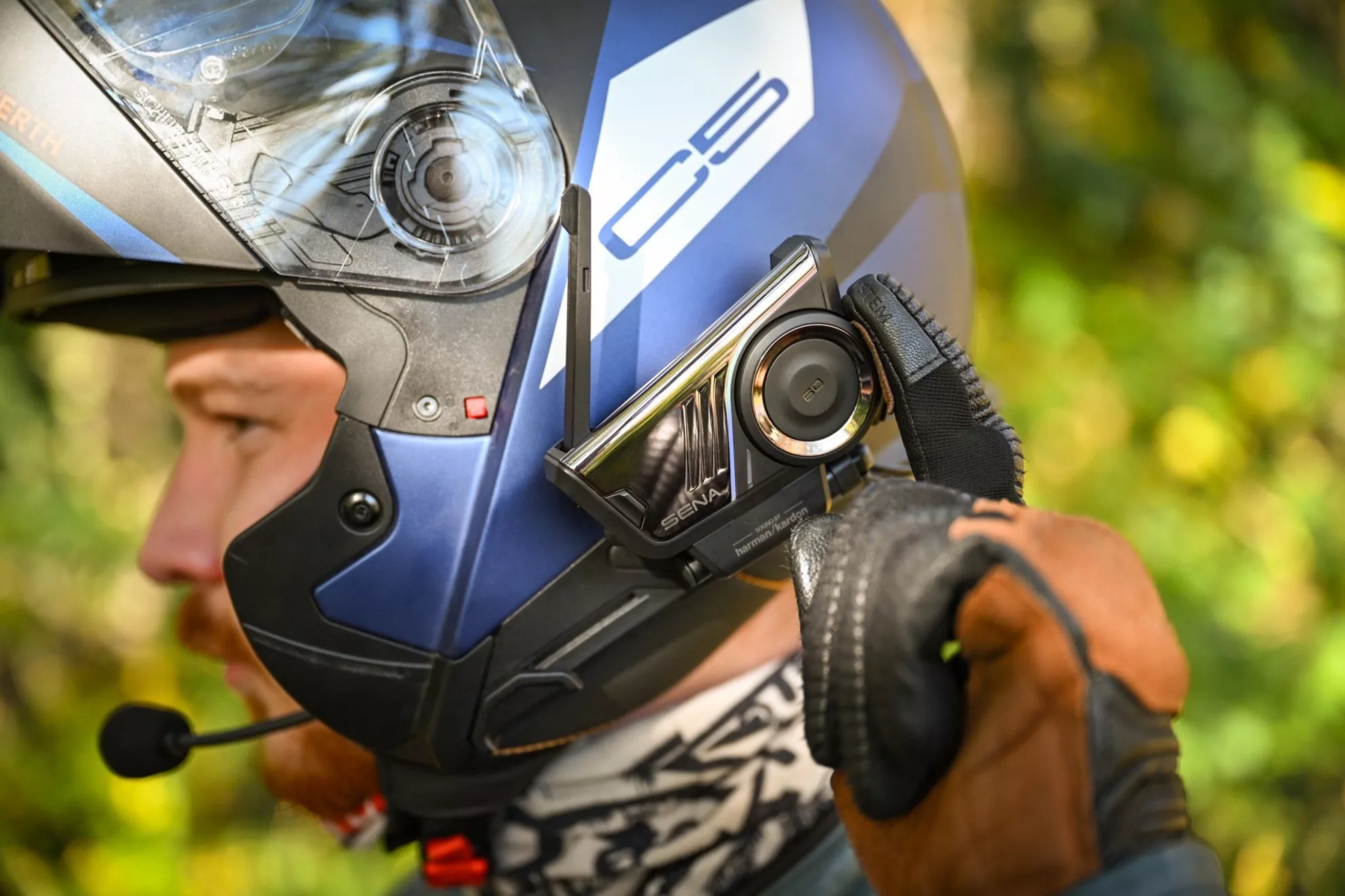
Anyone who's already familiar with SENA communication systems will find their way around the 60S too.
An interesting feature is the voice control, which now works with AI support and is available in several languages. The idea behind it is promising – you can not only give simple voice commands to the device itself (e.g. "louder", "mesh on"), but also speak directly to the smartphone's voice assistant. In testing, this partly worked surprisingly well: without pressing a single button, I was able to have Google Assistant calculate a route to Vienna, roughly 50 km away.
However: the voice commands don't always respond reliably. Sometimes it works right away, sometimes nothing happens at all. This makes control on the road somewhat unpredictable, which is why I personally mostly went back to the classic buttons – simply because they always work. Here, light and shadow lie fairly close together on the 60S.
Visual customization: The Sena 60S adapts to your helmet design
Unlike many other communication systems, which tend to look more functional than appealing, the Sena 60S offers surprisingly many options for personalization. The outer housing plate of the system is interchangeable and can be swapped, depending on taste, for a variant in dark chrome, metallic silver, pearl white, or gloss black. Additionally, the large dial wheel is also available in various colors. Those who like it especially eye-catching can also adjust the integrated LED light strip – the so-called RideGlow – in color and lighting behavior via the app. This allows the communication system to be better visually matched to your own helmet or riding style without having to sacrifice functionality. And despite this ability to independently attach and remove parts, the SENA 60S is water- and dust-proof to the IPX7 standard. Even in the nastiest winter rain, the SENA (unlike the rider) had no problem.
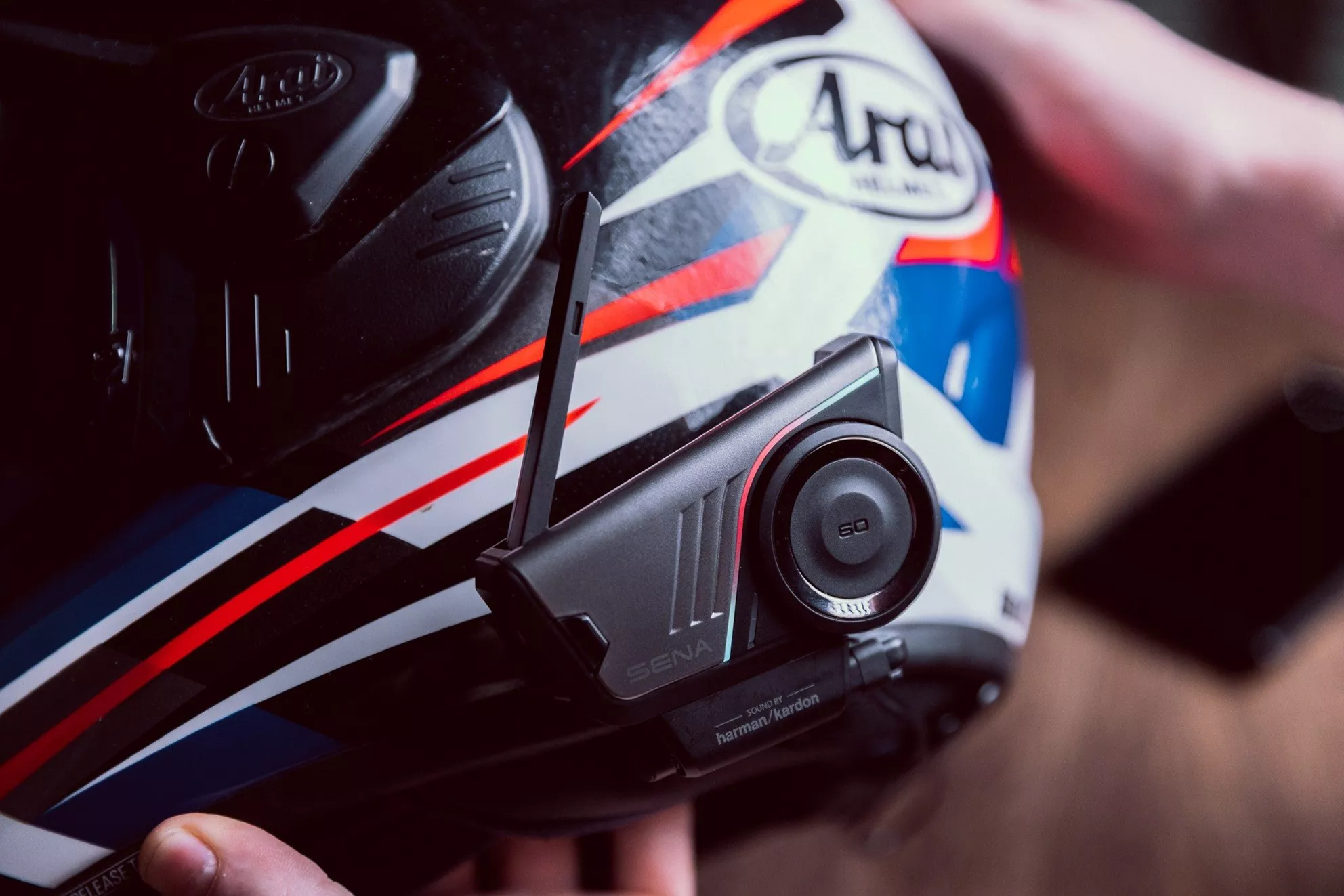
Customization is an important point with the new SENA 60S. Besides the interchangeable parts of the outer shell, the LED strip can also change color.
Strong sound for solo rides – Harman Kardon speakers in the Sena 60S
When riding the bike alone, you'll probably use your communication system for two things about 90% of the time: listening to music and making calls. In exactly this area of use, the new Harman Kardon speakers have their finest hour. While the predecessor model, the 50S, was often criticized for being too quiet, the 60S's speakers, which are 30% louder, provide noticeable relief here. At maximum volume, they genuinely make your ears vibrate. This makes it possible to follow a podcast without any trouble even with earplugs and at higher speeds on the highway.
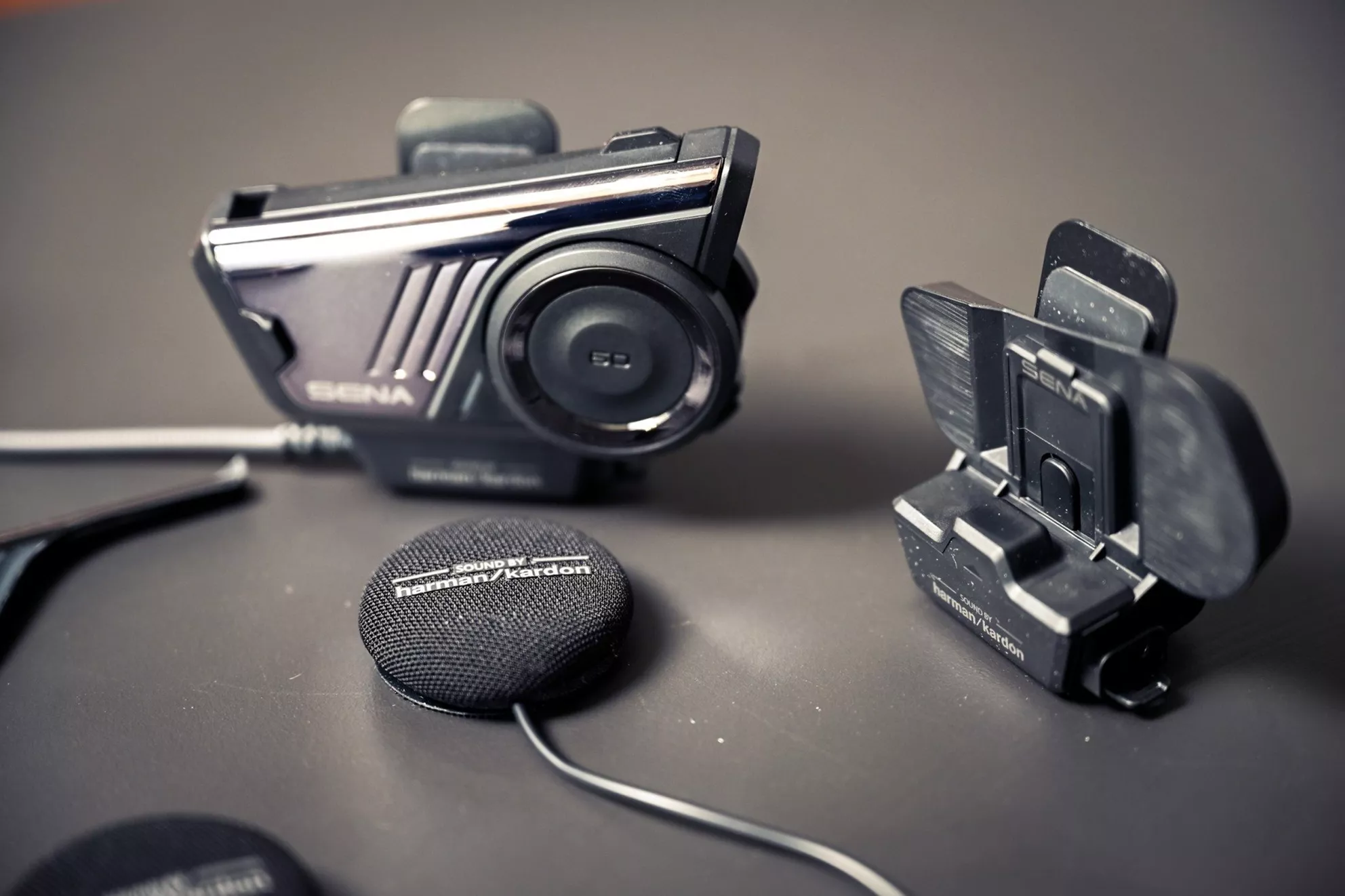
Harman Kardon delivers bombastic sound in the SENA 60S, provided the artificial intelligence doesn't interfere.
The speakers aren't just louder, though, they're also better in quality. Even erratic music genres like metal are reproduced clearly – a point where many other systems reach their sonic limits. The problems with sound quality only begin when interacting with other riders, but they aren't caused by the speakers themselves.
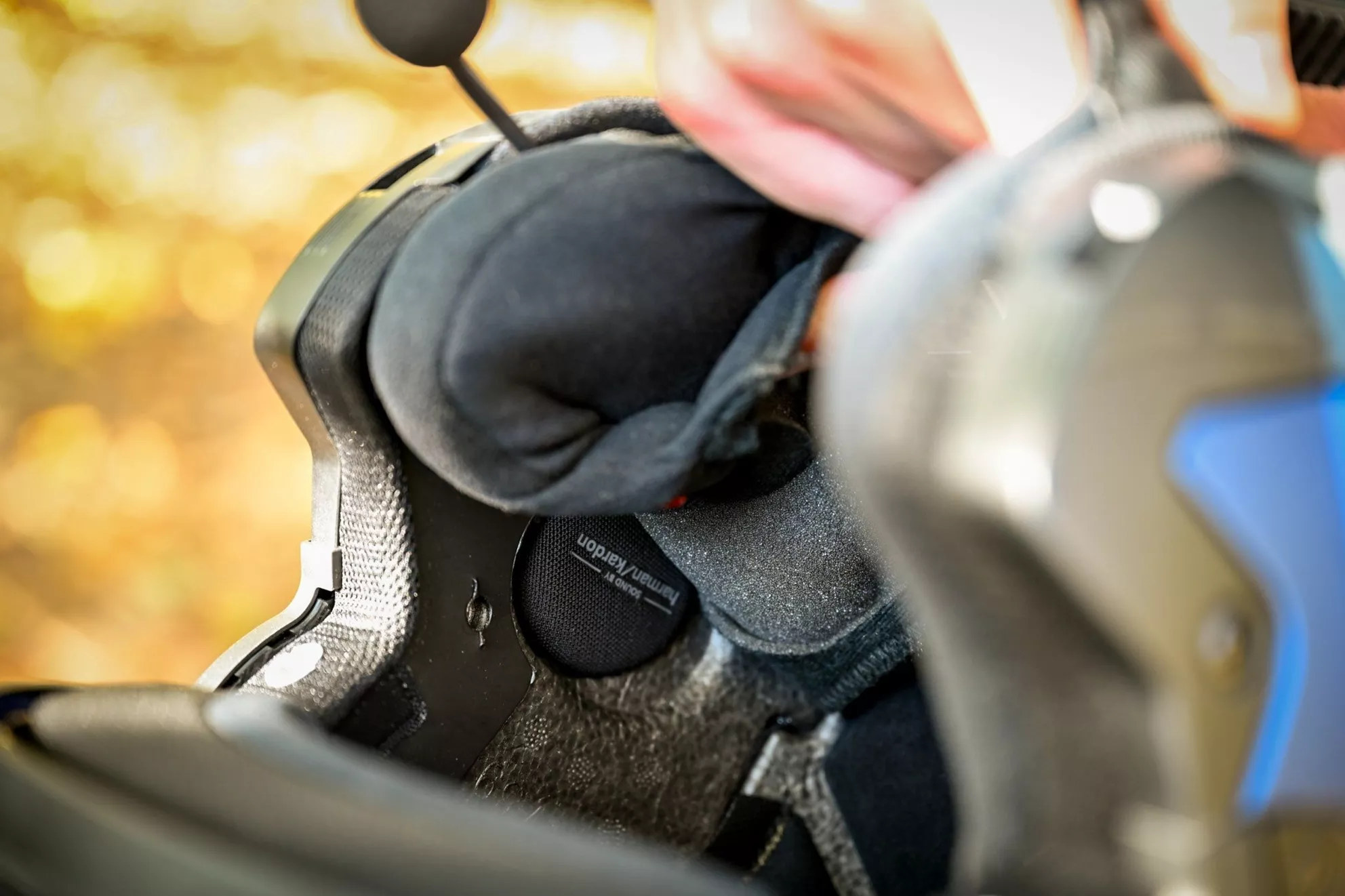
Practical: if you've already found your preferred headphones for the helmet, the 60S can also be used via a 3.5mm jack connection. This connection option expands the scope for individual setups and is a detail that isn't a given in this device class.
Group communication & AI noise cancellation in the SENA 60S – great potential with a clear weakness
Artificial intelligence is currently on everyone's lips – and it's meant to play a central role in the Sena 60S as well. The AI-supported algorithm in the system has the task of separating disruptive background noise such as wind and engine noise from the human voice, optimizing it, and then transmitting it as clearly as possible – both for voice commands and for intercom communication. An interesting idea in and of itself.
SENA even takes a different approach here than many competitors and deliberately does without strongly directional microphones. Instead, the microphone sits centrally in the barrel – i.e., the end piece of the microphone – and the AI is supposed to handle the rest. Cleverly solved in theory, but in practice it reveals one of the biggest weaknesses of the 60S.

As long as the wind noise stays within limits, everything's fine. But even the wind noise at Austrian highway speeds throws the AI off balance. A real shame!
Because the noise cancellation currently doesn't work reliably. The main problem is wind noise. Up to about 80 km/h, the voice quality over the Mesh intercom is still good – beyond that, the AI increasingly starts filtering out parts of the voice too. From around 130 km/h onward, sometimes only a robotic crackle reaches the conversation partner. Simply placing a hand on the underside of the helmet immediately improves intelligibility, which clearly points to the source of the problem.
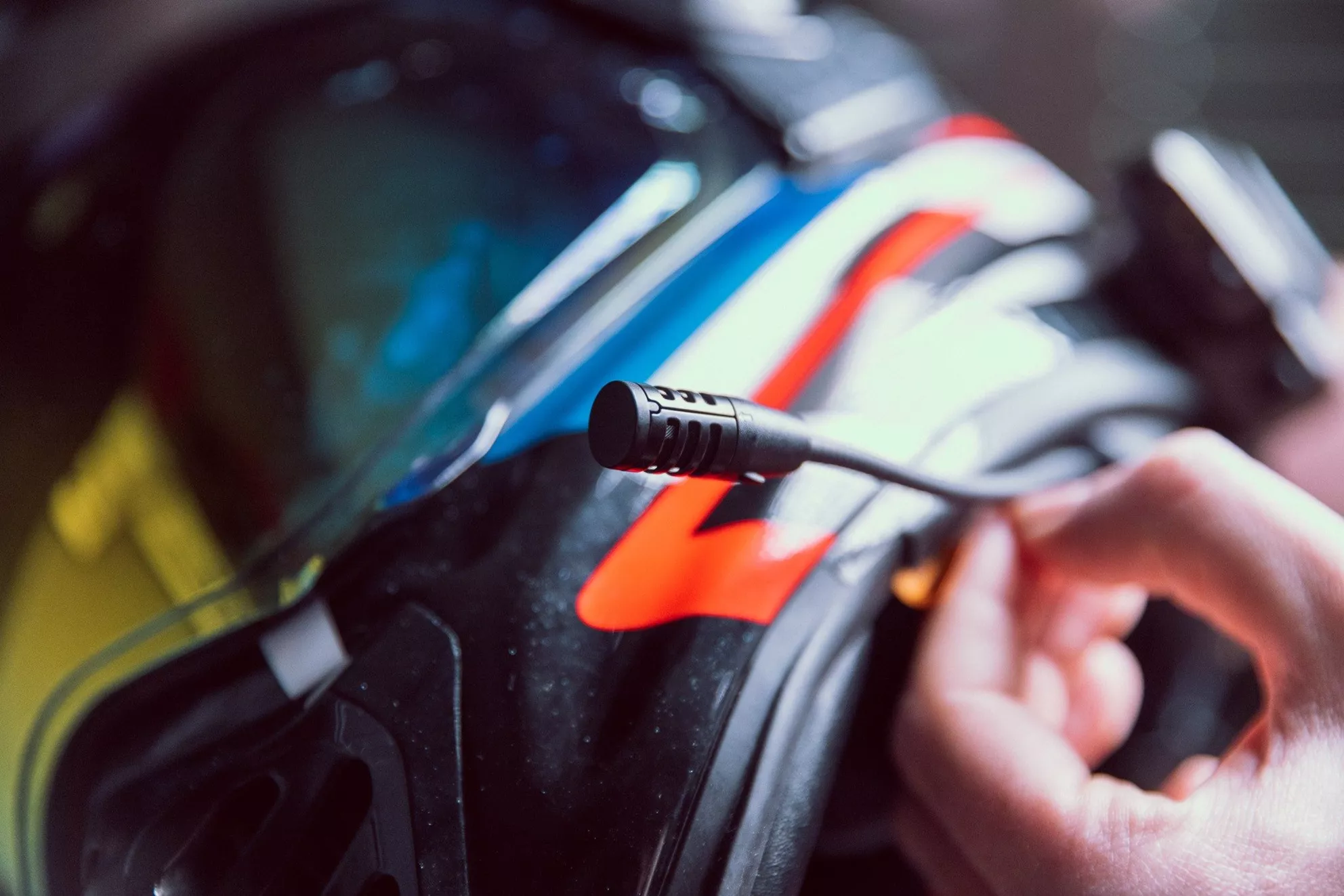
Our layman's guess: one reason for the problem with noise cancellation could be the microphone. It's not aimed toward the mouth, but rather toward the boom microphone, i.e., to the left out of frame.
For a system in this price class especially, such a weakness is serious. Understandable communication at higher speeds is one of the basic requirements of a modern motorcycle intercom – here, the 60S currently fails to convince. The fact that the AI algorithm can't be deactivated or adjusted in strength also further limits the user's room for maneuver.
The only silver lining: the system supports over-the-air updates, meaning future software improvements can be installed wirelessly. Let's hope SENA makes targeted improvements here – because the rest of the hardware actually provides the best conditions for strong transmission quality.
Mesh 3.0 in the Sena 60S – range, stability and new functions
Provided the sound quality allows for understandable communication, the technology behind it definitely has potential. Compared to Mesh 2.0, Mesh 3.0 offers a range of improvements aimed primarily at higher stability, better voice quality, and optimized range. A key feature is backward compatibility: Mesh 3.0 remains fully compatible with all previous SENA devices that support Mesh 2.0. New, however, is the reduction of the frequency range to just six channels. This lowers the likelihood of data collisions, which in practice is noticeable through clearer conversation quality. The system automatically checks whether a frequency is free before a signal is sent – the resulting minimal delay is technically present but barely noticeable while riding.
Also interesting: the AI-supported noise detection currently works exclusively in Mesh 3.0 mode. It distinguishes between speech and interference noise and is meant to contribute to cleaner communication – even though, as already mentioned, this doesn't always work reliably in practice. According to SENA, the company plans to extend this function to older Mesh versions later on.
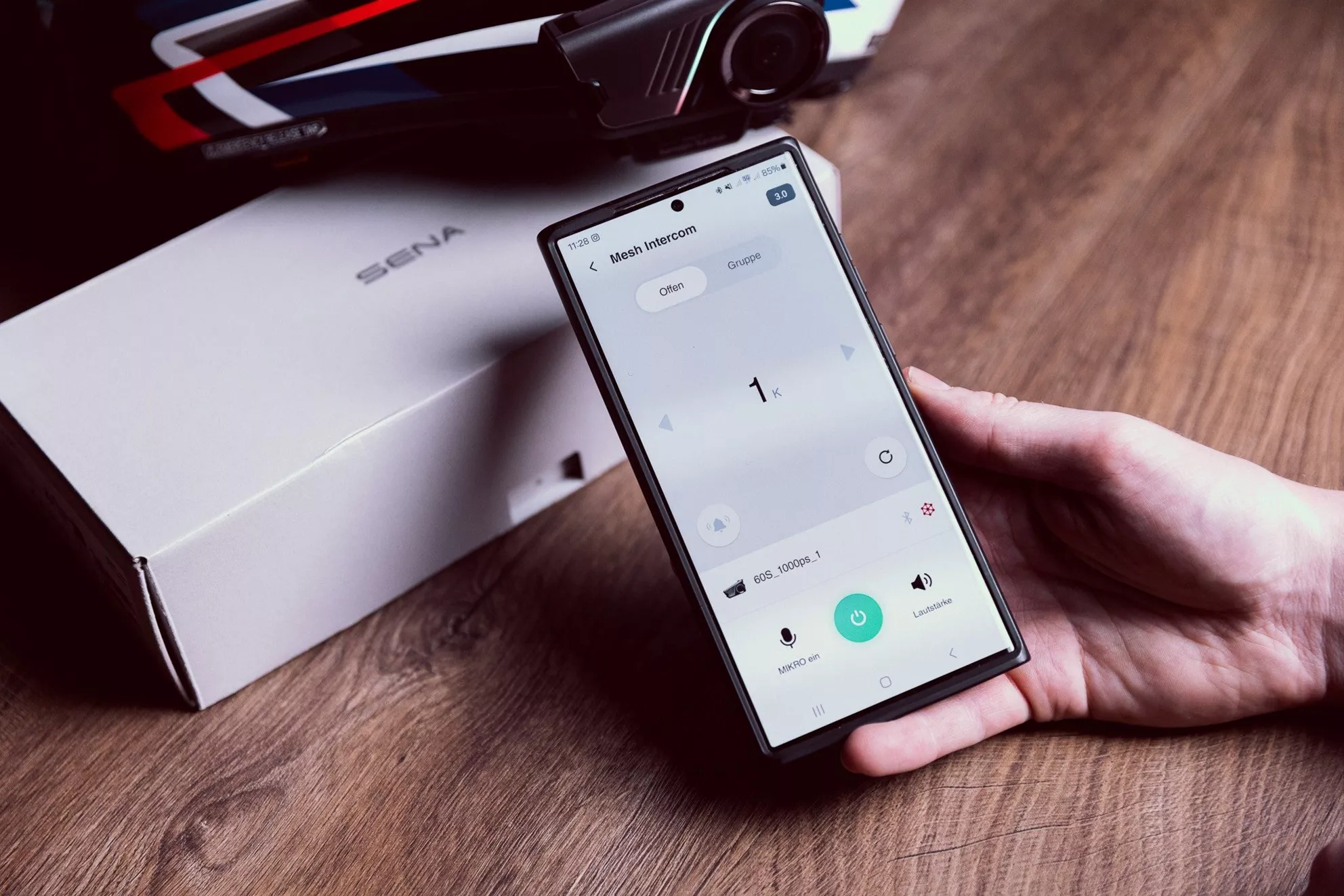
Mesh 3.0 now offers both public and private group channels with up to 24 participants. Big win: group pairing via QR code.
In terms of range, the 60S also gains ground thanks to an additional antenna. According to the manufacturer, the improvement is in the range of 25–30% compared to the 50S. In the optimal case – i.e., with a clear line of sight – ranges of up to 2 km should be possible in private mode. Once six or more riders are riding with a spacing of about 1.6 km, the range can theoretically be extended to up to 8 km. In practice, rock faces, mountainsides, or buildings limit the range considerably earlier, though this doesn't have much of a negative effect. Tendentially, you stay roughly together on a group ride, and the connection reliably manages several hundred meters. If it drops, you're reconnected in a flash at the first opportunity. However, even Mesh 3.0 isn't completely immune to interference. Especially in urban environments with thousands of WiFi, Bluetooth, radio, and TV signals, quality can suffer, as the SENA's signals have a harder time finding their way through the frequency jungle. Even modern systems reach their physical limits here. The 60S, however, remains within an acceptable, still usable range.
The Mesh system distinguishes between a public and a private mode. In public mode, you can communicate on a total of nine channels with a practically unlimited number of participants. In private mode, the group is limited to 24 participants, which is especially suitable for structured tours with a fixed group of participants.
Wave Intercom tested – limitless communication on the SENA 60S
With the new Wave Intercom technology, SENA introduces an additional communication option in the 60S that works over the mobile network. In principle, this is a VoIP connection – i.e., a kind of voice call over the internet, similar to WhatsApp calls. And that's exactly how it behaves in everyday use: if the internet connection is stable, communication works clearly, straightforwardly, and reliably.
Particularly practical: the associated Wave Intercom app also offers a live location tracking feature. This lets you see in real time where the rest of the group members are currently located – helpful especially when organizing joint rides, when you're still waiting for individual riders to arrive.
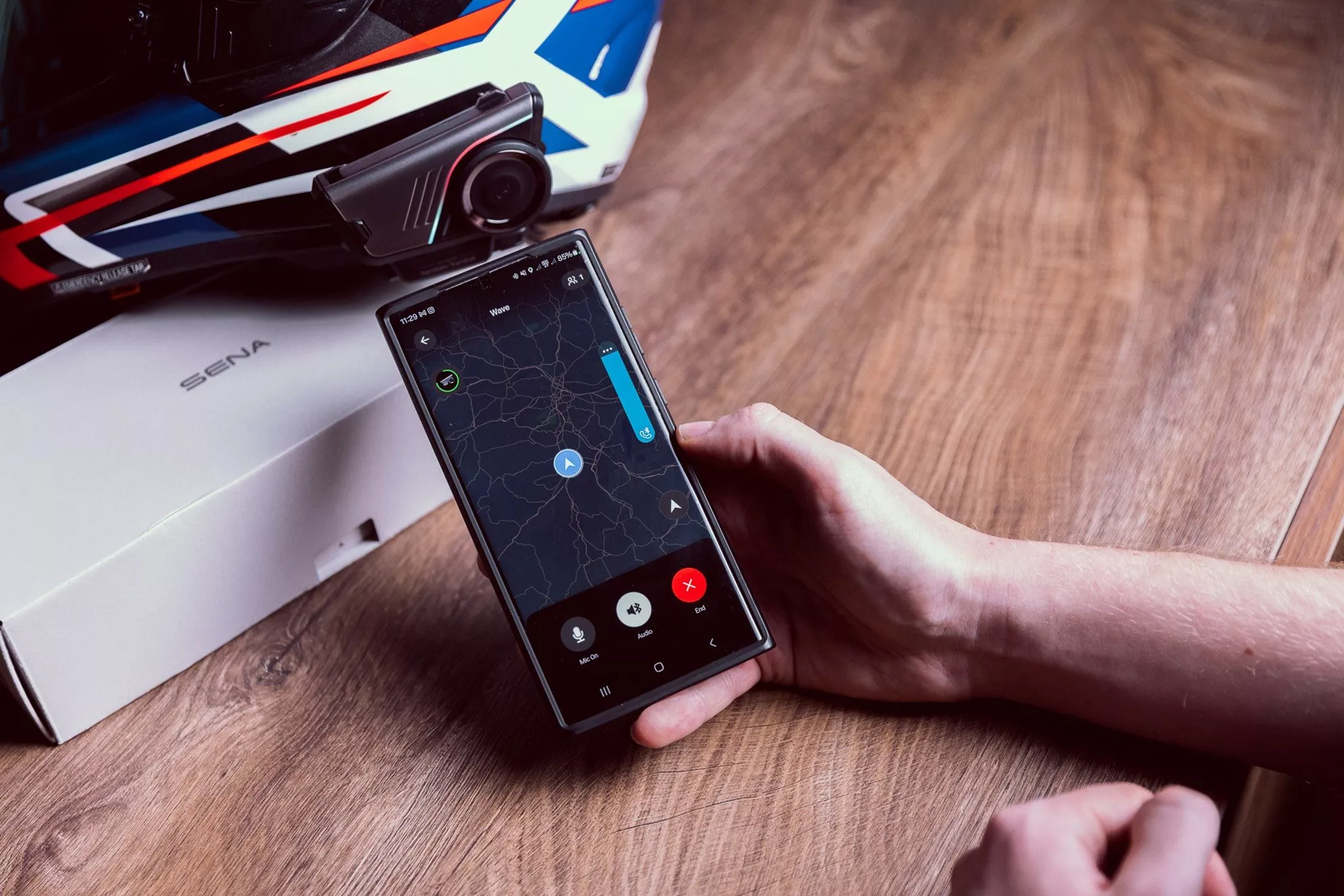
Wave Intercom is an exciting idea and a great addition to the other communication technologies. Very practical when the group of friends is just gathering. If the automatic switch to Mesh works now too, it will be a real highlight.
As expected, Wave communication reaches its natural limits in remote or mountainous regions. Without a stable mobile connection, a permanent connection simply isn't possible – that's logical and can hardly be avoided technically.
Less understandable, however, is that the automatic switch from Wave Intercom to Mesh intercom, as advertised by SENA, didn't work in practice. According to the manufacturer, the system is supposed to automatically switch to Mesh mode if the connection drops, provided other devices are within range. Despite several attempts, however, this switching function couldn't be reproduced in testing. This is disappointing, since exactly this seamless transition was supposed to be one of the biggest advantages of the hybrid system.
Bluetooth 5.3 in the Sena 60S – more efficient and reliable than its predecessor
Compared to the predecessor model, the 50S, the Sena 60S relies on the newer Bluetooth 5.3 standard. This brings several technical improvements in detail over Bluetooth 5.0, which primarily affect efficiency, connection stability, and energy consumption.
A key feature is the so-called channel classification. It allows the system to actively avoid overloaded radio channels, which reduces interference and increases connection reliability – especially relevant when using several Bluetooth devices simultaneously, such as a smartphone and navigation device.
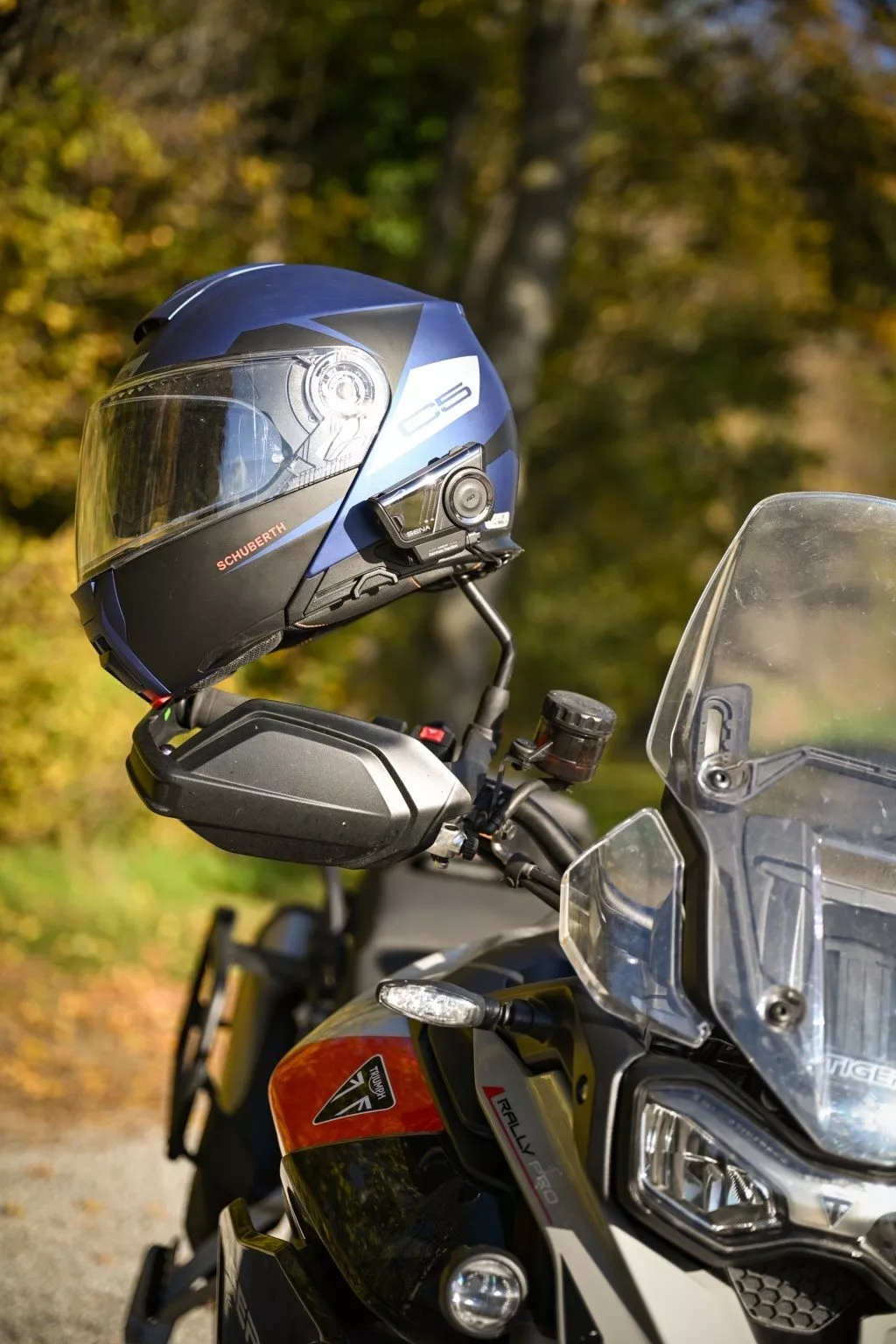
Bike, navigation device, or pillion – Bluetooth connections are everywhere. With Bluetooth 5.3, these work even better.
The connection subrating function also ensures lower energy consumption by allowing devices to switch to sleep mode more quickly during inactivity and become active again without delay when needed. This particularly improves the battery life of connected devices.
In addition, Bluetooth 5.3 optimizes the so-called Attribute Protocol (ATT), which is responsible for exchanging control information. This leads to faster responsiveness of the system, for example when switching between audio sources or when using voice assistants.
In practice, Bluetooth on the 60S mostly remains a side note next to Mesh and Wave Intercom, but the technical improvements over the 50S are there and make sense – especially for users who like to pair their system with multiple devices in parallel.
Test verdict SENA 60S: Promising, but with clear room for improvement
Overall, the Sena 60S is a successful further development in many areas. The build quality feels high-end, the haptics of the controls are well thought out, and the sound – especially in solo use – impresses with volume and clarity. Battery life is also solid, with up to 17 hours in Mesh mode or 22 hours with Bluetooth use. Thanks to USB-C and quick-charge functionality, the device is also fully charged in just 1.5 hours – 20 minutes are already enough for over three hours of Mesh communication.
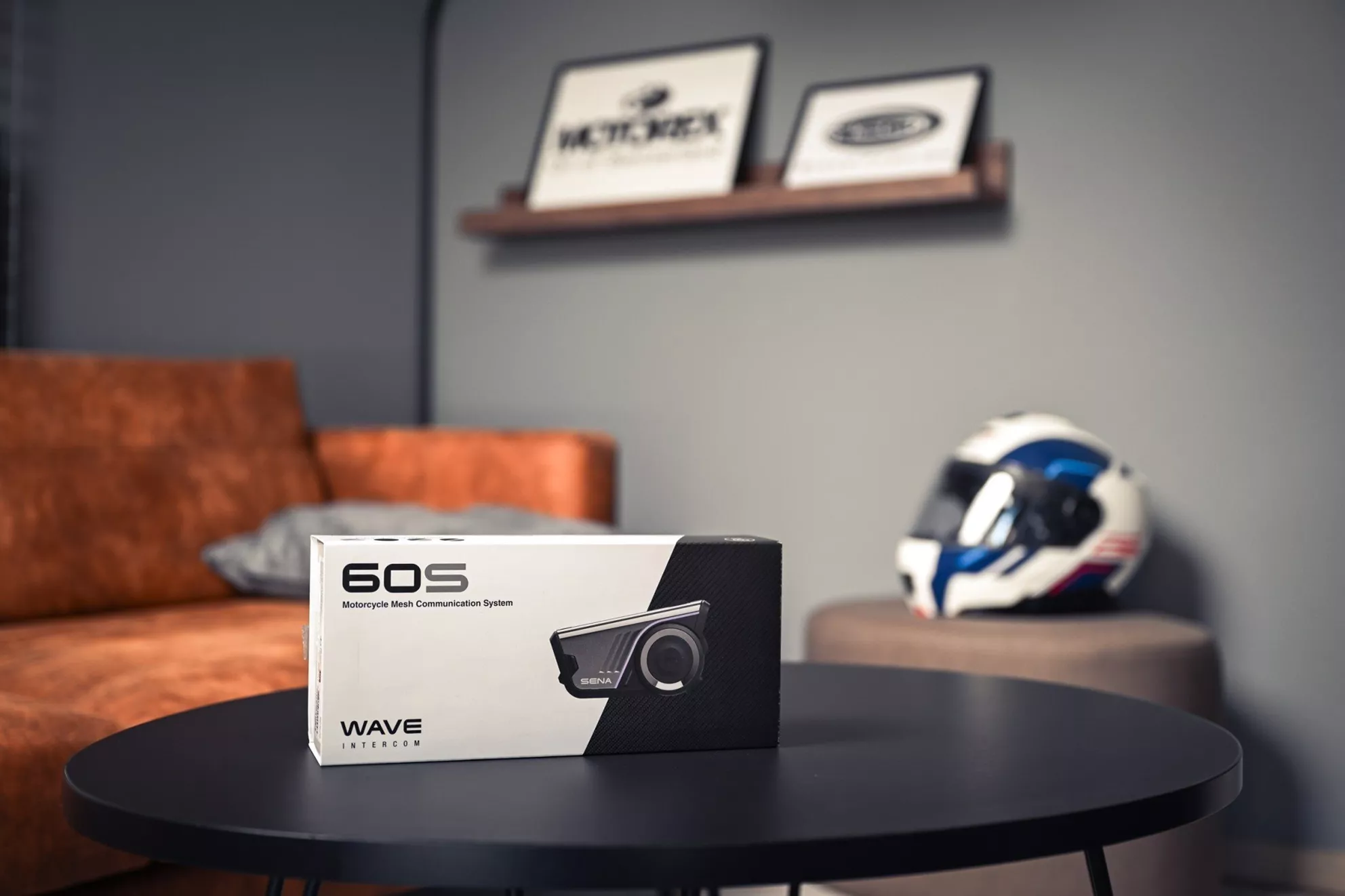
With the 60S, SENA delivers an in itself very interesting package. Given the current difficulties, though, it's worth waiting a bit longer before buying.
But despite all these positive aspects, the 60S cannot be unreservedly recommended in its current state. In particular, the central innovation, the AI-supported noise cancellation, disappoints in testing. From about 80 km/h onward, intelligibility in group communication noticeably decreases – at higher speeds, the voice is sometimes filtered so heavily that hardly anything comes through comprehensibly. A communication system at a recommended retail price of no less than €399 shouldn't be allowed such a glaring flaw in 2025.
Currently, the Sena 60S is therefore only really suitable for solo riders who primarily want to use the device to listen to music and want the best possible sound. Anyone planning regular group communication, on the other hand, should better wait before buying – at least until SENA has made improvements via a software update.
Even more reports on communication devices
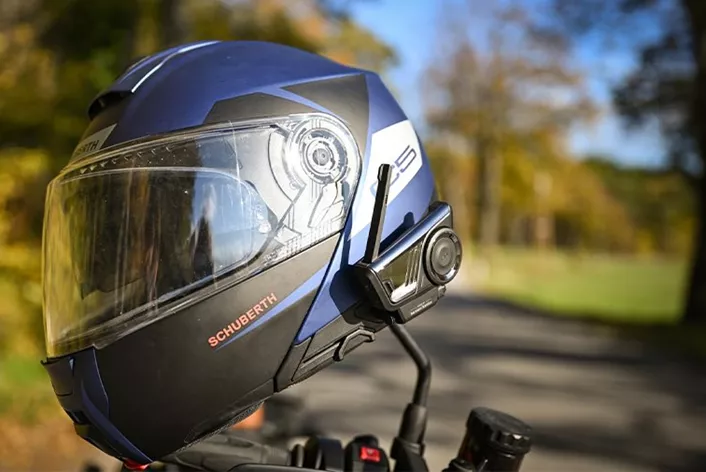
Conclusion: Sena 60S communication system put to the test
With its Harman Kardon speakers, the 60S delivers around 30 percent more volume than its predecessor and reproduces even metal cleanly. Two mounts included in the scope of delivery and the magnetic quick-locking mechanism make switching between helmets lightning-fast, and the housing is waterproof to IPX7. Operation via the dial wheel works even with thick gloves, while deeper settings run through the app. The voice transmission over Mesh weighs heavily against it: from around 80 km/h, the non-disable AI algorithm increasingly filters out the voice as well, and from around 130 km/h, sometimes only a robotic crackle comes through. The AI voice control responds unreliably. Improvement is possible via updates. Highly recommendable for solo riders who listen to music and make calls, but currently only limitedly recommendable for group riding above 80 km/h.
SENA 60S Test of the new communication system for motorcycle helmets Images
Source: 1000PS


