Back in 2022 we were fitted with the Mitas E-09 at the Seeker Raid Hobby Rally. The tire impressed on the asphalt as well as on the stony pistes and rough tracks of the Bosnian mountains. The E-09 has since been replaced by the Enduro Trail XT+, which at the rear uses the E-09 tread design with its rugged shovel-block pattern, but up front is modeled on the former E-13 tire with smaller, tall knobs. This combination, E-09 at the rear and E-13 up front, was used by many off-road pros, including NastyNils during his Bosnia Rally entries, and now the combo is essentially available as standard with the XT+. According to Mitas, the tire is designed for 80% off-road and 20% road use, but what does that mean in practice? Unlike the very stony, sharp terrain of the Balkans, this time the Enduro Trail XT+ has to prove itself in a different extreme: mud. On our trip through Slovenia it rains daily, turning forest tracks into a mud battle. Can the Mitas get our fully loaded bikes through here?
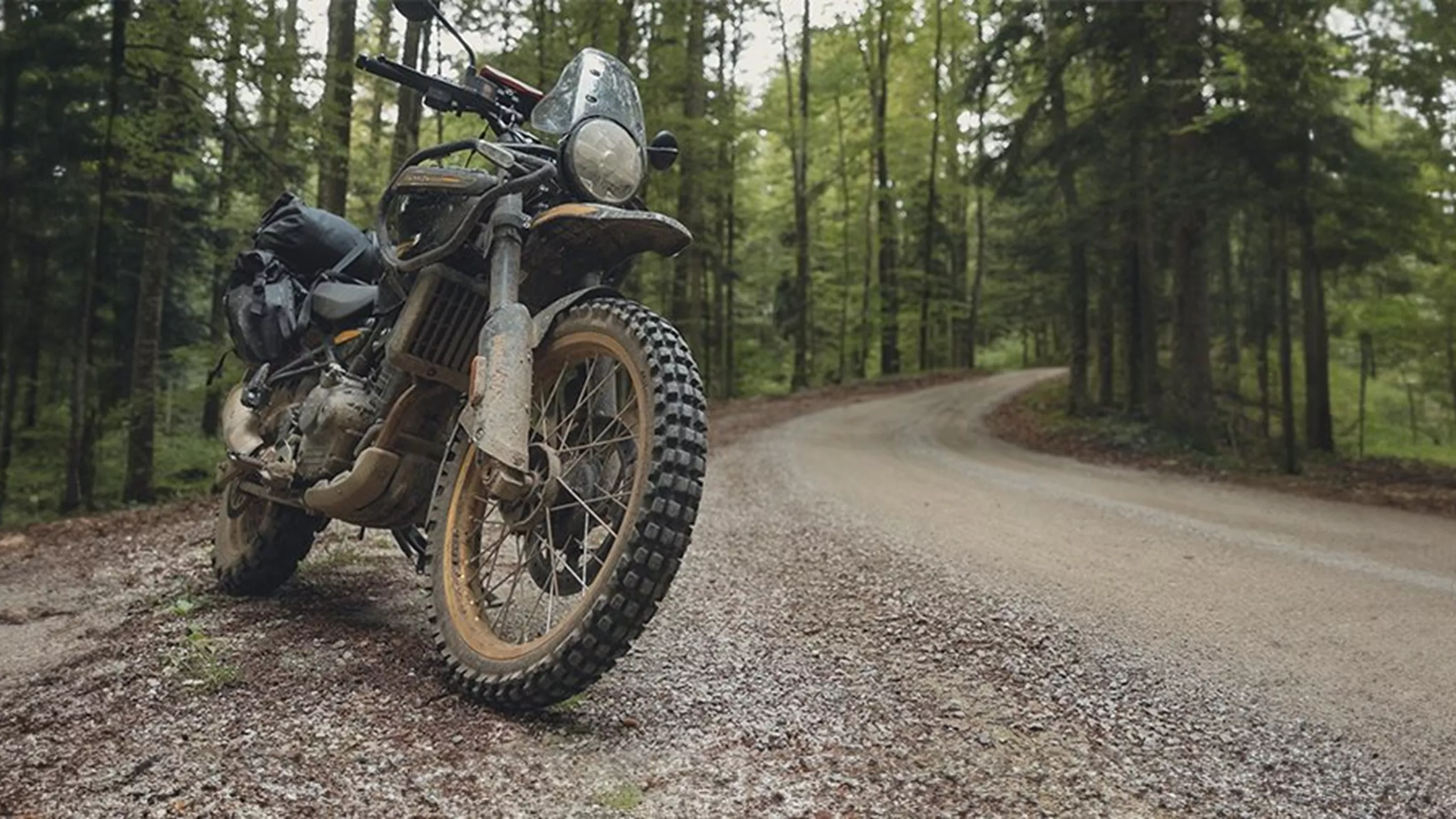
Mitas Enduro Trail XT+ Dakar off-road tire in the big 2024 test
Highway, country road, gravel & mud - the XT+ under the microscope
With bikes, people search for the unicorn: an enduro bike suited for both the big trip and rough terrain. Even though we're still searching for this legendary bike, Mitas may already have found the matching tire for it. We tested the Enduro Trail XT+ over 1,300 on- and off-road kilometers.
&width=72&height=72&bgcolor=rgba_39_42_44_0&mode=crop "Author: Gregor")
Gregor
published on 6/12/2024
Mitas Enduro Trail XT+ Dakar off-road tire: The features
Thanks to its shovel-block tread, the Enduro Trail XT+ tire is said to be suited to both hard and soft, muddy terrain. Just like on the E-09, the flat profile of the rear tire has an average knob depth of 13.2 mm. The front tire, in turn, features the same tread as the E-13, offers a knob depth of 12 mm, and is also compatible with other Enduro Trail tires from Mitas. The knobs, arranged longitudinally and angled forward, are aggressive enough to tackle harder trails, yet are still said to work well on highway stretches and asphalt. The Enduro Trail XT+ is in fact explicitly recommended for adventure bikes and is meant to master this balancing act between off-road and on-road. In the Dakar version, the heavy-duty rubber compound additionally improves durability and increases the tire life of the standard XT+ by up to 20%. A harder carcass also provides increased puncture resistance and stability under heavy loads. Puncture resistance and greater tire life were ultimately also the arguments for why we took the Enduro Trail XT+ Dakar for our tour. The planned mileage wasn't the issue, but my colleague Schaaf and I hate nothing more than having to change tires somewhere in the dirt with our delicate cameraman/journalist hands. Let's see if our plan works out.
Mitas Enduro Trail XT+ Dakar test on asphalt - highway and country road
The stated 20% road suitability doesn't do the Enduro Trail XT+ justice. In reality, the tire can do considerably more than you'd credit it with at first glance. At full, road-typical air pressure - in the case of the Triumph Tiger 900 Rally Pro, about 2.5 bar front and 2.8 bar rear - the XT+ is still a bit tippy and nervous. But as soon as you drop the front pressure slightly to 2 bar or just above, the turn-in becomes more harmonious and linear. A surprising amount is then possible on asphalt too. Sure, the knobs give noticeably at lean angle, but they still hold grip on dry asphalt for quite a while. Above all, thanks to the wide, clearly perceptible limit range, you move through the twisties with confidence. Unfortunately, we weren't granted too many kilometers of dry corners on our tour. In the wet, it takes more feel and caution.
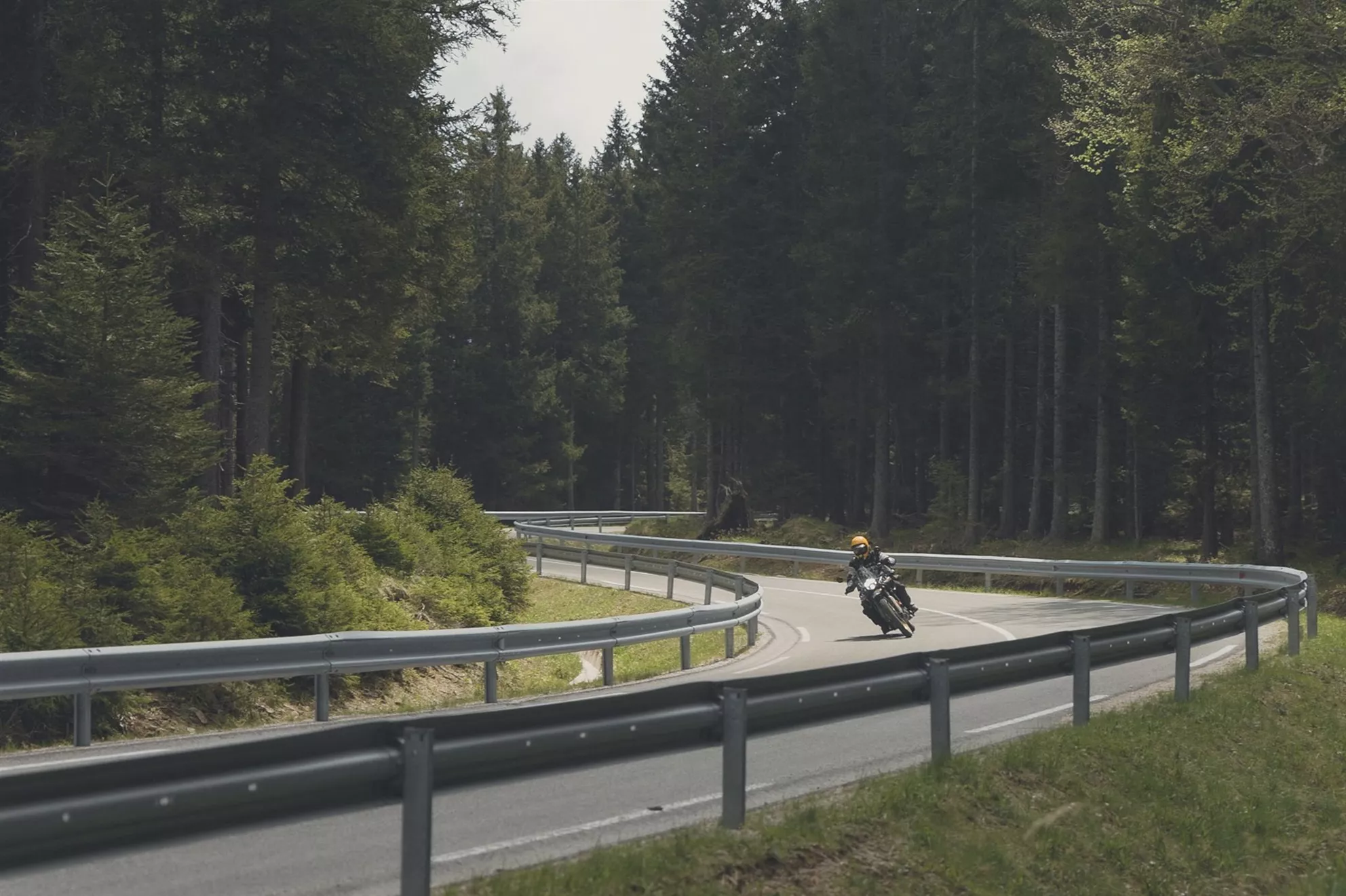
Despite its very knobby look, the Mitas Enduro Trail XT+ is also fun on asphalt. Only its tendency to follow ruts takes some getting used to.
Most of the asphalt kilometers were racked up by our tires on the Tiger 900 and the Royal Enfield Himalayan, but on the highway. Anyone who thinks the delicate knobs must get worn down over hundreds of kilometers at 120-130 km/h can rest easy. Even after the stretch from Vienna to Ljubljana, nearly 400 km at a constant pace of 120-130 km/h, the tire barely shows the strain and still has more than enough tread for further off-road adventures. What you do have to get used to, both on country roads and on the highway, however, is the front wheel's tendency to follow every rut, milling edge, and other longitudinally aligned unevenness. This can sometimes lead to a bit of unrest in the bike, for example when changing lanes, though at least with our machines not to any concerning degree. The bike doesn't wobble at all, but does briefly get a left-right movement in such moments, which subsides after a second.
Mitas Enduro Trail XT+ Dakar test on gravel roads - Drift King
Our tour across Slovenia was largely plotted by ourselves, without knowing the routes in advance. The track simply follows the smallest paths, staying away from towns and civilization. Accordingly, we spent a lot of time in the wooded hill country and low mountain range of the thinly populated eastern Slovenia. All the larger tracks here are gravel, of varying quality. But you rarely find the really rough, material-destroying gravel like in Bosnia. Instead, it's mostly fine, graded gravel roads, sometimes very even, sometimes spiced up with solid stones or earthy ground.
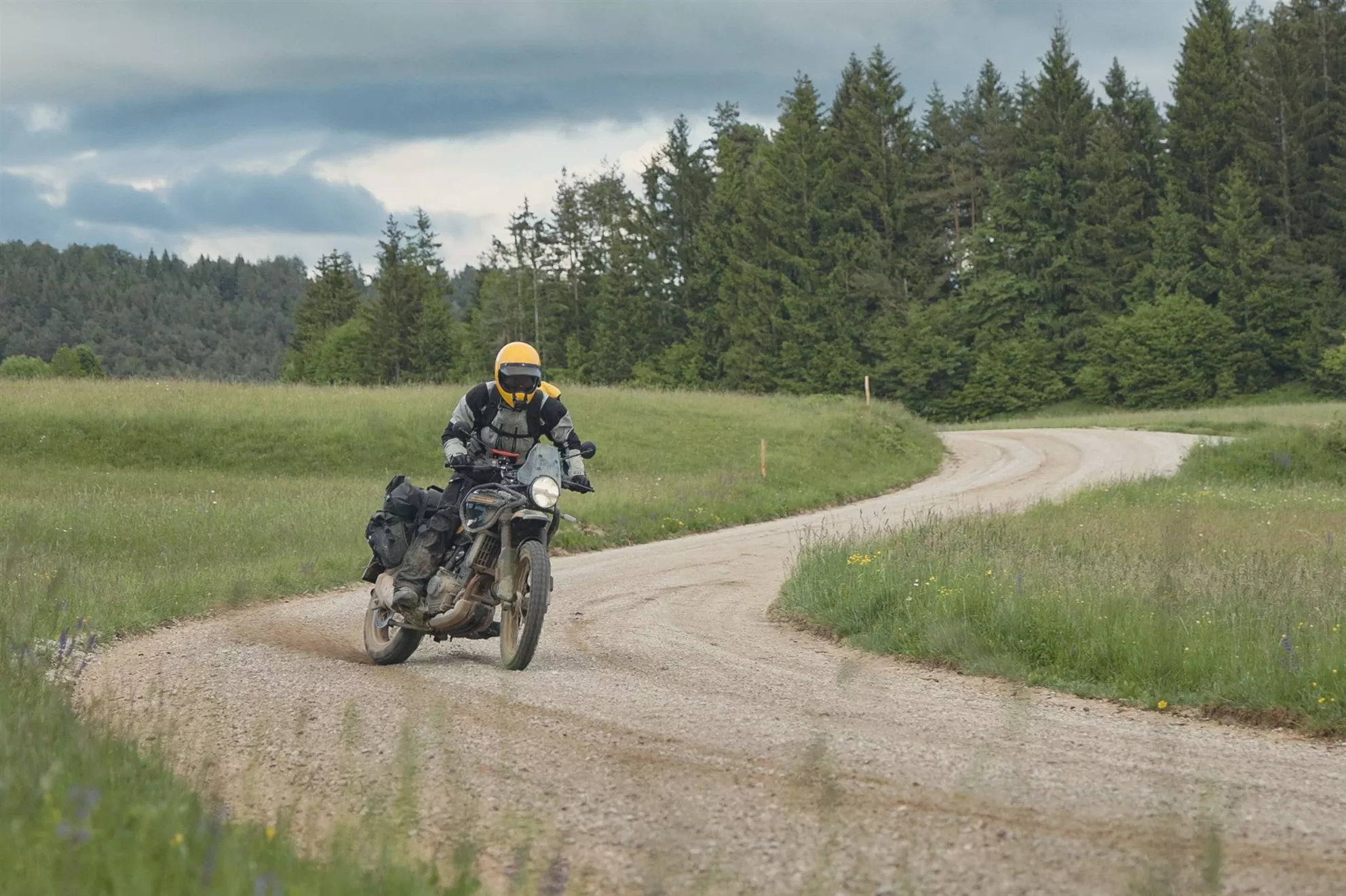
For drift kings and the sensible alike - the Mitas Enduro Trail XT+ transparently allows playing with traction.
Bad weather is relatively irrelevant on these surfaces. If anything, the gravel piste gets even grippier. Combined with the forward-angled knobs on the front wheel and further reduced air pressure, you can throw yourself into the gravel corners with great enthusiasm. The lateral grip of the XT+ front is genuinely decent, its slightly rounder shape compared to hard enduro tires stays predictable and doesn't tend to suddenly fold. At the rear, meanwhile, you can play very finely with traction. Weight on the outer footpeg and the XT+ tire offers nice forward drive even on loose ground. Weight on the inner footpeg and it goes sideways. At least on the finely graded gravel tracks. On tracks with firmer, grippier ground, the Mitas tire has almost too much grip, and the drift has to be initiated with real emphasis to break traction. That's ultimately a luxury problem though, and the Enduro Trail XT+'s gravel performance overall is commendable.
Mitas Enduro Trail XT+ Dakar test in mud - the final boss
That the Mitas tire works well on gravel didn't surprise us much after having lived through the Seeker Raid with its predecessor, the E-09. The most exciting challenge for us and the tire was clear from the start: muddy ascents and descents. Not only is the TET Slovenia known for becoming demanding in wet weather, but there are also numerous forest and woodland tracks along our route regardless. These are often not steep or demanding at all. But due to the heavy rain of the preceding days and weeks, the ground is so saturated with water that even flat stretches become a sweat-inducing obstacle. In the mud, it's important to keep your momentum, since it's almost impossible to get going again from a standstill. To still get the maximum out of the available traction, the tire should stay clear as long as possible, i.e. it needs the ability to self-clean, meaning mud gets flung out of the tread. Whether and when the tire clogs up depends not only on the tire itself, but also strongly on the terrain and the speed being ridden.
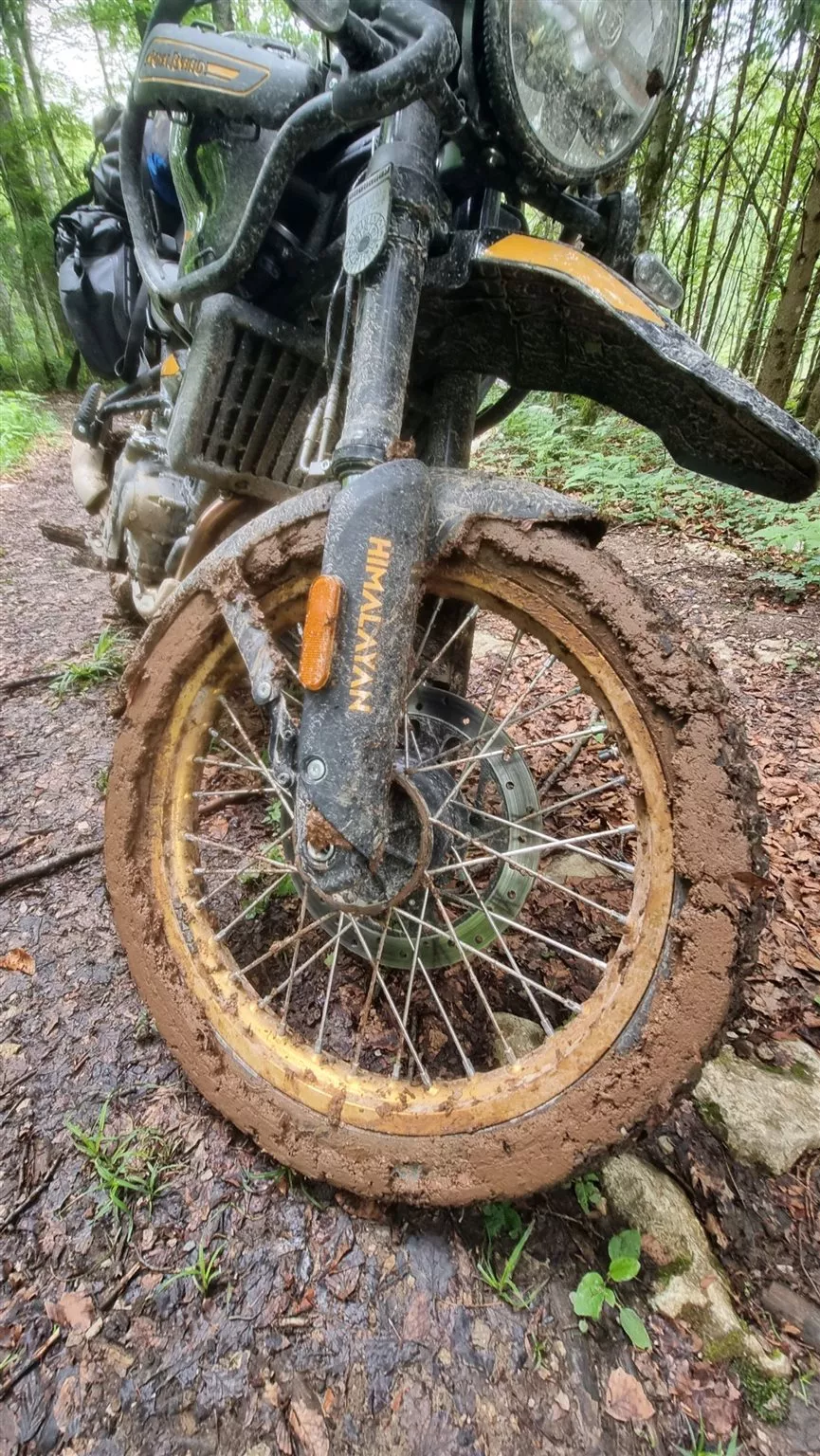
Eventually you hit a wall. On this clayey, waterlogged ground, we would have struggled even with hard enduro tires. Even the deep knobs of the XT+ clog up here.
For an adventure-bike-capable tire, an awful lot is possible with the Enduro Trail XT+. Even in slippery situations you can still find traction and maintain forward drive with a gentle throttle hand. But once it gets deeper and stickier, it reaches its limits. It admittedly takes considerably longer than with most other "compromise tires" for mixed use, but ultimately even with the Enduro Trail XT+ the knobs are still too close together to clear thick mud. Especially on clay-like ground interspersed with wet, slippery stones, the fun stops for us and we have to turn back. Given our average off-road riding skill and the fairly heavy machines, though, any tire would have had a hard time under these circumstances.
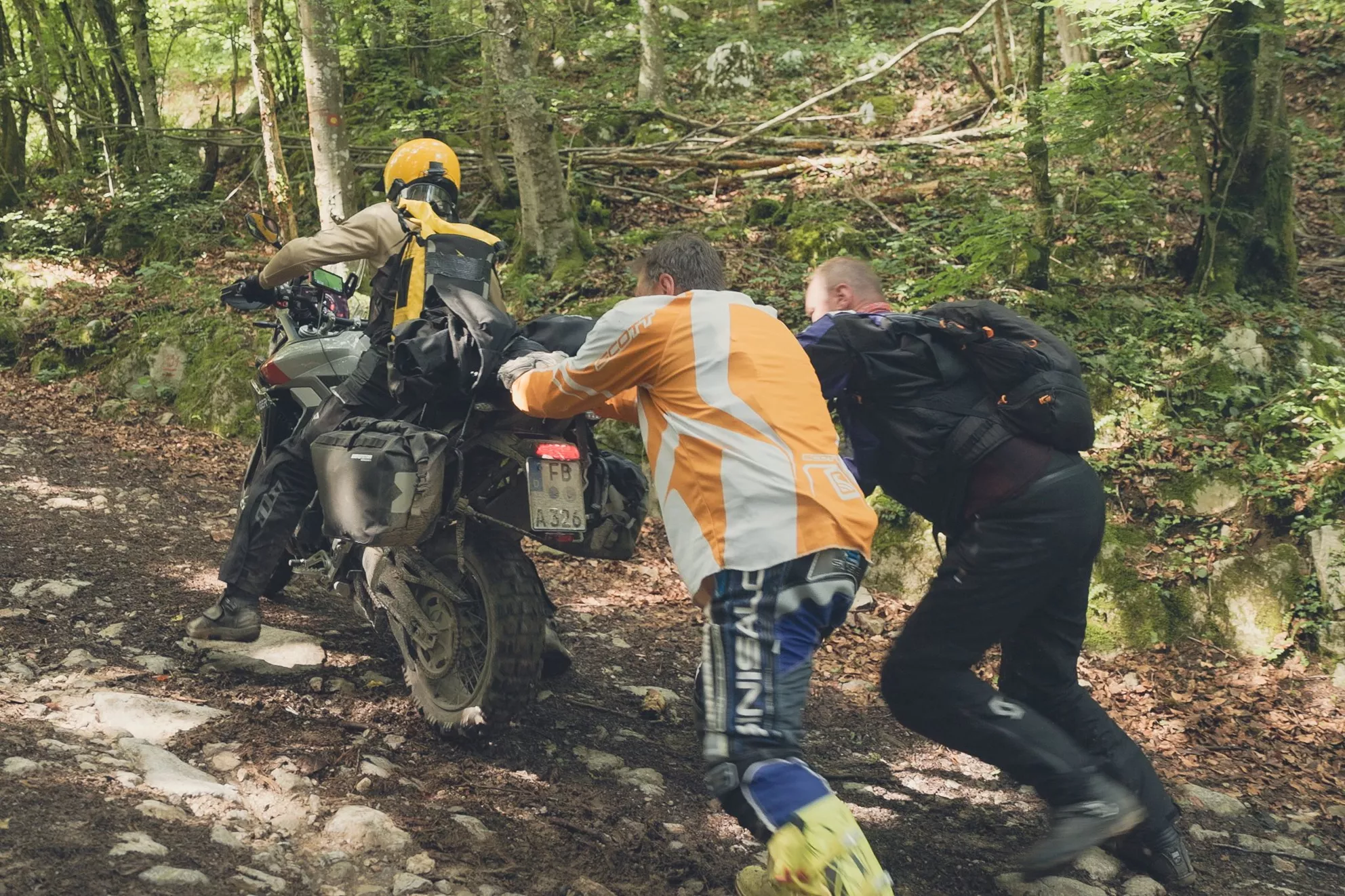
The Mitas XT+ does find a lot of traction, but once the momentum is lost, pushing on the slippery forest floor quickly becomes the order of the day.
Mitas Enduro Trail XT+ Dakar tire life - what's left in the end
In total we rack up 1,300 km on our trip, of which about 500 km highway, 300 km country road, and 500 km on unpaved tracks. After all these kilometers, the tire's condition is actually still very good and suitable for at least one more tour, if not several. I can't state the absolute tire life, especially since it strongly depends on the vehicle and the route ridden. In some relevant forums there's talk of tire lives of 2,000 km, though there's no real long-term experience yet with the new Enduro Trail XT+. Besides, that figure seems awfully low to me. My assessment after these first 1,300 km is that you'd only wear the tire down that fast with a high asphalt share, a powerful bike, and a motivated throttle hand. For rides with a bit more restraint on the wrist and also some kilometers ridden on soft forest or field tracks, I'd consider a tire life of 4,000 km or even more realistic. Below, the tire's appearance after just under 1,500 kilometers ridden for comparison.
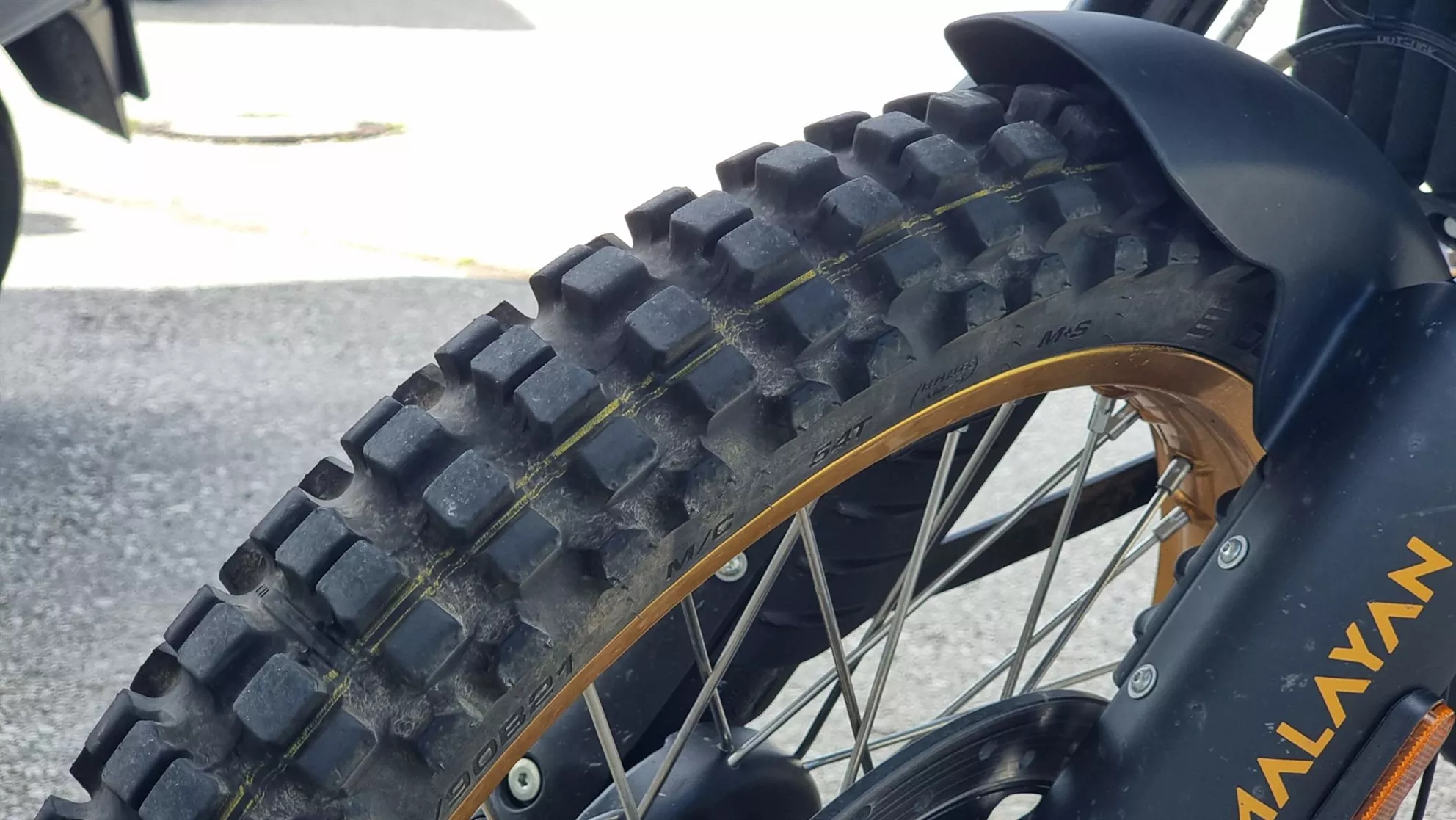
After about 1,500 km of mixed use, the Mitas Enduro Trail XT+ Dakar still looks pretty fresh at the front.
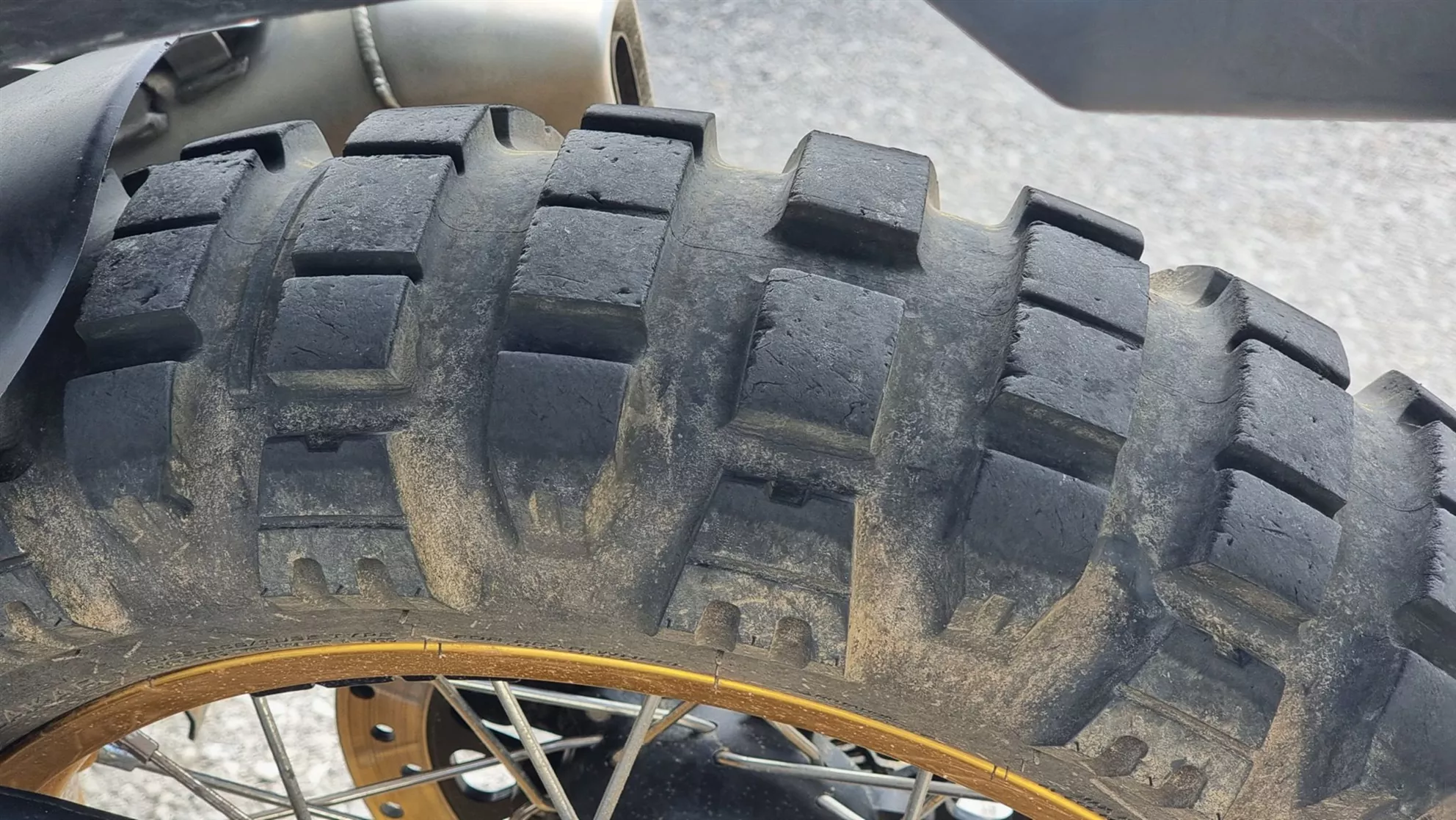
The rear tire of the XT+ Dakar also still has plenty of tours left in it.
Mitas Enduro Trail XT+ Dakar - tubeless or tube tire?
The Triumph Tiger 900 Rally Pro used the Mitas Enduro Trail XT+ tire on its tubeless rims on our trip. The Royal Enfield Himalayan, on the other hand, relies on classic tube tires. In the case of the Tiger, we set the tire pressure for the muddy stretches to 1.6 bar front and 2.0 bar rear. The Himalayan was ridden at 1.5 bar front and 1.8 bar rear. In principle I prefer tube tires, since they still allow you to help yourself in the wilderness in the event of a bent rim or a slashed tire. With tire damage from sharp objects, the tubeless tire is admittedly easier to patch, but in an emergency you still have to make do by fitting a tube, which isn't so easily possible on every tubeless rim. Given the soft conditions, there wasn't much risk of major tire damage on our tour, but if you want to blast across brutal stony pistes at high speed, say in Bosnia, the XT+ Dakar is well suited thanks to its hard carcass and heavy-duty rubber compound. The downside of this is that the hard tire is very difficult to lever off the rim by hand. Even on the related E-09, many a hobby mechanic has broken a sweat trying to change the tire by hand. Our tip: continue riding carefully a bit further with a flat tire to bring the rubber up to temperature through the flexing motion, then get the warm, and thus softer, tire off the rim as quickly as possible. That can help somewhat, but the XT+ still remains pretty much guaranteed to be a challenge for a roadside pit stop.
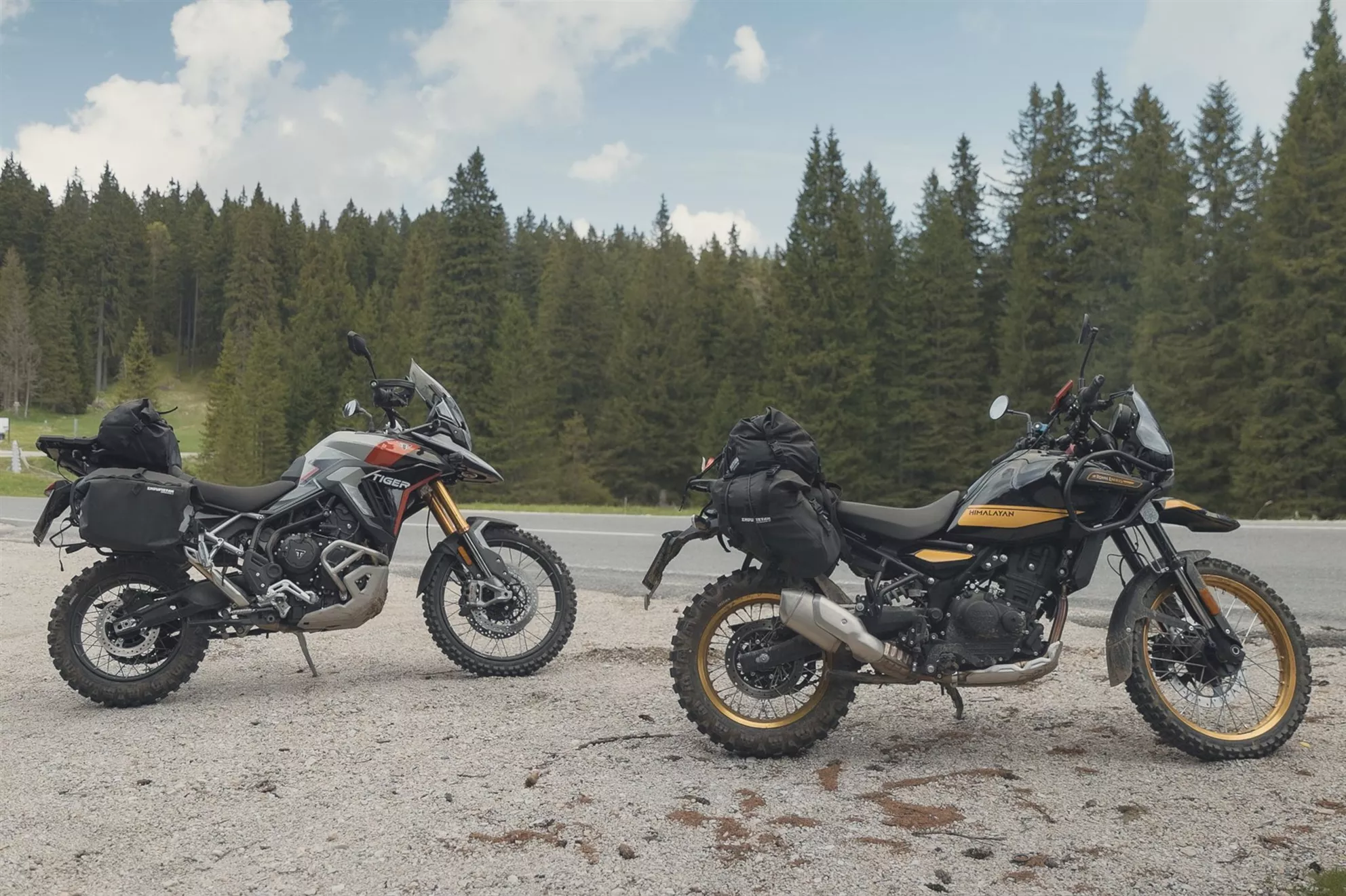
Once with a tube, once tubeless - the Mitas Enduro Trail XT+ works well in both cases, even without a tire holder and with low air pressure.
Mitas Enduro Trail XT+ off-road tire compared to the competition
The adventure bike segment keeps growing, and so does the number of tires for mixed use. For anyone currently looking for the right tire for their on-/off-road tour, I'll venture a quick comparison with competing tires that were considered ahead of the trip. Popular 50/50 tires, such as the Metzeler Karoo 4, Heidenau K60 Ranger, or Dunlop Trailmax Raid, were considered by me since they work excellently on the road and offer decent off-road performance. But due to the shallower tread depth and larger, more closely spaced tread blocks, a problem in muddy terrain was foreseeable. Also in the running was the classic among adventure bike tires, the Conti TKC 80. But due to its age it's a bit slippery in the wet, and above all the big knobs on the front were too wide and flat for me for muck and soft earth. Also under consideration was the Michelin Anakee Wild, NastyNils' favorite 50-50 off-road tire, which, however, doesn't roll as smoothly on paved roads. Ultimately though, the deep tread of the Mitas tire, and the resulting minimal nervousness when looking at the weather forecast, were decisive.
Verdict on the Mitas Enduro Trail XT+ Dakar off-road tire
The Mitas Enduro Trail XT+ is a great tire for anyone for whom the off-road performance of typical 50-50 tires is no longer enough. With it, you can confidently ride over light to rough gravel, forest roads, and field tracks, only reaching its limit with sticky mud. At the same time, longer stretches on the highway are no problem, and in the dry you can cruise through the paved twisties at a decent pace. As is typical with knobby tires, it takes some getting used to the knobs' own movement, and caution is needed in the wet. Anyone planning to tackle big tours should opt for the Dakar version of the XT+ tire due to its higher tire life, heavier load capacity, and to prevent possible punctures.
Does the Mitas Enduro Trail XT+ off-road tire sound interesting to you? You can find more information on the features and available dimensions of the Enduro Trail XT+ on the Mitas website.
Conclusion: Mitas Enduro Trail XT+ Dakar tested
The Enduro Trail XT+ Dakar can handle considerably more asphalt than the stated 20 percent road suitability would suggest. At full road pressure it still turns in tippy and nervous, but as soon as we drop the front to around 2 bar, the turn-in becomes harmonious and linear. On dry asphalt the grip holds for a long time, and the wide, perceptible limit range makes the twisties feel confidence-inspiring. Even after 400 highway kilometers at a constant 120 to 130 km/h, the tread barely shows the strain. On gravel the XT+ plays to its strengths: predictable lateral grip up front, finely dosable traction at the rear, and on firmer ground it has almost too much grip for controlled drifts. In the wet it needs more feel, and in deep, sticky mud the knobs are ultimately too close together to fling themselves free. After 1,300 kilometers, the tire is still good for at least one more tour. For adventure bike riders who prioritize puncture resistance and tire life over the last bit of mud capability, a strong choice, since the Dakar compound noticeably extends durability.
Mitas Enduro Trail XT+ Dakar off-road tire in the big 2024 test Images
Source: 1000PS


