Interview: Valentin Pokorny (Poky), 1000PS.
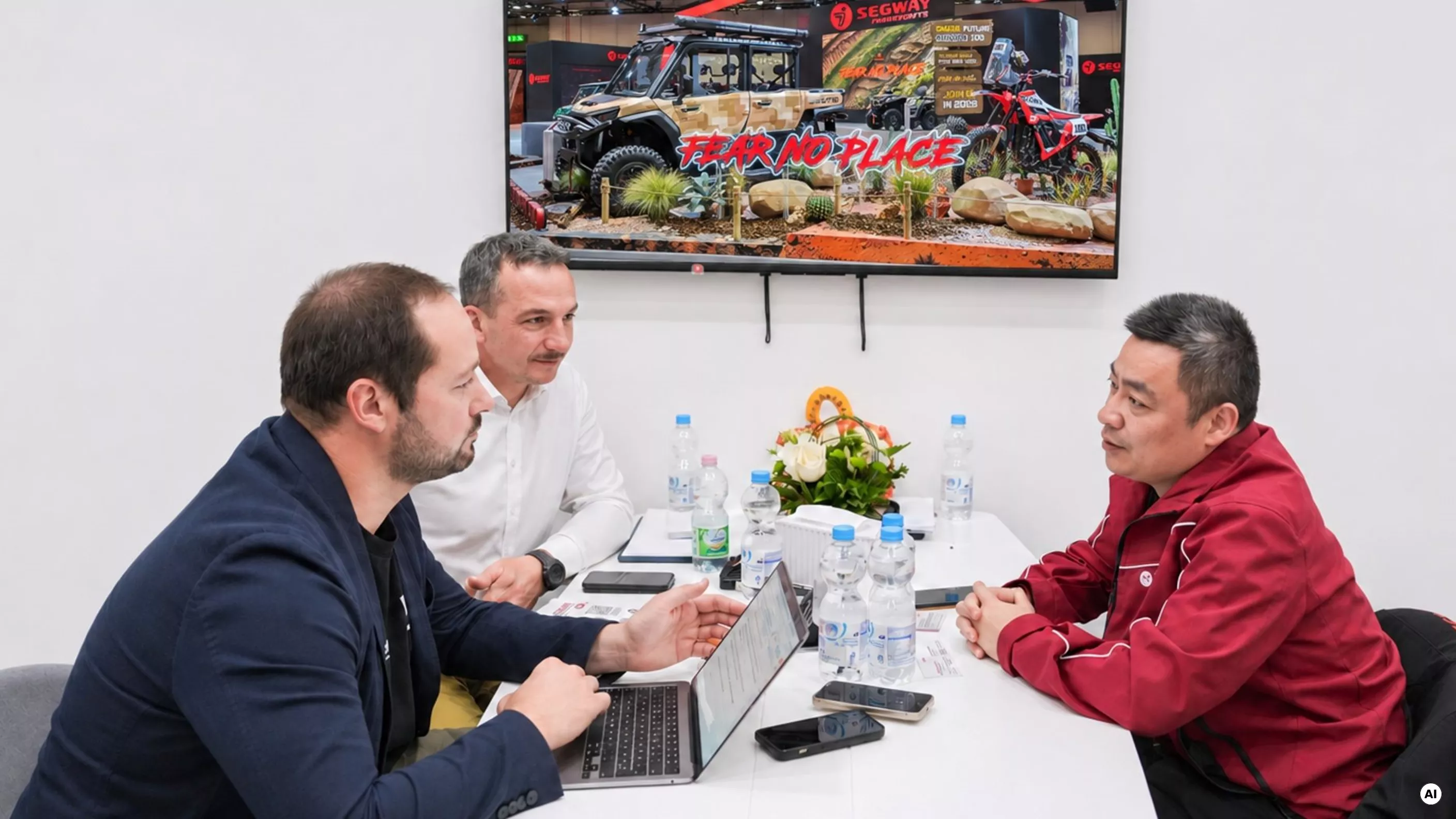
Segway wants to win over Europe with more than just price
Ethan Zhang on technology, offline maps and dealer expansion
Innovation rather than pure price competition: at EICMA 2026, Ethan Zhang explains to Poky how Segway Powersports plans to grow in Europe. The conversation covers offline navigation, more than 130 dealers in the DACH region and the goal of responding to service requests within 24 hours.

Poky
published on 27/11/2026
1,312 Views
Poky, Editor-in-Chief 1000PS: Ethan, thank you very much for the invitation. Segway is showing yet another generation of ATVs and UTVs at EICMA. What should Segway Powersports stand for in Europe by 2030? An alternative for price-conscious buyers or a direct competitor to established powersports brands?
Ethan Zhang, President of Sales and Marketing at Segway Powersports: At EICMA 2026 we held a major presentation for the 2027 model year. You're asking where Segway wants to be in 2030. That gives us a few years to further develop our position. Europe is currently our most important market in powersports. In the US, business is difficult because of the trade conflict with China and the high tariffs. Our powersports business is therefore focused particularly on Europe and South America, with Europe playing the most important role for us. We have achieved good results in several countries and are already among the top three brands in France and Turkey.
Over the past two years, more Chinese brands have come to Europe. European customers have become more open towards Chinese manufacturers and increasingly trust brands like Segway.
We don't want to be just another Chinese brand or compete on price alone. We have been selling products in Europe for seven years. Our brand research shows that customers associate Segway with innovation and technology. That is part of Segway-Ninebot's DNA. The group offers not only powersports vehicles but also scooters and other technology-oriented products.
We want to keep bringing new technologies to market. This year, for example, we introduced the second generation of our iFUN connectivity. Innovation and smart features are central to how we differentiate ourselves. In the long term, electrification could also play a growing role.
Poky: Let's stay with that connectivity system. Your vehicles are often used in remote areas with poor or no mobile reception at all. How useful is a connected system there, and which functions work without reception?
Zhang: The system offers several functions that go beyond the remote connection. One of them is entertainment: the rider can listen to music through it. Another covers safety-related functions. Then there's navigation. We have offline maps, so anyone heading into an area without reception can keep using offline navigation. We also want the system to work together with our smartphone app. We revamped the app this year. It lets users monitor the vehicle status and locate the vehicle remotely.
Poky: You're also showing a side-by-side built for racing. What have you learned from racing that can flow into series production?
Zhang: In the side-by-side segment, we currently have a 1,000 cc product and a 2,000 cc turbo product. We always want to offer our customers vehicles that are even more exciting and even more capable. Competition is part of powersports culture. In recent years we have organised the Villain Cup in several European countries, especially in Portugal. We want to build a stronger racing culture. Professional racing is a world of its own. We developed a special edition to bring more attention to racing. It isn't meant to remain purely a race vehicle. In future, we also want to offer a version for regular customers.
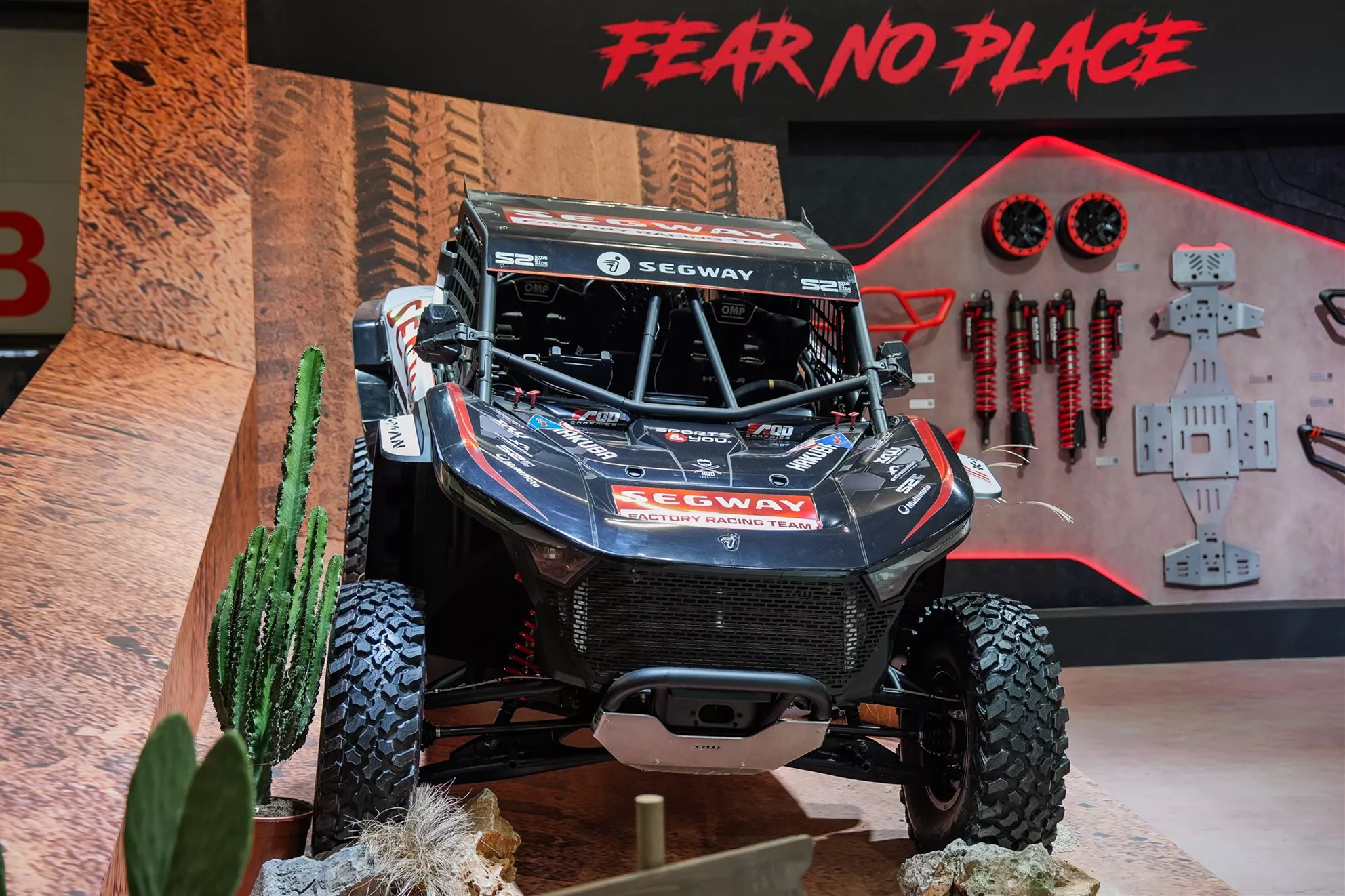
The Super Villain on display represents Segway's racing ambitions. Zhang announces plans to also offer the special edition developed for it to regular customers in future.
Poky: With ATVs and side-by-sides, service is at least as important as an attractive showroom. How many active powersports dealers and qualified workshops do you have in Germany and Austria? How is the network supposed to develop by the end of 2027?
Zhang: Germany is a very important market for us. We set up a warehouse in Hamburg, which has been operating since 2026. As products are sold, after-sales service becomes crucial. Customers expect reliability and durability, and spare parts supply can be a critical point. That's why we set up the warehouse: to stock spare parts and support our customers and dealers.
Our goal is to respond to service requests within 24 hours. We have also prepared training materials and certification programmes, drawing on technical resources from China, to support dealers and workshops in maintaining the vehicles. This year we launched an online AI service assistant that customers can use to search for solutions to technical problems.
Poky: How many dealers do you currently have in Germany?
Zhang: More than 130 in the DACH region, most of them in Germany. These businesses combine vehicle sales and workshop service.
Poky: Are you happy with that number of dealers, or do you want to expand the network?
Zhang: For now it's a workable number, but in the long run it's not enough. We want to keep expanding the German network. Germany is a significant market for Segway, and we want to improve our position there.
Poky: What growth do you expect for ATVs compared to side-by-sides? How is the portfolio supposed to develop?
Zhang: In ATVs we currently have four models, including the AT5, AT6 Pro, AT10 and AT10 W Mud. We are developing further ATV models. We believe the segment still has growth potential and are working on the next products. We are also planning a second generation of the existing side-by-side range for 2028. We want to present a complete series of second-generation models. We have already shown the four-seat UT10 Crew Pro, and we want to bring this version to market.
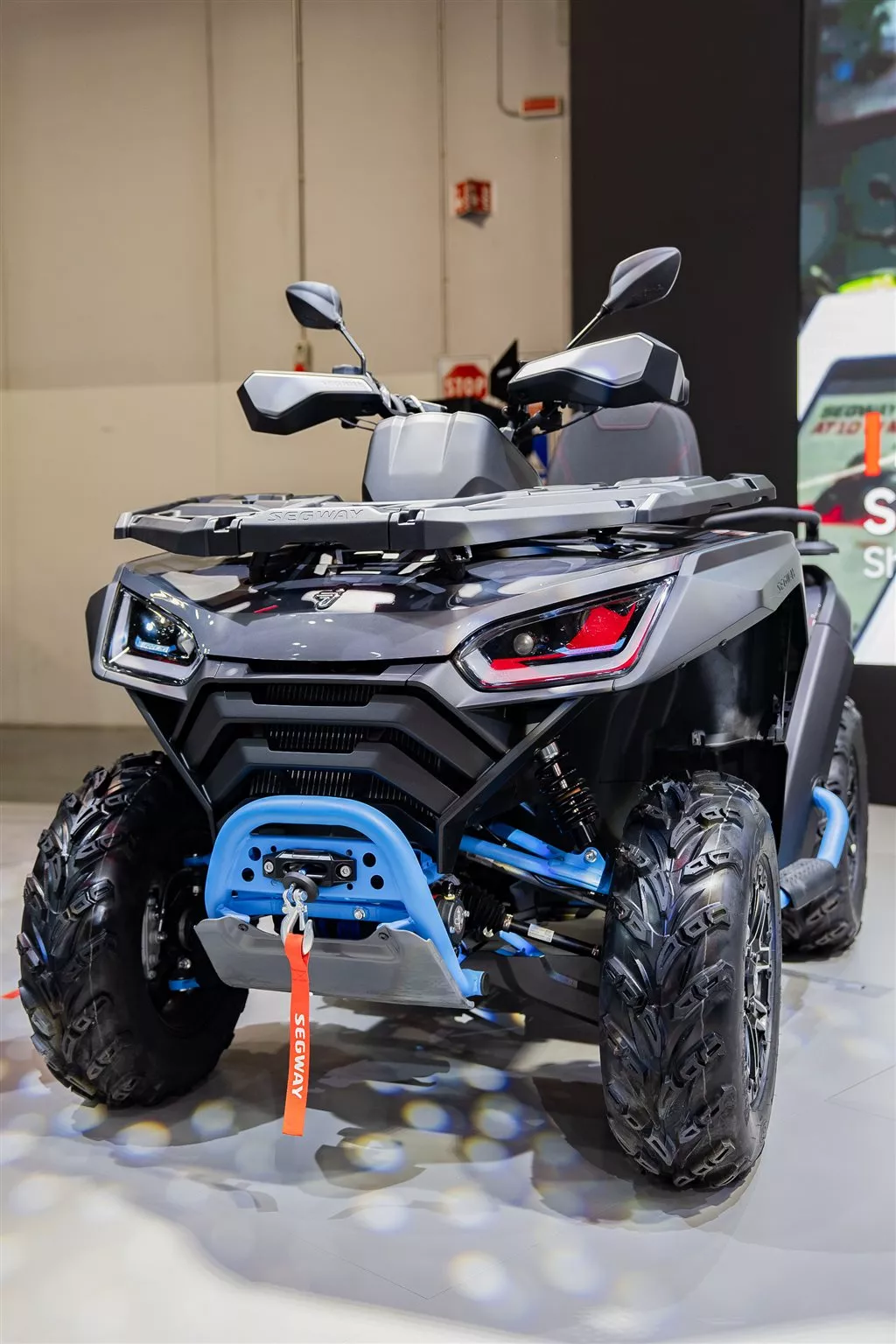
Segway sees further growth potential in ATVs and is working on additional models. A second generation of the existing side-by-side range is planned from 2028.
Poky: Let's turn to your new flagship UTV with two rows of seats and a weatherproof cab. Who is the target group? In Austria, for example, vehicles like this are often used by forest owners or hunters.
Zhang: You mean our UT10 Crew Pro with the enclosed, air-conditioned cab.
We see two key customer groups. The first are people who use the vehicle for practical work, such as farmers. The second are people who want to get outdoors and enjoy the vehicle with family and friends. Compared to an ATV, a UTV can carry several people. The model with the enclosed cab is meant to make such outings more comfortable, even with kids on board.
We paid particular attention to comfort in the cab. It is fully enclosed, which helps reduce unwanted air ingress. We redesigned the seats, including their shape and angle, to deliver a seating feel closer to that of an SUV. We also revised the dashboard and added comfort and entertainment features, including four speakers. We believe these changes make the vehicle more attractive to customers looking for both practical utility and leisure enjoyment.
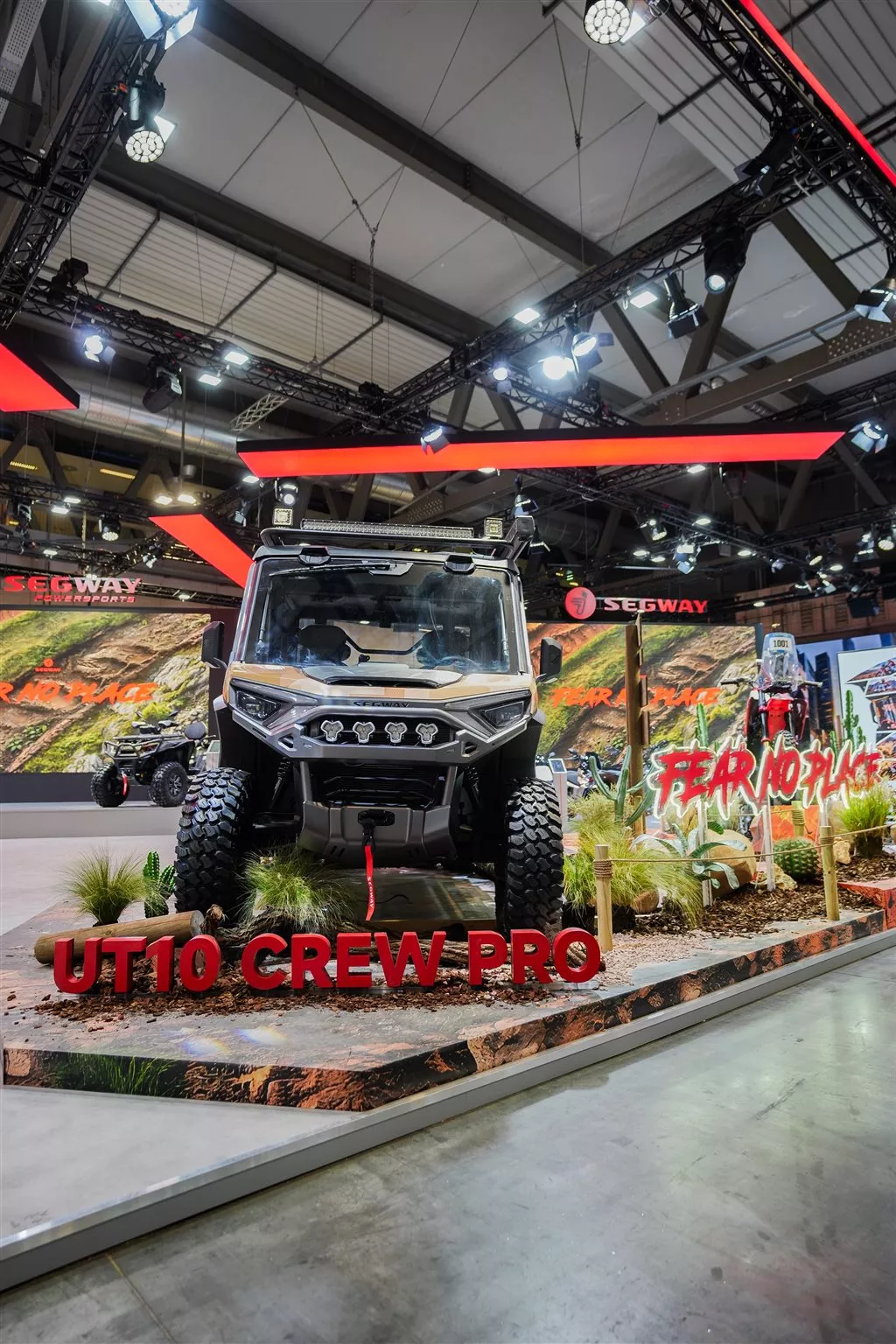
The UT10 Crew Pro with its enclosed, air-conditioned cab is designed to combine work and leisure. Zhang names farmers as a target group just as much as families and friends.
Poky: Do you offer all your ATVs and UTVs in road-legal versions, or are some models intended exclusively for off-road use?
Zhang: Most of these vehicles are primarily intended for off-road use. However, road homologation is also part of our development planning. In Germany we offer vehicles that can be registered for public roads if they meet the applicable homologation requirements, including ABS where it is mandatory. We already take road-use requirements into account in research and development, rather than developing solely for off-road use.
Poky: Thank you very much.