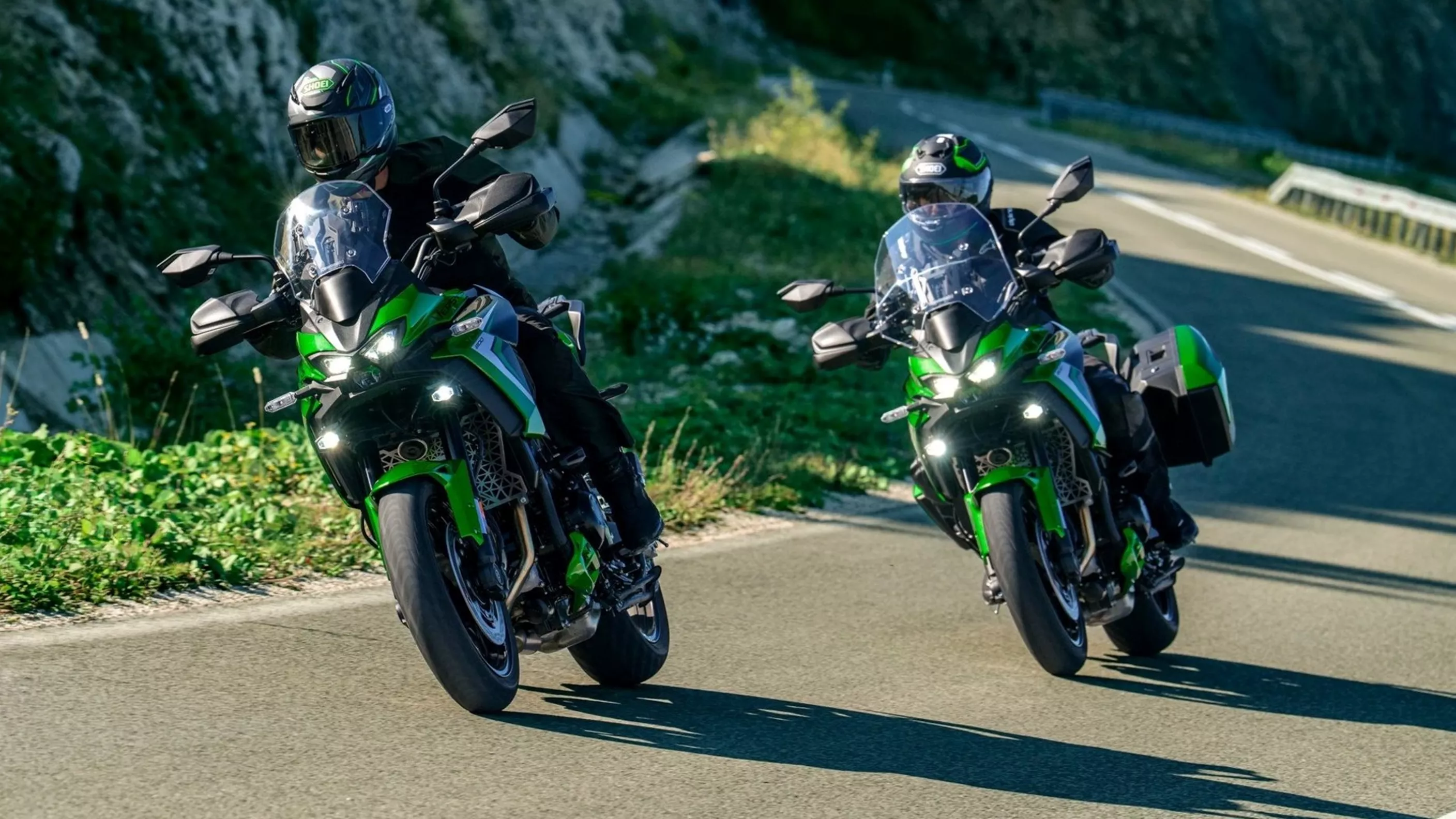
What happens when Kawasaki doesn't just spice up the Versys concept with more power, but ties it closely to the inline four of the Z900? The Kawasaki Versys 900 2027 is the answer. It combines a sportily tuned 948 cc four-cylinder with long-travel suspension, upright ergonomics and a luggage system for three cases. On top of that, radar-based rider assistance systems make their debut in the Versys family. The familiar touring crossover idea thus becomes a considerably sportier road bike. The Kawasaki Versys 900 SE 2027 adds a range of comfort and protection parts to the same technical basis.
Kawasaki Versys 900 and SE 2027: tech overview
The Z900 four-cylinder gets a touring chassis
Kawasaki combines the 948 cc inline four of the Z family with a new touring chassis, radar assistance and a 20-litre tank. The Versys 900 and Versys 900 SE aim to strike the balance between touring excellence and agile riding dynamics.
&width=72&height=72&bgcolor=rgba_39_42_44_0&mode=crop "Author: Gregor")
Gregor
published on 13/10/2026
5,785 Views
Kawasaki Versys 900 2027 with 122 hp
The liquid-cooled inline four displaces 948 cc, has four valves per cylinder and a bore and stroke of 73.4 and 56 millimetres. Kawasaki quotes 122 hp at 9,500 rpm and peak torque of 97.3 Nm at 8,000 rpm. These figures are very close to the Z900, but the Versys gets intake, exhaust and transmission tuning tailored to its broader range of use. Long, narrow intake funnels are meant to boost torque in the low and mid-range. Above 6,000 rpm, Kawasaki promises a more direct, linearly rising power delivery.
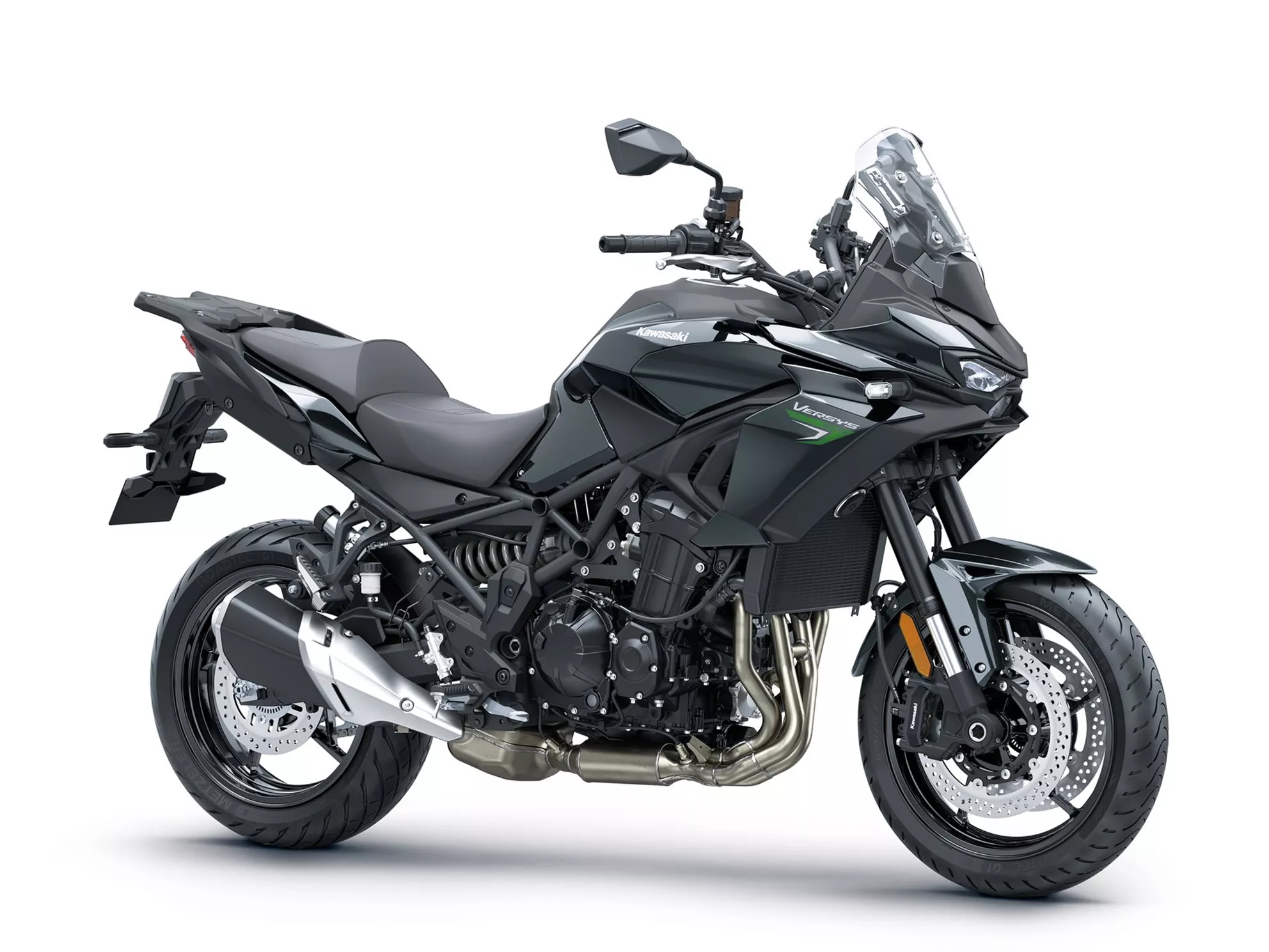
The Kawasaki Versys 900 combines the 948 cc four-cylinder with upright ergonomics and 17-inch wheels.
The final drive ratio has also been revised. The Versys 900 runs a 42/15 ratio, while the Z900 uses 44/15. This should let the Versys run at lower revs at cruising speed and cover a wider speed range per gear. Whether the four-cylinder really manages to be both a smooth touring engine and a revvy corner-carving engine at the same time can only be judged on a test ride.

The popular inline four from the Z900 is set to deliver riding pleasure in crossover trim as well.
The exhaust system follows a 4-into-1 layout with a pre-silencer and a compact end silencer. Differently connected header pairs are designed to support torque in the low and mid-range. According to Kawasaki, an assist and slipper clutch reduces lever effort and limits back-torque at the rear wheel during hard downshifts.
Kawasaki Versys 900 vs. Z900: technical comparison
It's no coincidence that the Versys 900 and Z900 share the same displacement. Bore, stroke, throttle body diameter and the basic engine architecture are identical. The Z900 2026 produces 124 hp at 9,500 rpm and 97.4 Nm at 7,700 rpm. With 122 hp, the Versys sits just below and reaches its almost identical peak torque 300 rpm later. That said, these small numerical differences alone tell you nothing about the engine's character. After all, the intake tracts, exhaust system, engine management and the longer final drive of the Versys all change how the power arrives at the rear wheel.
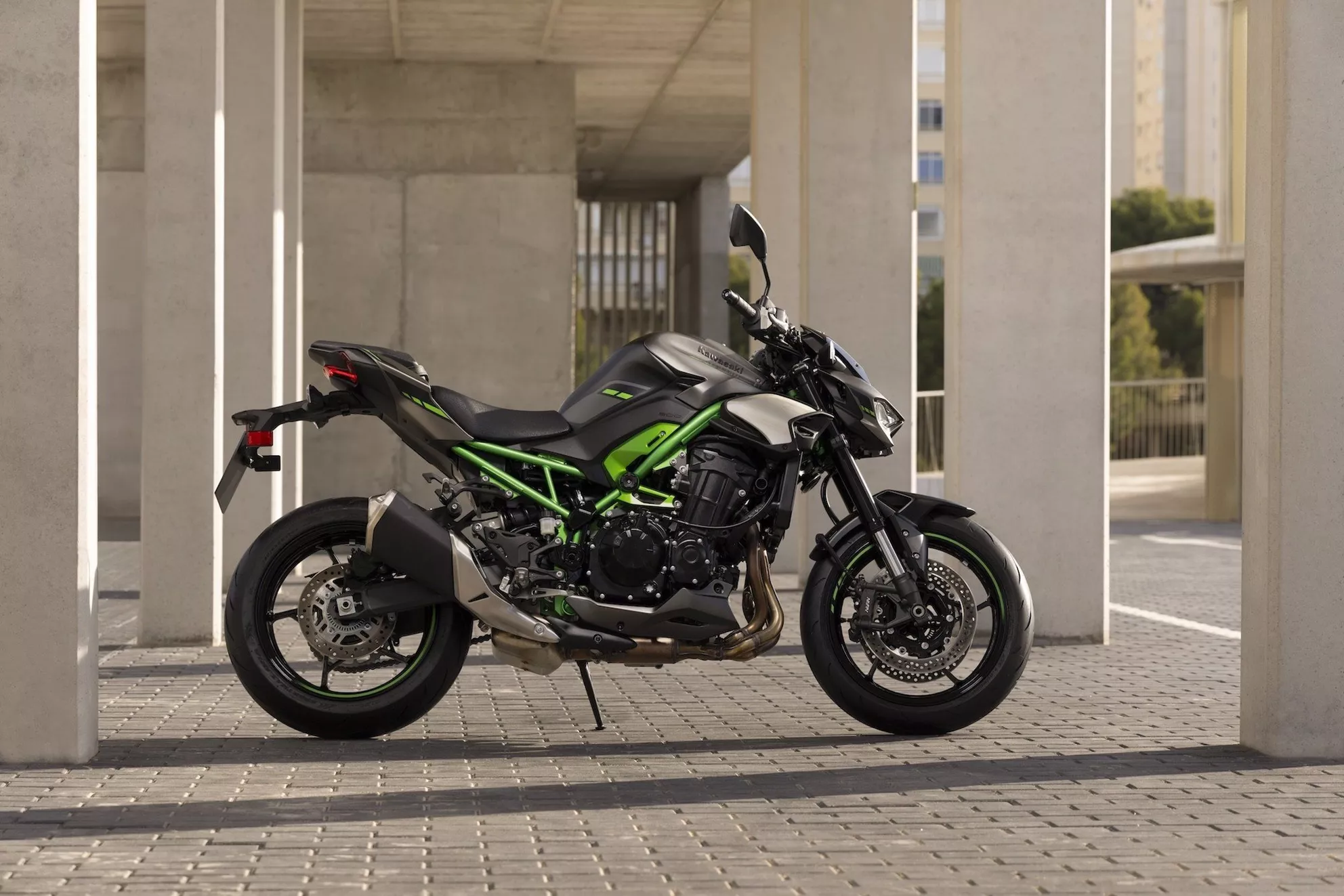
Engine-wise, the Kawasaki Z900 and Versys 900 are very close. But beyond the engine, the Versys 900 is packed to the brim with features.
The sisters part ways more clearly when it comes to the chassis. The Versys has a wheelbase of 1,550 millimetres, 100 millimetres more than the Z900. At the same time, its 43 mm fork and horizontal back-link shock offer longer travel at 150 and 159 millimetres respectively. The Z900 offers 120 and 140 millimetres. The Versys' 20-litre tank holds three litres more. Its seat height can be adjusted tool-free between 825 and 845 millimetres, while Kawasaki quotes 830 millimetres for the Z900.

The Kawasaki Versys 900 also puts a lot of emphasis on touring capability.
Despite the longer wheelbase, Kawasaki gives the Versys a 24.5-degree rake and 106 millimetres of trail. The Z900 has 24.7 degrees and 110 millimetres. So the Versys geometry should still allow for direct turn-in. Whether it feels as nimble as the much more compact Z900 remains to be seen. The wet weight of the Versys 900 has not yet been confirmed. But if the current Z900, with its 17-litre tank, no windscreen or generous fairing, no new electronics and overall smaller dimensions, tips the scales at 213 kg wet, the Versys will likely come in at an estimated 225 to 230 kg.
New chassis for the Kawasaki Versys 900 2027
Kawasaki has developed a new steel trellis frame for the Versys 900. The engine is rigidly bolted in at five points and acts as a stressed member. The heavy-duty subframe is designed to cope with a pillion and three cases. Kawasaki quotes a maximum payload of 220 kilograms.
The targeted weight distribution is roughly 50/50. Rider position, swingarm pivot and tank shape have been arranged so that the front wheel can be actively loaded. Up front, an adjustable 43 mm upside-down fork with 150 millimetres of travel does the work. At the rear, 159 millimetres are available. Spring preload and rebound are adjustable at both ends, and the shock's preload is conveniently adjusted via a remote hand adjuster.

The new steel trellis frame uses the inline four as a stressed member.
The Versys rolls on 17-inch cast wheels in Z900 style. Kawasaki fits Metzeler ROADTEC 01 tyres. Braking is handled up front by two 310 mm discs with radially mounted four-piston monobloc calipers, while a 260 mm disc with a single-piston caliper works at the rear. So, like its 650 and 1100 Versys sisters, it has been developed 100% for the road.
Kawasaki Versys 900 2027 with touring ergonomics
The upright seating position remains a key part of the Versys concept. A wide, rubber-mounted handlebar, rubber-topped footpegs and separate rider and pillion seats are meant to make long stages more comfortable. The rider's seat can be set to 825 or 845 millimetres without tools. An optional high seat adds another 20 millimetres. The front section of the seat and tank is kept slim to make it easier to reach the ground.
The windscreen can be adjusted in seven steps over a total of 48 millimetres. Kawasaki talks of more than 100 wind tunnel tests, but deliberately chose not to inflate the screen into a huge touring shield. If that's not enough for you, a screen that is 98 millimetres taller is available as an accessory.

The Versys 900 can be kitted out for longer trips with accessories.
For luggage, there is a system supplied by SHAD. According to Kawasaki, the 47-litre top case swallows two full-face helmets. The two side cases hold 32 litres each. Top case and side cases can be mounted at the same time. Damped mounts are designed to reduce vibrations and chassis movements, while the side cases, positioned close to the vehicle's centre of gravity, should affect handling as little as possible. All three cases can be operated with the ignition key.
Radar assistance on the Kawasaki Versys 900 2027
With the Versys 900, Kawasaki introduces radar-based rider assistance systems to this model family for the first time. A front radar sensor feeds Adaptive Cruise Control Lite and the Forward Collision Warning. A second sensor monitors the rear area for Blind Spot Detection. LEDs in the mirrors indicate vehicles in adjacent lanes. If the indicator is activated while a vehicle is detected, the corresponding warning light flashes too.

The mirror with blind spot warning on the Kawasaki Versys 900.
The word Lite in the adaptive cruise control is important. The system adjusts speed via the electronic throttle valves and maintains three selectable distances to the vehicle ahead. Unlike the more comprehensive solution on the Ninja H2 SX, however, it does not apply the brakes on its own. If stronger deceleration is needed, the rider has to brake. The Forward Collision Warning likewise only warns; it does not perform automatic emergency braking.

Front and rear radar provide the data for ACC Lite, collision warning and blind spot detection.
The Emergency Stop Signal rapidly flashes the indicators under hard braking to warn following traffic. Added to this are an IMU, cornering ABS, three levels of traction control plus an off option, and Kawasaki Cornering Management. The Versys 900 also offers Sport, Road, Rain and Rider riding modes as well as two power modes. In Low Power mode, output is limited to approximately 75 percent depending on revs and throttle position.
Quickshifter, TFT and Kawasaki Rideology
According to the manufacturer, the bidirectional Kawasaki Quick Shifter works from as low as 1,500 rpm. It enables clutchless upshifts and downshifts, which should reduce clutch work both on winding roads and when touring. Unusually, according to the presentation, the system also supports downshifts under acceleration and upshifts while decelerating.

The 5-inch TFT displays vehicle data and integrates the turn-by-turn navigation of the Rideology app.
The 5-inch TFT offers two layouts. Layout one puts the rev counter – and with it the sporty character of the four-cylinder – front and centre. Layout two makes more room for navigation, vehicle data and radar assistance alerts. Via RIDEOLOGY THE APP MOTORCYCLE, vehicle data, maintenance information, ride logs and settings can be accessed. Turn-by-turn navigation and voice control are provided for, but may require a valid licence and are not necessarily available to the same extent in every country.
For Europe, the technical presentation also lists 70 kW and 35 kW versions. These variants retain the three-level traction control including the off option. Power modes and integrated riding modes, however, are not provided. Which versions Kawasaki actually offers in individual markets still has to be confirmed by the respective country websites.
Kawasaki Versys 900 SE 2027 with extra features
The Kawasaki Versys 900 SE 2027 uses the same engine, frame, suspension and electronics as the standard version. Here, SE mainly denotes a factory-fitted accessory package. This includes LED fog lights, hand guards, heated grips, a radiator guard, frame sliders, a lower fairing and a centre stand.

The SE adds hand guards, auxiliary lights, a radiator guard and a lower fairing, among other things, to the technical basis.
So the SE doesn't automatically become the technically more radical or more modern model. Unlike the 1100 Versys range, there's no different suspension, no different brakes and no additional engine setup. Its added value lies in features for year-round riding and touring. Many of the listed components are available individually as accessories for the regular Versys 900. In addition, Kawasaki is announcing Tourer and Grand Tourer editions through its dealers, though we don't yet know their exact specifications.
Colours, price and market launch of the Kawasaki Versys 900 2027
In Germany, the regular Kawasaki Versys 900 is offered in Metallic Spark Black. The recommended retail price starts at 12,795 euros including VAT ex works. Including delivery, it starts at 13,270 euros. In Austria, the Versys 900 costs 14,349 euros. There, buyers can choose between Metallic Spark Black and, additionally, Pearl Robotic White.

Sharp: the Versys 900 SE is offered in Firecracker Red with Metallic Carbon Gray, among other options.
In both countries, the Kawasaki Versys 900 SE is available in Plasma Lime Green with Metallic Spark Black and in Firecracker Red with Metallic Carbon Gray. In Germany, the SE costs from 13,695 euros including VAT ex works. Including delivery, it's from 14,170 euros. The Austrian price of the Versys 900 SE is 15,249 euros. This puts the SE surcharge at 900 euros in both Germany and Austria. Both models are expected to be available from April 2027.
Kawasaki Versys 900 2027: a Z900 for touring
On paper, the picture makes sense. The Versys 900 adopts the basic architecture of the revvy Z900 four-cylinder, but puts it into a longer chassis with more suspension travel, a bigger tank, upright ergonomics and plenty of luggage options. At the same time, with 17-inch wheels, sporty geometry and strong brakes, it deliberately avoids becoming a touring barge.
That's exactly where the appeal of this bike lies. The Kawasaki Versys 900 2027 doesn't want to be merely a comfy Z900 with a tall screen, nor a scaled-down copy of a big touring bike. It claims its own position between sport, everyday riding and touring. Whether the formula works out on the road only a test can show. Things will really heat up in the first comparison tests. After all, the Triumph Tiger Sport 800, Yamaha Tracer 9 and BMW F 900 XR are very similar, potent rivals crowding the crossover segment.
FAQ: Kawasaki Versys 900 2027
How much power does the Kawasaki Versys 900 2027 have?
The Kawasaki Versys 900 2027 produces 122 hp at 9,500 rpm. Peak torque is 97.3 Nm at 8,000 rpm. The inline four displaces 948 cc.
What sets the Kawasaki Versys 900 2027 apart from the Kawasaki Z900 2026?
The Kawasaki Versys 900 2027 uses a closely related engine architecture, but has its own intake and exhaust tuning, a longer final drive, 100 millimetres more wheelbase, longer suspension travel, a 20-litre tank and adjustable seat height. The Kawasaki Z900 2026 produces 124 hp, the Versys 900 122 hp.
What extras does the Kawasaki Versys 900 SE 2027 offer?
The Kawasaki Versys 900 SE 2027 gets LED fog lights, hand guards, heated grips, a radiator guard, frame sliders, a lower fairing and a centre stand. According to the documents available so far, engine, suspension and assistance systems are the same as on the standard version.
Does the adaptive cruise control of the Kawasaki Versys 900 2027 brake on its own?
No. The ACC Lite of the Kawasaki Versys 900 2027 regulates speed via the electronic throttle valves, but does not apply the brakes on its own. If stronger deceleration is required, the rider has to brake.
When will the Kawasaki Versys 900 2027 and Kawasaki Versys 900 SE 2027 arrive?
The Kawasaki Versys 900 2027 and Kawasaki Versys 900 SE 2027 are expected to be available in Germany from April 2027. Prices have not yet been announced.
Is there an A2 version of the Kawasaki Versys 900 2027?
For Europe, the technical presentation lists a 70 kW and a 35 kW version of the Kawasaki Versys 900 2027. Kawasaki has yet to confirm specific availability in Germany or Austria.
Kawasaki Versys 900 and SE 2027: tech overview Images
Source: 1000PS

The Kawasaki Versys 900 SE 2027 on a twisty mountain road.

The Kawasaki Versys 900 SE starts at €13,695 in Germany, or €14,170 including delivery, and will be available from April 2027.


The Versys 900 SE 2027 in motion against an alpine backdrop.

The SE is available in Firecracker Red and Metallic Carbon Gray.

The Kawasaki Versys 900 starts at €12,795 in Germany, or €13,270 including delivery, and will be available from April 2027.

The Versys 900 SE merges the latest model generation with a touring-oriented fairing.

The 2027 Versys 900 in Metallic Spark Black, captured from a dynamic front angle.

Action shot of the Versys 900 SE on a mountain road.

The right side view highlights the proportions of the 2027 Versys 900.

The 2027 Versys 900 SE in a static shot by the mountain lake.

The graphic illustrates the sensor setup for the radar-assisted systems at the front and rear.

Two Versys 900 SEs on a ride together.

Rear view of the Versys 900 SE in Plasma Lime Green and Metallic Spark Black.

The top case expands storage for long trips.

Front view of the Kawasaki Versys 900 SE 2027.

The side cases are a touring-ready luggage solution.

The Versys 900 SE with rider and passenger during a photo op.

Close-up of the engine casing of the Versys 900 SE.

Rear angled view of the green Versys 900 SE.

The factory graph compares the power delivery of the Versys 900 with the previous Versys 1000.

The 2027 Versys 900 SE charging ahead.

Left side view of the 2027 Versys 900 SE.

The left handlebar control of the Versys 900 consolidates the operating functions at your fingertips.

Three-quarter view of the Versys 900 SE in the green color variant.

The Emergency Stop Signal alerts following traffic after a hard brake.

The report header image appears in the gallery intentionally only after the preview.

Right side view of the Versys 900 SE in Plasma Lime Green.

Detail of the tank fairing with green paint.

Two Versys 900 SE with riders against a rocky backdrop.

Top view of the Versys 900 SE 2027.

The mount sits above the instrument cluster in the line of sight.

The stripped-down view showcases the frame, engine, and chassis layout.

The Versys 900 SE with panniers in a static full shot.

The additional LED spotlight is mounted on the side below the fairing.

Left side view of the red Versys 900 SE 2027.

The side-mounted helmet lock is shown in detail.

Two Versys 900 SE beneath a natural rock arch.

The frame protector is positioned laterally in front of the engine case.

Right side view of the Versys 900 SE in Firecracker Red.

The windscreen is designed for the touring capabilities of the Versys 900 SE.

The Versys 900 SE with rider against a mountain backdrop.

The lower engine area with fairing and exhaust headers.

Engine, frame, and fairing converge in the midsection.

Two Versys 900 SE taking a break roadside.

Close-up of the exhaust, swingarm, and rear brake.

The two-part seat of the Versys 900 SE in full view.

The tank shape is designed for freedom of movement and wind protection.

Rider's view of the cockpit, tank, and mirrors of the Versys 900.

The handguard shields the grip and lever from the sides.

The seat can be raised by 20 millimeters according to the factory specs.

Right handlebar control with hand guard and heated grips.

Turn-by-turn navigation is integrated via Rideology and the TFT display.

Left handlebar control with clutch lever and hand protector.

A warning symbol in the mirror alerts to a detected vehicle in the rear area.

The Kawasaki Quick Shifter is visible on the shift lever.

The TFT display showcases the settings menu for riding and assistance functions.

Bright display variant of the TFT screen.

The USB-C port is located to the left of the cockpit.

Rider's view of the Kawasaki Versys 900 SE dashboard.

Close-up of the rear shock and frame structure.

The radiator guard features a Kawasaki logo.

The center stand lifts the rear wheel for maintenance and loading.

The LED taillight is mounted directly beneath the luggage rack.

Rear view showcasing the license plate holder, blinkers, and rear wheel cover.

Front wheel with dual disc brake and radially mounted caliper.

Rear wheel, chain drive, and swingarm of the Versys 900 SE.

The rider's seat with embossed Versys logo.

Right-side detail view of the engine casing.

The side view showcases the windscreen and its adjustment mechanism.