Poky, 1000PS: Carles, looking back, Chinese manufacturers have often been accused of copying existing designs or struggling to develop their own design language. At the same time, I wonder: is it even still possible to create something truly new in motorcycle design? Almost every basic shape has already been done before.
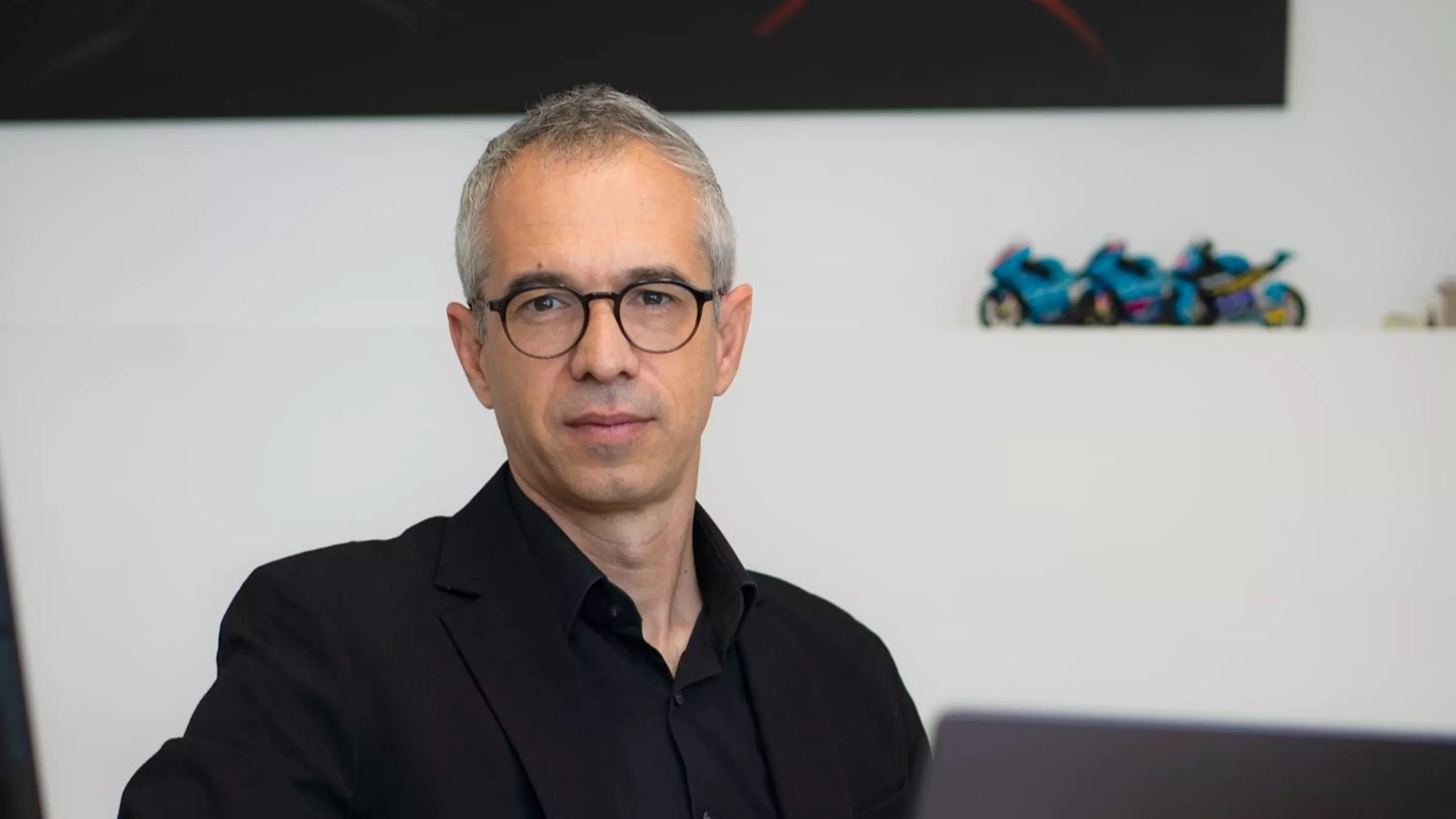
How do you still create new motorcycle design in 2026?
CFMOTO chief designer Carles Solsona interview
Carles Solsona, design chief at CFMOTO, talks in this interview about the brand's design language, the role of AI in motorcycle design, the dialogue between designers and engineers, and the future of CFMOTO as a global motorcycle brand.
&width=72&height=72&bgcolor=rgba_39_42_44_0&mode=crop "Author: Poky")
Poky
published on 07/10/2026
2,471 Views
Carles Solsona, CFMOTO: Yes. Design is complex. Designing a motorcycle isn't easy, and finding something truly new is even harder.
At CFMOTO we try to create an identity. It's not just about styling, and not just about developing a product. We want to create something bigger: a soul, a taste, a design language and an identity.
Poky: But how do you deal with the fact that so much already exists? Where's the line between inspiration from existing designs and something truly original?
Carles Solsona: That depends on the product. Some products need to align more closely with the market and existing trends. With others, you can be freer, take more risks and work more innovatively.
It's also a strategic question: how should the product and the brand be positioned? That's part of every project. Design is a bit like preferences in cooking. Sometimes you want it more spectacular, spicier, sometimes you play it safe.
Poky: What is CFMOTO's DNA for you? What makes a CFMOTO a CFMOTO?
Carles Solsona: For me that's simple: CFMOTO is unique, progressive, modern, futuristic, technological and fresh. All these things belong together. We're not like the others. We go our own way and try to push forward our own design ideas.
Some things we develop step by step. One example is the transbody line, which we introduced from the very beginning on the SR and NK and keep developing further.
Another example is the headlights. We put a lot of work into their design. The bikes should have a strong visual signature so that a CFMOTO is easy to recognize.
Poky: Where does the process start for a new product? Does the technical base come first, a buyer profile, or a design idea?
Carles Solsona: I love this phase. It's probably the most exciting part of a project - when something new comes into being. Sometimes the technical base already exists. Sometimes it still has to be developed and shaped. Then designers can have a bigger influence on the whole layout. If, for example, the engine is already finished and the performance targets are clearly defined, designers can influence the layout less. It depends on the specific project.
Poky: Many designers work at CFMOTO. How do you decide which design wins? Is there an internal competition?
Carles Solsona: We have different teams. One in Italy and one in China. There's also another design department in Minneapolis, Minnesota, which focuses more on four-wheeled vehicles. Sometimes all teams work on the same project. The internal "competition" mainly happens in the early stage. Different designers develop their ideas, and then we select the best ones, round by round.
Poky: How many designs exist at the start of a new model? More than ten? Maybe even a hundred?
Carles Solsona: That depends. If a project requires a lot of work on the technical base, I prefer to go deeper into that technical aspect. Then there are fewer designs. If the platform is already defined and it's more about a facelift or something similar, I like to see more proposals. Many designs can help figure out what's wrong - or what might be right.
AI in the motorcycle design process
Poky: Are these designs still created exclusively by humans, or does AI already play a role, for example in generating different design variants?
Carles Solsona: For me, AI is like a very powerful machine or a very powerful car. If you don't know how to drive it, it won't do you any good. I love working with AI, but AI can also be very dangerous. We use it frequently. We have our own AI department with three employees and are developing a very good process around AI. But AI doesn't work alone. You need a good driver, to stick with that image.
When technical foundations are crucial for the design, AI, in my opinion, is still a step behind. Human thinking and human experience remain important - including personal experience and knowledge of history.
AI works based on a database of things that already exist. That creates limits. But used correctly, it's a very useful tool.
From first sketch to production bike
Poky: Once a design direction has been chosen: how many iterations are there usually until the finished production product?
Carles Solsona: Very many. We want to bring the best possible products to market, so we do as many iterations as necessary. At some point you naturally have to stop, because tools and molds need to be manufactured. But we like to keep improving the product for as long as possible.
Poky: There's presumably always some tension between design and development. Designers want freedom, the engineers have to deal with packaging, cooling, aerodynamics, homologation and production costs. Where do the biggest conflicts arise?
Carles Solsona: You could talk about that for a very long time. (laughs)
Generally, the teams in China are more separated from each other. In Italy, design and engineering work more closely together. We don't just do styling. Styling is not my approach - I want to do design. For innovation, designers are crucial. Intuition and creativity can really help engineers solve problems. So I really like to combine creativity and engineering.
I once found an expression for this: "Creativity driven by performance." We have to keep performance in mind. Creativity must be directed toward that.
CFMOTO 675SR-R: Designers and engineers in dialogue
Poky: Can you give a concrete example, using the 675SR-R, of a conflict or dialogue with the performance engineers?
Carles Solsona: We had a lot of meetings between designers and engineers. Sometimes we bring in pretty crazy ideas. You look at MotoGP, for example, and see how the tank keeps moving further back. Then we might say: maybe we can build a tank in the rear area with a certain shape. The engineers might then say: yes, that could work, but we also need space for the headers.
Or we say: we'd like to shape the swingarm in a certain way because we could integrate wings there. It's a very open discussion with a lot of back and forth. I find that exciting.
What becomes of the spectacular CFMOTO V4 Concept?
Poky: The V4 SR-RR was a very spectacular concept bike at the last EICMA. I think it was one of the most highly regarded concepts there, and on our channel the content about it was among the most-viewed as well. But with concept bikes there's always the worry that the production bike ends up too far removed from the concept.
Carles Solsona: Whether that's the case, you'll see in Milan.
Poky: I'm already looking forward to that. But in general: does it hurt you as a designer when ideas have to be toned down or changed to meet road-legal or production requirements?
Carles Solsona: Yes, but that's part of the job. Taking production into account is always difficult. But I believe we at CFMOTO have a very good industrialization team. Our designers are also very good at solving production-related problems.
Why CFMOTO develops motorcycles in Italy
Poky: We're here in Misano. Italy and design have always been closely linked. Why is it important for a Chinese manufacturer to do development work in Italy? Why does CFMOTO need a European design center?
Carles Solsona: We believe Italian design is good. CFMOTO is not just a Chinese company, but a global brand. We want to develop the best products, and we believe design work in Italy can help us with that.
We use the best resources available. The same applies to China. There we have very strong teams in various areas. We try to combine these strengths and use everyone's abilities.
Poky: Does the Italian studio focus especially on Europe and European customers, or do you design globally?
Carles Solsona: I personally oversee some of the more strategic projects. Other projects I follow in less detail. I also support the internal team at headquarters a great deal. I'm based in Italy and spend most of my time here, but I travel a lot. With the internal design team I'm in close contact practically every day.
Many Chinese designers work in Italy, and some Italian designers go to China. That's a good combination. For some products we do the design here and the clay model is made in China. Some products for Asian markets are designed in Italy, because we believe that's better for that particular project.
Technical development work, such as in the wind tunnel, can also make more sense in Italy, because we may have more experience with certain racing topics there. In short: we work in both directions and are very closely connected to headquarters.
European and Chinese taste - the same or completely different?
Poky: Are there differences between European and Asian or Chinese taste? Are there models that are very popular in China, for example, but wouldn't work in Europe - or vice versa?
Carles Solsona: Of course. The background is different, the culture, the tradition and the environment are different. But our goal as designers doesn't change because of that. We try to define what CFMOTO is. We want to shape the brand and its identity. Italian design is just one component of that. It's another ingredient whose strengths we use.
If we develop a good product, for example, certain details should be very sophisticated. Italian design can contribute to that.
Colors as part of the CFMOTO identity
Poky: You've talked a lot about brand identity and DNA. How important are colors, graphics and materials nowadays for a recognizable motorcycle brand? With CFMOTO we often see dark colors combined with light blue.
Carles Solsona: That's extremely important. Brand identity is extremely important.
We shape the brand through our products, while the products in turn are inspired by the brand and its core principles. That's fully interconnected. Color is extremely important. Being recognizable and having a clear visual presence is absolutely necessary.
Poky: Does color therefore already play a role very early on in the development process of a new motorcycle?
Carles Solsona: Yes. In our minds, blue naturally belongs to CFMOTO. But right now we also like white and black, for example, as well as more sophisticated materials like aluminum or titanium. If these colors fit our brand values, why shouldn't we use them?
Where Carles Solsona draws his inspiration from
Poky: Where do you personally draw your inspiration from? From other motorcycles, cars, architecture or fashion?
Carles Solsona: From everywhere. Racing, motorsport, art, culture - everything. It's hard to name a single source.
Poky: Is there something you've seen that later influenced, for example, the 675SR-R?
Carles Solsona: Not in such a direct way. But I'm 44 years old, so I'm strongly shaped by the 1990s. Some motorcycles really inspired me: the Honda RC30, Ducati 916, Cagiva Mito, Honda NR750, NSR and others.
Some products stay in your mind because they represent a milestone. They influence you strongly. But a designer has to be very curious. You have to constantly look everywhere and try to understand new trends and the developments happening around you.
Trends versus one's own identity
Poky: How important are trends for new designs? Do you sometimes deliberately ignore them so as not to follow them too closely?
Carles Solsona: I think people sometimes misunderstand what uniqueness means.
Being unique doesn't simply mean being different. If you build a motorcycle and paint it purple, it's definitely different. But I don't know if that makes it truly unique. We want to be unique, but at the same time remain ourselves. That's what we work on. When we take inspiration from new trends, at the same time we always try very hard to protect our own identity.
If you simply follow a trend - as many Chinese manufacturers have done - you lose your identity and your DNA.
The CFMOTO design language keeps evolving
Poky: Is CFMOTO's design language firmly established by now, or does it keep evolving constantly?
Carles Solsona: It keeps evolving continuously. It has to be updated and reconsidered again and again.
Of course not literally every day, because development takes time. But we have to stay dynamic and creative and keep moving forward. We want to make our products more exciting and create more of that "wow" effect.
Poky: With most current models, in my opinion, you can clearly say: "That's a CFMOTO."
Carles Solsona: Thank you.
Poky: Don't thank me too soon. I deliberately said "most" and not "all." Is the goal to create an even stronger visual connection between the model families in the future?
Carles Solsona: We're working on that. But that's also a question of strategy. Sometimes you have to go a little less far, sometimes a little further. We think very intensively about planning. Some markets demand safer products, others look for something new.
We often talk about the "local to local" strategy. From a design perspective, that's not always easy. Personally I like the term "global-local", or "glocal" if you will: a mix of local thinking and a global approach. I find that very interesting. Exactly how we implement it, we're still thinking about.
CFMOTO CL-X and the end of the retro boom
Poky: Can you guess which model family I have in mind, the one that currently maybe fits less well with the others?
Carles Solsona: Maybe the CL.
Poky: 100 points. For me, the CL-X was one of the first CFMOTO models that really felt different, and I liked it a lot. At the same time, it's difficult to enter a retro or heritage segment when you lack the historical background that many European manufacturers have. What happened with the CL-X?
Carles Solsona: With the CL-X we wanted to enter that segment, bring in our own ideas and create a fresh look without losing the classic feel. The ambitions were very high. I still find the product cool, in the end.
But the market doesn't exist in that form anymore. You can see that in the sales figures. The heritage and classic segment had a big boom, but in my opinion that boom is completely over now. It has become a niche.
Poky: I still have a soft spot for motorcycles with a heritage look. If you could develop the CL-X again today, what would you do differently?
Carles Solsona: I'd probably start with the engine. It should get a very smooth engine, maybe a three-cylinder, maybe a twin, but in any case a very modern engine. It should be extremely easy to ride.
But honestly, I don't know exactly what it would look like. I think the CL-X's engine was very good at the time. If I were thinking about a new CL-X today, my first thought would still be the engine. That's where a significant upgrade would be needed.
CFMOTO's design chief's personal dream bike
Poky: If you could build your personal dream motorcycle with absolutely no restrictions, and it didn't have to sell either - what would it be?
Carles Solsona: That's a very difficult question.
I like race bikes. So maybe it would be some kind of race bike.
Developing a real race bike on a very low budget could be very interesting.
Poky: A proper race bike, so without road homologation?
Carles Solsona: Yes. Or maybe something crazy with a very innovative engine. Maybe even something electric. I'd like that too.
Poky: Carles, thank you very much for your time.
Carles Solsona: My pleasure.
How do you still create new motorcycle design in 2026? Images
Source: 1000PS

Success isn't just luck.


