Take a look at the labels on your motorcycle gear sometime. A large portion of it comes from Asia today. All the more unusual, then, is what NEXX Helmets does in the small Portuguese town of Amoreira da Gândara. The brand wants to offer high-quality helmets at prices that don't automatically climb into four-digit territory, while keeping both development and production in Europe. How can that work out? We enter the factory with this question in mind – and with every room it becomes clearer that "Made in Europe" here is no pretty badge slapped on a finished import product.
How a motorcycle helmet is made! NEXX factory visit in Portugal
Insights into the challenges & advantages of Made in Europe
Carbon from the fridge, a water jet at 1,500 bar, and cheek pads made from more than a dozen parts: at NEXX in Portugal, a motorcycle helmet is made by hand, with attention to detail and entirely in Europe. A rarity these days. Mirko Nagler gives us a look behind the scenes at NEXX.

Gregor
published on 17/10/2026
2,769 Views
How is Made in Europe still possible?
NEXX celebrates its 25th anniversary in 2026. Hélder Loureiro founded the company in 2001 with the idea of building premium head protection in Portugal. As early as 2002, according to the company's history, NEXX became the first Portuguese company to bring helmets made from modern composite fibers to market. This was followed by the X60 Vintage with hand-finished leather stitching in 2004, a helmet made from real denim fabric in 2006, and the modular X30 in 2007. Collaborations with Hugo Boss, Swarovski and Touratech are part of its history, as is a major fire that destroyed parts of the factory in 2018. NEXX rebuilt production in record time and brought new models to market that same year. Since then, things have been steadily looking up for the brand, and NEXX now counts among the established helmet manufacturers on the market.

The NEXX Helmets headquarters in Portugal now comprises several huge, state-of-the-art halls.
Carbon goes into the fridge at NEXX
Mirko Nagler, responsible for marketing and sales at NEXX and familiar to some from the ACT videos, starts our tour where a composite helmet itself begins: among rolls of fiberglass and carbon. Dry-layer fiberglass sits ready as dry fabric and is later processed with resin in the mold. In the prepreg process, several carbon layers are already prepared and combined with resin. This material is more expensive, harder to transport and must be stored refrigerated, but is said to be lighter and more stable as a result. Except for the jet helmet, NEXX manufactures all its composite helmets using this process.

The freshly baked helmet shell comes out of the oven.
A die cuts the required shapes out of the mats. However, exactly how these pieces are subsequently laid onto the helmet mold to the millimeter remains a company secret; the camera has to stay outside. Understandable, since the composition and positioning of the layers is precisely where a significant part of the know-how lies. What comes next, we're allowed to see again: the loaded mold is closed, heated, and pressurized from the inside via an inserted bladder. Heat, pressure and time turn pliable mats into a rigid helmet shell.
Baking, weighing, checking – and scrapping if necessary
As soon as the mold opens, the first quality gate is already waiting. Every shell goes on the scale, the model is selected on the display, and the weight is compared against the stored reference range. If a shell falls outside this window, it doesn't get passed on. Because the process involves a lot of manual work, employees also check the surface and appearance. Producing scrap this early in the process hurts; but dragging a questionable shell through all the further production steps would be even more painful.
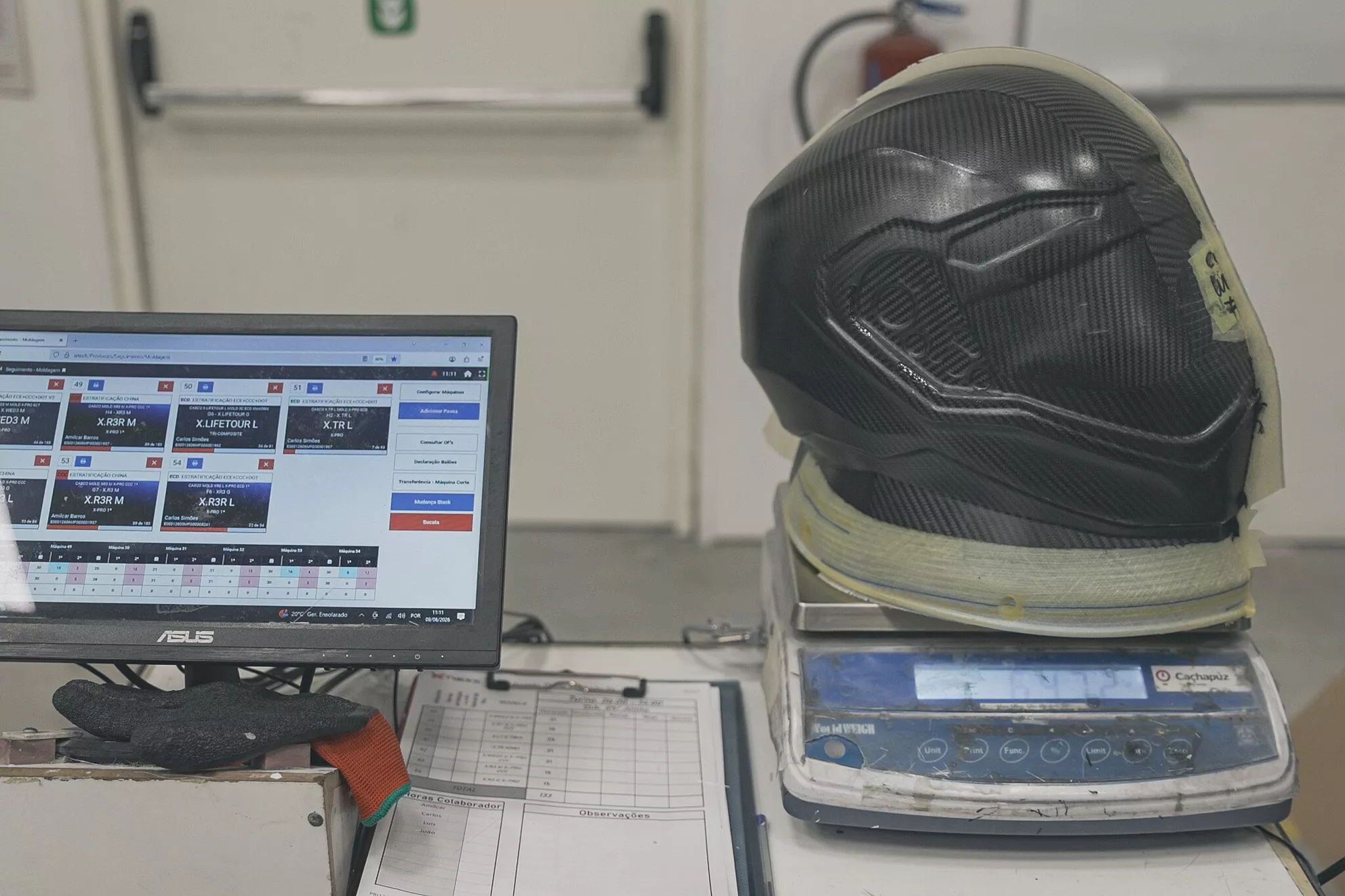
Strict quality assurance at NEXX: every helmet is weighed and inspected in detail.
The raw materials are more international than the finished helmets. The carbon comes from Japan, the fiberglass partly from Japan and partly from Portugal. Many other suppliers, however, are located within a radius of around 60 km, including manufacturers of the bladders used to apply pressure to the shells during baking. "Made in Europe" therefore doesn't mean that every fiber is of Portuguese origin. But it also doesn't mean that cheap parts are imported from overseas and merely screwed together locally. NEXX is proud that it still carries out the vast majority of work steps and materials with local partners and by hand.
The water jet cuts at 1,500 bar
In the next hall, things get really loud! The baked shells are cut and ground. A fine water jet at 1,500 bar cuts the openings for the visor and vents and trims off the lower edge. It's one of the few semi-automatic steps we see on the tour. After this, the shell already looks remarkably finished. But it isn't.

The necessary holes and cutouts are cut into the helmet shell with high precision using a high-pressure water jet.
The rough surface first receives a filler. It looks like paint when applied, but serves as a sandable intermediate layer. Only after sanding is the surface closed and smooth enough for painting. Right next door lies a stark contrast: a thermoplastic shell comes out of the injection molding machine almost finished. A few production-related nubs are removed, and the budget helmet shell is already done. Where a composite shell at NEXX occupies two buildings and many hands, a machine handles most of the work for thermoplastic helmets. This difference makes clear why an affordable plastic helmet and a carbon helmet can't cost the same.
Paint, airbrush and decals instead of simple stickers
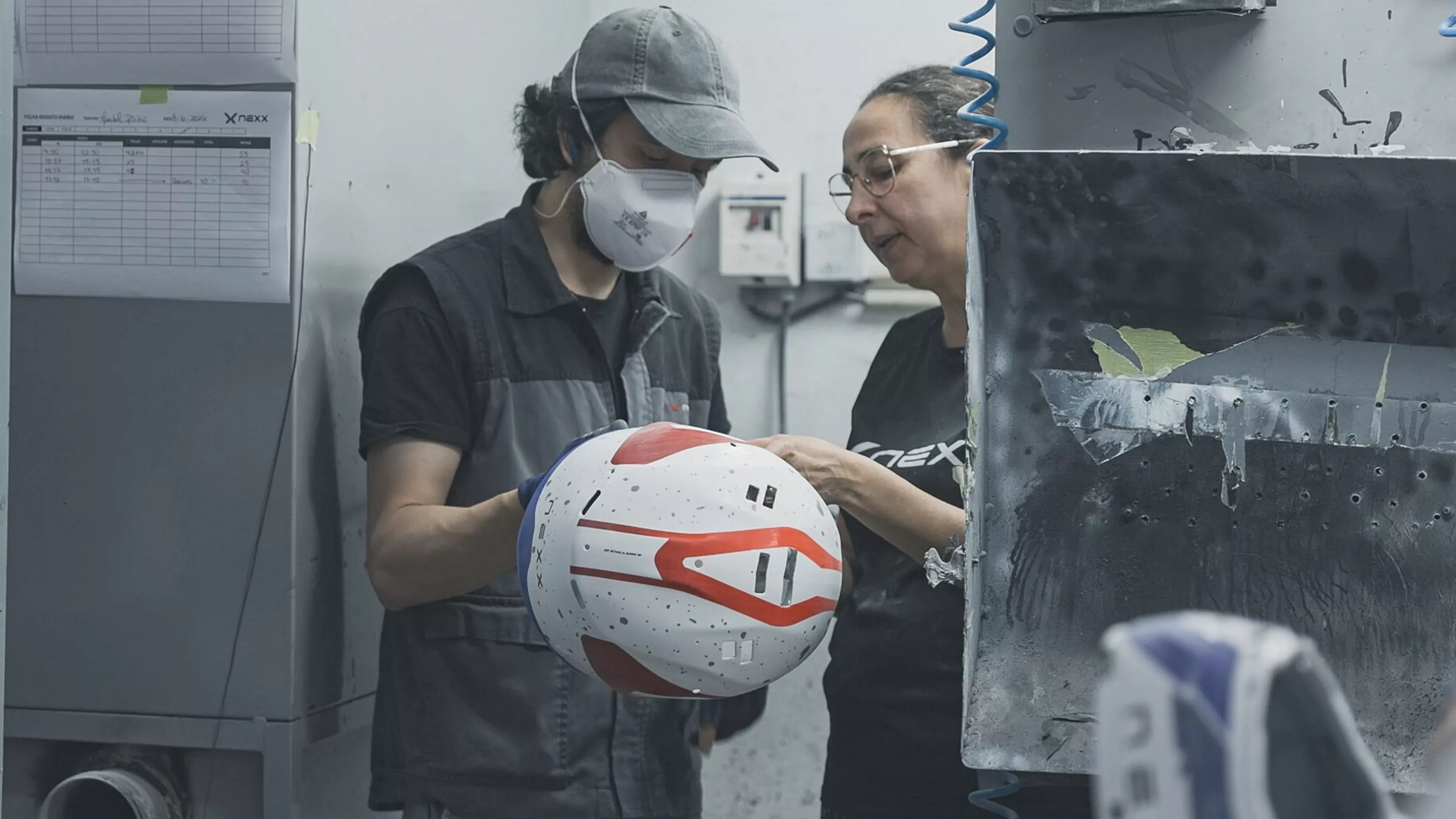
In painting, craftsmanship meets automation. Single-color shells run through two automatic systems. One cycle, from loading to removal, takes about an hour. Elaborate finishes are created in the manual booth. On the X.ZERO PRO, for instance, an employee traces the design lines onto the visible carbon with an airbrush. Mirko tried it himself and produced nothing but a zigzag instead of a straight line. Watching is deceptive: behind that steady hand lie dozens of hours, if not years, of experience.

NEXX helmets come in many extravagant designs, which in turn require a lot of skill and manual work.
The decals aren't thick stickers either. They're prepared in a water bath, positioned by hand, and then freed from a protective film. What remains is a paper-thin layer of color with no perceptible edges. During our visit, only women work at this station. Mirko explains that in previous attempts, men simply couldn't achieve the required precision. They often lack the fingertip feel and patience for it.

Steady hands are a basic requirement when applying helmet decals. That's why this department at NEXX is staffed almost exclusively by women. They're faster and more precise than the men.
After paint and decal comes the next quality checkpoint. Small hairs or polish marks are fixed directly via smart repair. Bigger problems send the shell back. These checks happen after every process. Only once paint, surface and decal are all correct is the shell allowed into intermediate storage and later into final assembly.
Three weeks for the shell, 30 minutes for the helmet
In the shell warehouse, Nagler mentions a pair of figures that explains the production better than any factory brochure. From internal planning to the finished, painted shell, NEXX calculates around three weeks. That doesn't mean three weeks of uninterrupted work on a single helmet. Not every model is produced every day, which is why workload distribution and stations have to be planned. From the shell warehouse to the fully assembled helmet, on the other hand, only about 30 minutes pass.

Manufacturing the helmet shell is the lengthy, elaborate part of helmet production. After that, things move lightning-fast to the finished product.
Before completion, however, a department waits that's easy to underestimate when looking at a finished helmet: the sewing room. Interior and cheek pads are made entirely in-house. A rally cheek pad starts with three foam pieces, to which, according to Mirko's spontaneous count, about ten more components are added. Fabric strips are die-cut in the factory and the individual pieces sewn together. The finished pad looks so complex that, as a layperson, I would have assumed a machine was behind it. In fact, people are.

NEXX's massive sewing department turns an empty shell into a wearable helmet.
The chin straps don't sit finished on a shelf either. They're assembled from several components per order, complete with certification label, strap protector and buckle. They're then anchored into the shells. In a pre-assembly cell, plastic sub-assemblies, vents and opening mechanisms are produced at the same time. Pinlock pins go into the visors, and accessory and warranty packages are prepared.
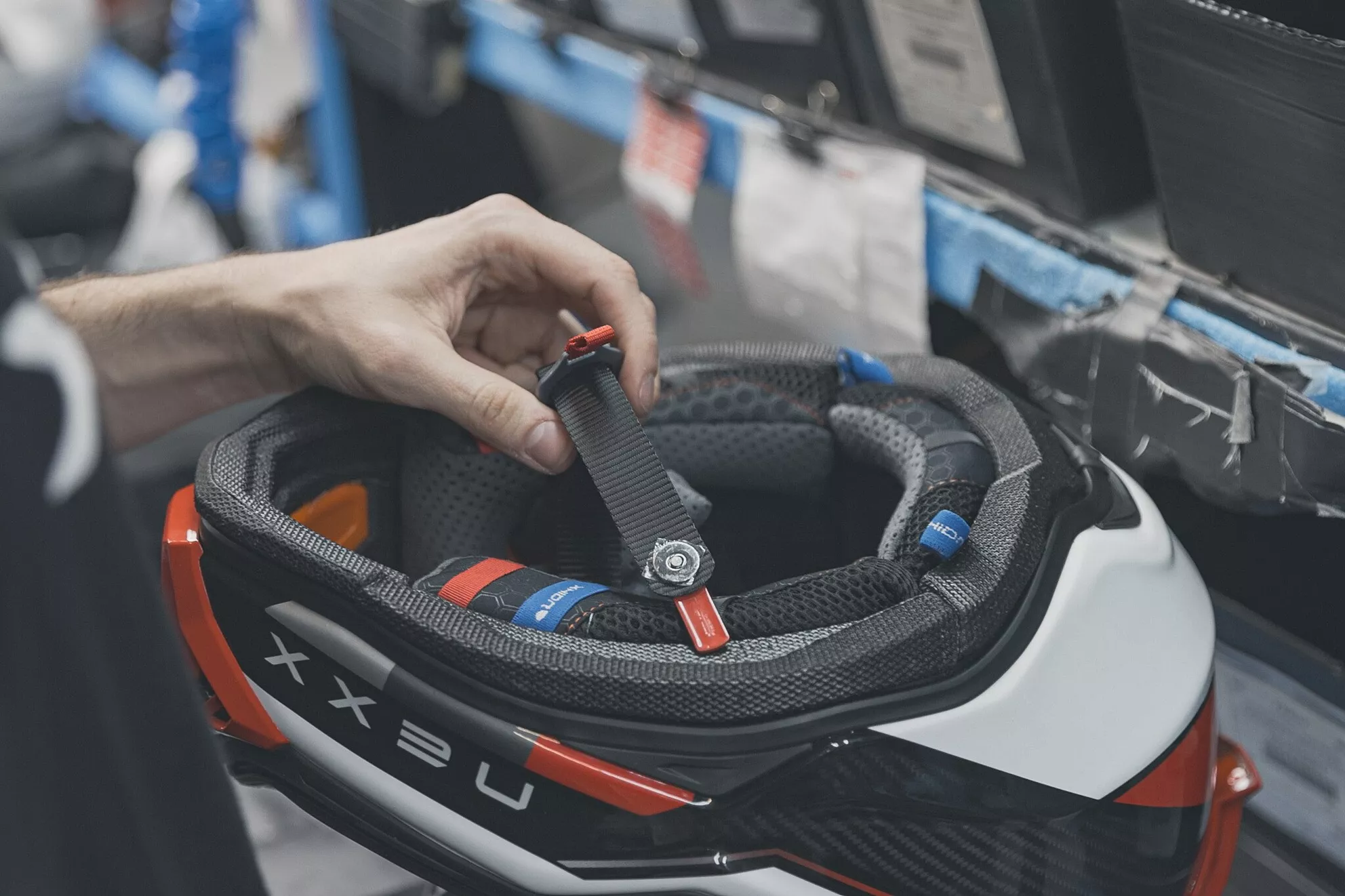
From the cheek pad to the chin strap – the complex interior parts of NEXX helmets are also made by hand.
Assembly line work, but only one model at a time
Final assembly is neither classic one-off craftsmanship nor an anonymous high-speed line. At the production cell we visited, the X.WST3, X.WED3 and X.RALLY are made on a related shell base. One model is produced at a time, moving from station to station. Each employee continuously performs two or three work steps. A supply cart refills the component boxes so that hands can stay on the helmet.

Countless work steps ultimately culminate in final assembly and inspection – of course also carried out by hand.
Before the helmet is allowed into the box, the final inspection awaits. The surface is checked for damage and paint defects, the complete helmet is weighed again, and the mechanics are tested. The visor or flip mechanism must function. Only then do a spare visor, Pinlock, warranty documents and accessories – depending on model and market – go into the packaging. According to Nagler, around 300 people work at NEXX in total. After this tour, that number no longer sounds like a staffing statistic, but like a great many hands on a great many small parts.
Full control comes at a price
Why put yourself through all this? Nagler names flexibility and control over every single, tiny part as the biggest strengths. NEXX offers a five-year warranty. The flip side is organizational: composite processing, tool-making, cutting, grinding, painting, decorating, sewing and assembly are practically different industries. According to Mirko, anyone who keeps everything in-house isn't running just one company, but "five, six, seven, eight companies" at once, and has to have the know-how ready for all of them.
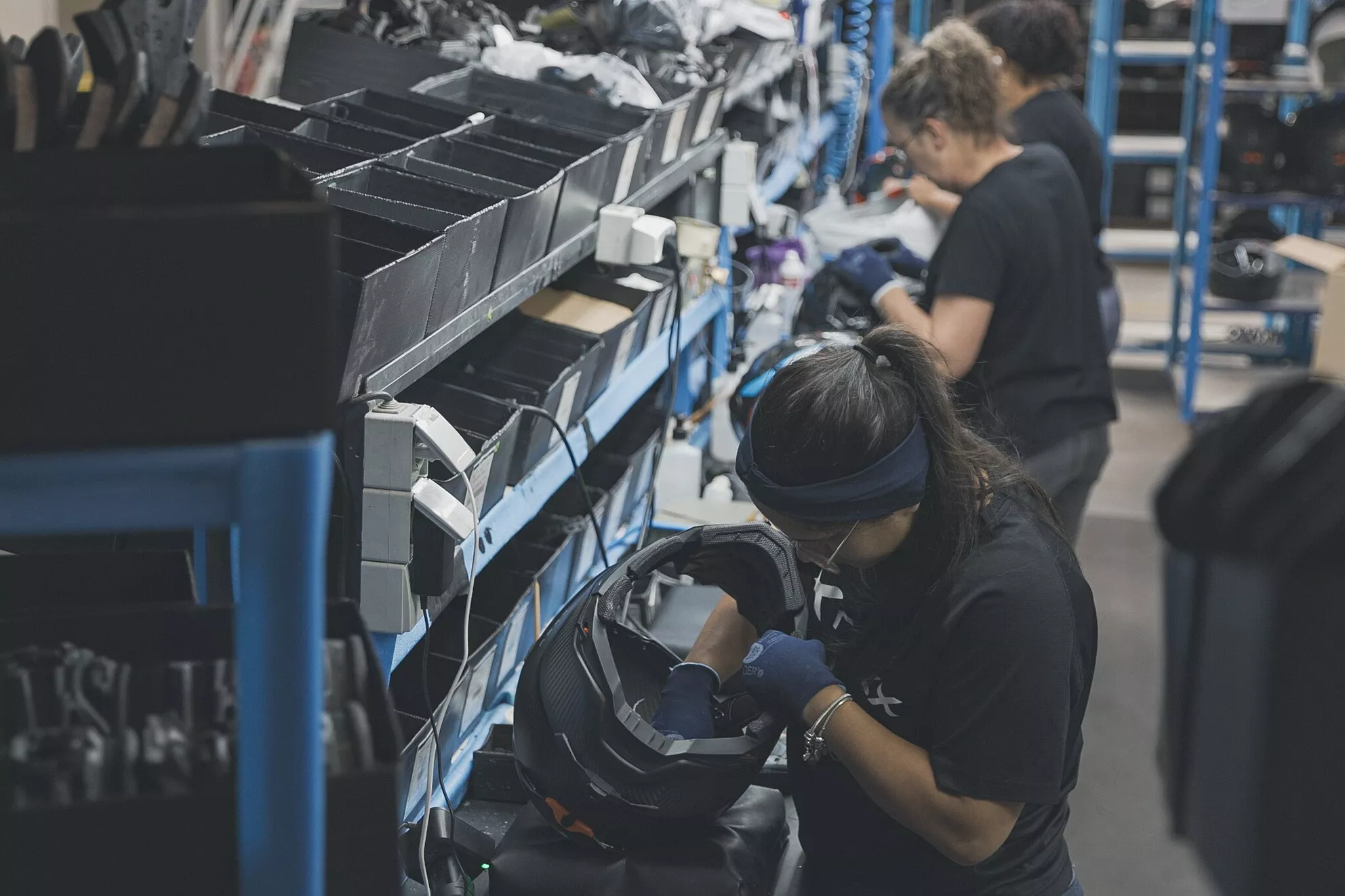
The almost entirely in-house production at NEXX offers big advantages, but also increases the complexity of production and logistics.
Growth, too, can't simply be delegated to a supplier via a larger order. At NEXX, higher volumes require more space and more people. An additional helmet platform in the existing plant has to be precisely coordinated with other production lines. So light and shadow lie close together. The short distances and in-house manufacturing create a maximum level of control, but NEXX has to shoulder every capacity expansion itself.
NEXX X.TR: Luxurious sport-touring helmet
At the end of the production line, two current helmets await that serve as a good example of NEXX's approach to the helmet market. The new sport-touring full-face helmet is called the X.TR. It's available in an X-PRO carbon version and an X-MATRIX2 multi-composite version. The carbon version weighs 1,625 g ± 50 g. Three shell sizes cover XXS to XXXL.
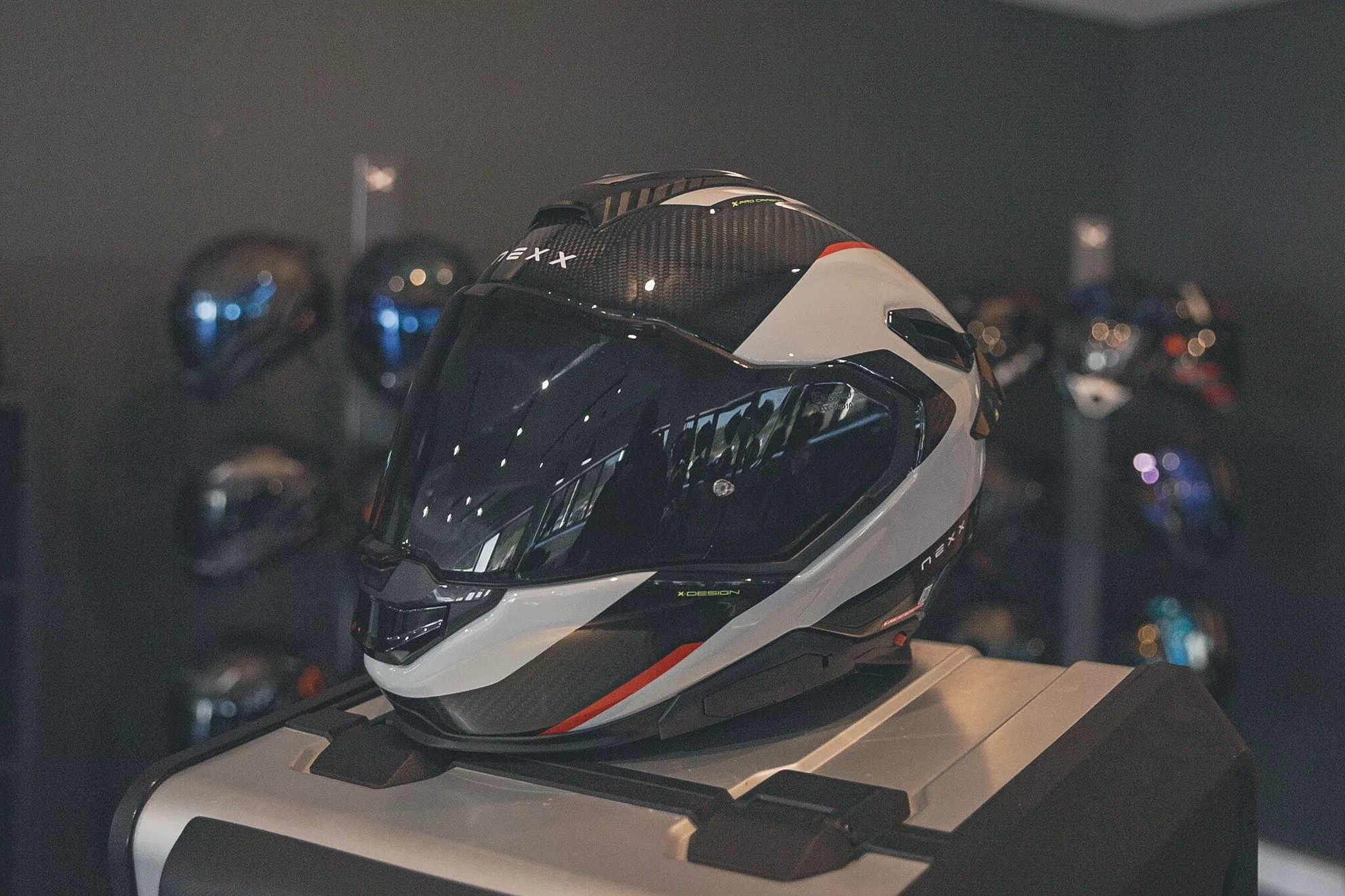
The new NEXX X.TR with numerous comfort features
The X.TR isn't meant to be merely light, but above all comfortable, stable and quiet. Its particularly large field of view is complemented by a deep-reaching sun visor. The Fast Release System releases the cheek pads without tools, for cleaning or so rescue personnel can remove the helmet with less friction. Between the inner and outer EPS layers sits a rubber element that allows small movements and is meant to reduce vibrations caused by air turbulence. The same gap also serves as an air chamber through which warm air is vented to the rear. A sturdy neck roll is meant to keep wind and noise out. Add to that the preparation for X-COM3 and X-COM3 PRO, Pinlock 200 XLT MaxVision, two intakes and two outlets, ECE 22.06 approval and – on the carbon Atlantic graphic shown – a manufacturer's RRP of 699.99 euros.
NEXX X.RALLY: Three helmets in one
With the X.RALLY, the objective is different. The carbon adventure helmet officially weighs 1,350 g ± 50 g and likewise uses three shell sizes. It can be ridden in three configurations: with visor and peak as an adventure helmet, without the peak as a street full-face helmet, or without the visor paired with off-road goggles. NEXX also offers a version homologated to FIM Racing standard. Anyone who wants the real deal off-road will find more here than just adventure looks.

Thanks to its modular design, the NEXX X.RALLY is extremely versatile.
The off-road focus is embedded in many small solutions. Nine intakes and six outlets, additional cheek pad ventilation and an air chamber are meant to dissipate heat. X-Foam bumpers made of lightweight EPP foam run along the lower helmet edge into the chin area and are meant to absorb impact energy and reduce the risk of collarbone injuries. The X-Hidro cheek pads have tabs for a hydration tube and mouthpiece. A universal communication system fits into prepared recesses and a clamping point.
The package for the X-PRO carbon models, which NEXX designates as the top version, also includes a photochromic visor, Pinlock 200 XLT MaxVision, a winter filter, wind deflector, street cover, peak extension, and camera mounts on top, on the side and on the chin. The inner lining is designed to wick sweat, dust and sand away from the skin and is removable and washable. The X.RALLY costs just under 500 euros in the multi-composite version and starts at 699.99 euros RRP in the carbon version.
A 300-gram difference isn't a quality verdict
Why does the X.TR weigh around 300 g more than the X.RALLY despite being carbon? Because comfort brings mass with it. Sun visor, noise damping, neck roll, visor mechanism and the many small touring solutions each add ten or twenty grams. Mirko says it openly: the X.RALLY is noticeably lighter, but also noticeably louder. The sport-touring helmet, on the other hand, is meant to be a "luxury helmet" with everything included. Under ECE 22.06, helmets in general have become bigger and heavier.
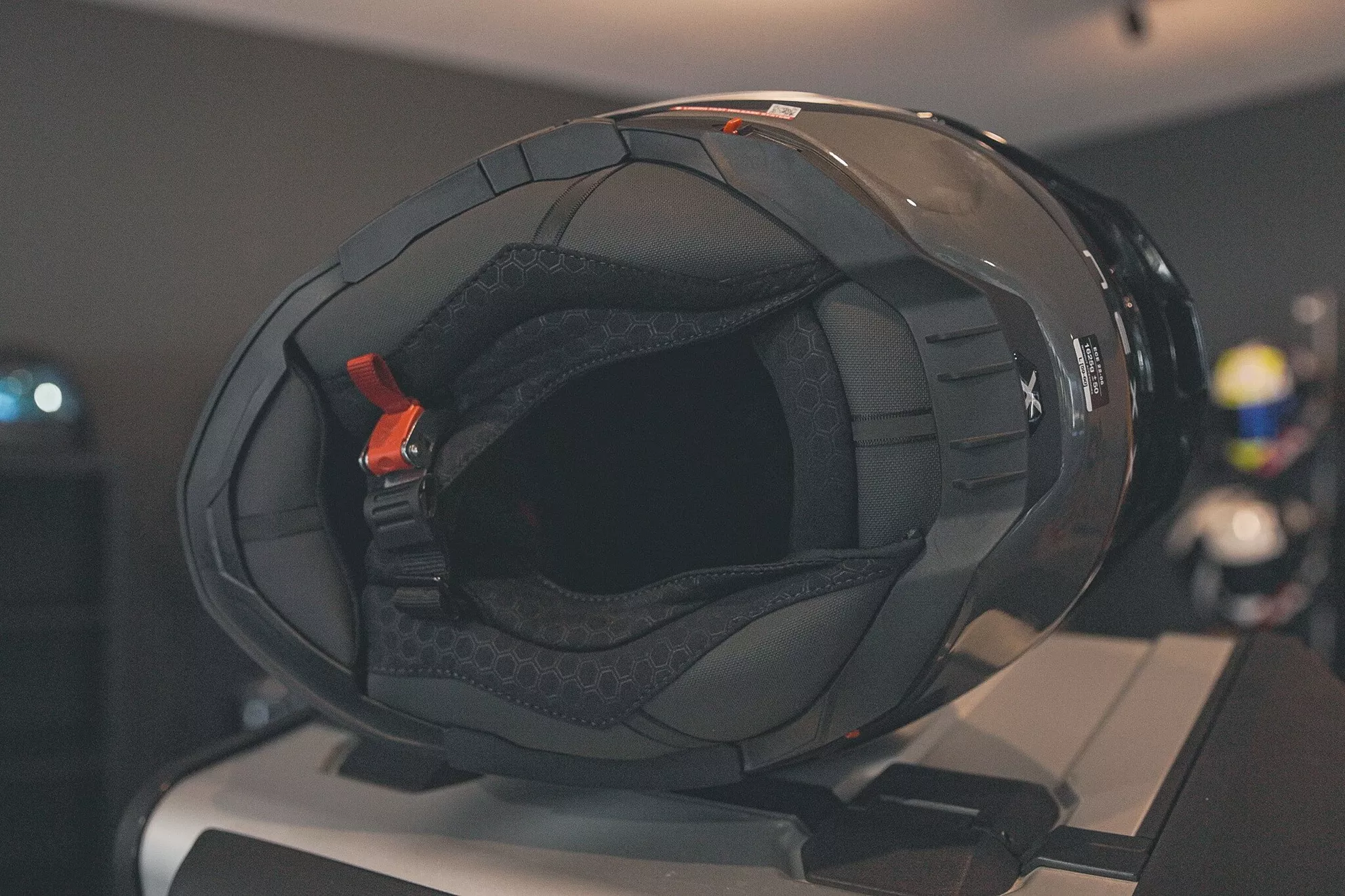
More is more! At NEXX, the focus isn't just on lightweight construction, but also on offering customers well thought-out features.
Any helmet could be built even lighter, but that would mean sacrificing safety margin or luxury. NEXX tries to build as light as possible without touching its own safety buffer. So, even with helmets, the spec sheet only tells part of the truth. Anyone comparing grams needs to know whether they're weighing a hard enduro helmet or a quiet sport-tourer.
Tight and sporty or loose and comfortable?
Fit, too, follows the intended use. Sporty models like the X.R3R race helmet and the X.RALLY sit tighter, according to Nagler, and are meant to stay snug for longer. Comfort-oriented helmets feel looser. An M therefore doesn't necessarily feel identical across all NEXX model lines, even though it's nominally the same size. For Europe, NEXX generally works with an elongated-oval head shape. For Asian markets there are rounder cuts, and DOT versions also get slightly adjusted fits.
That doesn't replace trying it on. Quite the opposite: precisely because padding and purpose change the fit, you should try on the helmet you actually want, not just any NEXX in the same size. A number on a label, after all, can't measure your own head.
Cheaper than the carbon competition – but why?
After so much manual labor, the price feels almost more miraculous than the product. Compared to the two helmets presented here, the competition on the helmet market operates in markedly more expensive territory: for example, the Leatt 9.5 at around 950 euros, the Schuberth E2 Carbon at around 1,000 euros, and the AGV Pista GP RR at around 1,800 euros. These helmets naturally belong to different categories and have different equipment. Still, the comparison shows that, aside from NEXX, carbon helmets – especially those made in Europe – are only found in the high-priced premium segment. NEXX wants to compete at this top level in terms of wearing comfort and equipment with its carbon models, but at an affordable price.
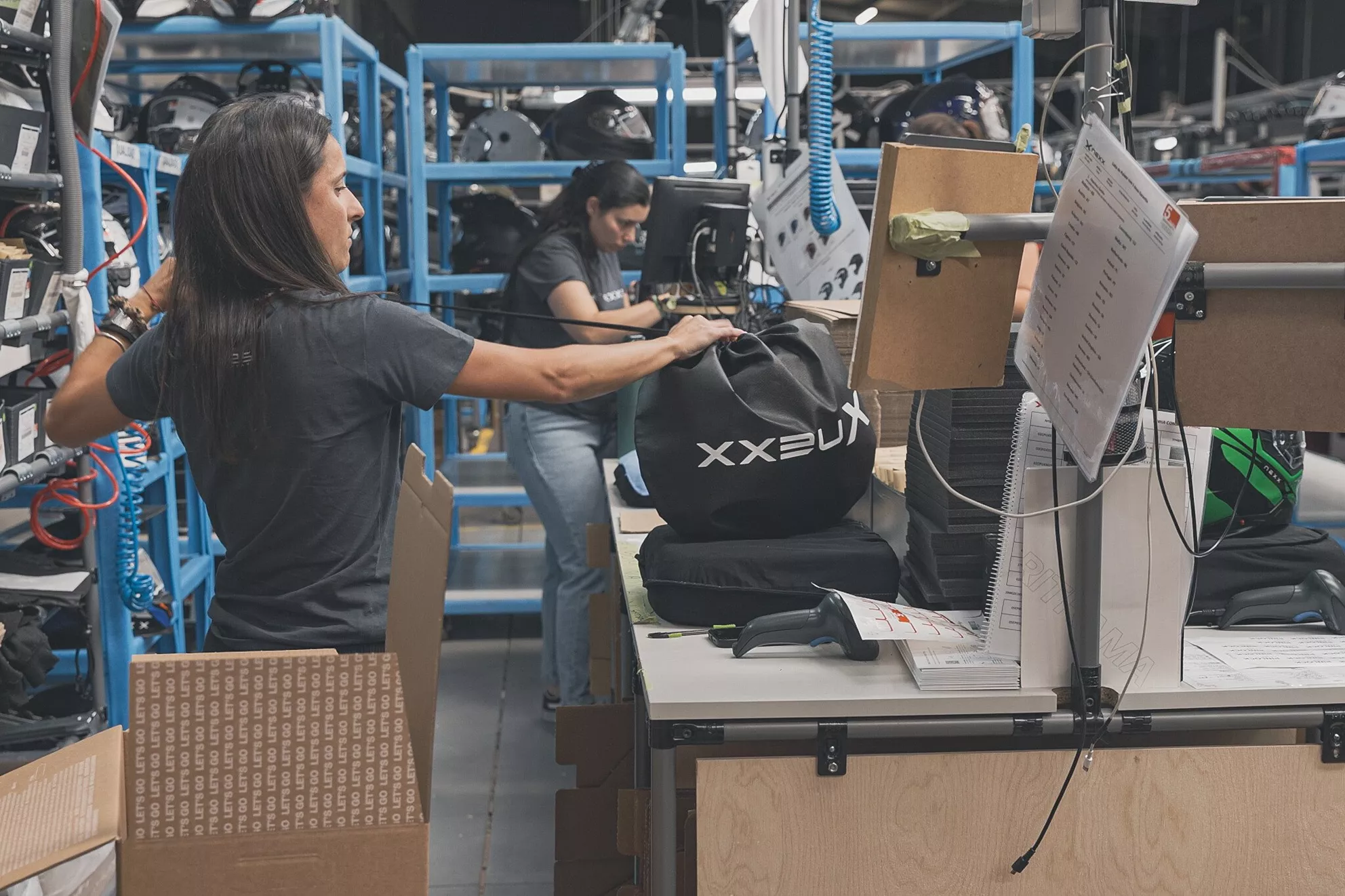
NEXX's recipe for success: pride in origin and products, instead of profit maximization and turbo-capitalism.
How is that supposed to be possible? Mirko's answer is less about cost accounting than company philosophy. Founder and owner Hélder remains active in the business and has never put financial maximization first. Many employees are riders themselves. That doesn't explain every number in a calculation, but it does explain why NEXX wants to keep manufacturing and know-how in-house despite higher European labor and social costs. The official explanation adds: concentrated know-how is meant to make development, improvement, adaptation and service more flexible.
2027 brings the X.R5R Spectrum
The tour ends in the open-plan office where development, product design, marketing and sales sit together. This is where ideas grow, Mirko says – and shows us one in advance. The X.R5R is planned for 2027. The Spectrum model shown is ultra-compact and, according to Mirko, feather-light, focused on the race track but also intended for the road. Its paint shifts from purple to green depending on the viewing angle. Very cool!
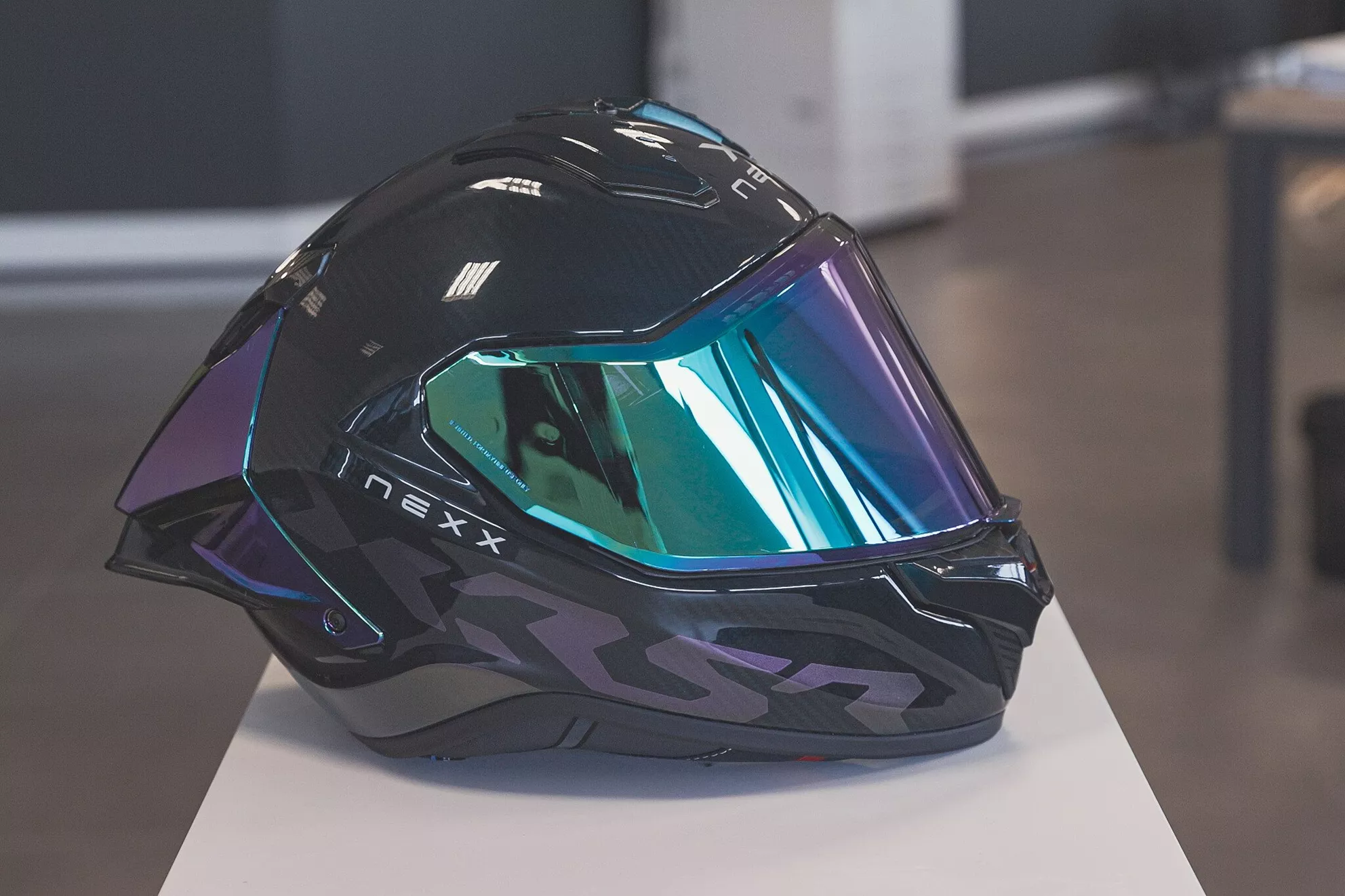
The strikingly good-looking X.R5R will soon top NEXX's racing helmet line-up.
The even bigger idea for the future lies beyond the window. NEXX has acquired a green field previously used for off-road test rides and plans to build a smart factory there. Instead of today's production spread across four buildings, the first step is to create a plant of 12,000 to 13,000 square meters that genuinely brings everything under one roof. According to Mirko, the hoped-for groundbreaking is roughly a year after our visit. With this, NEXX wants not only to grow but to organize European production more efficiently.
Conclusion: Does Made in Europe still matter?
After a long day spent amid cold fiber mats, hot molds, water mist, sanding dust, airbrushes, sewing machines and final inspection, the opening question can be answered. Yes, modern helmet production in Europe is possible. But it's not easy. NEXX buys control over quality and pace at the price of enormous complexity, many specialists, and the need to hold its own against international mass production with domestic quality.
Whether "Made in Europe" matters when buying is something everyone has to decide for themselves. Here, at least, it's tangible: in the woman carefully applying a paper-thin decal, in the employee with the airbrush, in the constant clatter of dozens of sewing machines, and in every quality gate that sends a shell back. That's more than an origin sticker. And the fact that an X.RALLY or X.TR, after passing through all these hundreds of hands, still doesn't have to cost four figures is remarkable in itself.
How a motorcycle helmet is made! NEXX factory visit in Portugal Images
Source: 1000PS


