Norton has been promising a return to the top for years. With the Manx R, the brand from Solihull takes its most serious and costly step to reclaim a segment it should never have left.
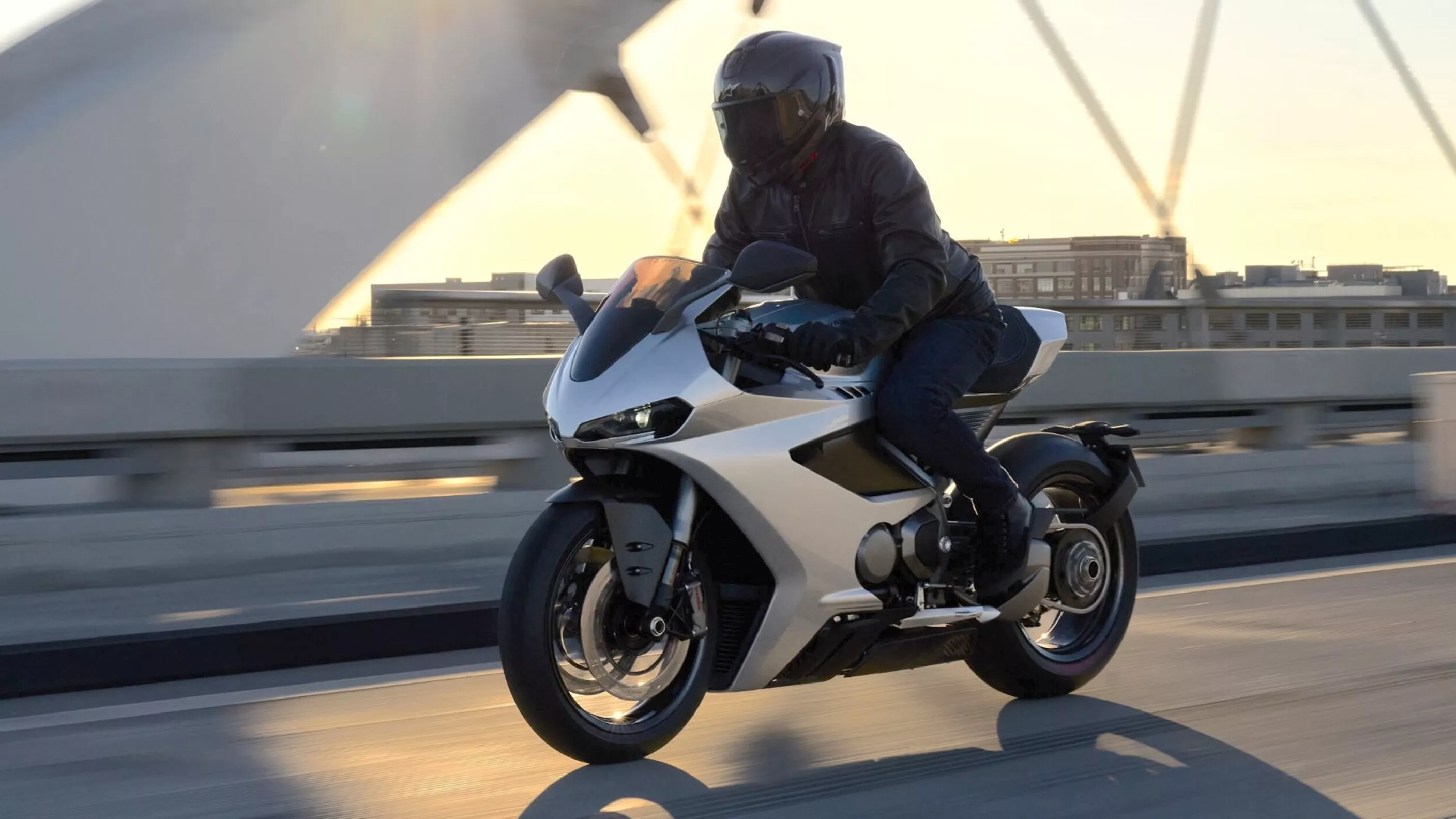
Norton Manx R: The New British Superbike with 209 HP in Detail
Norton Manx R: 209 HP Starting at €23,250
I'm writing these lines from Seville, where Norton has unveiled its new Manx R to the international press. Right beside me, Martin Bauer, three-time IDM Champion, is hitting the track with it as you read this. You'll soon be able to catch his firsthand impressions here. Until then, here's everything we know about the bike.
&width=72&height=72&bgcolor=rgba_39_42_44_0&mode=crop "Author: CarlosDominguez")
CarlosDominguez
published on 06/05/2026
22,195 Views
Anyone following British motorsport and the rebirth of Norton under the TVS Motor Company umbrella won't be surprised by the unveiling of the Manx R. The brand has been steadily working towards this goal for years: first with the V4SV, and now with the Manx, Manx R, and the Atlas, unveiled together at EICMA. A V4 with 1,200 cc, 209 HP, semi-active Marzocchi suspension, and the latest Bosch electronics. In short, everything a serious manufacturer in the superbike segment must bring to the table in 2026.
Norton Manx R: An All-New Engine from Scratch
Although the Manx R's engine shares the same 1,200 cc displacement, 82 mm bore, and 72° V-angle with the V4SV unit, it is completely newly developed. Not a single component was carried over, according to Norton. The result: 209 HP at 11,500 rpm and a hefty 130 Nm at 9,000 rpm. The most interesting figure is another: At just 5,000 rpm, the engine delivers 77 percent of its maximum torque. This is the class-best figure in this parameter and should make a noticeable difference in everyday riding, as this is where you spend most of your time. Gear selection, rhythm changes, corner exits: everything becomes simpler when torque is available at any moment.
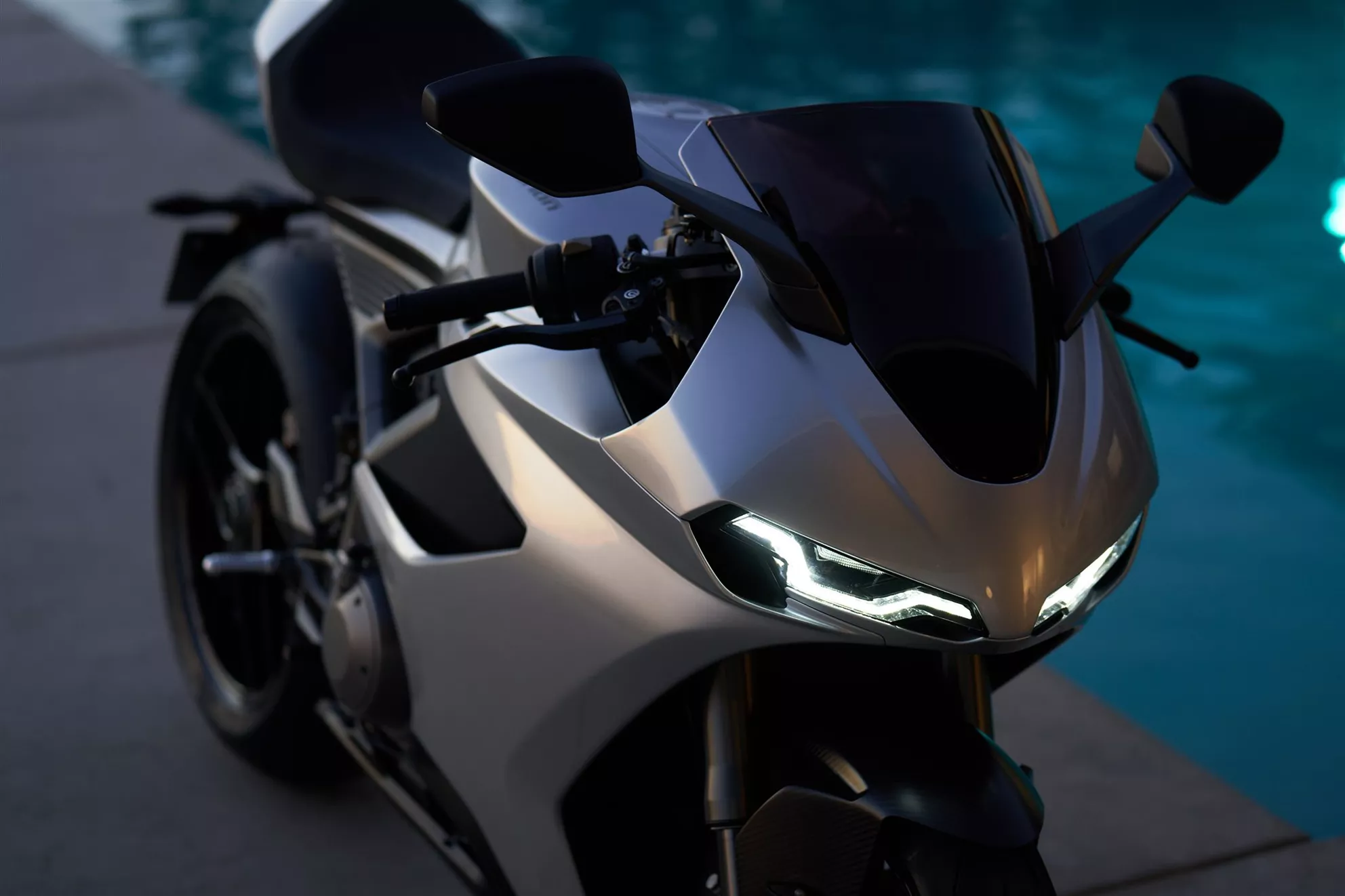
The Norton Manx R is a unique piece. Among other features: no winglets!
The 72° V-angle allows what Norton calls the "Phased Pulse" ignition sequence: an irregular firing order that enhances traction and creates a unique riding feel, especially during hard acceleration in quick succession of corners.
In the 82 mm bore combustion chamber, development focused on optimizing tumble and swirl flow. With such a high compression ratio, precise combustion control is crucial, especially for Euro-5+ homologation, which requires misfire detection. The solution: two injectors per cylinder in different positions. The lower one, below the throttle valve, optimizes throttle response; the upper one, as a "shower" injector above the throttle valve, maximizes peak output. Since all four throttle bodies stand vertically, gravity assists in filling the cylinders before each combustion impulse.
A detail not found in any brochure, but revealed at the press conference: Norton regulates the two cylinder banks independently. In practice, the engine behaves like two coupled twin-cylinder engines. When accelerating out of a corner, as the rider begins to throttle up, the cylinders of one bank can remain nearly closed while the other bank operates with more open throttle valves. This increases intake speed, improves mixture preparation, and thus combustion. According to Norton engineers, this significantly enhances throttle response compared to uniform control of all four cylinders.
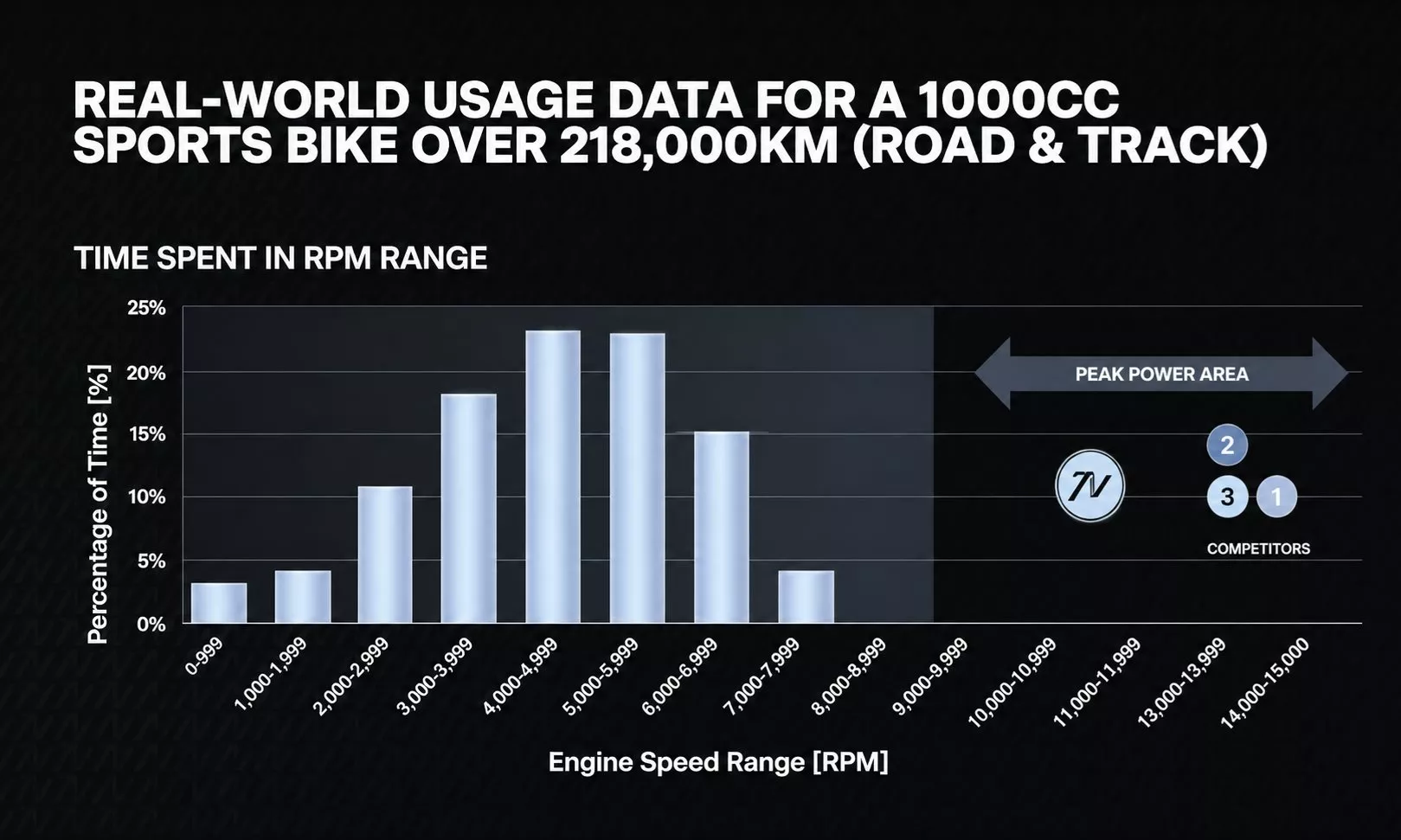
Norton studies reveal the RPM ranges where superbikes operate most frequently.
The gearbox is installed with a slight upward tilt, providing two practical benefits: the gears are positioned above the oil level in the sump, reducing drag losses, and this makes the engine block more compact. This allows the swingarm mount to move forward, resulting in a longer swingarm without increasing the wheelbase. The camshaft drive employs an intermediate gear with split gears instead of a chain, which permits smaller sprockets and lowers the overall engine height by 12 mm.
Exhaust System: What might initially appear as a design choice is actually a well-thought-out piece of engineering. Positioning the exhaust system under the engine rather than on the side isn't just about aesthetics: it maintains a low and centralized center of gravity, prevents mass from shifting rearward and upward—which would impair braking performance and reduce rear wheel traction—and channels heat away from the rider. Heat management on a bike with over 200 HP is no minor detail: it causes fatigue, and fatigue diminishes the riding experience. According to Brian, the chief engineer who presented the technology in Seville, the development process for the exhaust system was "extremely complex" and involved numerous intense discussions with Simon, the design lead.
Norton Manx R: A Chassis with a Unique Philosophy
Norton made an interesting and bold decision with the chassis. Instead of copying the purely track-focused philosophy of its European and Japanese rivals, they've drawn inspiration from the Isle of Man TT. The reasoning: a road superbike must perform on real roads, with all their bumps and unpredictability, not just on the perfectly smooth tarmac of a racetrack.
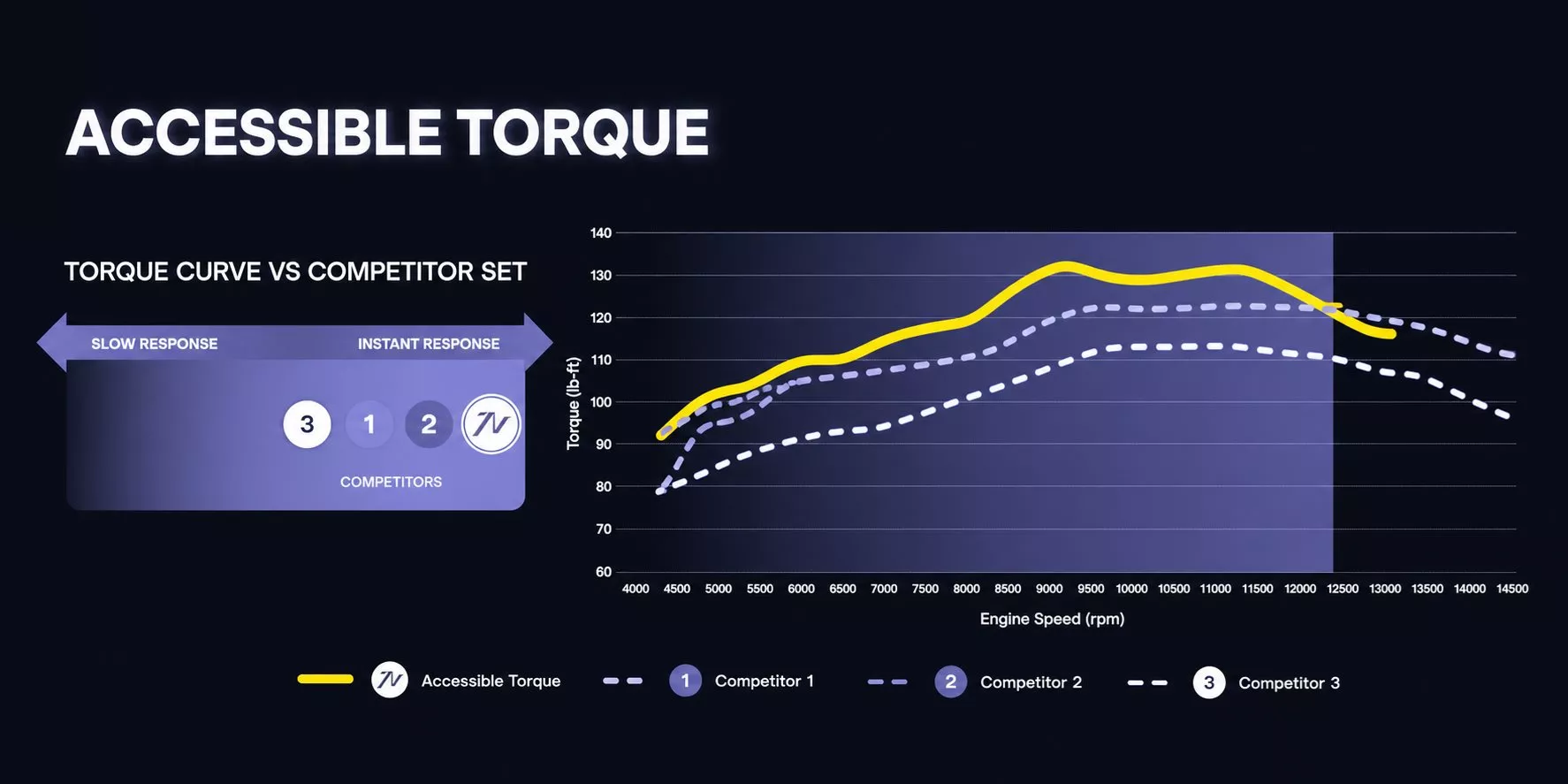
Norton focuses on torque and everyday usability.
The key to this lies in the distribution of stiffness. The frame is very rigid longitudinally, which is ideal for hard braking and acceleration. However, Norton has incorporated controlled flexibility in the torsional and lateral planes. The reason is simple: beyond a lean angle of 40 to 42 degrees, it's no longer the suspension that absorbs road surface irregularities but the inherent flexibility of the frame. On real roads, with their potholes and bumps, this very flexibility is what keeps the tires in contact with the ground and provides feedback to the rider.
The result is a frame made from five die-cast aluminum components, entirely manufactured, welded, and CNC-machined as a unit in the UK. The geometry is conservatively designed for a superbike: 24.1° steering head angle, 94.5 mm trail, and a 1,435 mm wheelbase.
The semi-active Marzocchi suspension deserves its own mention. What sets this system apart from others is the position of the linear potentiometer: not externally on the fork, as in race bikes, but integrated inside the right fork tube. This allows precise knowledge of the fork's position, movement speed, and acceleration at all times. The rear shock also features an integrated potentiometer. Using data from the six-axis IMU, the system continuously adjusts the compression and rebound damping with an algorithm that updates every three milliseconds. This isn't marketing hype: it's exactly what MotoGP bikes have been doing for years, now applied to a road bike.
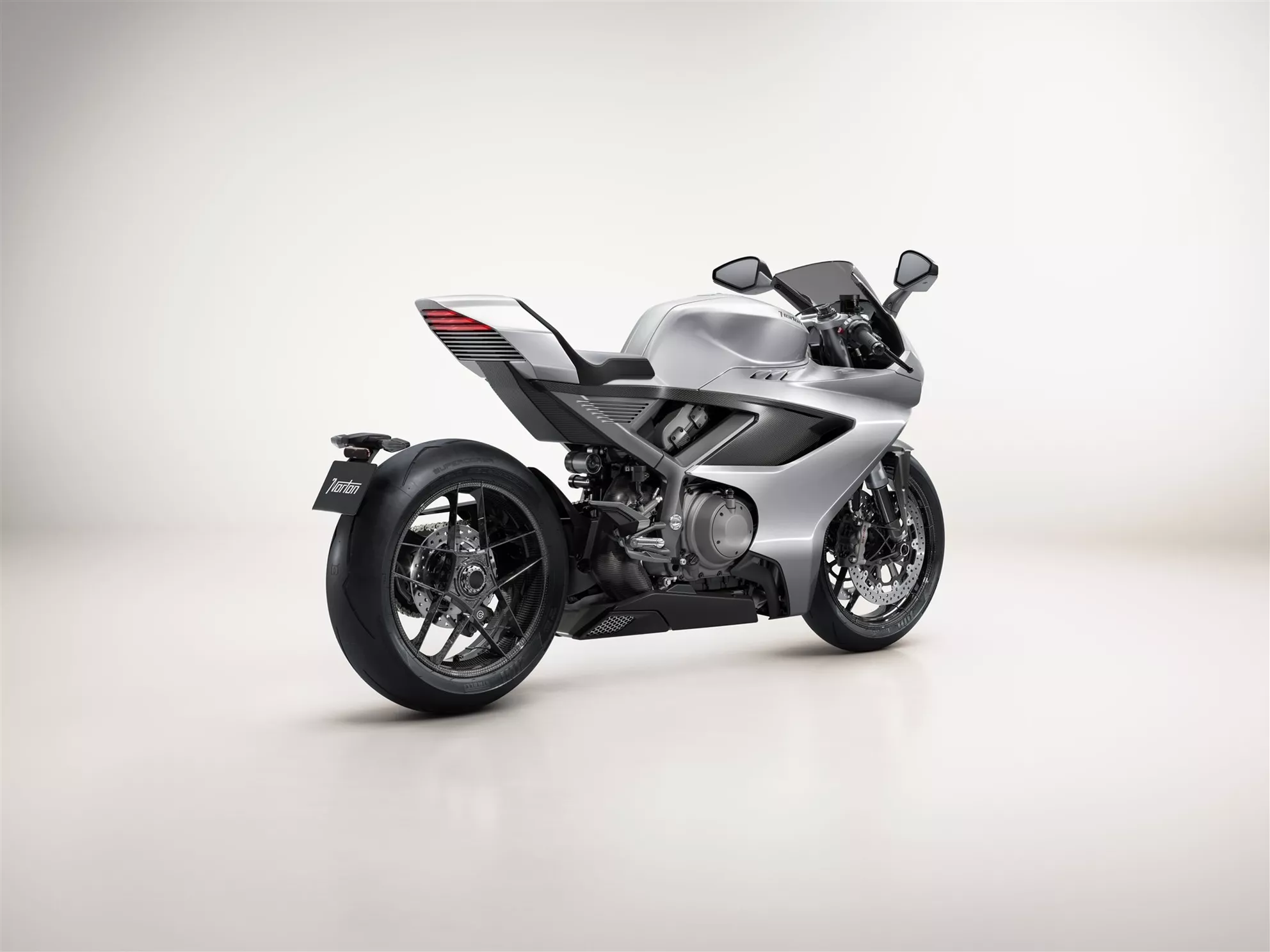
The design is undoubtedly one of the strongest points of this new Norton era.
Norton Manx R: Electronics as the True Epochal Shift
What truly sets the Manx R apart from its predecessors is not the power curve, but the depth of its electronics package. The six-axis Bosch IMU controls ten active systems. Some of these warrant an explanation, as they are not what they initially appear to be.
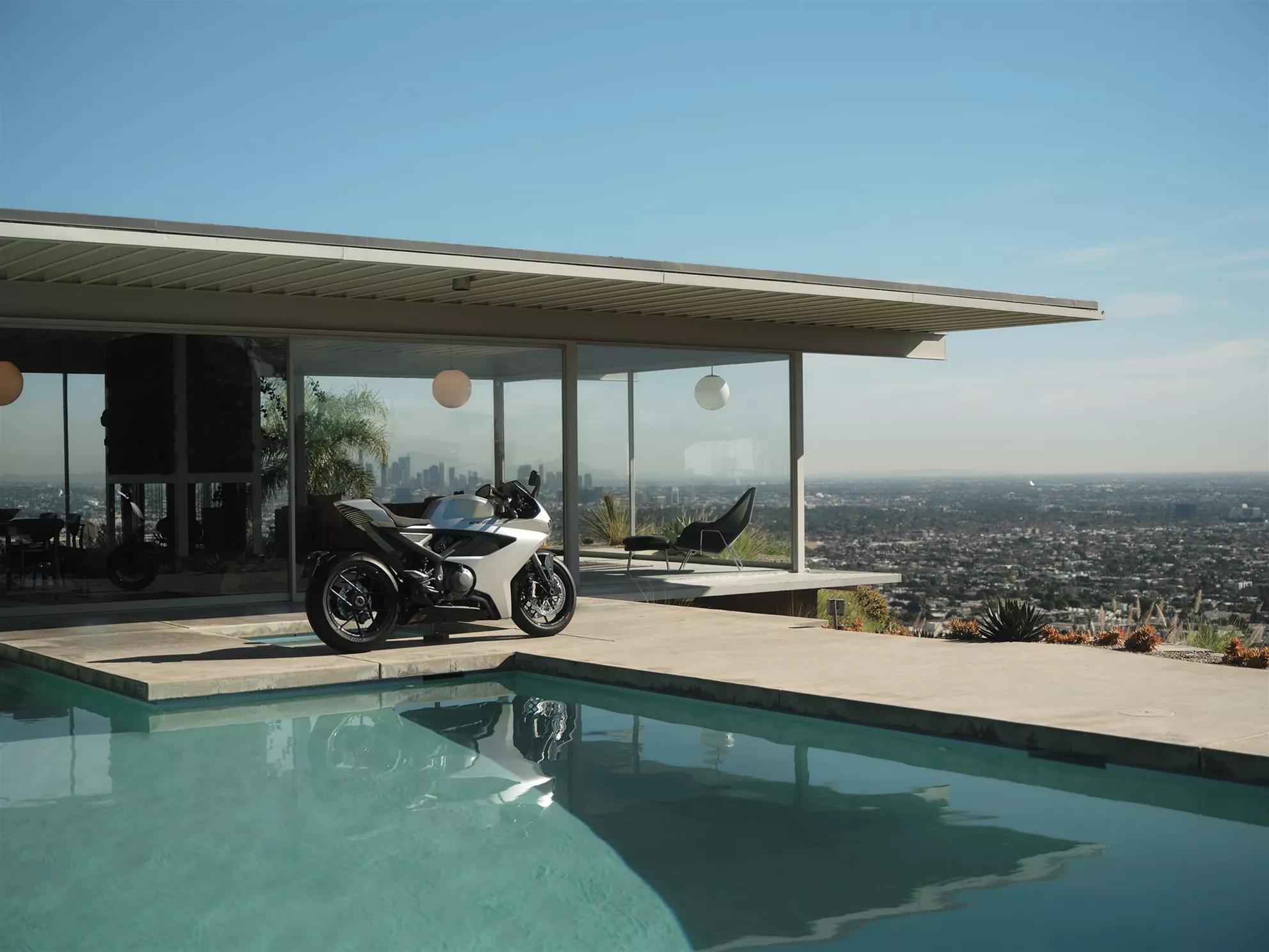
Norton aims to position itself as a premium brand.
Take the wheelie control, for example. Brian was very clear in the presentation: "We don't have an anti-wheelie system. We have wheelie control." The distinction isn't just semantic. The system doesn't try to prevent the front wheel from lifting; it controls it: adjusting pitch rate and torque saturation to prevent the front wheel from rising too high and to manage the speed at which it returns to the ground. It's adjustable and can be fully disabled. Norton wants wheelies to be safe and fun, not eliminated.
The braking system also deserves attention. Norton and Bosch didn't just pick a system off the shelf; they first defined the desired braking behavior and then worked together to achieve it. The goal was a deceleration of 1 G, which Norton claims no hyperbike has accomplished in independent tests. The RLM system (Rear Lift Mitigation) allows the rear wheel to lift briefly under hard braking for maximum weight transfer to the front wheel and maximum grip. It then lowers the rear wheel in a controlled manner and keeps it on the ground for the remainder of the braking maneuver. With the rear wheel grounded, engine braking can be applied, the bike can be steered, and the apex reached earlier. Martin Bauer will find out how well this works in practice. The discs are floating Brembo discs with a diameter of 320 mm, paired with the new generation Hypure calipers.
The combined braking system adds another dimension: by combining front brake pressure with a light tap on the rear brake, the slide control activates during cornering, regulating the bike's drift angle towards the apex. A powerful tool for those wanting to push the bike to its limits on the track.
A feature rarely seen in hyperbike spec sheets: hill start assist. You stop at a traffic light on an incline, press the brake once, and can release it. The bike holds itself in position until you move off. A small detail with significant everyday benefits.
We're particularly excited about the N-DCC, the world's first "cornering cruise control."
The 8-inch TFT display is a touchscreen, and that's more relevant than it sounds. No menu navigation with handlebar switches: you tap directly on what you want on the screen. The connectivity system, developed by the TVS engineering team in Hosur, India, integrates Bluetooth, Wi-Fi, GoPro control, waypoint navigation, and smartphone mirroring in the cockpit. Updates are delivered over-the-air. And according to Norton, the Manx R is the only fully keyless bike in its category, featuring a remote-controlled IMU immobilizer for theft protection.
A detail not mentioned in the press release: the daytime running lights at the front are customizable. You can choose the LED activation sequence when starting the bike. Someone in the room mentioned Knight Rider, and the engineer did not disagree.
Norton Manx R: Four Versions and a Ruthless Price List
Norton launches the Manx R in four variants that differ not only in appearance but substantially. The Manx R entry-level version starts at €23,250, featuring a manually adjustable passive Marzocchi suspension, cast aluminum wheels, and Pirelli Diablo Supercorsa SP-V4 tires sized 120/70-17 and 200/55-17. The electronics package is comprehensive: five riding modes (Rain, Road, Sport, and two configurable Track modes), lean-sensitive traction control, wheelie control, launch control, bidirectional quickshifter, and Bosch cornering ABS. Dry weight: 210 kg.
The Manx R Apex is priced at €29,750 and is probably the most interesting variant in the lineup. It adds a semi-active Marzocchi suspension with electronic real-time adjustment and OZ Racing forged wheels. The weight drops to 207 kg. This is the best option for those who intend to ride the bike regularly on the road.
The Manx R Signature, at €43,750, marks a significant leap in material quality: full carbon fairing, Rotobox Bullet Pro carbon wheels, single-seat configuration, the same semi-active suspension as the Apex, and a cockpit welcome sequence dubbed "Signature" by Norton. The weight falls to 203 kg, mainly thanks to the carbon wheels that significantly reduce unsprung rotating mass.
And then there's the First Edition, with a price on request, which adds to the Signature a standard Akrapovič titanium exhaust system, titanium fasteners for the frame, engine, and fairings, machined billet aluminum components on all controls (levers, footpegs, caps), a DLC-coated front fork, a quilted leather saddle with embroidery, a numbered top yoke, and an airbrushed Union Jack on the side panels. For those who want something truly exclusive and can afford it.
Norton Manx R and TVS: Context Matters
Since 2019, Norton has been under the control of TVS Motor Company, one of the world's largest motorcycle manufacturers based in India. TVS has invested over £200 million in reviving the brand and has established a completely new production facility in Solihull, at the heart of the West Midlands. The Manx R is the first model to be launched in this new chapter, bearing the full responsibility of proving the seriousness of the project.
Will it succeed? On paper, undoubtedly. 209 HP, 130 Nm, 201 kg dry in the lightest version, semi-active suspension with integrated potentiometers in the fork and shock, Brembo brakes with 1-G deceleration, street-legal racing tires, and electronics that not only manage power but redefine how the rider connects with the bike. The shopping list is complete.
What remains is the question of whether all this translates into a motorcycle with its own character; into that riding feel Norton has promised for decades, which its recent models have come closer to achieving without fully realizing it. The road will tell. As a starting point, however, the Manx R is undoubtedly the most serious Norton in decades. Now, it's time to test.
Norton Manx R: The New British Superbike with 209 HP in Detail Images
Source: 1000PS


