In this candid conversation at EICMA, Poky, 1000PS, speaks with Michele Colaninno, CEO of the Piaggio Group. Colaninno explains why Europe remains the most valuable two-wheeler market despite volatility, why EV adoption will be slow, how Piaggio balances Italian heritage with global production, and how Aprilia's MotoGP program, Vespa's design DNA and Moto Guzzi's future will evolve.
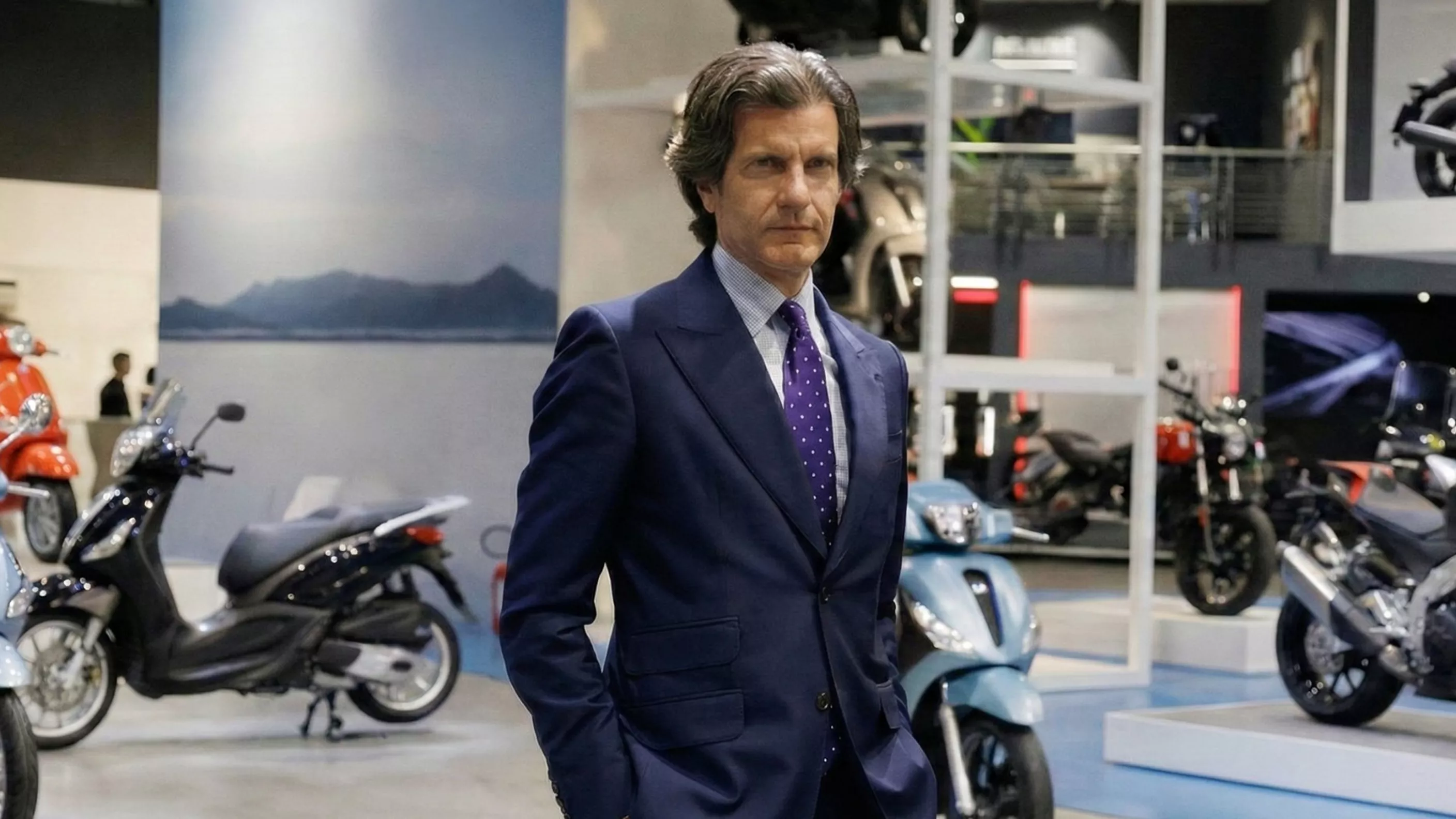
Europe remains the most valuable arena, says Piaggio CEO
Michele Colaninno on EV delays, India's rise and the future
Piaggio CEO Michele Colaninno discusses market outlook, electrification hurdles, Europe vs. India production, MotoGP strategy, Vespa limits and Moto Guzzi's future.
&width=72&height=72&bgcolor=rgba_39_42_44_0&mode=crop "Author: Poky")
Poky
published on 17/12/2025
Interviewer: Poky, 1000PS Interviewee: Michele Colaninno, CEO Piaggio Group
Poky, 1000PS: Looking at the current year, we see a decrease in market sales of 2025. What is the outlook for the European two-wheeler market in 2026 and 2027 after this slowdown?
Michele Colaninno: I don't know. If you find someone with a crystal ball, he will be able to tell you. Europe is still the most relevant market in the world by value, and everybody is investing in products for Europe. But with politics, wars, inflation, exchange rates, it's difficult to forecast.
Poky: Which market is the second most important after Europe?
Michele Colaninno: India. They are growing their capability to buy premium products. GDP per capita is growing faster than in other countries. They want to grow.
Poky: In Europe we see a trend towards electromobility. With Piaggio 1 and Vespa Elettrica you have your own approach. You're also part of the swappable battery consortium. Will we see fixed batteries, larger packs—what's your take?
Michele Colaninno: The consortium was launched through a Piaggio idea. I'm personally convinced that swapping is the most interesting system for two-wheel customers: easy, no need for recharge stations, no need to wait six hours. But we depend on battery technology. If a battery could guarantee 1,000 km on a single recharge, everybody would move in that direction for scooters. For bikes it's different—more powerful batteries, limited dimensions. The electric market will take longer than expected in Europe. It's a transition, but it's not tomorrow morning. Nobody is investing in public infrastructure. The market is not there. It will come—slowly.
Poky: What slows it down—Brussels, competition, or the market?
Michele Colaninno: Battery technology: autonomy and recharge time. A customer can buy a combustion engine that does 50 km with one liter. Two-wheelers account for 0.5% of total pollution in Europe. Two-wheelers are not the problem. The constraints are infrastructure and batteries. If you solve batteries first, it becomes interesting.
Poky: When will electric alternatives meet the low cost of ownership of combustion engines?
Michele Colaninno: Fifteen years. It's just a number—maybe ten, maybe twenty. Fifteen is an average.
Poky: On platform sharing: where do common components make sense, and where do you protect brand DNA?
Michele Colaninno: In combustion engines everything is known. The "brain" of the vehicle—combustion management, battery management—that I want to own and protect. The future is more robotics and software than steel and engines. We invested in a Boston robotics company. From them we created our own radars, rear and forward. Safety can be improved through software. In electric, everything is software—the brain stays at home.
Poky: You're building a new plant for Moto Guzzi. With KTM moving to India—will it still be possible to produce in Europe as costs rise?
Michele Colaninno: Someone told me I'm crazy to put money in Italy for a new factory. Production cost in Europe is ten times India. But European culture is part of our heart; we won't throw it away just for money. Money is important, but so are people. I won't fire people in Italy to move everything to India or China. Mandello will be the next hundred years. A factory is part of our culture. We want to stay in Europe, while understanding Europe is not alone.
Poky: With Aprilia you are producing in India already. Will we see more bikes from there?
Michele Colaninno: The bike world is divided in two: upper high-end bikes can stay in Italy with higher prices. World bikes must follow competitive price positioning. Competition builds outside Europe—we must follow. For middle displacement, India is the right place: not only low cost, but the market is there. Technology growth in India is now more comparable to Europe. China slowed down but grows slowly every year. India is where growth will be stronger.
Poky How do you avoid cannibalization between Piaggio and Vespa?
Michele Colaninno: Different customers. Piaggio is commuting A to B. Vespa is premium, fashion, lifestyle. Some overlap, but Vespa is unique—no competition. Some try to copy us, but they cannot copy brand, history, culture. We try to prevent stupid copying.
Poky Aprilia has grown in MotoGP. Will racing continue to play a strategic role?
Michele Colaninno: Absolutely yes. Liberty Media will attract younger generations with their platform. Competition must be fair—if only the richer wins, that's not good. I'm not pushing for a budget cap. We have shown you can achieve results even as newcomers. Did we increase investments? No. Too much money stops people thinking. I prefer ideas. I'm happy about the new regulations for 2026/27. We'll see fantastic Aprilia products. Racing helps—brand value and sales have grown. We try to use what we can from MotoGP for street bikes. With the new rules, less aero, less software, more mechanical.
Poky: Moto Guzzi has loyal but older customers. Are you worried the generation will fade—and how do you attract younger riders?
Michele Colaninno: Younger generations will be happy. New factory, new development, new engineers—everything is aligned. There might be room for something below a V7. Come to Mandello in September—you will be astonished. It will not just be production; it will be a world of Moto Guzzi with a new museum, services, fine-tuned bikes. The location is unique—Como Lake and mountains.
Poky: There is demand in German-speaking countries for a bigger Vespa. You have a 400 cc engine—why not use it?
Michele Colaninno: With Vespa you must pay high attention to style and design. Everything must match dimensions and the steel body. We are thinking about it, but we don't want to create a monster. Vespa must remain a Vespa. Even a smaller one could be interesting. It's not a GT—if you make it too big, design suffers. If design can match a bigger displacement, why not.
Poky: How is the Vespa Elettrica performing?
Michele Colaninno: Not a tough start. Customers are low in numbers; most of the electric market is delivery riders, not private owners. They love the electric Vespa—we sell it for €8,000, but only a few. We keep producing it to be ready when the market starts. Every year we invest in electric, without rushing a completely new range.
Poky: Gen-Z is mainly on phones and screens. How do you attract them to Vespa?
Michele Colaninno: By giving them a world, not just a vehicle. Vespa has always been more than a vehicle. We create a world of music, art, sculpture—whatever attracts the new generation. Could this be virtual? Could be.
Poky: Which regulatory changes would improve two-wheeler uptake?
Michele Colaninno: Licensing, parking, urban access. Policymakers must understand two-wheelers are a solution, not a problem. Smaller, not polluting, easy to use. They could kill the market with legislation in two hours, but I don't think they're against us. We have no CO₂ legislation because our share of pollution is 0.5%. Mobility is widening—two-wheelers will grow.
Poky: Beyond electrification: synthetic fuels, lightweight materials—what defines the next decade?
Michele Colaninno: Nobody should dictate the technology. We should be free to choose, as long as we meet targets. No single technology will revolutionize the market. It will be a mix—some electric, some e-fuels. Not hydrogen: compression and storage are too complex. Technology is never a problem if it fits customer needs.
Poky, 1000PS: Thank you very much.
Michele Colaninno: Thank you.