Its predecessor, the V02, already made a name for itself in the paddocks thanks to its forgiving character and long service life. Available in various compounds, it brought plenty of joy to trackday riders on all sorts of asphalt surfaces and temperatures. But when it came down to the fight for the last few tenths, the V02 still had a bit of room for improvement in certain areas. That's exactly where Bridgestone now steps in, delivering the completely newly developed V03 to close that small gap. Drawing on extensive experience, especially from the Endurance World Championship, the engineers have poured their knowledge into the new slick and improved it particularly in terms of performance.
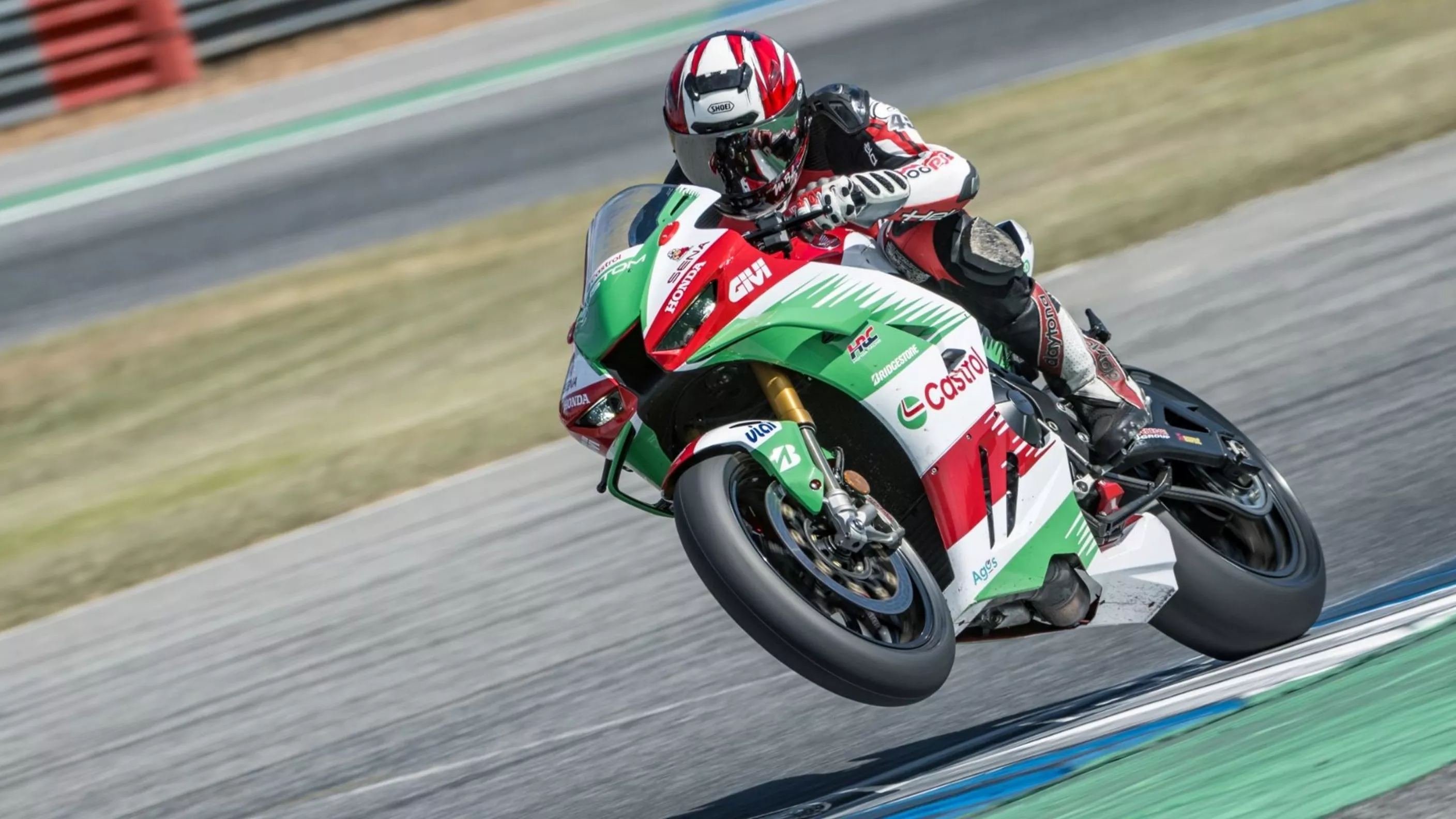
Bridgestone V03 Slick Tested: More Grip, Stability and Speed
New Bridgestone V03: Noticeable Advantages Over the V02
The new Bridgestone V03 shows on the race track right away that it's far more than just an evolution of the V02. More grip, more stability and impressive feedback make it the ideal tire for ambitious trackday riders and racers chasing the last few tenths.
&width=72&height=72&bgcolor=rgba_39_42_44_0&mode=crop "Author: Martin_Bauer")
Martin_Bauer
published on 07/12/2025
10,199 Views
So what's different now?
Basically everything. From the carcass to the contour to the rubber compound, Bridgestone has given the entire construction a complete overhaul.
The carcass has been expanded with the GP-Belt, an additional belt, which enables an increase in the contact patch particularly where it matters most, namely at lean angle. This is meant to increase not only side grip but also grip when accelerating out of a corner.
At the same time, the tire's contour has also been adjusted. On the front tire, the diameter in the middle section hasn't changed. Toward the shoulder, however, the new V03 builds up a bit more grunty and therefore has a slightly less pointed contour. This is meant to bring advantages not only in contact patch but also in stability, especially when trail braking into a corner. Depending on flex, this also provides more options for adjusting the tire's inherent damping.
With the rear tire, they took a different approach. Here the inner diameter was increased by about 7mm while the shoulder was left nearly unchanged. This tips the bike slightly forward when riding in a straight line and creates a more nimble geometry, meant to compensate for the somewhat grunty shape. This must, however, be taken into account elsewhere too. Anyone switching from the V02 to the V03 can switch to a shorter final drive ratio, since this is compensated for by the larger tire diameter.
With the rubber compounds, there are different options depending on ambient temperatures. At the front, you can choose between 2 compounds: Soft-Medium and Soft.
On the rear tire, there are 3 compounds to choose from: Medium, Soft and Sprint.
As a general rule, Bridgestone recommends that the softer tires be used at colder temperatures and the harder ones at hotter temperatures, contrary to some competing brands. With the Sprint compound, however, they want to give the rider especially high grip regardless of temperature, in order to get even more performance over shorter distances.
Size matters
The new V03 slicks will be available in sizes 120/70 R17 and 200/60 R17 from early 2026. From 2027, the smaller 190/60 R17 dimension is set to follow.
So much for the theory, now for the practice.
Ride test:
Right from the first contact with the new Bridgestone V03, it became clear that this tire is more than just a model update. The conditions for this test could hardly have been better: various superbikes, constant weather conditions, and with the Chang International Circuit a modern race track that demands grip, quick direction changes, and high stability in equal measure. Bridgestone had also prepared us perfectly. This allowed us not only to draw a direct comparison between the V02 and V03, but also to experience it on four different bikes: Honda Fireblade, Yamaha R1, BMW S1000RR/S1000R, and Ducati Panigale V4 S.
The test day deliberately began classically with the V02, to have a fresh reference point. As soon as the V03 was fitted afterward and we rolled out of the pit lane, the difference was immediately apparent and left no room for interpretation. Where the V02 still felt lively, at times almost nervous, the V03 presented itself with a completely new sense of calm and stability. Right from turn-in, the two tires behaved like night and day. Especially on bikes that naturally carry a bit of restlessness, the BMW S1000RR being a good example, the V03 delivers an impressive amount of ground-feeling, trust, and predictable feedback. Even riding in a straight line feels more relaxed and precise.
This enormous difference doesn't come about by chance, as Bridgestone worked intensively on the basic construction. The now grunty front tire delivers noticeably more inherent damping and increases control as well as stability at lean angle. The front tire itself is noticeably softer in construction, which particularly helps when bumps or limit situations put strain on the front. Feedback stays calm, clean and clear. The rear tire, on the other hand, was increased in diameter in the middle, creating a more pointed contour. Combined with nearly unchanged outer areas, this results in a wider, more effectively usable contact patch that improves grip not only through the compound but also through the geometry. The stiff carcass remains characteristic of the rear tire, which under certain conditions can lead to a slight tendency to chatter over hard bumps, but overall delivers very stable riding behavior.
On track, this new interplay of flexibility and stability is very clearly evident. The V03 requires a bit more effort when turning in than the V02, but many bikes can be perfectly tuned to it via a small geometry adjustment, such as raising the rear end. Once this fine-tuning has been done, the advantages of the V03 come through even more strongly: a calm front wheel, impressive stability even at the limit, and a precise, predictable feeling in every phase of the corner. This is exactly where the tire shows its great strength, especially on bikes that can benefit from a bit more settling in the chassis.
For the compounds, Bridgestone draws on a great deal of know-how from the Endurance World Championship and previous MotoGP campaigns. The new, softer Sprint compound brings not only maximum grip but also additional flex to the stiff rear carcass. The overall result is a tire that scores points both with grip and with flexibility. It also covers a very wide temperature window and can be used on both cold and warm asphalt. This should make tire selection considerably easier for many users.
Durability is also impressive. In our sessions of 10 to 20 fast laps, both the front and rear showed clean, even wear patterns. The initial grip is especially strong, drops off slightly after a few laps, but then remains stable over a long time afterward. The Sprint compound on the rear naturally delivers the highest grip and still shows surprisingly strong performance even after 15 fast laps. Particularly positive: even on the very grippy Chang asphalt, the shoulders remained clean and even, a strength the V02 already had and which is found again on the V03.
The optimal tire pressures are at the familiar level: 2.3 bar at the front, 1.6 to 1.8 bar at the rear when warm. This is where the V03 shows its best blend of grip, stability and feedback.
The V03 will initially be available in 120/70 17 and 200/60/17. The slightly smaller 190 size will only be available from 2027.
Conclusion:
Bottom line, the Bridgestone V03 is a clear step forward. It gives the bike noticeably more calm, provides a first-class feel for the surface, and combines grip with stability at a level that surpasses the V02 in nearly every area. A tire whose improvements aren't just on paper, but which you can clearly feel within the first few meters.
Pros:
- Calmer riding performance
- Long service life
- New Sprint compound for a wide temperature window
Cons:
- Somewhat prone to chatter over bumps and on soft chassis setups
More tire tests on the race track
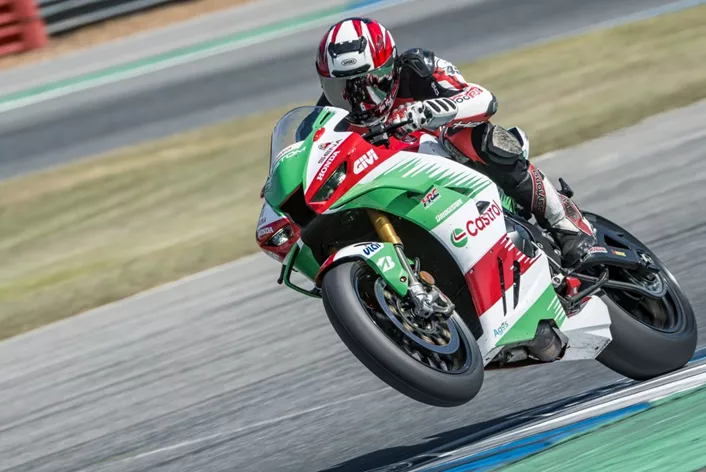

Conclusion: Bridgestone V03 Slick: more calm and stability
The V03 is a fundamental redesign from carcass to contour to compound. In a direct comparison with the V02 on the Chang International Circuit, the difference is immediately apparent and leaves no room for interpretation. Where the V02 feels lively and at times nervous, the V03 presents itself with a new sense of calm and stability. Especially on restless bikes like the S1000RR, the grunty front tire delivers more inherent damping, more ground-feeling and predictable feedback. When turning in, it requires a bit more effort than the V02, but can be well tuned via a small geometry adjustment. The new Sprint compound brings high grip and covers a wide temperature window on both cold and warm asphalt, which makes tire selection easier. Durability is convincing: initial grip drops off slightly after a few laps but then stays stable for a long time, even after 15 fast laps. On rough bumps, the stiff rear carcass can be slightly prone to chatter. For trackday riders who want a calm, controllable bike, the V03 is clearly the better choice over its predecessor.
Bridgestone V03 Slick Tested: More Grip, Stability and Speed Images
Source: 1000PS


