Initially, only a model update was planned. "But it somehow got out of hand," chuckled one of the KTM engineers during the presentation of the numerous new features of the 1390 Super Adventure S EVO in Tenerife. The result is the new spearhead of the orange adventure and touring segment—a motorcycle packed with technical innovations and cutting-edge performance. Even with a year's delay, it's no outdated machine, as we confirmed during an extensive ride. While parts of the frame and tank shape from the previous model were retained, we were presented with a completely new bike. Ten years after the first Super Adventure in 2015, it was simply time for the next big leap, which was fortunately only postponed, not canceled, due to the insolvency.
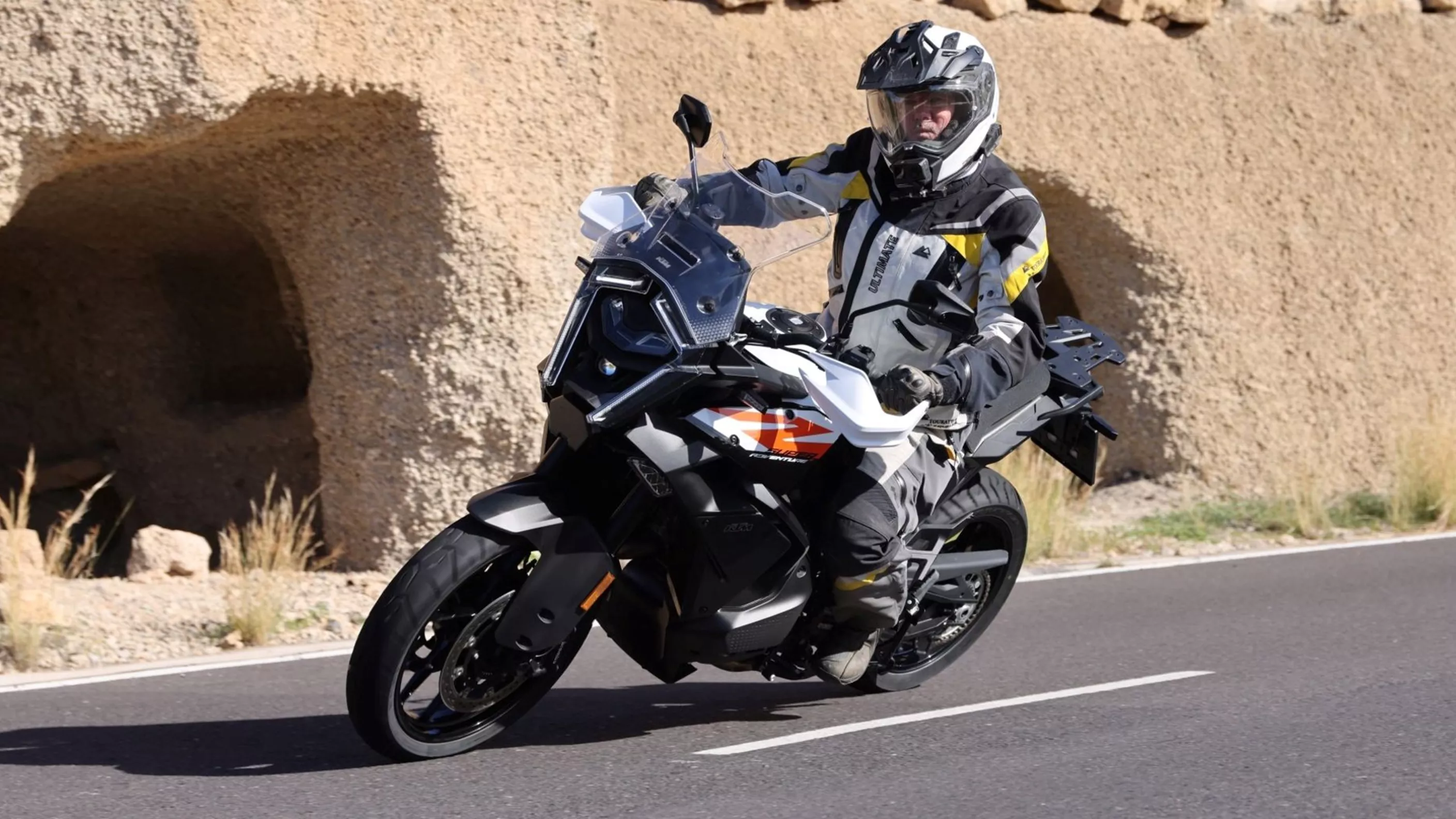
First Ride Review of the 2026 KTM 1390 Super Adventure S EVO
An Explosive Powerhouse with Utterly Refined Manners
Last year at EICMA, KTM proudly unveiled the 1390 Super Adventure S EVO with an automatic transmission as the new touring flagship from Mattighofen. Now, a year and an insolvency later, it finally hits the dealerships. We had the opportunity to put it to the test in Tenerife. Our travel expert, Wolf, explored whether the wait was worth it and how the many new features of this thoroughly revamped "made in Austria" motorcycle perform in real-world conditions.
&width=72&height=72&bgcolor=rgba_39_42_44_0&mode=crop "Author: wolf")
wolf
published on 04/12/2025
Model Update Gone Wild
The Engine with Camshift Technology Now Delivers an Impressive 173 HP
The 75-degree V-twin engine's displacement was increased from 1,301cc to 1,350cc, producing 173 HP at 9,500 rpm, making the Super Adventure the most powerful adventure tourer on the market. This is because Ducati's Multistrada V4 RS (180 HP) with its 17-inch wheels is classified under the crossover segment. The maximum torque of 145 Nm kicks in at 8,000 rpm. The engine received new throttle bodies, a two-millimeter increase in piston diameter, and, most importantly, a camshift system (variable camshafts/geometry) aimed at boosting power delivery from 6,500 rpm. Additionally, the valve seats were modified, allowing the valve adjustment intervals to be doubled from 30,000 to 60,000 kilometers!
Automatic in a KTM? The World Might Be Ending, but It Works
The biggest innovation—or revolution—here is the new AMT. KTM calls it "Automated Manual Transmission," but let's be real, it's an automatic. What? An automatic in a KTM? Ready to Race? Seriously? The market and the riders will decide if it catches on, but the system works so well that it doesn't detract from the bike's sportiness. Instead, it significantly boosts comfort. Riding in manual mode feels a lot like using a Rekluse clutch, which isn't too far off technically. The clutch lever is absent, though. You can still switch to manual shifting anytime, with several options: a traditional foot lever, paddle shifters on the left handlebar, and even the ability to downshift by quickly closing the throttle. It feels like riding with a quickshifter, but the longer the test ride went on, the less I used those options. The automatic works extremely well. No shifting surprises; the system inspires confidence and lets the gears slip right in. There are three shift modes—Comfort, Street, and Sport—each differing in how high the RPMs go before shifting, and they're linked to the respective riding modes. In Sport mode, it gets really sporty, almost too much on twisty roads, where the more moderate modes offered a smoother ride without sacrificing much speed. Moderate might be an overstatement; even Comfort isn't under-revved, and it's absolutely "KTM-worthy," turning out to be the most pleasant shifting option for me. If you intervene in the automatic mode using the foot lever or paddle shifters, you stay in manual mode for four seconds before the system returns to automatic. You can't stall the bike in manual mode either; if you don't shift to neutral at a stop, the system does it for you. Besides the six gears, there's also an eighth position, 'P' for Park, which locks the rear wheel.
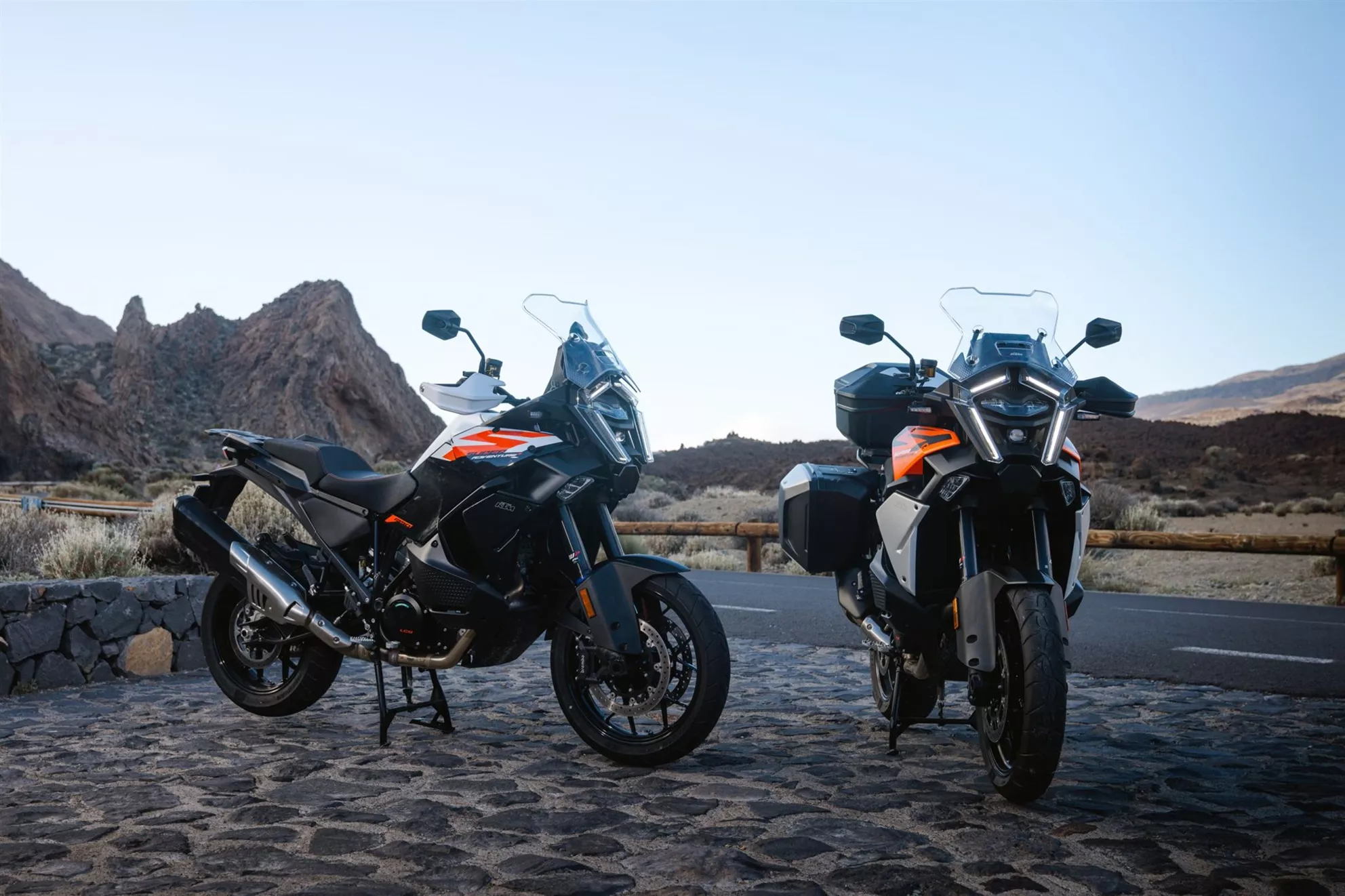
KTM with Automatic? Yes, you read that right.
From Soft to Hard: The WP Semi-Active Suspension Handles It All
Just like the AMT, KTM seamlessly integrates the semi-active suspension into the rest of the electronics, particularly the ride modes. The latest generation of the WP Apex SAT, with 220 millimeters of travel front and rear, responds even faster and more sensitively to various data and road conditions. This enhances comfort and, together with the stiffer frame, provides even greater ride stability. The fork received a new cartridge concept, and each ride mode has its own suspension setup, which can be further adjusted in the menu. Especially when pushing hard, the Sport setting is recommended, as it makes the bike carve through curves like it's on rails. The shock's preload can be adjusted both individually and automatically, ensuring the bike maintains the same level regardless of the load. As with the previous model, there's an electronic "Anti-Dive" function for the fork, preventing it from diving. While useful for sporty riding, I personally miss the front-end feedback you get from a classic upside-down fork. That's why this function remained mostly unused during our tour on Tenerife's winding roads. The electronically controlled damping works so well, you can customize almost everything on this motorcycle to your liking, whether you prefer it comfortably soft or sportily firm—it's purely a matter of adjustment.
8-Inch Color Display with Integrated Offline Navigation
Settings and readings are displayed on an 8-inch TFT color display in portrait mode with a touchscreen that responds to gloved hands and features a split-screen function. Besides standard smartphone connectivity for calls or music, the display stands out with integrated offline navigation, requiring no connection to a mobile phone. You only need a Wi-Fi connection or hotspot to download map data, freeing you from network worries on the road. With 32 gigabytes of storage, there's space for maps of several countries, even for extended trips. However, routes currently need to be planned on the display itself, as you can't yet import GPX files or create and transfer routes from a PC or mobile app. These functionalities are expected to be available next year when future owners in our regions embark on their first extended tours. We independently navigated to our lunch stop and back to the hotel, with active speed warnings and excellent readability. Once the mentioned drawbacks are addressed, a conventional GPS will be unnecessary on the KTM 1390 Super Adventure. All menu functions can be operated via touchscreen or the new joystick on the well-organized handlebar, considering the extensive features. The switchgear feels solid, and despite numerous settings, it's easy to navigate through the KTM's depths.
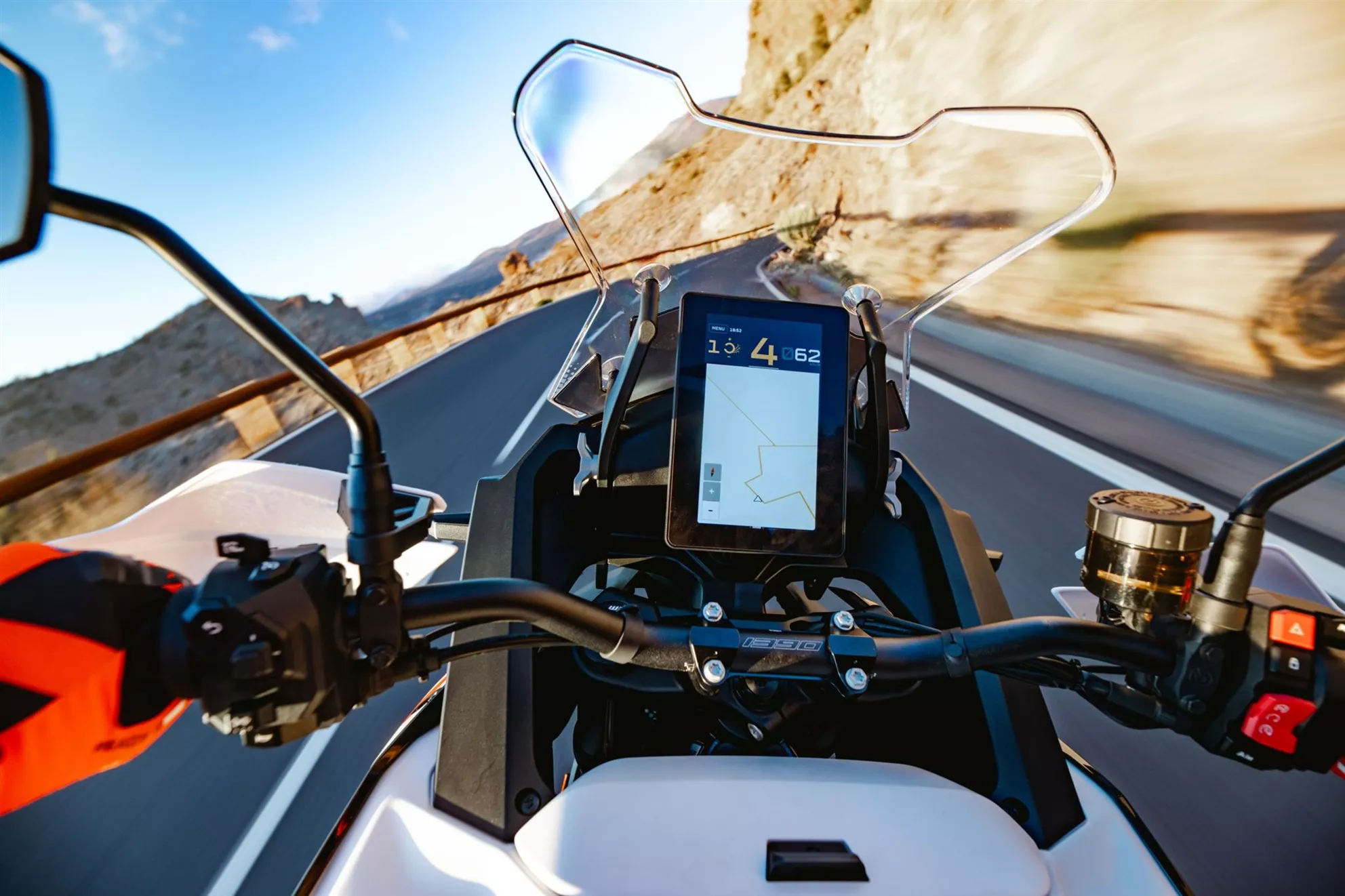
The 8-inch TFT color display in portrait format.
Five Riding Modes Standard - Get Three More Plus Dynamic Slip Adjuster with the Rally Pack
Practical: A dedicated mode button on the right handlebar allows for quick switching between riding modes. Standard modes include Street, Rain, Sport, Offroad, and a customizable Custom mode, each coordinating throttle response, traction control, ABS, engine braking (a first for KTM), electronic suspension settings, and AMT shift level. In practice, it makes sense to combine a smoother shift mode with sharper throttle response or different damping, so it's definitely worth saving your preferred combination on this bike. Or better yet, three combinations, for which you'll want to opt for the recommended Rally mode as an extra. This not only gives you two additional Custom modes but also allows you to adjust traction control through nine levels while riding. Additionally, there's the new Dynamic Slip Adjuster, which debuted on the new 690 Enduro R and will gradually be introduced to KTM's adventure tourer models. The 1390 Super Adventure, whether the S EVO, S, or R, leads the charge. What's that mean? If you're on a loose surface like a steep gravel climb or a muddy section and the traction control is set too high, the electronics detect the mismatch between wheel traction and throttle input, reducing the TC until the section is cleared, then returning to the original setting. It works almost frighteningly well. The only reason not to ride constantly in Rally mode, which can be combined with road ABS, is that ACC is unavailable in this mode.
Radar-Controlled Cruise Control with Stop-and-Go Function
Which brings us to the next technical highlight of the new 1390 Super Adventure S EVO: the radar-controlled Adaptive Cruise Control. Produced by Bosch, this system has significantly improved in terms of sensitivity and capabilities, allowing for effortless cruising on highways. Thanks to the new Stop-and-Go function in conjunction with the AMT, it can even handle urban traffic for extended stretches. After coming to a short stop behind a vehicle, be it a car or motorcycle, the SAS will automatically resume moving. However, this only works if the stop is under three seconds; beyond that, you'll need to manually apply throttle. The throttle response is determined by the preset, whether in Sport, Comfort, or Group Ride mode, which is optimized for riding with multiple motorcycles. These excellent comfort features are complemented by safety enhancements from the radar, such as prohibiting overtaking on the "wrong" side while in cruise control—right in our region, left in Britain—though in practice, this is rarely used. Why limit yourself, for example, if the right lane on the highway is moving faster? Even without active cruise control, the emergency braking assistant functions, actively aiding the braking process when a vehicle in front decelerates significantly, and the system senses you're too close. It works well with cars, though in a fast-moving motorcycle group, the system intervenes a bit early for my taste. There's no "objection" from the ghost hand on the brakes if you're simply driving faster than the vehicle ahead—you might just be overtaking. Unlike its predecessor, which wasn't retrofittable, the current ACC allows a Super Adventure S or R, which comes standard with a conventional cruise control, to be equipped with a radar sensor from the Power Parts catalog.
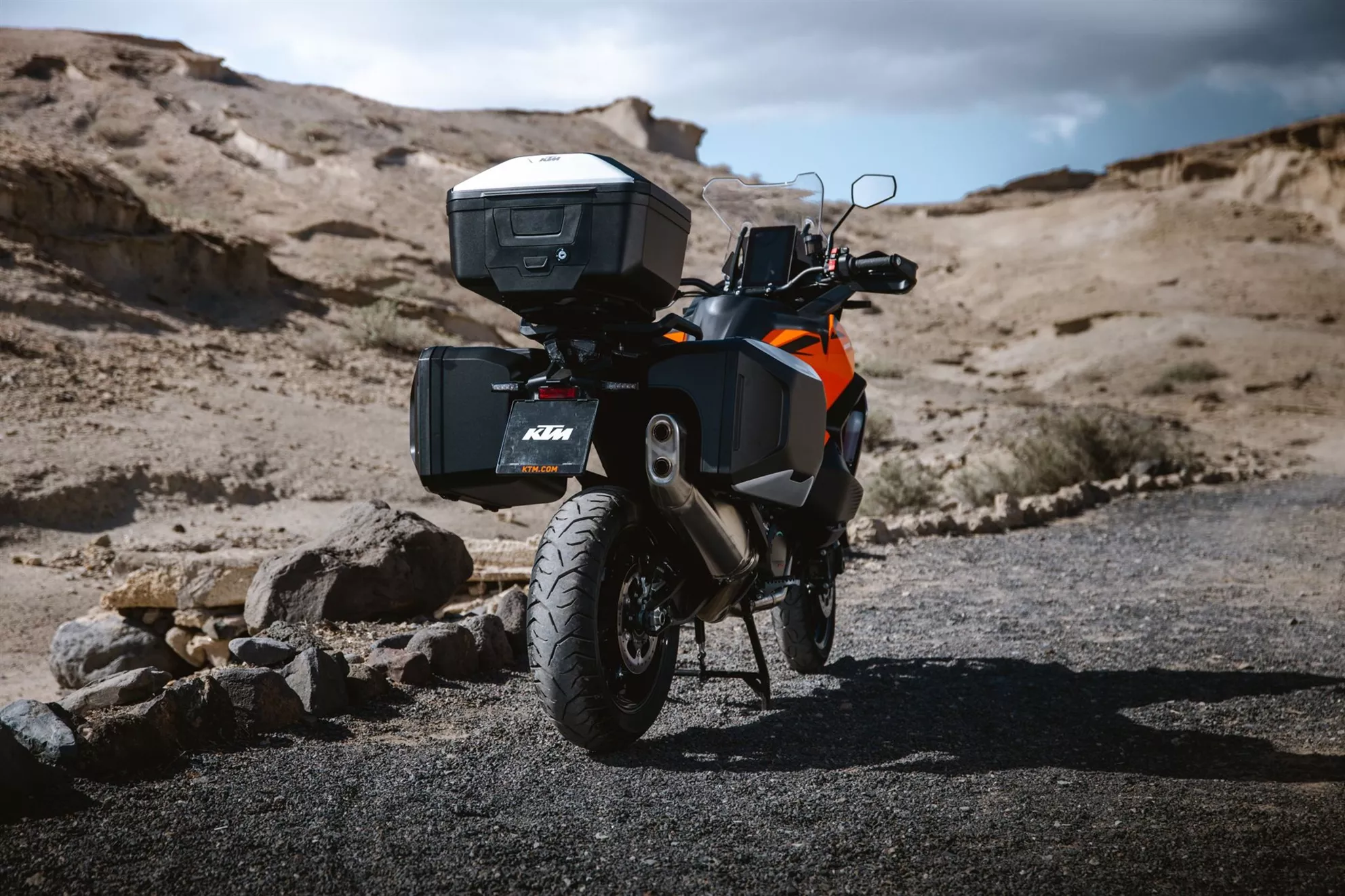
KTM also offers various luggage systems in the accessory catalog.
A Powerhouse That Can Behave Impeccably When Desired
All of this contributes to the 1390 SAS EVO striking a better balance between comfort and sportiness than just about anything else on the market. The bike is perfect for relaxed touring and traveling—even two-up with luggage, thanks to its impressive power—and equally adept for some serious sporty riding. With a twist of the throttle, it transforms from a laid-back companion into a powerhouse flexing its muscles! Whether tackling tight or sweeping curves, the bike is effortlessly maneuverable. The handlebar, 30 millimeters wider than its predecessor and equipped with standard vibration dampening, aids active riding in a relaxed, upright position. The seat height of 847 to 867 millimeters is quite moderate for an adventure tourer. The knee angle is comfortable for my 1.75-meter frame, although the still rather wide tank doesn't offer a perfect seating position, especially when things get sporty. There's nothing to complain about regarding the wind protection, thanks to the newly designed screen, now adjustable by 70 millimeters instead of 50, which should minimize turbulence for those up to 1.85 meters tall. The footpegs have moved 10 millimeters outward and 8 millimeters downward, making standing rides more comfortable without noticeably sacrificing the SAS's legendary lean angle capability. On our route, the pegs might have scraped the asphalt twice, but given the countless corners, it's negligible.
The Thirst of the More Powerful Engine Needs Closer Examination
In terms of fuel consumption, the powerhouse was anything but frugal. By the end of the day, the display showed 7.1 liters per 100 kilometers, with the figure rising a fair bit higher at times. This warrants closer examination in real-world scenarios. KTM claims a standard consumption of 6.7 liters, which, combined with the 23-liter fuel tank, still provides a realistic range of over 350 kilometers. However, it's more than the not-at-all underpowered predecessor typically consumed. The 1290 Super Adventure S could realistically be ridden with well under 6 liters. Weighing in at 227 kilos dry and 245 with a full tank, the new model is definitely among the lighter options in the high-performance touring motorcycle category. With a generous payload capacity of 230 kilos, it's also well-suited for two-up touring. It can certainly venture into the Tyrolean Außerfern, as the KTM can only chuckle at the arbitrary 95-decibel limit with its stationary noise level of 91 dB.
Without AMT and ACC, Save Two Grand and Still Get the Most Powerful Adventure Tourer
Conveniently, there's a larger compartment in front of the fuel cap, which can easily store an XXL smartphone and charge it on the go via a USB-C port. The well-organized toolkit under the seat leaves nothing to be desired. When it comes to stock tires, they don't cut corners either, equipping it with the Dunlop Trailmax Meridien, a premium 90/10 tire, which some felt the Mitas Terraforce didn't quite match. In addition to AMT and ACC, the 1390 Super Adventure S EVO comes with a center stand as standard, priced at 25,399 euros in Austria and 22,999 in Germany. If you opt out of the automatic and adaptive cruise control, the Super Adventure S is two grand cheaper (23,399 in Austria and 20,999 in Germany), while the R version is priced at 23,799 in Austria and 21,399 in Germany. These prices are quite competitive compared to rivals like Ducati or BMW, though a wide range of Power Parts can certainly drive them up.
The Technical Foundation is Set to Regain Customers and Trust
There's no doubt: The 1390 Super Adventure S EVO, planned, developed, and manufactured in Mattighofen, is an immensely important model for KTM on its arduous journey to regain lost customers and trust. Technically, it's beyond reproach—an outstanding motorcycle, also in terms of its tactile feel and detailed craftsmanship. The amusing feature of finding "Austrian" in the language menu, where terms like "Schoitblitz" for shift light or "Owe vom Gas" for throttle close provide a chuckle or two, proudly showcases their patriotism. The goal is to ensure that Austria remains a production hub for at least the large models and the Hard Enduro and Motocross product lines. Ultimately, it will be quality that decides this. Satisfied customers want to ride the motorcycle, not push it into the workshop for repairs. A four-year warranty is commendable, but ultimately irrelevant if the product doesn't live up to expectations. The technical foundation is certainly laid with the 1390 Super Adventure, but the well-deserved initial praise from an impressive test day must prove itself in the long run. The Orange Bleeders have bled enough over the past twelve months; the new models must once again put a smile under their helmets if KTM wants to sustainably compete with the big players.
Reviews of Other New Releases
- How much does a KTM 1390 Super Adventure S EVO cost?
- Here you will find an overview of the price level of new and used motorbikes!
&width=60&height=60&bgcolor=rgba_39_42_44_0&mode=crop "Author: wolf")
KTM 1390 Super Adventure S EVO 2026 - Experiences and Expert Review
wolf
With the 1390 Adventure S EVO, KTM demonstrates what is technically possible, packing new and improved comfort features like a wonderfully functioning automatic transmission, adaptive cruise control, and semi-active suspension into an extremely refined motorcycle after ten model years. It undoubtedly ranks among the sportiest adventure tourers. Whether cruising comfortably on a tour, even two-up, or aggressively carving through mountain passes, the SAS proves that comfort and sportiness are not mutually exclusive.
First Ride Review of the 2026 KTM 1390 Super Adventure S EVO Images
Source: 1000PS


