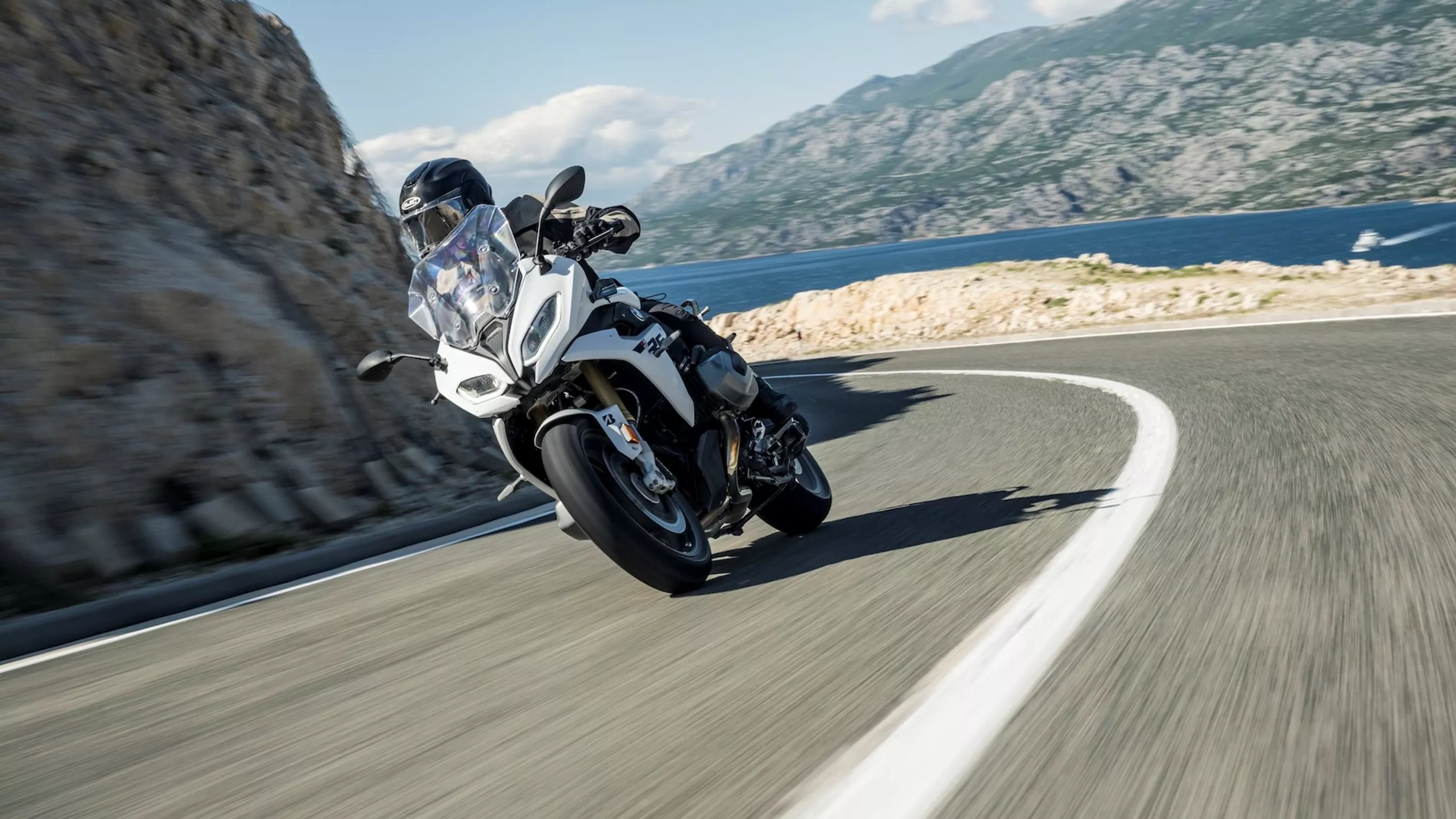
As the Croatian coastal road winds ahead of me like a ribbon of asphalt through the landscape, Bridgestone's new touring tyre shows me what it's really capable of. The T33 impresses with lean-angle confidence, neutral cornering technique, and high riding comfort. During my test on various bikes – from the heavy BMW R 1250 RT to the versatile Kawasaki Versys 1100 – one thing stands out in particular: a tyre that strikes an astonishingly good balance between durability and performance.
Bridgestone T33 tested
Now with more tread life
The new Bridgestone T33 wants to shake up the sport-touring segment! Significantly longer tread life and fine feedback on a wide range of bikes. We rode the new tyre on various bikes in Croatia.
&width=72&height=72&bgcolor=rgba_39_42_44_0&mode=crop "Author: nastynils")
nastynils
published on 18/05/2025
53,884 Views
When the rubber bites – first corner-carving in Croatia
The asphalt glows in the Croatian midday sun as I steer the BMW R 1250 RT through the next hairpin. What would normally be a ponderous manoeuvre on this 279-kilogram touring behemoth turns into an almost playful affair with the new Bridgestone T33. The front wheel glides into the radius as if by magic, as though someone had secretly outwitted physics. A bike in this weight class shouldn't feel this light-footed – and yet it does. The first proper cascade of corners in the mountains reveals what really defines the T33: this incredible trust in the front wheel. I can feel every millimetre of asphalt through my palms, without being disturbed by nervous reactions. It's this fine balance that makes me pause. Am I still riding a big touring machine, or has someone secretly swapped in a sport tourer? "This thing pulls into the corner like a terrier on a leash," I blurt out during the first photo stop. Bridgestone's press representative smiles. "That's down to the newly developed center compound and the optimised tread design." Sounds like marketing blabla, but after a few more twisty kilometres I have to grudgingly agree with him. What I'm feeling here isn't imagination, but the difference between good and outstanding tyre design.
One spec for all – revolution or marketing gimmick?
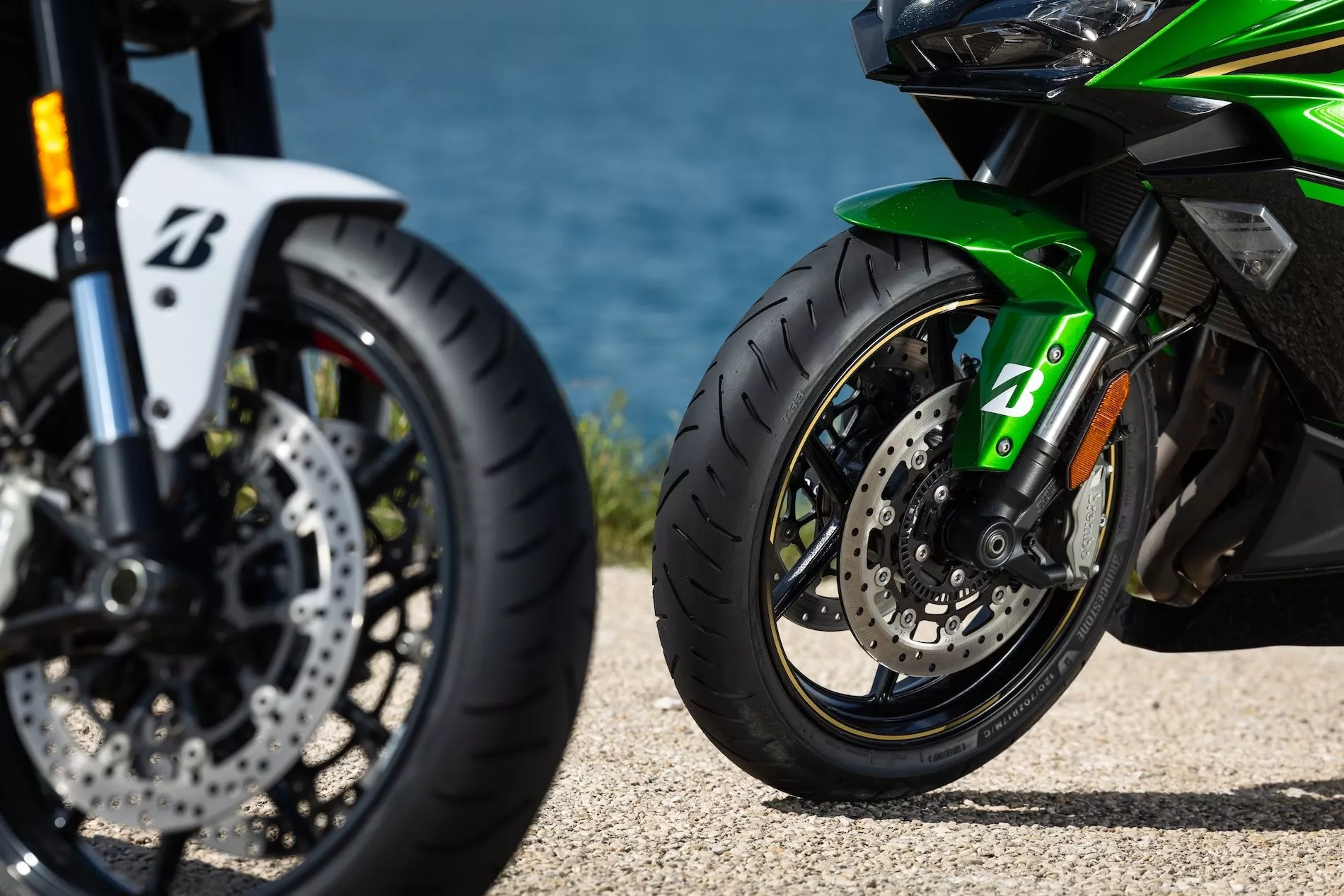
One tyre for a wide range of bikes. From naked bike to touring machine!
When the T32 came onto the market, Bridgestone launched two variants at once: the standard tyre for regular sport-touring bikes and the GT version for heavier bikes. With the T33, they're now taking a radically different approach: one tyre for everything – from the light naked bike to the fully loaded tourer. On paper, that sounds like a lazy compromise. In practice, it turns out to be a clever move. According to Bridgestone, the goal was simple: retain the T32's performance but dramatically increase its tread life. What resulted is a tyre that, in Bridgestone's internal tests in Sardinia, is said to offer a remarkable 47 percent increase in tread life compared to its predecessor. A figure I initially viewed with the typical skepticism of a motorcycle journalist. Such leaps are rare in tyre development – evolution here usually proceeds in small steps. Technically, Bridgestone really dug deep into its bag of tricks for the T33. I focus on the front! The tyre is stable but not stubborn – it offers feedback without becoming nervous. This characteristic is reminiscent of the predecessor's GT variant, but tuned more sensitively. At the rear, a 3LC technology (3-Layer Compound) works with a newly developed center compound, which is said to contribute significantly to the improved tread life. What's particularly impressive is how differently the same tyre feels on different bike types. On the BMW R 1250 RT it offers confident touring performance, while it works just as well on the Kawasaki Versys 1100. But the 19-inch variant also did a fantastic job. I was able to confirm this in the saddle of the BMW R 1300 GS Adventure.
Great dynamics – when every corner becomes a pleasure
The Bridgestone T33 has a remarkable trait: it makes twisty roads addictive. With every turn-in, this subtle "I-want-to-go-into-the-radius" feeling emerges across the various bike models. It's not the aggressive falling-into-the-corner that some sport tyres show, but a gentle, almost elegant pull-in that always gives the rider the feeling of staying in control. On the BMW R 1250 RT with its 136 hp and a hefty 143 Nm of torque, you get handling this bike really shouldn't have. The boxer engine, with its unmistakable, commanding torque from down low, keeps tempting you to push the pace. The T33 gives you a damn good feeling of how the engine doles out its power – with precise feedback and no nervous twitches. "Barely any drawbacks from the boxer concept, but all the advantages." That's how the test log neatly sums up the boxer's character. And it's exactly this characteristic that the T33 supports perfectly. When you go full throttle and the boxer yanks you forward with its lovely punch, the tyre stays stable. That pressing forward-pull so typical of boxer engines is transmitted unfiltered, without losing any control. On the 19-inch front of the BMW R 1300 GS Adventure, the T33 shows yet another face. Here you feel a gentle pull inward – not tippy, not nervous, but precise and pleasant. Over bumps and rough surfaces, a composure remains that should surprise even experienced adventure riders. The T33 doesn't take anything away from the Adventure's characteristic feel, but reinforces its strengths.
Wet performance – on par with the T32
According to Bridgestone, the T33's wet performance sits slightly above the level of the T32. Unfortunately - or fortunately - we didn't have to verify this ourselves. Bridgestone ran complex tests here and presented us with equally complex graphics. Steering angles and "necessary corrections" were described. By this point in the presentation, though, I was already eyeing the massive grill. There, the dedicated cook had already laid out some seriously thick steaks, and the buffet offered plenty of treats. So I filed it away for myself as: "A bit better than the T32!" That should be fine both for me and for our community. Because in truth, the T32 only had one weakness - tread life. And that, according to the test riders, has been significantly increased. The rest is a nice bonus but not really necessary. So I used an old trick - big applause as the marketing guy paused for breath, the colleagues clapped along, and so we managed to shorten the PowerPoint marathon considerably and attack the buffet.
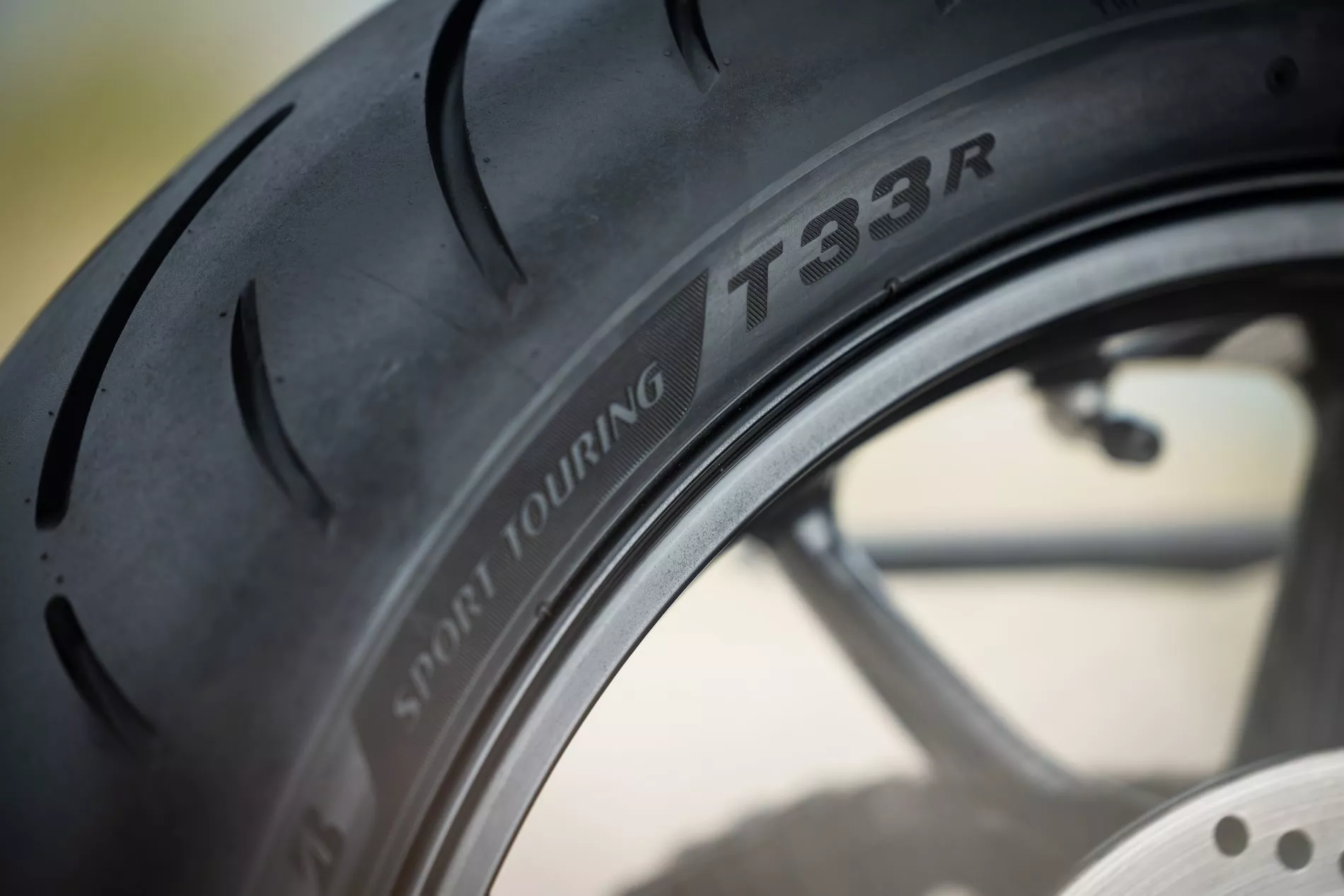
Bridgestone T33
The art of balance – longevity meets performance
Perhaps the biggest challenge for any tyre manufacturer is the balance between grip and durability. More grip usually means less tread life, and vice versa. Bridgestone's developers claim to have partially resolved this trade-off with the T33. The promised 47 percent increase in tread life over the T32 is a bold claim. My short test obviously can't verify this long-term claim, but the first signs are promising. Bridgestone says it evaluated tread life in an internal test using a fleet of Kawasaki Z1000SX bikes in November 2023. On the same route, under the same conditions, the T33 reportedly lasted 47% longer than its predecessor. The technical explanation for this improved tread life lies in the combination of new compound, optimised tread pattern, and improved construction. What's particularly important to me as a tester: this improved tread life doesn't come at the expense of handling or grip. Here, Bridgestone has genuinely made a step forward. Big leaps are rare in tyre development – which makes it all the more remarkable when a new model can score in several disciplines at once.
From tourer to sportbike – who is the T33 made for?
The one-spec-for-everything strategy naturally raises the question: can the T33 really be the best choice for every type of bike? Based on my experience, the tyre copes remarkably well with a wide range of bikes. The 1300 BMW GS Adventure with its 19-inch front wheel, 269 kg weight, and 145 hp feels confident with the T33. On the heavy BMW R 1250 RT with 17-inch wheels and its 279 kg, the T33 plays out its stability. Riding performance here is noticeably more neutral than in my previous tests with the machine. Especially at higher motorway speeds, the T33 conveys security without feeling sluggish. What surprised me most, though, was the performance on the Kawasaki Versys 1100. At 255 kg it's no lightweight, but noticeably more agile than the BMW models. Here the T33 showed its sportiest side. So who is the T33 best suited for? The answer is actually: almost everyone. From the sport-touring rider who attacks mountain passes on weekends to the long-distance tourer primarily after tread life, the T33 covers a broad spectrum. It's even excellently suited to sportier naked bikes. Like other sport-touring tyres, this one offers 3 key advantages over sport tyres: short warm-up time, great wet grip, and high tread life. In exchange, sport tyres like the S23 offer even sharper handling and more grip at high temperatures.
Sport-touring motorcycle tyres at a glance
So you can properly place the tyre, here are the relevant competitor models. In the fiercely contested sport-touring segment, the Bridgestone T33 positions itself against established rivals. Its direct competitors are the Michelin Road 6 and Road 6 GT, the Dunlop RoadSmart IV, the Continental Road Attack 4, and the Pirelli Angel GT II. Mitas offers the Touring Force and Touring Force SP in this class. Metzeler enters with the Roadtec 02.
Perfectly kitted out – SPIDI gear put to the test
During our Croatian test rides, I had the pleasure of wearing the SPIDI Mission-V jacket, which won me over with its innovative modular concept. The combination of a waterproof hard shell and a flexible armour layer proved to be a practical companion for the changeable production conditions. In particular, the STEP-IN ARMOR technology, with its versatile wearing combinations, proved to be a well-thought-out feature over the long test rides – started in the morning with all layers on, quickly adjusted at midday as temperatures rose. My outfit was rounded off by the SPIDI Charged Tex trousers, which formed a harmonious unit together with the jacket. The fit was excellent throughout, even after hours of sitting on various test bikes. Also notable was the high wearing comfort of the SPIDI X-GT gloves. The flexibility of the entire outfit proved thoroughly practical – whether on the agile Kawasaki Versys or the massive BMW R 1300 GS Adventure, freedom of movement was never restricted. A convincing overall package that held up well after the intensive test week. Because keen 1000PS readers will have noticed that I wore the same gear earlier in the week in Slovenia during the Tracer 9 GT+ test. There I also conveniently had the chance to test the T32 in practice. Equally handy: for my private hiking trip in Bled between the two tests, I had a high-quality, waterproof adventure jacket with me right away thanks to SPIDI's outer jacket.
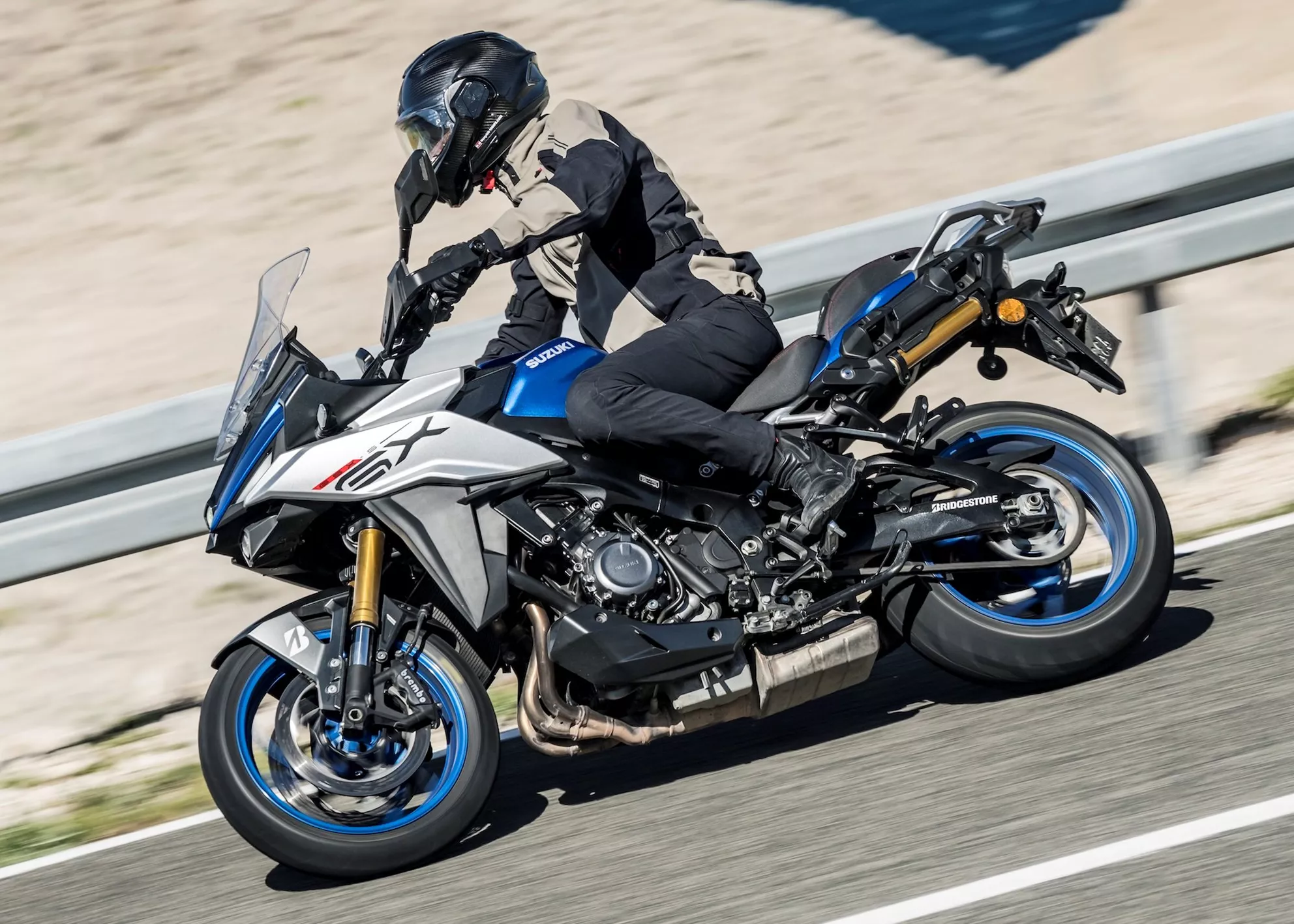
Tested: Spidi Mission V jacket
Available tyre sizes Bridgestone Battlax T33 (2025)
Front tyre sizes:
- 120/70ZR17 M/C (58W) TL
- 120/70ZR18 M/C (59W) TL
- 120/70R19 M/C 60V TL
- 110/80R19 M/C 59V TL
Rear tyre sizes:
- 150/70ZR17M/C (69W) TL
- 160/60ZR17M/C (69W) TL
- 170/60ZR17M/C (72W) TL
- 180/55ZR17M/C (73W) TL
- 190/50ZR17M/C (73W) TL
- 190/55ZR17M/C (75W) TL
According to Bridgestone, these ten sizes have already been available on the market since February 2025. Another five sizes, including some more exotic ones as well as the ZR variant of the 19-inch size for the GS and Multistrada with a W rating, will follow in 2026.
Bridgestone T33 tested
An interesting aspect is the extensive model lineup Bridgestone now offers. The T33 positions itself as the first choice for the European market, the T32 continues as the second line, and the T31 remains in the programme as the third line. This means Bridgestone also has affordable alternatives on offer - for motorcycle manufacturers, for motorcycle dealers who use them to equip their used bikes, but also for private riders. After impressions on various bikes and under a wide range of conditions, a clear picture emerges: the Bridgestone T33 is a solid step forward in the sport-touring segment. The promised 47% increase in tread life still has to prove itself in widespread practice, but the initial signs are promising. Even more important to me as a rider: this improved durability doesn't come at the expense of riding pleasure. What convinced me most is the T33's versatility. Whether on a heavy BMW R 1250 RT, an adventurous BMW R 1300 GS Adventure, or a sporty Kawasaki Versys 1100 – the tyre always behaves confidently and brings out the respective strengths of the bike. In the end, it's not about marketing promises or lab figures, but about the feeling on the road. And here the T33 delivers a package that convinces. It instills confidence, invites spirited riding, without denying its touring genes. It's exactly what a modern sport-touring tyre should be: a loyal companion for long distances that can also attack the twisties now and then.
Conclusion: Bridgestone T33 sport-touring tyre tested
The T33 pulls into corners with astonishing light-footedness, even a 279-kilo BMW R 1250 RT feels almost playful with it. Turn-in is gentle and precise rather than aggressively falling in, and front-wheel feedback stays clear without becoming nervous. On 17-inch tourers as well as on the 19-inch front of the R 1300 GS Adventure and the more agile Kawasaki Versys 1100, one and the same tyre performs confidently. Bridgestone claims 47 percent more tread life compared to the T32, while handling remains just as assured. Instead of two versions, the T33 now covers everything from naked bikes to heavy tourers. Broadly recommendable for sport-touring and long-distance riders, as it combines handling and durability unusually well.
Bridgestone T33 tested Images
Source: 1000PS


