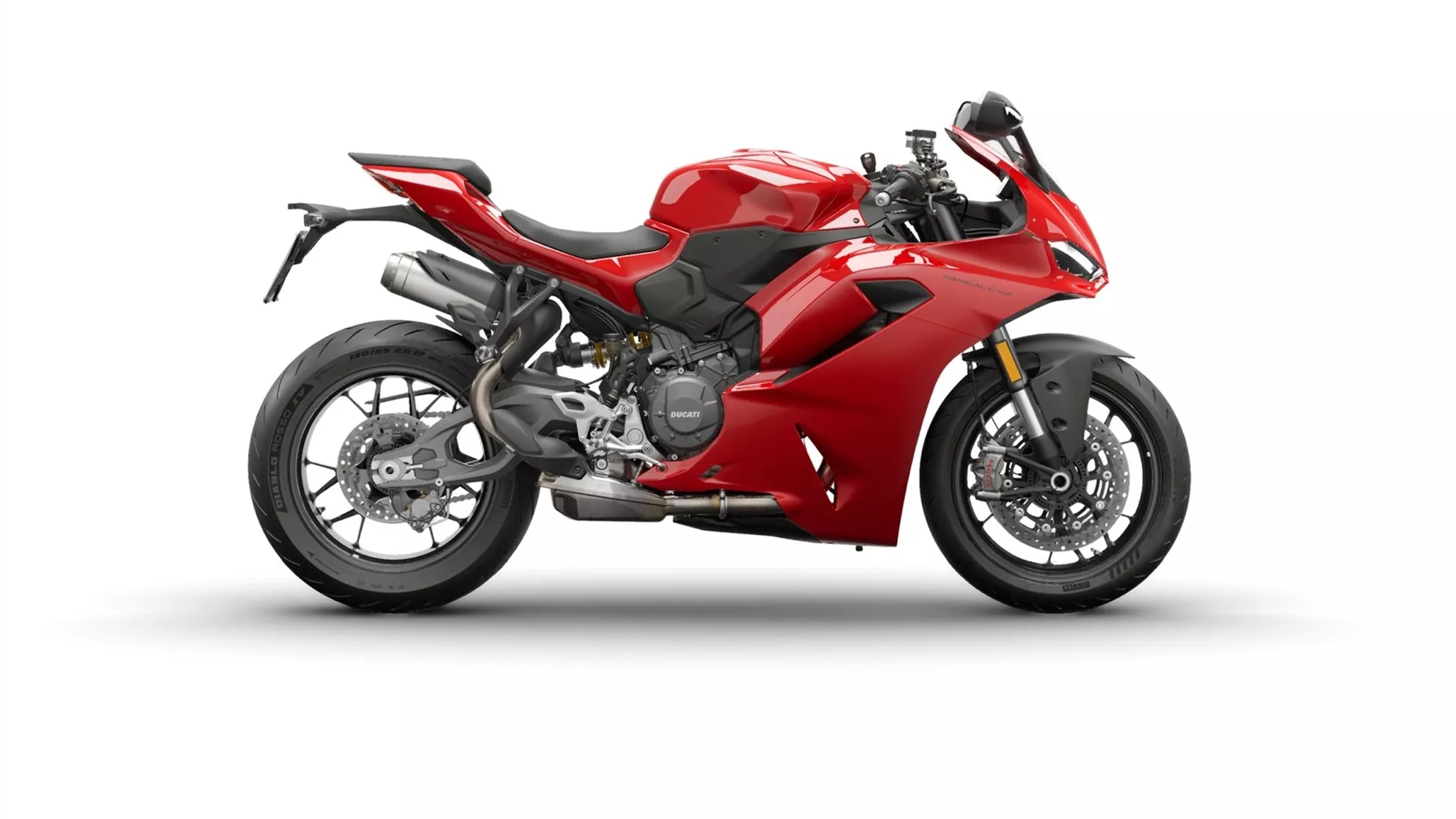
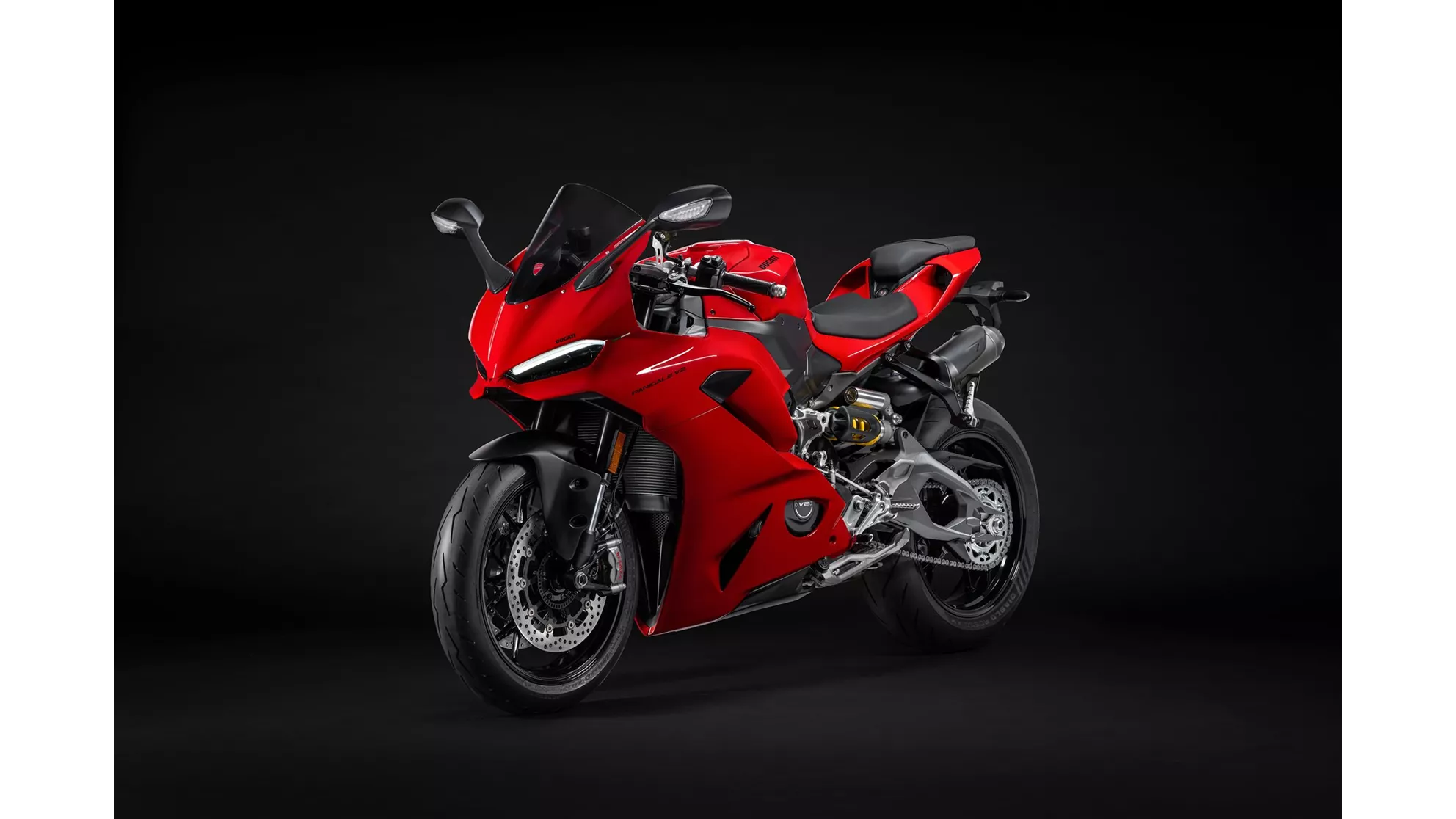
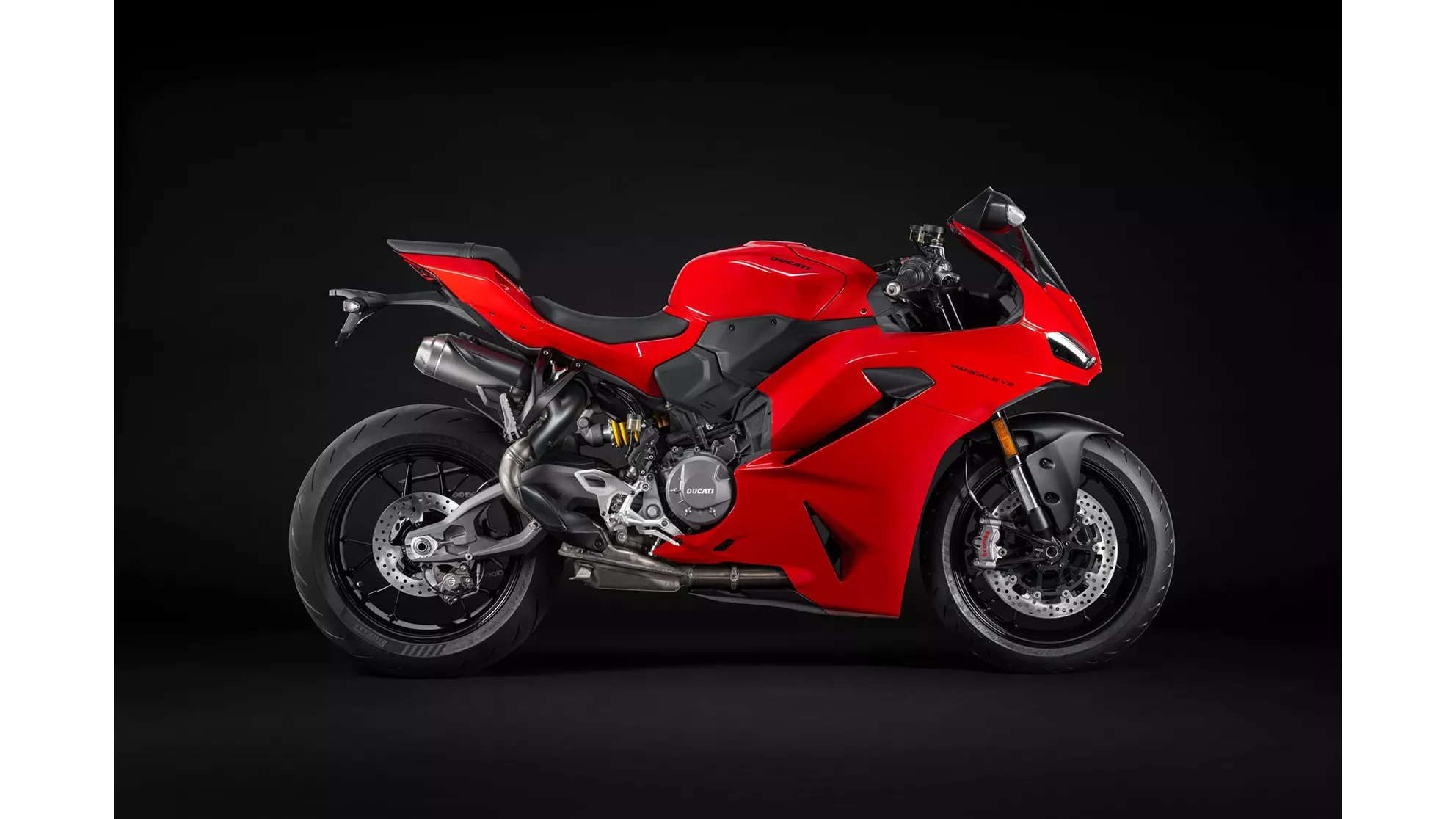
Ducati's new 890cc V2 engine breathes life into several Ducati bike novelties 2025. We got to find out just how well the new engine performs in the Panigale V2 at the new Circuito de Sevilla.
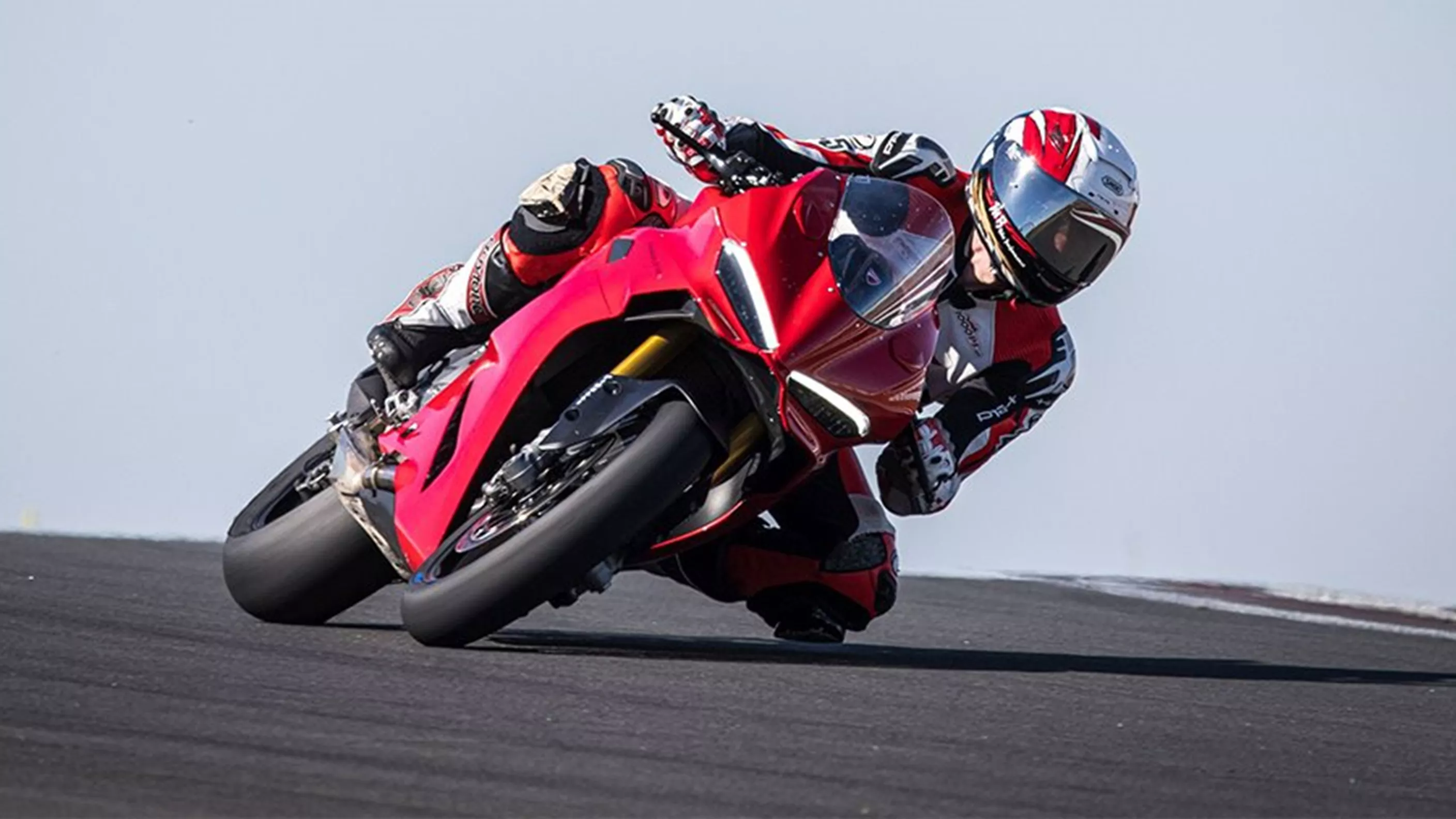
Ducati Panigale V2 2025 Test on the Race Track
Ducati brings a new V2 Panigale with reduced displacement!
You'd have expected anything from Ducati, but a new V2 Panigale with a newly designed engine that has less power was hardly one of them. Especially since the predecessor was already not exactly seen as a powerhouse compared to the in-house V4 version. But the Italians are going in the completely opposite direction, opting for downsizing on the engine. With smaller displacement and reduced power, they clearly want to score points in the lower segment too, using the illustrious "Panigale" name as a calling card. What can we expect?
&width=72&height=72&bgcolor=rgba_39_42_44_0&mode=crop "Author: Martin_Bauer")
Martin_Bauer
published on 17/02/2025
28,518 Views
The New V2 Engine of the Panigale - Ducati Panigale V2 Test 2025
As already mentioned, the new V2 engine has been reduced in displacement and power, arriving on our shelves with 890cc of displacement and 120PS. The basic construction as well as the 90° cylinder angle have remained unchanged. However, thanks to the smaller displacement, Ducati managed to build the engine slimmer and, above all, lighter. A staggering 9.4 kg was shaved off compared to the 955 Superquadro. This was achieved through many small details, such as hollow-bored and chrome-plated valves. On top of that, DLC coatings are used in the valve train, and thanks to the increased wear resistance at the contact points, the component size could also be reduced, saving further weight. Furthermore, the new engine doesn't use desmodromic valve actuation. Here, as in almost all other bikes, the valves are closed again by springs. This eliminates the elaborate valve adjustment typical of Desmo engines and stretches the valve clearance check intervals to 30,000 km. A large part of the weight saving also comes from the smaller housing construction with smaller cooling channels and the water/oil heat exchanger fitted between the cylinders, which makes the oil cooler redundant.
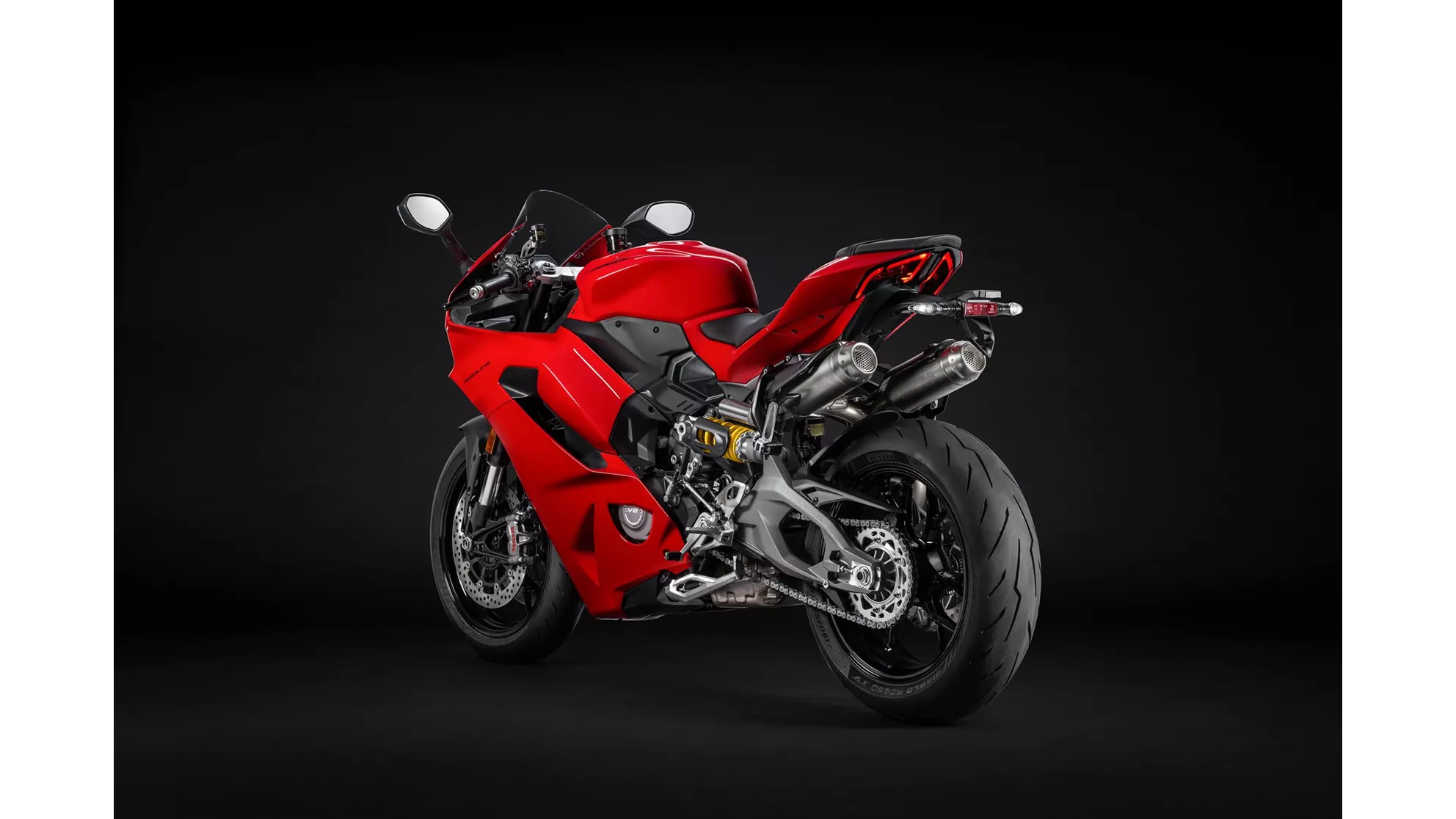
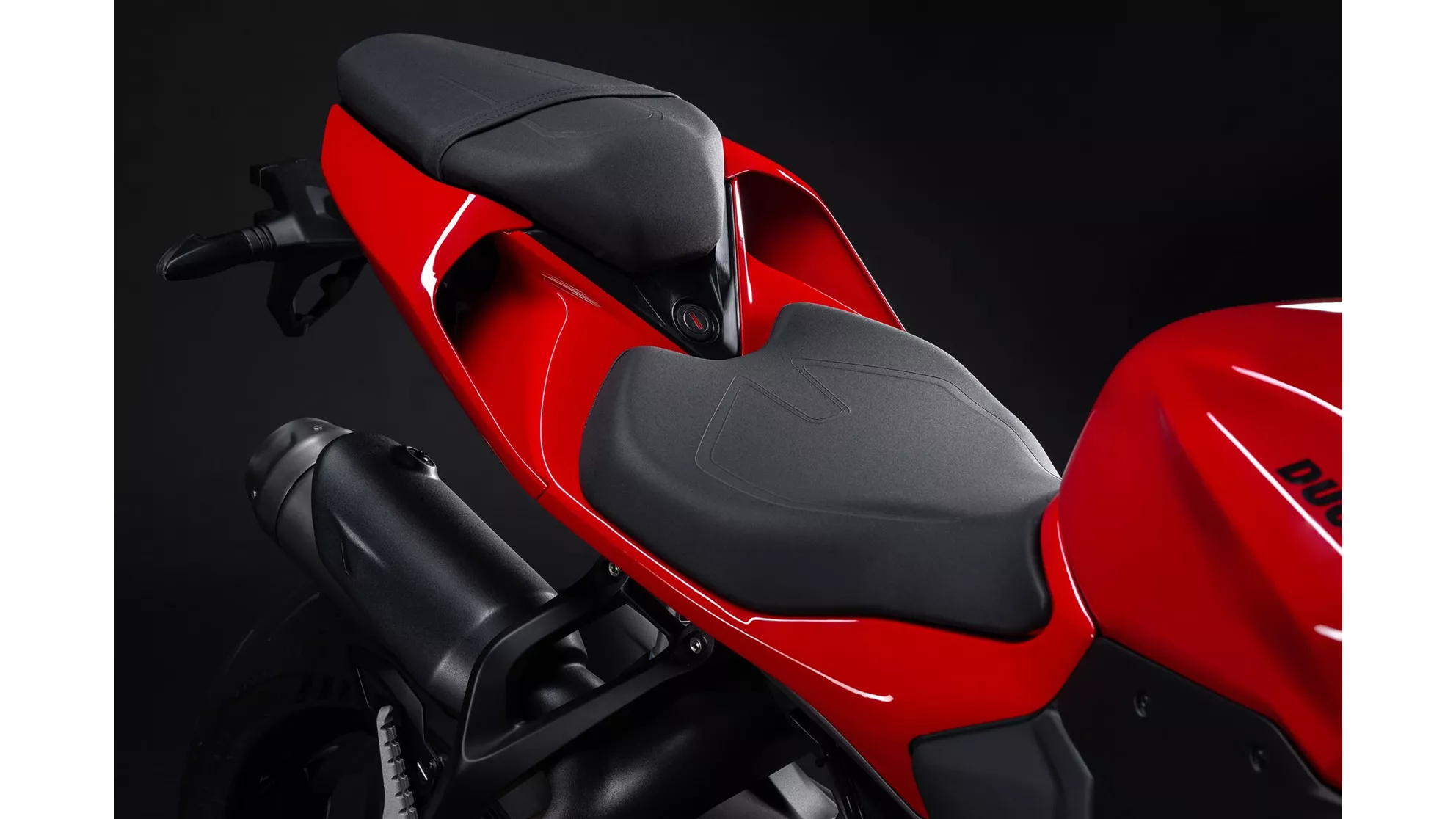
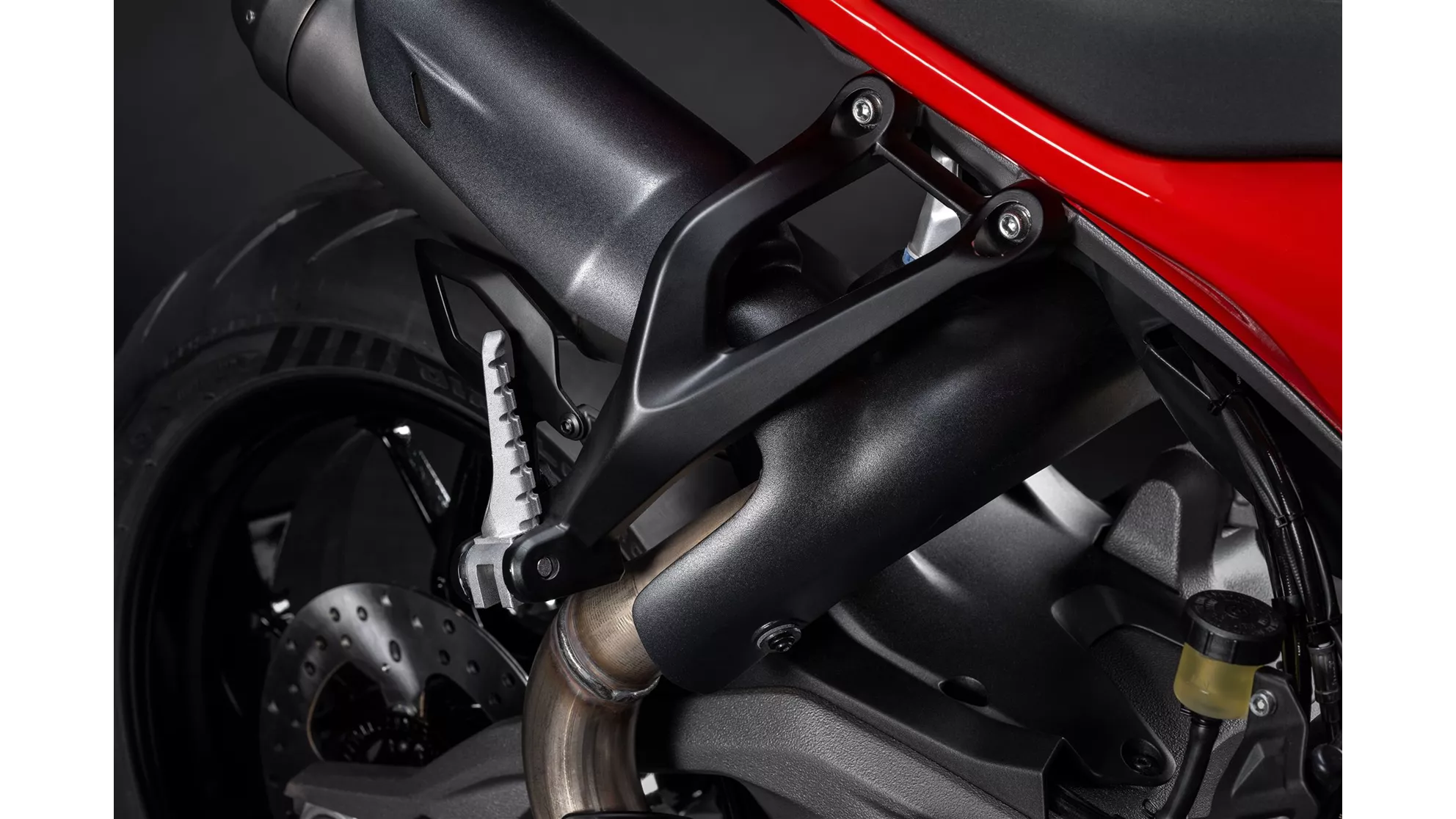
In addition to the weight advantage, Ducati is using variable valve actuation, already known from the competition, to compensate for the displacement disadvantage in the lower rev range. This improves performance at lower revs and thus provides a more even delivery of power, which is especially beneficial in road use. Nevertheless, maximum power only arrives at 10,750 rpm, and the maximum torque of 93 Nm comes in at 8,250 rpm, before the limiter kicks in at 11,350 rpm. With the optimized Termignoni exhaust system available as an accessory, the engine is said to reach 126PS. Based on this data, anyone wanting maximum drive will still need to stay in the upper rev range. Ducati also goes its own way with the standard exhaust system. While the outlet uses two silencers mounted under the seat, similar to the V4 racing system, the routing of the pipes towards the rear is somewhat unusual. Whereas manufacturers usually try to elegantly hide these within the bike, in this case they are routed far to the rear underneath before being led very prominently upward alongside the swingarm. This is a result of the new Euro 5+ emissions standard, which requires a correspondingly large pre-silencer to meet these strict limits. Because of this, there wasn't quite enough room to route the pipes within the swingarm. And to still ensure enough legroom from the hot exhaust pipes, the pipe routing was executed in this somewhat unusual way. Whether this is also visually appealing is for everyone to decide for themselves. Anyone looking for a remedy will find it in the Termignoni accessory system. This eliminates the pre-silencer entirely, and the pipe routing is aesthetically routed within the swingarm up to the silencers. As a nice bonus, the total weight of the V2 Panigale drops dramatically once again to 169kg!
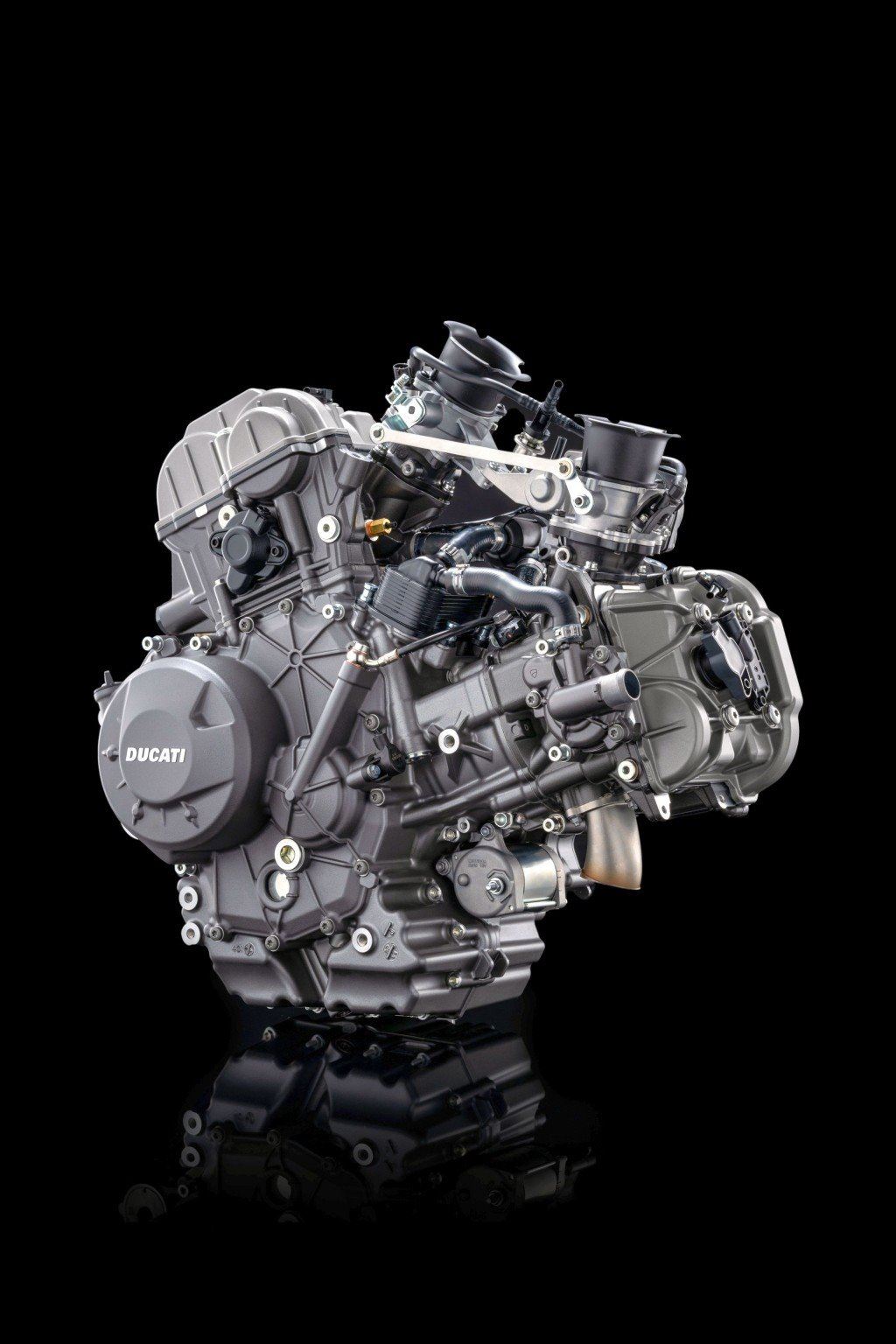
Ducati's new V2 engine with 890 cm³ displacement, 120 PS and 93 Nm torque.
The anti-hopping clutch runs in oil, thus preventing the earlier, Ducati-typical clutch rattle at standstill, which would hardly be approvable under today's noise restrictions. Of course, the new engine meets the latest Euro 5+ standard and is therefore fit for further future applications. That's also why the engine will be available with 115PS and greater flywheel mass, allowing further concessions towards riding comfort/touring to be made so other bike types can also be equipped with it. Ducati also hopes to be better positioned in the Supersport World Championship with the new engine. Due to the large displacement of the predecessor at 955cc, Ducati had to fit the V2 with a restriction on throttle valve opening, capping it at max. 70%. This meant a relatively large engine had to be "dragged along" without being allowed to unleash its full potential. That issue has now been solved with this step.
The Chassis of the Ducati Panigale V2 2025 on Test
The monocoque chassis of the Panigale V2 is cast from aluminum and, at 4kg, is very light. It's mounted directly to the engine's cylinder head, which strengthens the bike's structure while simultaneously reducing weight. The chassis also doubles as the airbox, saving additional weight. With a wheelbase of 1,465 mm, a steering geometry of 23.6° steering head angle and 93 mm of trail, the Panigale V2 is easy to handle and should allow quick, precise steering. These characteristics should provide stability when cornering and at high speeds. The swingarm, like on the larger V4 sibling, is a double-sided design.
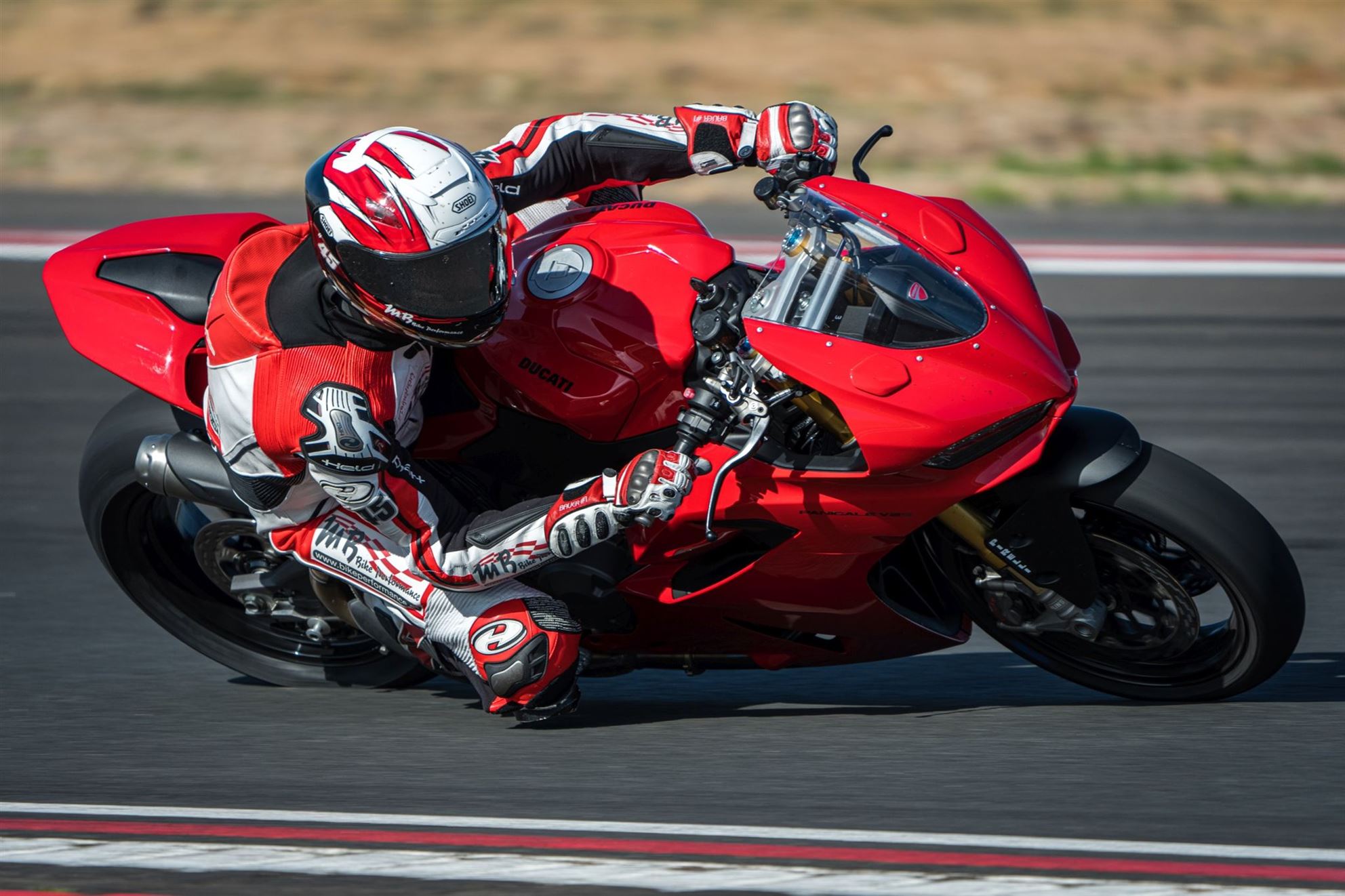
It hardly looks like it in this photo, but the new geometry of the Panigale V2 also allows for a fairly relaxed seating position.
A bigger difference lies in the seating position. Compared to before, this is noticeably softened with higher handlebar stubs, thus underlining its road suitability for longer stretches. With a seat height of 837mm, average to tall riders should find their footing well, though shorter riders will have a bit more trouble. Overall, weight savings were also made in these areas, and with a light lithium battery on the "S", the total weight of the bike has been reduced by a staggering 17kg compared to its predecessor, now weighing just 179kg for the standard version and 176kg for the "S", ready to ride without fuel.
Ducati Panigale V2 2025 Test of Brakes & Suspension
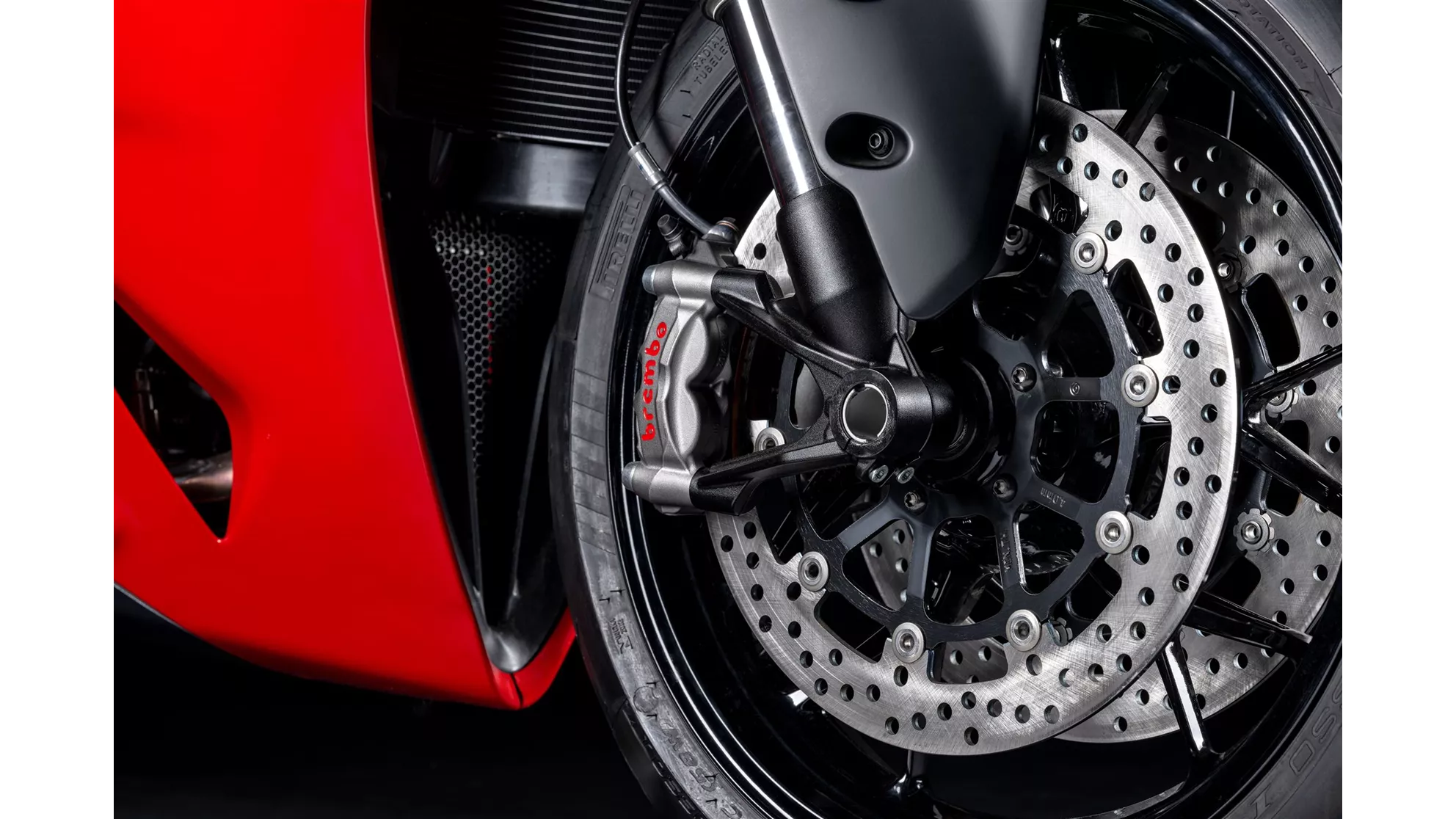
For the brakes, Ducati naturally relies on Brembo as usual. With two 320mm discs up front, gripped by M50 calipers, the new Panigale should also be able to decelerate effortlessly. A radial brake pump serves as the pressure generator.
The standard version uses a 43mm Marzocchi fork up front and a Kayaba shock at the rear, while the "S" variant goes fully with Öhlins. This time, however, no electronic adjustability is implemented, making concessions towards pricing and weight. Nevertheless, a fully adjustable system is found across all suspension configurations.
Electronics and Riding Modes of the Ducati Panigale V2 2025
Besides the 5" TFT display, the Panigale V2 features an advanced electronics package based on a 6-axis inertial measurement platform. Its functions include:
- Sport ABS Cornering: Provides additional safety when braking in corners.
- Ducati Traction Control (DTC): Prevents the rear tire from spinning.
- Ducati Wheelie Control (DWC): Controls front wheel lift under acceleration.
- Engine Brake Control (EBC): Regulates engine braking.
- Ducati Quick Shift 2.0: Enables quick clutchless shifting in both directions.
The Panigale V2 offers four riding modes (Race, Sport, Road, Wet), which allow the rider to adjust the settings for all controls and throttle response to their preferences and respective riding conditions.
Riding Impressions of the Ducati Panigale V2 2025
Right when getting on, the seating position feels unusually comfortable for a supersports bike, simply due to the high handlebar stubs. When riding at a relaxed pace, this isn't a drawback even on the race track, since the feel for the front wheel doesn't suffer either. In braking zones, this even helps the rider maintain their position during hard braking maneuvers without much physical effort. Additionally, the extremely low weight helps enormously to decelerate the bike well. This continues through to the apex, where extremely tight radii can be ridden despite high entry speed. One of the most striking plus points of the new V2 Panigale.
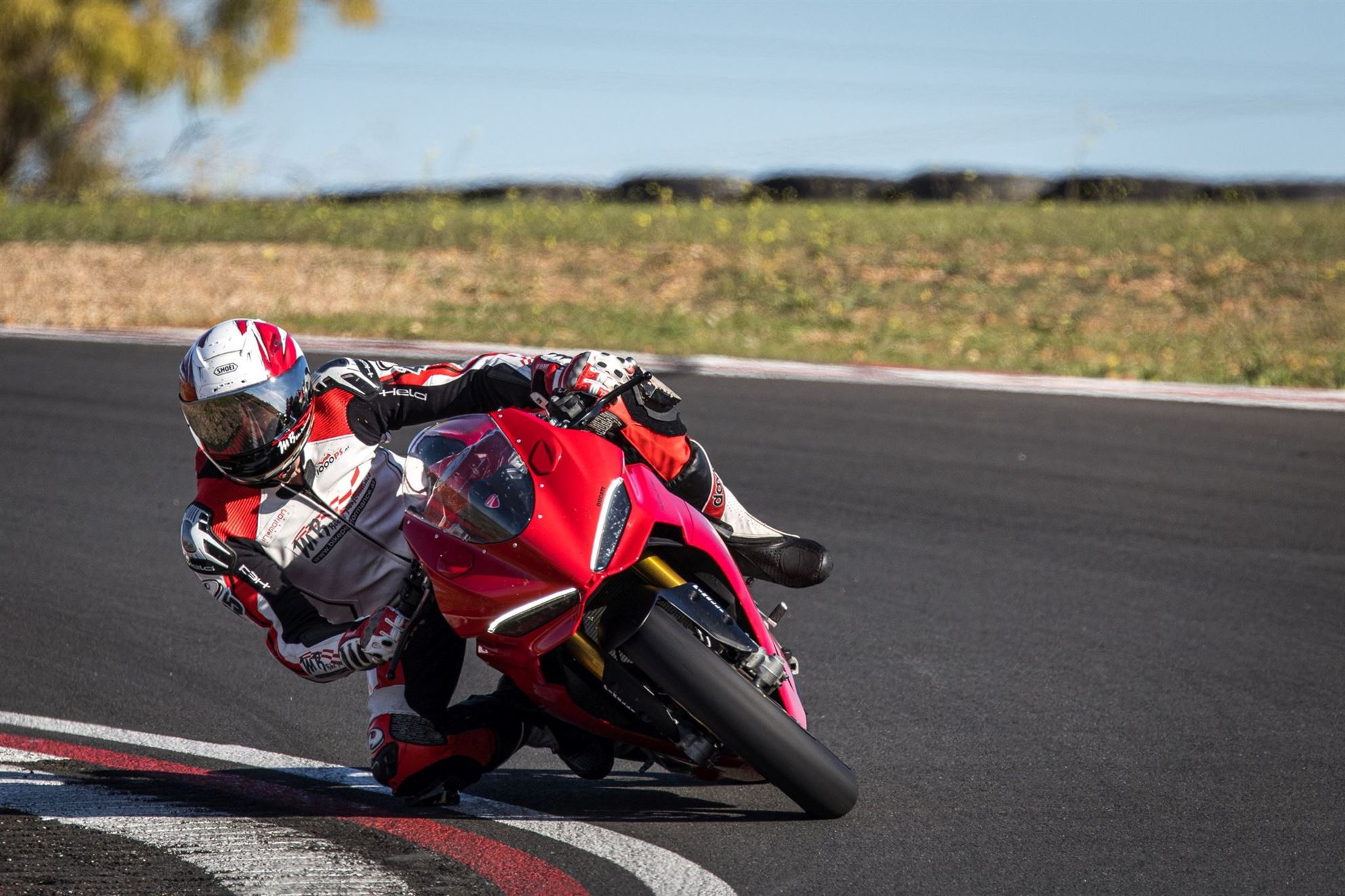
The lower power of the new Panigale V2 is made up for by its radical weight loss. Only towards the top of the rev range does it run a little short of breath.
Even the engine, which on paper is weaker than its predecessor, doesn't feel as much weaker thanks to the low weight. Thanks to the variable intake control, it delivers its power very smoothly from low revs onward. From 4,000 rpm, 80% of maximum torque is already available, and from 6,000 rpm it really digs in. Only towards the limiter does the eagerness to rev drop off a bit, a concession to the Euro5+ standard exhaust system. Still remarkable, since noise emissions per the standard only produce "hairdryer" volume. For anyone looking for a punchier sound and a stronger pull to the rev limiter, the complete Termignoni system is a good choice. With +6PS, it delivers not only more revvy character but also the typical V2 pops sound. Unfortunately, this takes it out of the running again in terms of road homologation. What takes some getting used to is the surprisingly low braking torque, quite atypical for a V2. Even with the engine brake set to maximum, the bike decelerates very little from engine braking alone. However, since the Panigale, thanks to its slim build and low weight, allows very high cornering speeds, this isn't necessarily a drawback. Once you've adjusted to it, you can easily turn the higher entry speed into tight radii to come out of the corner well again. Otherwise, the engine shows itself to be very solid, with no major vibrations and smooth throttle response. This is of course also due to the ride-by-wire system, where even an inexperienced rider can select the sharpest setting for throttle response without issue.
New-Style Quickshifter Not Yet Fully Perfected - Ducati Panigale V2 Test 2025
The new V2.0 system is used for the quickshifter. Instead of a shift sensor in the shift linkage, a position sensor is now fitted in the gearbox. This detects the change in position of the shift shaft when the shift lever is actuated and triggers the necessary interventions for the shifting process. One advantage is that no force sensor and the associated "loose" cables leading to the moving shift rod need to be installed. On the other hand, this system can't define a triggering force, and therefore can't generate a shift preload on the shift shaft, which ultimately helps for a fast and smooth shifting process. This also shows on the new V2 Panigale. While the quickshifter works unobtrusively in most cases, it rarely but occasionally acts up, particularly during shifts in the middle gears at high revs. Here, further improvements could probably be achieved with different interruption algorithms.
The Öhlins suspension of the "S" works very well even under heavy load on the race track and enables fast lap times without major adjustments. Nevertheless, thanks to its good adjustment range, it can be tailored to different requirements. It's not really an issue that the rear only has a standard Öhlins shock instead of a TTX damper. Unfortunately, we weren't able to test the Marzocchi/Kayaba suspension of the standard version.
Lap Timer and Steering Damper of the Ducati Panigale V2 2025
The GPS module for the bike's integrated lap timer proved to be a very useful accessory. It's mounted at the rear and creates the automatic trigger for timing on all race tracks. It only needs to be taught once per track, but can then also capture multiple split times. It worked flawlessly throughout the test. For anyone who prefers to be on the safe side in terms of stability, an Öhlins steering damper kit is additionally available for the Panigale, since it's not included as standard equipment. Since the Panigale runs fairly calmly, though, this isn't strictly necessary.
Ducati Panigale V2 2025 Price & Availability
The Ducati Panigale V2 is available now from dealers, initially in the classic Ducati red livery. The V2 is offered in a two-seater configuration, while the V2 S is available in a single-seat configuration, with a passenger kit available as an accessory if needed. In addition to the Öhlins suspension, the "S" also has a lightweight lithium battery, which together account for the -3kg weight difference.
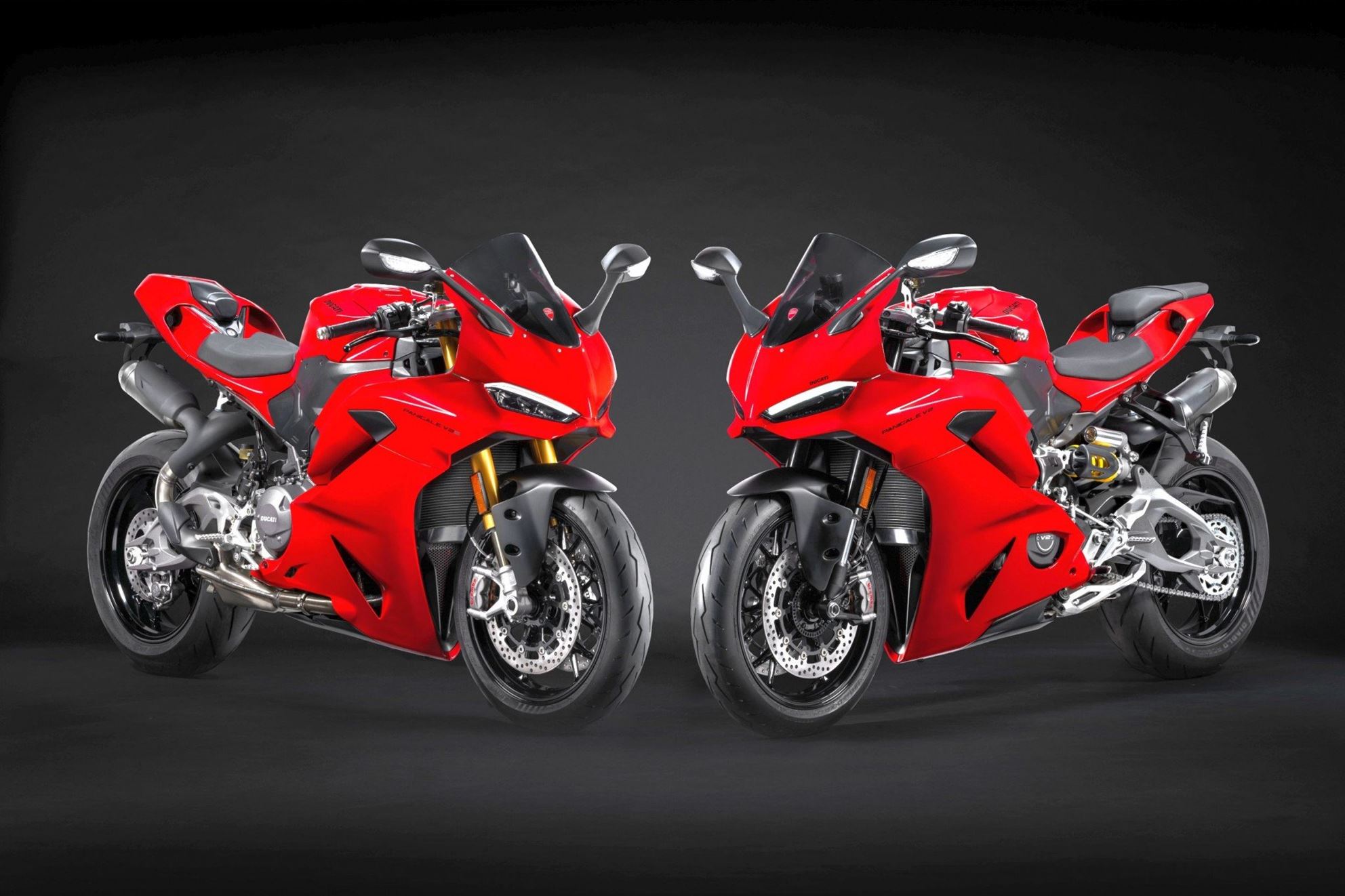
Ducati Panigale V2 & V2 S 2025
Prices have also shifted downward considerably. While the V2 is already available in Germany for €16,390 and the V2S for €18,890, in Austria they cost €19,795 and €22,495 respectively, including all taxes and duties. The previously mentioned complete Termignoni system is offered for around €2,500.
- How much does a Ducati Panigale V2 cost?
- Here you will find an overview of the price level of new and used motorbikes!
&width=60&height=60&bgcolor=rgba_39_42_44_0&mode=crop "Author: Martin_Bauer")
Ducati Panigale V2 2025 - Experiences and Expert Review
Martin_Bauer
Ducati has fully achieved its goal of building a supersports bike that is very easy to ride. With extremely light handling, low weight and an easily controllable engine, the new V2 Panigale is a whole lot of fun, especially on technically demanding tracks. The big highlights here are the late braking points as well as the tight cornering radii that can be held even at high cornering speeds. The somewhat lower power almost makes up for the weight again. This means the new V2 Panigale offers a significant improvement over its predecessor, especially for beginners, and, contrary to the well-known saying "power is everything," its lightness will likely help less experienced riders achieve better lap times. Even I - as a power-spoiled superbike rider - couldn't help but smile on the small Panigale. Ducati has scored many points especially for use on country roads. With the new Panigale, the Italians have brought a softened variant that, with a noticeably more comfortable seating position, clearly moves towards road suitability and beginner-friendliness. This is also underlined by the fact that the V2 will be available in an A2 version. Combined with the reduced prices, the V2 Panigale is thus also within reach for sharp calculators. A Panigale as an entry-level bike, who would have thought?
More from 1000PS Magazine
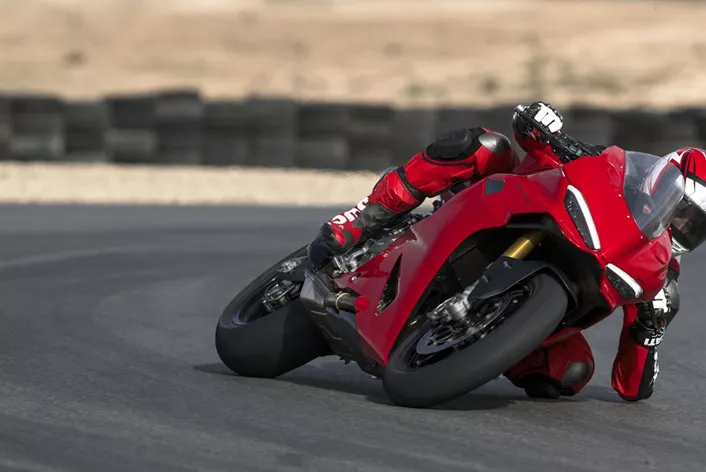
Ducati Panigale V2 2025 Test on the Race Track Images
Source: 1000PS