Mips has set itself the goal of reducing head injuries and saving more lives through its patented safety systems, something the company works on through research, testing and innovation. The Mips® safety system was carefully developed to provide additional safety in many common motorcycle accidents by mitigating the dangers of rotational motion through a low-friction layer designed to redirect rotational forces away from the head during certain angled impacts.
Mips - more safety for motorcycle helmets through innovation
The Swedish company Mips is revolutionizing safety
In a crash or impact, an exact linear hit to the head is something you rarely experience in everyday life. Nevertheless, helmets are primarily manufactured with the intention of protecting against linear impacts. In reality, however, rotational movements are the biggest cause for concern, and although rotational protection in helmets is now recognized worldwide, it remains secondary. In this article, everything you need to know is explained with the help of Stockholm-based company Mips!
&width=72&height=72&bgcolor=rgba_39_42_44_0&mode=crop "Author: vauli")
vauli
published on 06/03/2025
17,864 Views
Employee turnover at Mips is very low, which says a lot about the company and is largely attributable to the safety systems Mips has developed. For Mips employees, it's about the vision of saving lives. This noble idea alone ensures that all the employees I met and spoke with at Mips in Sweden work with enthusiasm and drive. It's no surprise that after almost 30 years of persistent research and development in helmet safety, Mips today offers an extensive portfolio of safety systems for helmets across all areas of use. Although motorcycle helmets currently make up only a small share compared to the main players, bicycle and ski helmets, Mips CEO Max Strandwitz explains in the following interview that this is set to change in the near future.
7 Questions for Mips CEO Max Strandwitz:
1. Thank you, Max, for letting me visit you here at Mips headquarters in Sweden. Can you tell us a bit more about the work Mips does?
Max Strandwitz: Mips is the name of the company, and we are the inventors of the original system developed to account for rotational movement in helmets, the Mips® safety system. This system comes into play during angled impacts on the helmet. The main goal is to compensate for the rotational motion that occurs in almost all impacts, so that the initial impact motion is "cushioned". This happens within 5 to 10 milliseconds - by comparison, a single blink of an eye takes about 100 milliseconds. The Mips® system is designed to allow movement of 10 to 15 millimeters. Through this movement, the rotational motion during those few milliseconds of impact is meant to be redirected away from the head. Not all helmet manufacturers take this rotational motion into account, and the current ECE 22.06 standard also doesn't address it to the degree we would like - at least not yet.
2. How did it all start, and how many employees does Mips have?
Mips was founded by neurosurgeon Hans von Holst together with researchers Peter Halldin and Svein Kleiven, after von Holst repeatedly observed brain injuries in accident victims despite them wearing a helmet. In 1995 a long process began before Mips AB was founded in 2001. In 2015, Mips turned a profit for the first time and has fortunately - and rightly so, in my opinion - been on a steep upward trend ever since. Work on computer models, meaning simulating how the brain functions, is becoming increasingly important, and by using the finite element method we can derive plausible insights from computer simulations even before physical crash tests. That saves an enormous amount of time and effort. Mips currently employs around 110 people, including 60 engineers. We have 24 employees permanently stationed in China, working with the helmet manufacturers producing there.
3. I've heard that your safety technology is integrated into more than 1000 helmet models from around 150 manufacturers, including ski and bicycle helmets. What share do motorcycle helmets make up?
The share of motorcycle helmets equipped with the Mips® system is rising rapidly across the overall market, and we already work with more than 20 helmet manufacturers. This means customers increasingly understand how important our system can be. Within the Mips® range, however, motorcycle helmets currently only make up about 5 percent, and these are predominantly motocross and adventure/enduro helmets. That sounds quite logical at first, since the likelihood of crashes is higher when riding off-road - anyone who has ridden off-road has probably experienced at least one, if not several, crashes. That's why off-road riders typically wear extensive protective gear and pay attention to possible safety features. The road rider, on the other hand, is to a very high percentage a completely different kind of person - it's about freedom and speed. The only points of contact, to put it bluntly, are the two wheels and the engine.
…so is Mips more suited to off-road riders?
Mips is suitable for every rider! Because any impact with even a hint of rotation can have severe consequences. That's why it's illogical to think you need less protection on the road. On the road, you can just as easily crash or get involved in an accident - and you need to be prepared for that. Especially on the road, the likelihood of colliding with other road users is much higher than, say, in open off-road terrain. The highest probability of colliding with other objects exists in the city - I don't accept the argument that speeds aren't that high in this environment. We conduct most of our impact tests at speeds below 30 km/h and can identify significant effects that could lead to brain injuries despite the helmet.
4. You mainly have brand ambassadors in the motocross sector, and in road racing currently only the recently retired MotoGP rider Aleix Espargaro - will that change in the near future?
Yes, absolutely. Developing a helmet takes three years on average, and we are already working with other racers. So in the future, every helmet buyer will have an even greater selection of motorcycle helmets with integrated Mips® systems. Aleix, by the way, rides with the Kabuto F17 Racing featuring the Mips Integra TX system, which is a very integrated system worked into the actual padding itself. The helmet meets the especially strict FIM requirements. Additionally, Mips technology is available not only for expensive helmets but also for models in the lower price segment.
5. What additional cost should one expect for a motorcycle helmet with the Mips® safety system?
That varies depending on the helmet. Currently you can expect an additional cost of about 20 to 60 euros.
6. How much does a Mips® system weigh in a motorcycle helmet?
In bicycle helmets we install systems that weigh just 7 grams - so it really doesn't have a significant effect on weight. But even the heaviest variant for ski and equestrian helmets weighs barely more than 50 grams. The systems for motorcycle helmets fall somewhere in between.
7. What does the future hold for Mips, and what can we expect from you going forward?
Well, I can't go into too much detail, but we are currently building another test lab at our headquarters in Sweden. In this lab we will be able to conduct further tests and continue developing our Mips® safety system. We have also developed some helmets of our own, which we currently use for research and development purposes. So far we've found that it's better to work with well-known helmet brands, where we integrate our product into other products to make them even better. This year, more than 12 new motorcycle helmet models will be launched.****
Many thanks to Max Strandwitz for this insightful interview!
High degree of integration of the Mips® safety system - the background:
Due to the varying requirements for motorcycle helmets (full-face helmets, for example, differ significantly from motocross helmets), Mips has set itself the goal of offering solutions that are integrated in such a way that they don't compromise the overall experience and feel of the helmet. That's why Mips has developed three highly integrated systems for motorcycle helmets: Mips Integra Fuse, Mips Integra Split and Mips Integra TX.
Because the respective Mips technology system is integrated into the manufacturing of the helmet, it is not always visible to the naked eye. To make sure a helmet is equipped with the Mips® safety system, look for the yellow Mips logo on the back of the helmet.
Mips - more safety for motorcycle helmets through innovation Images
Source: 1000PS

Max Strandwitz (CEO of Mips) shares valuable insights in the interview about Mips - check out the report for all the details!

This crash test dummy head weighs about 4 kg

Using Finite Element Method, valuable insights can be gained from computer simulations even before real tests. This saves a tremendous amount of time and effort.

A relieved Max Strandwitz (CEO of Mips) after the intense interview with 1000PS

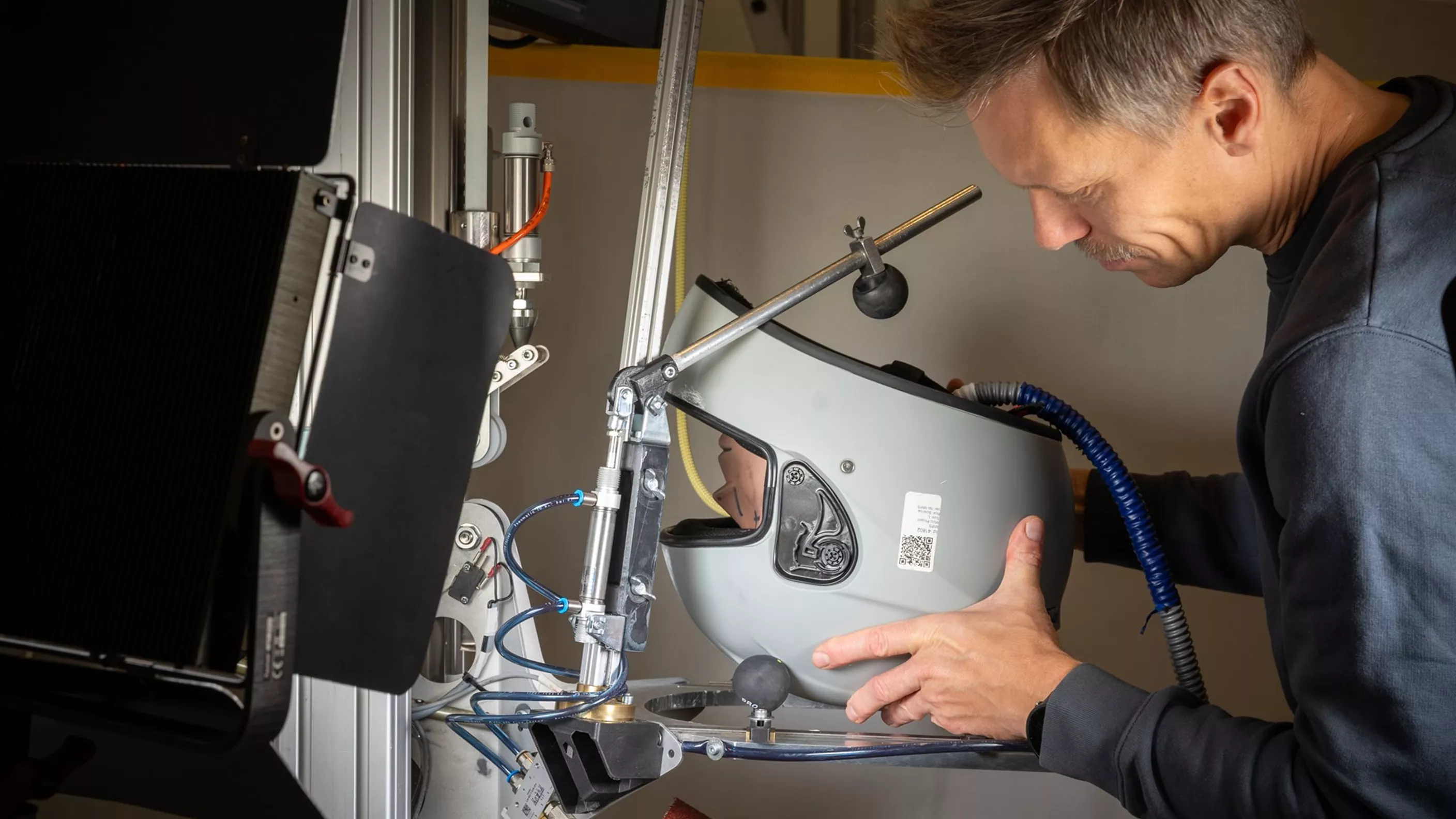
The testing protocol must be strictly followed. At Mips, focused work is the name of the game.

Mips has developed some of its own helmets currently used for research and development purposes.

MX and enduro helmets make up the bulk of motorcycle helmets

When riding off-road, the awareness of a potential spill is significantly heightened.

Mips aims to reduce head injuries and save more lives

The Mips safety system is almost seamlessly integrated into the helmet

It doesn't compromise comfort with pressing parts on the head or excessive weight

The headquarters of Mips in Sweden

Using a caliper, the gap between helmet and nose is precisely set

The 1000PS editor seems to have asked a clever question, despite being completely clueless.

Helmet box featuring an overview of the MIPS safety system

A brief yet solid description of the MIPS safety system
